New Senate: DEM 49 GOP 51
New polls:
Dem pickups: (None)
GOP pickups: (None)
Previous | Next
Giuliani Says Muller's Investigation Is Illegitimate
Yesterday on CNN, Donald Trump's lawyer Rudy Giuliani was asked if special counsel Robert Mueller's investigation is legitimate. He responded: "Not anymore." He explained further that it was legitimate when he was hired but now due to "Spygate" it is not. "Spygate" is Trump's term for the incident in which the FBI, upon hearing that people within the campaign—namely George Papadopoulos and Carter Page—had contacts with Russians, asked a retired academic to go talk to them about that. Despite Trump's use of the term "spygate," at no time did the FBI plant anyone inside the campaign for spying or any other purpose. Consequently, Giuliani's statement in no way changes the fact that the campaign had many contacts with Russians, and so did the transition. Mueller's charge is to investigate precisely that. He is also specifically authorized to investigate any other unrelated crimes he discovers during the process. Spygate and Giuliani's remark are simply attempts to get the public to forget that the reason the FBI wanted information from Papadopoulos and Page is that they were talking to Russians.
Giuliani also said: "I know 50 years of investigatory experience tells me they don't have a darn thing because they would've used it already..." Actually, Mueller has already indicted 22 people. These include Trump's first national security manager and his campaign manager. It is true that Trump's family has not been indicted (yet), but as Giuliani knows very well, prosecutors always work bottom up, first nailing the small fish, then the medium fish, before going after the big fish. That Mueller hasn't gotten there yet does not mean he won't in due course. (V)
Trump (& Co.) Will Say Anything
Let us assume that Rudy Giuliani remains a reasonably intelligent fellow, and that he hasn't lost complete control of his faculties. If so, then he is surely aware that a lot of what he was peddling on Sunday (see above) is nonsense. To take but one example, during his time as a prosecutor, Giuliani surely did not rush into court the moment he found one piece of inculpatory evidence. No, he gathered all of the inculpatory evidence that he could, then organized it into a criminal case, then went into court and tried to get the defendant convicted. He did it this way because this is how it is done, and this is what works. Consequently, when he claims that Mueller's failure to move forward while an investigation is still underway is somehow proof of a lack of evidence, Giuliani is lying through is teeth. He's not even particularly good at it; in the video where he claims the Mueller investigation is "illegitimate," he waves his arms around like a bad Las Vegas magician and blinks so many times one might think he's sitting in a sandstorm. Both of these are dead giveaways that a person doesn't really believe what they are saying.
The point is this: Team Trump is clearly getting desperate. Maybe it's because the investigation has gone on so long, and such a thing wears on a president and an administration. Maybe it's because Giuliani joined the team, and whipped everyone into a frenzy. And maybe it's because one or more recent developments have gotten Robert Mueller, and/or the FBI, and/or the various state-level authorities dangerously close to something that Team Trump would not like them to know. Any or all of these is possible. But the result is that the President and his underlings are, as Gen. Michael Hayden, observes, "willing to throw almost anything against the wall" in order to "delegitimize the Mueller investigation." And Hayden is hardly a Democratic hack or an ignorant amateur; he served as director of the CIA and NSA during the George W. Bush administration.
Just in case we needed evidence that Hayden is on to something, Trump made sure to provide it for us via Twitter on Sunday morning, during one of his patented weekend morning Twitter jags. He started with this:
Who’s going to give back the young and beautiful lives (and others) that have been devastated and destroyed by the phony Russia Collusion Witch Hunt? They journeyed down to Washington, D.C., with stars in their eyes and wanting to help our nation...They went back home in tatters!
— Donald J. Trump (@realDonaldTrump) May 27, 2018
Everyone is mystified as to exactly what this means. The youngest person to be ensnared in Mueller's investigation is George Papadopoulos, who is 30. However, he's already pleaded guilty, so even if his life has been devastated, it's not like he's an innocent victim. Further, 30 is pushing it when it comes to calling someone "young." Meanwhile, Carter Page did an interview this weekend where he claims he lost his girlfriend and his business due to the Mueller probe. But again, it's not like his hands are clean, even if he hasn't yet flipped. Further, Page is 46, which is really, really pushing it when it comes to calling someone "young." Heck, he's four years away from qualifying for AARP membership.
The "young and beautiful" tweet generated an unusually poor response on Twitter (note the "like" to "comment" ratio of almost 1:1, which is not good), so later in the day, Trump switched gears, and went back to conspiracy theorizing and whataboutism (which, by the way, was a favorite tactic of the Soviets):
Why didn’t the 13 Angry Democrats investigate the campaign of Crooked Hillary Clinton, many crimes, much Collusion with Russia? Why didn’t the FBI take the Server from the DNC? Rigged Investigation!
— Donald J. Trump (@realDonaldTrump) May 27, 2018
Why didn’t President Obama do something about the so-called Russian Meddling when he was told about it by the FBI before the Election? Because he thought Crooked Hillary was going to win, and he didn’t want to upset the apple cart! He was in charge, not me, and did nothing.
— Donald J. Trump (@realDonaldTrump) May 27, 2018
The "facts" included here—such as the notion that Robert Mueller's team is made up of a bunch of Democrats—have been debunked many times. More important than that, however, is this "Hillary did it, too!" and "Barack Obama didn't do enough" are not at all the same thing as "The Trump campaign is innocent!" It's just more evidence that Team Trump knows they are in it up to their ears, and that all that is left is for them to distract and obfuscate. That will work with the base, at least for now, but it won't work with judges and grand juries. And depending on how many members of Team Trump go up the river, distracting and obfuscating may even stop working on the base. After all, the amount of time that elapsed between "a majority of Republicans stand behind President Nixon" and "Therefore, I shall resign the presidency" was only about four months. (Z)
Preparations for Talks with North Korea Are Proceeding
Despite Donald Trump writing Kim Jong-Un a letter telling him that the June 12 summit is canceled, U.S. officials are continuing to plan for it. Kim has suggested that he wants to remove all nuclear weapons from the Korean peninsula.
However, not everyone believes Kim. Former CIA Director Michael Hayden said yesterday: "These folks are not going to get rid of all their nuclear weapons." He wasn't the only one who is skeptical. Sen. Marco Rubio (R-FL), who is a member of the Senate Foreign Relations Committee, is convinced that it won't happen. He said Kim Jong-Un "does not want to denuclearize." In addition, the director of the Asian affairs for the National Security Council in George H.W. Bush's administration, Victor Cha, expressed the same thought yesterday, saying: "But in terms of the substance, the key issue is, are they going to give up their nuclear weapons? And I think unfortunately the answer is no." NSA John Bolton didn't state a position yesterday, but for decades he has said that he doesn't trust North Korea, so it is inconceivable that he would support an agreement to remove nuclear weapons from both North and South Korea because he doesn't think North Korea can be trusted to live up to such an agreement.
Kim is undoubtedly trying hard to get a deal, even if he has no intention of living up to it, because he knows Trump badly wants a "win." He is surely aware that if he gave up his nuclear weapons, Bolton would be the first one to call for "regime change," and Kim knows what "regime change" meant in Libya and Iraq. So, in reality, the only way North Korea would ever give up its weapons is if China, its only benefactor in the world, put a gun to Kim's head and told him either he gives them up or it is cutting off all of its oil supply permanently. That would likely result in millions of deaths, riots in the streets, and possibly a revolution. But Trump's constant threats about tariffs make it very, very unlikely China will pressure North Korea. (V)
Heitkamp Has a Native American Problem
We pointed out yesterday that Sen. Elizabeth Warren is trying to make nice to Native Americans to get rid of her "Pocahontas" problem. As it turns out, she is not the only female Democratic senator with a Native American problem. Sen. Heidi Heitkamp (D-ND) has one too, albeit a different one. Nobody is calling her Sacagawea or any other Native American name. No, her problem is about oil and water, which don't mix well. In 2012, she won her election by about 3,000 votes, with three majority Native American counties, Sioux, Rolette, and Benson, giving her a net 4,000-vote margin. In other words, absent the Native American vote, she would have lost.
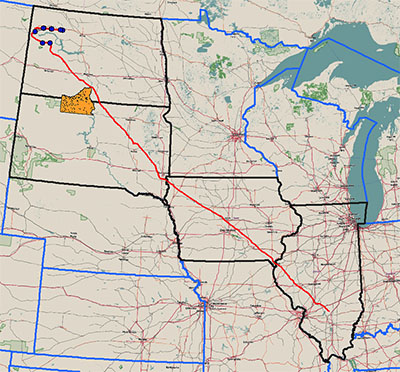
She understood this, and has been a great friend to the Native American community, working on issues of importance to it. But now the Dakota Access pipeline is causing her a big headache. The oil companies wanted the pipeline to transport oil from North Dakota to Illinois. They claimed that was safer than rail transport. Most state leaders in the area supported it. But the pipeline runs right by the Standing Rock Indian Reservation, as shown on NittyG's map below. The pipeline is shown in red and the reservation is shown in orange.
The 10,000 Native Americans who live on the reservation were and are wildly against the pipeline because they are afraid it will pollute their water. They wanted Heitkamp to oppose the pipeline. She didn't and it was built, despite huge protests against it. If Heitkamp loses the support of the Native Americans in her state, she may have a big problem. (V)
Democrats Are Spending Millions to Avoid Disaster in California
California is an overwhelmingly blue state. That being the case, the jungle primary system sometimes works out quite well for the Democratic Party. For example, in the 2016 race to replace the retiring Barbara Boxer, the final round came down to a Democrat and...another Democrat. The tradeoff, however, is that there are circumstances in which the jungle system can turn disastrous. Like, for example, when Democratic enthusiasm is high, Republican enthusiasm is low, and the blue team is trying to flip a GOP incumbent who is standing for re-election. That is to say, circumstances like those that exist right now.
The exact situation where things can blow up in the blue team's face looks something like this: A congressional race attracts two Republicans (usually an incumbent and a challenger) and four or five viable Democrats. In that scenario, it is entirely possible that GOP 1 gets something like 35% of the vote, GOP 2 gets 14%, and the five Democrats get 13%, 13%, 10%, 8%, and 7%. Under California law, the Democrats—though claiming the majority of the votes (51% to 49%)—would have no candidate on the ballot in the general election.
There are three key districts where the blue team is risking this fate: CA-39, CA-48, and CA-49. All of these are eminently winnable; they have PVIs of Even, R+4, and R+1, respectively. All are currently represented by Republicans with serious vulnerabilities: Ed Royce, Dana Rohrabacher, and Darrell Issa (though Issa is retiring). And in all cases, the Democratic establishment has a preferred candidate: Gil Cisneros, Harley Rouda, and Sara Jacobs. However, there are also at least three other Democrats running in each race, along with at least one viable non-incumbent Republican (or two, in the case of the open seat in CA-49).
As we have noted previously, the Democratic pooh-bahs have tried pretty hard to avoid taking sides, for fear of alienating one wing of the party or the other. Consequently, the DCCC and other party organs and super PACs have spent millions targeting Republican #2 in each race. For example, Democrats invested $1.2 million in tearing down Republican Scott Baugh, who is challenging Rohrabacher from the right. All that the Democrats really need is for the #2 Republican to finish in third place (or worse), and all is well. And, by focusing on the GOP, rather than one Democrat or another, nobody can claim the Party is taking sides.
Now, however, the rubber is meeting the road. The California primary is just a week away, and there remains much murkiness on the Democratic side of these contests. And so, the Party is delicately trying to get more "hands on" in an effort to make sure that at least one member of the blue team makes it past the first round. In particular, outside PACs have shifted from attacks on Republican candidates to spending millions on ads in support of the Democratic establishment's candidates. Using PACs in this way allows the DNC and DCCC to distance themselves from the ads, and to say, "Hey, we're staying out of it," even if that might not be strictly true.
The Democratic muckety-mucks are worried about two different things here. The first is that they want these seats so badly they can taste them; if the blue team is to retake the House, they simply cannot afford to lose elections due to self-inflicted wounds. The second is that the Party has gotten enormous mileage out of Conor Lamb's win in Pennsylvania; if the Republicans manage to return the favor (on some level) in California, that would be very bad PR. In eight days, we will know if the Democrats played their hand correctly.
In the long run, the only solution is to get rid of the crazy Louisiana jungle primary system and go back to partisan primaries in which Democrats slug it out for their nomination and Republicans slug it out for theirs. If Democrats are shut out in these three key House races and Republicans are shut out in the races for senator and governor, which seems entirely possible, then both parties might agree that the jungle primary system didn't work out as hoped and needs to be abolished. (Z)
Almost Half of Republicans Believe Millions of Illegal Votes Were Cast in 2016
A new YouGov poll shows that 48% of Republicans believe that as many as 5 million votes were cast illegally in 2016, with only 17% saying they don't believe it. Among Democrats, 25% believe the illegal vote theory and 51% don't believe it. There is essentially zero evidence that more than a handful of votes were cast illegally, and in most cases when there were illegal votes, it was a matter of a legal voter showing up in the wrong precinct, rather than someone not eligible to vote casting a ballot.
Donald Trump has pushed the idea of illegal votes frequently to explain how it came to be that Hillary Clinton got more votes than he did. However, every state voting official who has commented on the matter said that the number of illegal votes is tiny. So if Trump is right, somehow all the state voting officials missed millions of illegal votes. The lesson from this poll is that if you repeat a lie often and loudly enough, large numbers of people will believe it. (V)
In Case There Was Any Doubt...
The claim that millions and millions of illegal aliens cast fraudulent votes is rooted in racist and/or xenophobic fears of hordes of non-white folks descending upon the country to impose themselves on those who were born here. Over time, the same fears have attached themselves to Irish immigrants, Jews, the Chinese, the Japanese, and Mexicans, among others. And before anyone points out that Irish people and (most) Jews are white, they were not perceived as such back in the 19th and early 20th centuries.
Now, Donald Trump claims he's not a racist. He may even believe that when he says it (although it's worth noting that most racists don't identify as such). There is no question, however, that his thinking is shaped by racist and xenophobic instincts. Whether it's his insistence on slurring gang members (always brown-skinned ones) as "animals," or his argument that undocumented immigrants are particularly likely to be rapists, or his railing against "illegal" votes, or his Muslim travel bans, or his characterization of African countries as "sh**holes," he is expressing some serious bigotry. If we desperately wanted to excuse Trump's behavior and his verbiage, then we might point out it's possible that the bigotry is subconscious, that it reflects ideas that were not nearly as problematic when he was growing up, and that what may be going on here is that he's a 71-year-old man who merely hasn't managed to evolve with the rest of American society. That happens quite a lot, though even then it's worth noting that certain professions—teacher, business owner, judge, doctor, reporter—do not have the privilege of refusing to adapt. Are we to hold the president to a lower standard than a second-grade teacher or the owner of a McDonalds?
There is also no question that Trump is enabling bigotry on the part of other politicians as they work hard to appeal to the base. For example:
- In Kansas, State Rep. Steve Alford (R)
explained
that marijuana laws were first put in place in the 1930s because "African
Americans, they were basically users and they basically responded the worst off
those drugs just because their character makeup, their genetics, and that."
- In Texas, Republican Vickers Cunningham is running for county commissioner
in Dallas County. It turns out that the
trust
he set up for his children gives them more money if they marry people who are "white, Christian and the opposite sex."
- In Florida, Republican John Ward is running for the right to represent FL-06 in Congress. He has
opined
that he does not think that Puerto Ricans "should be allowed to register to
vote," that the U.S. should be looking to put them "back in their homes" and
that Puerto Rico is "where they belong." It's safe to say that Ward does not
have similar concerns about Texans or South Carolinians or Georgians who have
relocated to Florida.
- In Georgia, meanwhile, kowtowing to racist and/or xenophobic voters is
turning into a veritable cottage industry. Lt. Gov. Casey Cagle (R), who
advanced to the second round of Georgia's primaries last week, appears to have
been copying and pasting the scripts for his commercials from Donald Trump's
Twitter feed. "Criminal illegal aliens are spreading across the country," he
declares in one ad while Latinos with MS-13 tattoos appear on the screen,
"Liberal politicians in sanctuary cities are shielding them, making it possible
for them to terrorize us on our streets." Not to be outdone, Cagle's opponent in
round two—Brian Kemp—has a commercial where he threatens to
personally drive his (enormous) pickup truck around Georgia and to deport
illegal immigrants himself:
What Cagle is threatening to do, of course, is called "kidnapping" and is a crime in all 50 states. And these two are just the fellows who managed to survive the first round of the primaries. Not making it through were Republicans Michael Williams (who staged a "deportation bus tour"), Clay Tippins (who couldn't stop talking about "criminal gang networks"), and Hunter Hill (a real estate developer who promised to drain the swamp, "fix" the illegal immigration problem, and "bring an end" to all sanctuary cities). Keep in mind that all of these men were running for governor of Georgia, which means that (1) they would not actually have any influence over the other 49 states, and (2) they would be leading a state that has less than 3.5% of the United States' undocumented population. In other words, all of this is pure, 100%, unvarnished pandering.
This is just another way in which the GOP has, quite clearly, become the party of Trump. The real question is: What will happen on this front when the party of Trump no longer has Trump? One possibility is that racism and xenophobia, which had largely become unacceptable in the 1990s and 2000s, are reintroduced into the process as legitimate political discourse, and that the GOP becomes a reactionary party. This would, in essence, be the course charted by the Democrats from the 1860s to the 1920s. The second possibility is that, sans Trump, the GOP is shunned as a party of anti-American traitors who care more about themselves and their friends abroad than they do about the well-being of the country as a whole. This would, in essence, be the course charted by the Federalist Party in the 1810s and 1820s. It is worth noting that in both of these cases, the reactionary party was relegated to minority and regional status (and, in the case of the Federalists, eventual oblivion). (Z)
Back to the main page