Previous | Next | Senate page
New polls: AZ CO MD MI NH TX
Dem pickups: AZ FL GA IA MI NC PA WI
GOP pickups: (None)
Takeaways from the Vice Presidential Debate
The one and only 2020 vice presidential debate is now in the history books. Here are some takeaways:
NPR:The New York Times:
- The election still hinges on the coronavirus
- There was an actual debate, but the candidates didn't answer the moderator's questions
- The candidates reflected their team's overall strategies and pushed their talking points
- A fly generated the most buzz
The Washington Post:
- The race was not upended
- Harris wanted to make the election a referendum on Trump
- Pence wanted to make the election an ideological choice
- Pence's interruptions revealed the stage's gender dynamics
- Harris got tangled up on the courts
- Pence and Harris sparred on race and racial justice
CNN:
- Pence set up and then knocked down coronavirus straw men
- Pence bulldozed Harris
- "If you have a pre-existing condition, they're coming for you"
- Another lackluster debate
AP:
- Pence's alternative universe
- Harris played it safe
- No answers on Trump's health or the transfer of power
- Harris ducked Pence's court-packing question
- Plexiglass served as a COVID-19 reminder
The Hill:
- The debate was mostly uninterrupted
- The pandemic was center stage
- Racial justice was on the table
- Pence pressed Harris unsuccessfully on whether Biden would pack the Supreme Court
- Pence was graceful in acknowledging that Harris is a historic candidate
- Lots of questions and answers, but the answers weren't to the questions asked
Yahoo! News:
- Harris hit her goals
- Pence did his job
- Whole lotta dodging going on
- The fly won
- No game changer
- Kamala kept the focus on the pandemic
- Pence tried to smooth Trump's rough edges
- Harris didn't tolerate Pence's interruptions
- The fly seen round the world
Observers across the pond stayed up until the middle of the night to watch:
The Guardian:BBC:
- Harris hammered home criticism over coronavirus response
- "They're coming for you"
- Harris: "I'm speaking"
- Pence ate up time and the moderator couldn't stop him
- Both candidates dodge questions
- Did Pence have pinkeye, a symptom of COVID-19?
- A very different tone from last week
- Harris failed to exploit virus weakness
- Both sides were uncomfortable on climate change
- Pence denied systemic racism
Our takeaways look like this:
- The debate hurt Trump because it didn't change the course of the race
- Neither candidate hurt the team
- The pandemic is not going away any time soon, not in the country and not in the race
- Women are going to like Harris' standing up to Pence when he tried interrupting her
- Both candidates are experienced politicians: They refuse to answer questions they don't like
That may be it for this cycle (see below). (V)
Next Presidential Debate Will Be Virtual--If It Happens
The Commission on Presidential Debates announced yesterday that the second presidential debate, scheduled for Oct. 15, will be virtual, and that the candidates are to be in separate (as yet) undisclosed locations.
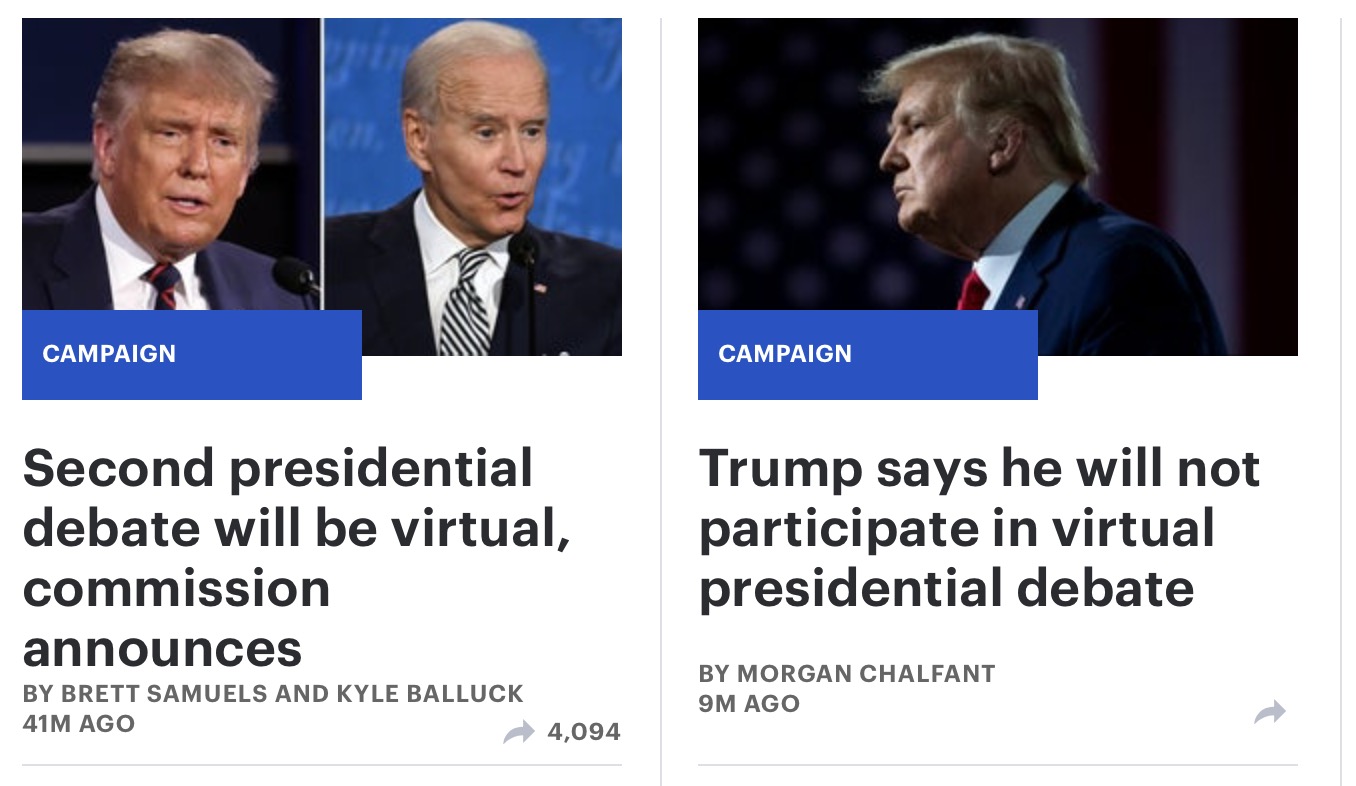
Will Donald Trump show up? Anything is possible. Here are two side-by-side stories from The Hill yesterday:
Trump responded to the Commission almost immediately, and declared: "I'm not going to waste my time on virtual debate. That's not what debating is all about. You sit behind a computer and do a debate. It's ridiculous, and then they cut you off whenever they want."
Basically, he was given Hobson's choice: Take what the Commission offered or no debate at all. Given the fact that he has an active case of COVID-19, there was no way Joe Biden was going to accept being in the same room as Trump. And also given how far behind Biden he is in the polls, Trump needs a way to reset his campaign, and the debate is pretty much all there is, short of AG William Barr arresting Biden for treason.
We think the key part of Trump's statement was: "they cut you off whenever they want." In other words, what Trump fears most is not being able to dominate Biden. If he tries shouting when Biden is speaking, the moderator will just cut off his mic. Then people will hear what Biden is saying and Trump's whole strategy of turning the debate into chaos will fail.
Whether Trump will actually bail remains to be seen. He can and does change his mind on a dime. His advisers are going to tell him that if he doesn't show up, he will miss his last (two) chances to reset the race. Maybe they will get through to him. Maybe they won't. We may not know until just before the debate next week. It is also worth considering the possibility that Trump has already accepted that he will be beaten at the ballot box, and his goal now is to build up a laundry list of "unfair" things that were done to him, either as a basis for challenging the outcome of the election, or else to save face.
Another possibility is that Trump skips the Oct. 15 debate but agrees to the Oct. 22 debate, although that, too, could be by video. Waiting until then also runs a big risk for Trump if he is still trying to win the election. By Oct. 22 tens of millions of votes will already have been cast and even a stunning performance might not have a big effect. Biden is certainly in no mood to bend the rules to please Trump. For him, the best-case scenario is no more debates and Trump getting the blame.
The second "debate" is actually supposed to be a town hall, with questions from the audience. Biden doesn't need Trump to do that. In fact, he already said that he will find a venue and take questions from voters there. Trump's campaign manager, Bill Stepien, who also has COVID-19, said his candidate isn't going to bail out Biden (who is leading in national polls by 10 points), so Trump will do a rally instead. But with Trump, everything could be different by tomorrow.
Republican consultants are in a state of dismay at Trump's attitude. One of them, Liam Donovan, said: "The president's threat to walk away from a virtual debate is a power move that seems almost certain to backfire." Donovan, like most of the others, knows that Trump can't reset the race by talking to a sparse crowd of his own supporters.
If the debate ultimately does happen, it wouldn't be the first video debate. The first one was held in...1960. In the third Kennedy-Nixon debate, John Kennedy was in a television studio in New York and Richard Nixon was in Los Angeles. The moderator was in the middle, in Chicago. It worked fine. (V)
Whitmer Kidnapping Plot Is Foiled
The United States has a problem with violent, right-wing extremists right now. And there may be no state where things are worse on that front than Michigan. Already, there have been incidents of armed militia members plotting to kill police officers and storming the capitol in protest of Gov. Gretchen Whitmer's COVID-19 prevention measures. On Thursday, the situation took a frightening turn for the worse, as the FBI revealed that, aided by informers, it had broken up a plot by right-wing extremists to kidnap the Governor. The general plan was to storm her vacation house, take her prisoner, and then put her on "trial." If that sounds batsh*t crazy to you, then congratulations, you're normal.
Once the plot was foiled, the finger-pointing began. Whitmer blamed Donald Trump for encouraging right-wing extremism. That's not unreasonable, given his generally violent and angry rhetoric, not to mention his remarks at the presidential debate a week ago. The administration might have risen above the Governor's criticism, and might perhaps have used this as an opportunity to denounce this sort of vigilante "justice." But, of course, that is not Trump's style. So, instead, the President took to Twitter to send a series of blistering tweets attacking Whitmer.
Politically, this will surely give the Democrats at least a small boost in Michigan. Whitmer will engender some sympathy and the whole incident will trigger fear about what another four years of Trump might look like. Since Michigan is already nearly out of reach for the President, this could be the final nail in the coffin. Meanwhile, voters in other states who hear about this could also ask themselves "How much more domestic terrorism will happen if the President is sustained at the polls?" If so, that will not work to his advantage. (Z)
Trump Will Return to the Campaign Trail Next Week
Donald Trump plans on returning to the campaign trail next week, despite having COVID-19 now and having no assurance that it will be completely over by then. His goal is to appear in Pennsylvania on Monday and Michigan on Tuesday, with a possible appearance in Florida on Friday. The President announced this, incidentally, on Sean Hannity's program—while coughing and wheezing.
Will people show up at his rallies? We don't know yet, but our guess is that if he says that he is healthy as a horse and his doctor, Sean Conley, nods his head in agreement, enough people will show up for Trump to claim the rally was a huge success. If the rallies turn out to be superspreader events, the consequences probably won't be clear before Election Day. Thus the upside of the rallies—adoring crowds roaring their approval at him—will be before the election and the possible downside of the rallies—people dying from COVID-19—will be after the election. That works fine for Trump.
Trump's hope is that by appearing in public and acting normally (for him), he can try to convince people that the coronavirus is no big deal and those 210,000 dead Americans probably died of something other than COVID-19. Of course, all this is contingent on his actually being well enough to travel to distant locations and speak for an hour or more. Many COVID-19 patients take a turn for the worse after 7-10 days, so we'll have to wait a few more days to know if Trump is out of the woods. (V)
Appeals Court Rejects Extended Deadline for Receiving Ballots in Wisconsin...
Democrats are filing lawsuits all over the country to try to extend the deadline for receiving absentee ballots. Republicans are opposing this everywhere. Republicans are winning. The most recent case is in Wisconsin, a hotbed of suits and countersuits. Yesterday, the U.S. Court of Appeals for the 7th Circuit overturned a lower-court decision to extend the date by which returned ballots would be accepted for counting. The appeals court held that designing election procedures is a legislative function, not a judicial function. If the Wisconsin legislature feels that, due to COVID-19, voters will be compelled to wait until the last minute to vote by absentee ballot, it is free to change the deadline. Of course, the Republican-controlled legislature isn't going to do that under any circumstances. So, in effect, the court said if you are stupid enough to wait until the last minute to cast an absentee ballot, then it is your own fault if it arrives too late to be counted. You could have voted earlier.
Similar suits are pending in other states. It is likely that the Republicans will prevail in all of them. After all, any voter who requests an absentee ballot in plenty of time and then sends it back the day after it arrives won't have any trouble. It's tough for any judge to say that it is unfair to expect voters to cast their ballots in a timely fashion. The Democrats would be better served by telling voters to cast their absentee ballots as soon as they receive them. Depending on the courts is not going to work. (V)
...But District Court Smacks Down Ohio Ballot Box Policy
You win some, you lose some. Although Republicans probably have the stronger hand to play when it comes to absentee ballot deadlines (see above), there are other areas where they are standing on much shakier ground. On Thursday, Judge Dan Polster ruled against the GOP in Ohio, where Secretary of State Frank LaRose (R) had interpreted state law as allowing only one absentee ballot drop box per county. Taking off the kid gloves, the Judge wrote that, "The Secretary is continuing to restrict boards from implementing off-site collection, and he appears to be doing so in an arbitrary manner. The Court has given the Secretary every opportunity to address the problem...and he has been unwilling or unable to do so."
This particular dispute was rooted in the wording of Ohio state law, which says that voters must either place their absentee ballots in the mail, or else "personally deliver it to the director." LaRose interpreted that as meaning that the absentee ballot must therefore be delivered to the county elections office, which is where "the director" is. Polster decreed that LaRose's interpretation is too narrow, and risks depriving people of their right to vote. What this means is that in other states that have severely limited drop boxes (like Texas), the decision may stand depending on how state law is written. Still, even if this goes no further than Ohio, it's a pretty big deal, since polls have the Buckeye State as a dead heat, and more ballot boxes should mean more Democratic votes. Count on this decision being appealed up to the Supreme Court if LaRose loses the expected appeal to the circuit court. (Z)
Larry Sabato's Crystal Ball Has Biden over 270 Electoral Votes...
One of the other sites that tracks the presidential election state-by-state, to see where the Electoral College is heading, is Larry Sabato's Crystal Ball. Its map has just been updated and the score is Joe Biden: 290, Donald Trump: 163, toss-ups: 85. Our current score (counting only the "solid" states) is Joe Biden: 308, Donald Trump: 107, toss-ups: 113. Here is Sabato's map:
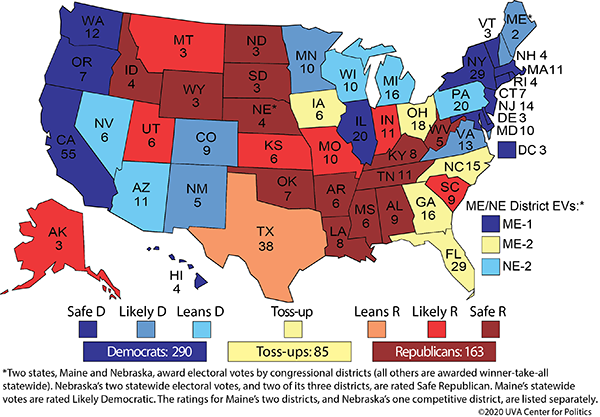
The maps differ because the underlying algorithms differ. Ours is entirely data driven. Theirs is done using copious amounts of their judgment, which includes factors other than polling. For Biden, we have him winning Florida but Arizona is a toss-up. They have these reversed. We actually think they are probably right because Florida is always a toss-up, but the average of the last six polls gives Biden a 5-point lead, so we go where the data go. On the toss-ups, our biggest difference other than Florida and Arizona is Texas, which we have as a toss-up and which Sabato has awarded to Trump. Again, we think Sabato is right and Trump will narrowly win Texas in the end. (V)
...And So Does CNN's Electoral College Outlook
The Crystal Ball isn't the only site to move Joe Biden into "winner" territory on Thursday, as he also crossed 270 EVs in CNN's tracker for the first time this cycle. More specifically, they have the Democratic ticket with 203 solid EVs and another 87 leaning heavily in that direction, for a total of 290. Donald Trump, by contrast, has 125 solid EVs and 38 leaning EVs, for a total of 163. CNN's model also has Florida, Georgia, Iowa, ME-02, North Carolina, and Ohio, with a total of 85 EVs, as toss-ups.
While Sabato's Crystal Ball incorporates a certain amount of subjective judgment, CNN's approach is entirely data-driven, as ours is (albeit theirs is a bit more conservative). But the bottom line is that whatever approach is used, Joe Biden is in the driver's seat with a little more than three weeks until Election Day. If Trump wants to save his presidency, he is going to need a game-changer, and fast. On the other hand, if he does indeed skip the remaining debates (see above), and spends his remaining time communing only with the base, it gives credence to the notion that he is more interested in setting up the next chapter of his career (constant airing of grievances, possible Trump "News" Network, etc.) than he is in winning the election. Or it could mean that he really isn't very smart and doesn't realize he is way behind now. (Z)
Pelosi Decides to Play a Little Hardball
Donald Trump has been sick with COVID-19 for at least a week. And since he was discharged from Walter Reed, he's been quite erratic, even by his standards. Since it is clear that the President could go full Jack Torrance —killing people with a hatchet, writing "REDRUM" on mirrors, laughing maniacally—and his Cabinet wouldn't bat an eye, Nancy Pelosi thinks that there should be another means of declaring presidential incapacity. So, consistent with the terms of the 25th Amendment, the fourth section of which specifically allows this step, she is working on a bill to create a commission that would evaluate presidents' fitness to do their job. If the commission and the VP agreed that the president was incapacitated, he or she would be out.
Several attempts have been made in the past to create such a commission, but have gone nowhere. Chances are slim that this bill will do any better, and are even slimmer that Mike Pence would play along should it become law. In other words, this is just a bit of political theater designed to draw voters' attention to the possibility that Trump is no longer fit to serve. A secondary goal is to draw an over-the-top response from the President, further making the point that he may have taken leave of his senses. That response has already come, in the form of Trump claiming a coup is underway. He will undoubtedly have more to say at such point that the House actually passes the bill. (Z)
A Stand-Alone Bill to Bail Out the Airlines Is on the No-Fly List
The airlines are all bleeding money because hardly anyone is going anywhere. If the airline industry were to collapse (or even if one of the big players were to go under), it would be a disaster for the country and many cities would be without airline service. Consequently, Donald Trump has proposed a bill to bail them out by giving them tens of billions of dollars. Yesterday, Speaker Nancy Pelosi (D-CA) made it clear that a bill to save only the airlines but not help working Americans who are also in financial trouble is a nonstarter. She's OK with a bailout for the airlines in order to save an estimated 40,000 jobs, but only in the context of a much bigger bill that would also help individuals, cities, states, schools, and more, not just airlines.
It's hard—if not impossible—to figure out what Donald Trump actually wants. One day he says that a new stimulus bill is not going to happen until after the election. The next day he is proposing a bill. Maybe he thinks that because Pelosi is a woman, he can dominate her and get her to accept his terms. He would be well served if someone who works for him, for example, Treasury Secretary Steven Mnuchin (who has negotiated with her before), were to tell him that just ain't gonna happen. If he wants a bill of some kind, he can get it easily, but not on his terms. He would have to give Pelosi a fair amount of what she wants. And if he wants something to happen before the election, playing cat-and-mouse games with Pelosi isn't the way to achieve it. Stay tuned. Tomorrow is a new day and Trump will probably have a shiny new plan. (V)
Trump Required His Doctors to Sign Nondisclosure Agreements in 2019
In November 2019, Donald Trump made a secret midnight trip to Walter Reed Medical Center for reasons never disclosed. Now NBC News is disclosing the reason we don't know what happened: Trump demanded that the doctors there sign NDAs before being allowed to treat him. The technical term for this is "chutzpah." Imagine that you had a ministroke (as Trump may well have had), are rushed to the hospital, and then demand that the doctors sign an NDA before being allowed to save your life. At least two doctors refused to sign and were removed from the case. Trump was lucky that some of the doctors were willing to sign. What would he have done if they all said "no, thanks"?
NBC News's sources didn't know if Trump had the same requirements on his recent visit, but it is known that he uses NDAs all the time, so it wouldn't be surprising. What he does not seem to know is that an NDA isn't even needed. Under a federal law (HIPAA), doctors are not allowed to disclose any medical information about a patient without the patient's consent. So an NDA is really redundant, but by making a doctor sign a document that no doubt specifies cash damages for violations, Trump is no doubt hoping to scare doctors even more and make sure they don't speak out, even if his official doctor is misleading the media or even outright lying. Furthermore, since Walter Reed doctors are government employees, the NDAs would probably be unenforceable. So it is all about intimidation. (V)
New England Journal of Medicine Makes Its First Presidential (Anti-)Endorsement
Published continuously for the last 208 years, The New England Journal of Medicine does not typically comment on elections (0 times before this week). It also does not typically print editorials signed by the entire editorial board (4 times before this week). On Wednesday, however, they did both, printing an editorial that calls for the Trump administration to be voted out of office due to its mishandling of the COVID-19 pandemic.
The editorial pulls no punches, laying out a data-based case for the failures of the Trump administration, and then going for the knockout blow:
Anyone else who recklessly squandered lives and money in this way would be suffering legal consequences. Our leaders have largely claimed immunity for their actions. But this election gives us the power to render judgment. When it comes to the response to the largest public health crisis of our time, our current political leaders have demonstrated that they are dangerously incompetent. We should not abet them and enable the deaths of thousands more Americans by allowing them to keep their jobs.
The Journal's editorial staff does not say which candidate voters should vote for, but since there's only one viable alternative, readers can probably figure that out for themselves. We don't imagine that an academic journal with a relatively limited circulation will sway that many votes, but perhaps the unprecedented nature of this piece (not to mention the one in Scientific American last month) will capture the attention of at least a few undecided voters. (Z)
Today's Presidential Polls
Michigan, as we note above, is going, going. Meanwhile, Colorado, Maryland, and New Hampshire are gone. As to those Texas results, keep in mind that Pulse barely makes our cut because of its C+ grade on FiveThirtyEight and pronounced Republican house effect. (Z)
| State | Biden | Trump | Start | End | Pollster |
| Arizona | 48% | 45% | Sep 28 | Oct 06 | Latino Decisions |
| Colorado | 50% | 40% | Oct 01 | Oct 06 | SurveyUSA |
| Maryland | 61% | 30% | Sep 30 | Oct 04 | Goucher College |
| Michigan | 54% | 43% | Oct 06 | Oct 07 | Emerson Coll. |
| New Hampshire | 53% | 41% | Oct 01 | Oct 04 | St. Anselm Coll. |
| Texas | 44% | 51% | Oct 05 | Oct 06 | Pulse Opinion Research |
| Texas | 50% | 49% | Oct 07 | Oct 08 | PPP |
Today's Senate Polls
If these numbers are on target, it would be three holds and two pickups for the Democrats. Meanwhile, we doubted yesterday that MJ Hegar was really within a point of John Cornyn. We also doubt she's 9 points down, especially given the pollster. What we are really waiting for is a poll of the Cunningham-Tillis race in North Carolina, now that there has been time for the dust to settle after the announcement that Cunningham had an affair. C'mon, PPP. It's your own state. Go for it. (Z)
| State | Democrat | D % | Republican | R % | Start | End | Pollster |
| Arizona | Mark Kelly | 47% | Martha McSally* | 42% | Sep 28 | Oct 06 | Latino Decisions |
| Colorado | John Hickenlooper | 48% | Cory Gardner* | 39% | Oct 01 | Oct 06 | SurveyUSA |
| Michigan | Gary Peters* | 51% | John James | 41% | Oct 06 | Oct 07 | Emerson Coll. |
| Minnesota | Tina Smith* | 44% | Jason Lewis | 37% | Oct 01 | Oct 06 | SurveyUSA |
| New Hampshire | Jeanne Shaheen* | 53% | Corky Messner | 39% | Oct 01 | Oct 04 | St. Anselm Coll. |
| Texas | Mary "MJ" Hegar | 39% | John Cornyn* | 48% | Oct 05 | Oct 06 | Pulse Opinion Research |
* Denotes incumbent
Previous | Next
Main page for smartphones
Main page for tablets and computers