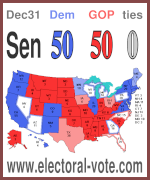
Previous | Next | Senate page
New polls: (None)
Dem pickups: AZ GA MI PA WI
GOP pickups: (None)
Impeachment, Part Deux
Donald Trump loves to break records, and he's about to do so again, as House Democrats are preparing to impeach him for a second time. Not only will this make him the first president to pull off a double-impeachment, it will also mean that he'll have as many impeachments on his résumé as all of his 43 predecessors combined.
House Democratic leadership has already released a draft of the article they plan to bring, which you can read here. Note the singular; in its current form, at least, the document charges just one "high crime and misdemeanor," namely incitement of insurrection. Of course, that's a pretty serious high crime and misdemeanor. Meanwhile, Senate Majority Leader Mitch McConnell (R-KY) has circulated a draft memo of how the second impeachment trial would be conducted, should it come to pass.
At this point, the overwhelming likelihood—barring something like a resignation from Trump—is that the impeachment will indeed come to pass. As the Democrats consider the possibility, there are really two questions they're thinking about. The first is: "Is impeachment philosophically and ethically justified?" And the answer to that question is clearly: "yes." Whether one thinks that Trump actually crossed the line with his rally remarks and his earlier instigating, or he merely approached the line, there is enough here to make the question worth examining. Meanwhile, the offense he's alleged to have committed is so serious that it's simply not appropriate to look the other way, even if his term is almost up.
The second question, meanwhile, is: "Is impeachment politically wise?" And the answer, once again, is clearly "yes." Polls have already shown that well over 90% of Democrats think Trump committed a crime. If Pelosi & Co. just let that go, their base would be furious. Meanwhile, putting Republicans' feet to the fire—forcing them to cast a vote that chooses between the Constitution and Trump—is no small benefit, either. Certainly it will help make the emerging split in the GOP even worse.
In any event, a "yes" to either of these two questions is plausibly enough to trigger an impeachment. The fact that the answer to both is "yes" made the decision fairly easy for the blue team, even with Trump's term coming to an end. That impeachment makes all the sense in the world for the Democrats is one reason that we think it's now essentially inevitable. The other reason is that Pelosi would not go so far as to release a draft of the article, and McConnell would not go so far as to release a procedural memo, if this was all just for show.
At the moment, there are four questions that leap to mind, three of them consequential, and one of them more a matter of curiosity. Let's take a look at all four:
- What is the timeline?: In the memo that McConnell circulated, he observed that the Senate
will not be back in regular session until Jan. 19, and that a hypothetical impeachment trial cannot begin until then. He
laid out a timeline wherein the trial would either start that day, or else the next day. Either way, it would be taking
place during Joe Biden's inauguration, which is surely deliberate on the Majority Leader's part. It would, of course, be
easy enough for incoming majority leader Chuck Schumer (D-NY) to push things for a day, though, once he assumes
leadership of the upper chamber.
At the moment, McConnell holds all the cards, and so he can probably insist upon this timeline. The only way that changes is if there is some Republican apostasy. And actually, there are two different forms of apostasy that might get it done. The first is that some sizable portion of McConnell's caucus insists on dealing with this immediately, as opposed to postponing. That would have been unthinkable with Ukraine Mobilier, but at the moment, it's not a great look to be the party responsible for allowing Donald Trump to remain in power (and with his finger on the nuclear button) for two extra weeks.
The other type of apostasy is much more of a longshot, but we're a full-service site, so we'll lay it out nonetheless. This one would require just two Republicans to pull off. The first of those is Georgia Secretary of State Brad Raffensperger, who would need to get Sens.-elect Raphael Warnock (D-GA) and Jon Ossoff (D-GA) credentialed as quickly as is possible. Given his rather rocky relationship with the President, the Secretary might just be inspired to do that. Friday was the final deadline for ballots in Georgia (specifically, those from the military), and there are expected to be only about 10,000 of those to count. So, it's entirely plausible that both of the new senators could have their credentials by Monday if Raffensperger wants them to have them.
The second Republican that would be needed is any GOP member of the Senate who is willing to jump ship and caucus with the Democrats. The obvious candidate here is Sen. Lisa Murkowski (R-AK), who is out of step with the current iteration of the GOP, who has won election as a third-party candidate before, and who comes from a state that just adopted ranked-choice voting. She knows full well that if she's the swing vote on all/most legislation, she'll be able to bring home so much pork that they'll have to make sauerkraut the official state side dish. Oh, and Murkowski has already made noise about getting rid of Trump and about leaving her party. U.S. senators do not talk publicly about abandoning their party unless they are at least 80% of the way toward actually doing it. The only complication is that her state's economy is based on oil and all 50 of the other Senate Democrats want to get rid of oil (in Joe Manchin's case, to replace it with coal). If Murkowski were to actually flip, Schumer would have to give her permission in advance to vote against any bill that would hurt her state, otherwise, she wouldn't do it since she is up in 2022.
So, we have Raffensperger (plausible) and Murkowski (plausible), and now we get to the third element, which is where things get implausible. With these two folks giving the Democrats a 51-person majority (even without the VP tiebreaker), all 51 of them could show up for work some day this week, declare themselves a quorum for purposes of conducting business (the minimum required by the Constitution), immediately elect Schumer as majority leader, and then set a new calendar for Senate business, including immediately calling them back into session. We really don't think this will happen, but you never know. - What will the Republicans do?: At some point, whether in a few days or a few weeks, the
Republicans in Congress are going to have to decide what to do about their impeachment vote. With the previous
impeachment, the charged "high crimes and misdemeanors" were somewhat abstract, Trump was likely to remain as president
for two more years, and the whole thing could plausibly be presented to Republican voters as a power grab by Democrats.
In this case, however, everyone saw the pictures of people storming the Capitol, Trump is out of power in a
couple of weeks, and it's rather harder to spin this as a power grab because the Democrats are taking over the White
House and the Senate regardless of what happens.
Undoubtedly, Trump's support in the House will largely hold firm, though there may be some number of Republicans there (starting with Adam Kinzinger of Illinois) who might join with the Democrats to pass the article of impeachment. It's in the Senate where things get interesting. Those folks, on the whole, represent much more diverse (and so much less red) constituencies, generally speaking. They were literally front-row witnesses when it comes to the evidence that will be put forward to prove Trump's guilt. And every one of them is taking note of what is happening right now to newly christened pariah Sen. Josh Hawley (R-MO; more on this below). If 92/93 of them opposed the claims that Trump got cheated at the ballot box, it's possible that 92/93 of them will conclude that an impeachable offense has taken place here. Some, perhaps many, may welcome the chance to rid the Republican Party of Trump once and for all. Certainly, the GOP will be better off without two years of "will-he-or-won't-he?" questions about the Donald, since as long as he's potentially "in," it will be difficult for other candidates to gain traction (much less raise money, hire campaign staff, etc.). - Can you impeach an ex-president?: This is something that the gentlemen who wrote the
Constitution did not spell out—must someone be a current officeholder to be impeached? And, until the Supreme
Court weighs in, we won't have a definitive answer. However, there are two strong arguments that suggest it's kosher.
The first is that one of the two possible penalties for a conviction—being banned from future
office-holding—is just as relevant to a former officeholder who is guilty of wrongdoing as a current one. The
second is that there is precedent for post-hoc impeachment. In 1876,
William W. Belknap
got enmeshed in a bribery scandal, resigned after being impeached, and was tried nonetheless (he was acquitted).
In the end, if and when Schumer & Co. move forward with the impeachment, they will have achieved the majority of their goals (philosophical and political) even if Trump is not convicted and barred from future officeholding. And if he is convicted and barred, then it will stick unless he sues, goes to the Supreme Court, and wins. - Who presides?: This is the question that's really just a curiosity. The Constitution specifies that the Chief Justice presides over the impeachment trial of a president. However, it does not say anything about ex-presidents. So, it's not clear if the presiding officer in a Trump impeachment, if it takes place on or after Jan. 20 at noon, would be John Roberts or if it would be...Kamala Harris. Wouldn't the latter possibility be interesting?
And there you have it—the Trump reality show is going to keep going until the bitter end. (Z)
Twitter to Trump: "Bye!"
The Trump reality show will keep going, but it will do so without the President's favorite megaphone. In case the move toward a second impeachment wasn't news enough, Twitter announced on Friday that the President has refused to straighten up and fly right, and so they are banning him permanently. Trump's last ever tweets, and the ones that did him in:
- The 75,000,000 great American Patriots who voted for me, AMERICA FIRST, and MAKE AMERICA GREAT AGAIN, will have a
GIANT VOICE long into the future. They will not be disrespected or treated unfairly in any way, shape or form!!!
- To all of those who have asked, I will not be going to the Inauguration on January 20th.
The social media platform's management decided that the first tweet encouraged further rebellion and the second one called into question Joe Biden's legitimacy, and so they were strikes three and four, enough to be out and then some. Twitter also said that the @POTUS and @WhiteHouse accounts would be left online, but would be carefully monitored for problematic content. The President (or someone working for him) decided to put that to the test, firing off four tweets Friday evening, beginning with "As I have been saying for a long time, Twitter has gone further and further in banning free speech, and tonight, Twitter employees have coordinated with the Democrats and the Radical Left in removing my account from their platform, to silence me." All four tweets disappeared almost instantly.
According to White House insiders, Trump blew a gasket when he learned of the ban. He and his family are painting themselves as victims and martyrs, of course, and are threatening to build their own social media platform to stick it to the libs. They might want to ask Parler and Gab about how well that works. In any event, the President has his e-mail list, and FOX, and OAN, and Newsmax, and this hypothetical new platform he's going to build. All of these things will let him stay in touch with the base, but he's going to struggle enormously to connect with people beyond that. We've said before, and we still believe, that once he's out of power, "Trump says crazy stuff" just won't attract much coverage in the media. (Z)
Saturday Q&A
We got close to 1,000 questions this week. Did something newsworthy happen?
Q: Over the course of the past 6 months, you did an excellent job going over and explaining the various ways Donald Trump and his associates could overturn the election results. At any point, did you have storming the Capitol on your short list? Or your long list? Or any list? B.M., Norwich, CT
A: You know, we got a lot of "I told you so!" and "Guess you were wrong!" e-mails on Wednesday. However, our position has never, ever been that there would be no attempt at a coup, or no violence. Our position—raised in numerous news items and Q&A answers, and reiterated by a number of Sunday letters—was that if it did happen, it wouldn't work. And though we didn't specifically envision an attack on the Capitol, we were right—the coup attempt didn't work, and wasn't even sustained for more than a few hours.
Q: This may be a ridiculous question, but here goes: Do Secret Service agents take an oath to uphold the Constitution? If so, could they take action to protect the nation from a deranged President, like lock him in a room for 12 days without access to phone or Internet, or whisk him off to an undisclosed location for 12 days? I realize they might face some charges, but wouldn't their oaths protect them if they are defending the nation and the Constitution? L.S., Greensboro, NC
A: They take the same oath that all federal law enforcement officers take:
I [name] do solemnly swear (or affirm) that I will support and defend the Constitution of the United States against all enemies, foreign and domestic; that I will bear true faith and allegiance to the same; that I take this obligation freely, without any mental reservation or purpose of evasion; and that I will well and faithfully discharge the duties of the office on which I am about to enter. So help me God.
That said, "I was just following my oath, as I understood it" is not a justification for committing a crime. And kidnapping Trump would certainly be a crime.
Q: What is to prevent Donald Trump from granting anyone participating in the attack on the Capitol a blanket pardon? A.P., Santa Monica, CA
A: Probably nothing, if it was worded very carefully and concisely. Presidents have issued blanket pardons before, most notably Andrew Johnson (Confederate soldiers) and Jimmy Carter (Vietnam War draft dodgers).
That said, this may not be the salvation that many of those folks are presumably hoping for. First of all, Trump lawyers tend to be pretty poor at drafting airtight legal documents. And second, most of the planning took place in the participants' home states, which means they could be popped by state-level authorities for conspiracy. The President, of course, cannot pardon state-level crimes.
Q: I have noticed that among the flags waved by the insurrectionists was the flag of the late, lamented Republic of [South] Vietnam. In the years following the final fall of Saigon in 1975, there was a small group, including veterans, who adhered to a stab-in-the-back mentality regarding America's worst lost war. As the decades went by, this faded as America's concentration turned to other issues. Most of the insurrectionists were a lot younger than those of us who lived through the Vietnam Era. So does anyone know who were waving this flag and why? M.M., Plano, TX
A: There were many national flags carried by protesters, among them South Vietnam, Cuba, Georgia, and South Korea. What these nations have in common, of course, is that their residents (some of them, at least) fought back against communism. And so that is the message being sent, since Donald Trump is—of course—protecting America from being taken over by the socialists.
We will point out that there were also Canadian flags being carried. Clearly these folks are willing to seize any opportunity to advance their nefarious plans. Surely it's no coincidence that the only people present for both occasions that the Capitol was assaulted (1814 and 2021) were the Canadians.
Q: A comment
you made
raised an interesting question: "This certainly looks like the tea party all over, except that the tea party was always
a minority faction within the Party, whereas MAGA vs. The Establishment could split the GOP right down the middle."
What are the differences between the Tea Party and the MAGA faction of Republicans?
S.G., Morgantown, WV
A: The tea party had a real political principle around which it was organized, namely lower taxes. The MAGA faction does not have a clear principle like that, unless maybe it's xenophobia.
The more important difference, however, is that the MAGA faction is larger and has a clear-cut leader, namely Donald Trump. That makes them far more dangerous to the GOP, since the tea party was often disorganized and ineffectual.
Q: On Thursday, you chose to include pictures of Donald Trump's tweets rather than embedding them, as they were subsequently deleted. Given that Trump's account is almost certain to be deleted before too long, are you bothered by all the embedded tweets of his on your site from the last 5 years disappearing? I presume you don't intend to go through a couple of thousand pages and fix them all. A.M., Bradford, UK
A: Luckily for us, the content of the tweet is actually built into the html code that Twitter provides. And so, the pretty formatting and the information about likes/retweets/comments is now lost, but the actual content remains. See here for an example.
Q: I don't understand why Donald Trump is trying so hard to "win" Georgia. Even if he "won" the state, he still would not have enough electoral votes to become President. Can you explain his actions? S.W., New York, NY
A: Let us note that it's entirely possible that he's slipped a gear, and that there is no rational thought right now.
That said, we've got two guesses, neither of them great. The first is that he thinks corrupting the results in the other two states he'd need will be easier once he corrupts the results in the first one. The second is that what he really wants is someone to blame, so his loss is not his fault. Brad Raffensperger filled that need for a few days, and now Mike Pence is taking his turn.
Q: This is now Trump's worst week ever, right? J.S., Tulsa, OK
A: Absolutely. In seven days, we had the Georgia phone call and the fallout from that, the loss of two U.S. Senate seats and with it the Senate majority, the insurrection, Trump being compelled to concede he lost the election, the loss of his beloved Twitter account (and probably his Facebook page), and then the drafting of the paperwork needed for a second impeachment. Excluding assassinations, that's not only the worst week he's ever had, it's gotta be the worst week that any president has ever had.
Q: Are there many other countries that have a similar electoral process as the United States' Electoral College system? If so, do these countries have as many points in their process as the U.S., where the presumed candidate can be challenged by the opposition party? T.S.I., Seattle, WA
A: There really is nothing equivalent to the Electoral College. There are situations where supreme leaders are chosen by an indirect vote, but the folks who get to choose are either elected officials (e.g., members of Parliament choose the prime minister in the U.K.) or else are high-ranking members of the polity (e.g., the College of Cardinals chooses the pope). In some nations (France, Germany, India, etc.), the members of the upper chamber of the legislature are chosen by some select group of citizens, again usually elected officials, the same way U.S. Senators were chosen before the adoption of the 17th Amendment. And in some nations, the head of state (usually a ceremonial position) is chosen by "electors," which pretty much always means "parliament." Germany, Hungary, Italy, India, Israel, and Malta are among the nations on that list.
Q: Every member of Congress that supported the objection to electoral votes on Wednesday was
participating in and enabling Donald Trump's insurrection. I believe every one of them should be ejected from Congress.
Yes, that means 100+ from the House and 13 from the Senate. This would not result in a durable partisan advantage for
Democrats; most of the insurrectionists are from safe districts or states and so would be replaced by another Republican
in a special election later this year, and the Democrats already control both houses of Congress for now, anyway.
I'm sure this will not happen, but is there any mechanism by which it could?
B.J., Boston, MA
A: The Constitution grants to Congress the right to expel members as it sees fit. However, it takes a 2/3 vote. It is possible (though not probable) that the Senate might make an example of Josh Hawley and/or Sen. Ted Cruz (R-TX) and toss them out on their rear ends. However, inasmuch as more than 1/3 of the House stuck with the electoral challenges even after the insurrection, there's no way that 2/3 of the House will vote for the expulsion of even a single member, much less more than 100 of them.
Considerably more plausible, and more likely, is that some or all of them are censured. That only requires a majority vote, and while it's mostly symbolic, it does carry one specific penalty: censured members cannot serve as committee chairs or ranking members.
Q: Apparently it is not possible to recall representatives and senators, but I wonder what the legalistic explanation is? If I am disgusted with my governor, I can vote to recall them...why not my representative and senators? H.B., State College, PA
A: The legalistic explanation is that the Constitution (specifically, Article I, Section 5, Clause 2), grants that power exclusively to Congress, and so the states are not allowed to claim it for themselves.
Q: You have written that Josh Hawley is now "radioactive," and I've heard that his presidential ambitions are dead. Do you think that's true? Do you think he'll lose his Senate seat, or resign from it? Republican voters in Missouri will vote for even the most odious candidate (see Eric Greitens), so I don't think he's finished yet. Your opinion? C.N., St. Louis, MO
A: It is one thing to run on ideas that 30% or 40% or even 50% of the electorate find reprehensible. It is another thing entirely to muck around with the foundations of the democracy in obvious service of selfish personal goals.
You can read here about some of the consequences that Hawley is already suffering. He lost his book contract, of course, and every big paper in his home state has published an op-ed flaying him. Most of his Senate colleagues, including the Republicans, now hate him, and some are even saying so publicly (Sen. Ben Sasse, R-NE, called Hawley a "dumbass," for example). Several of his major donors have abandoned him. Former senator John Danforth (R), who was Hawley's mentor, and who moved heaven and earth to get him the GOP nomination in 2018, announced that "Supporting Josh and trying so hard to get him elected to the Senate was the worst mistake I ever made in my life."
He is now, and will forever remain, unelectable on a national ticket. He will be an outcast in the Senate, and might even be cast out. And when and if he runs for reelection, trying to hold on to a seat that was occupied by a Democrat immediately before him, he's going to have trouble winning (in fact, he will have trouble getting renominated).
Q: I'm only assuming that Vice-President-elect Kamala Harris has started receiving Secret Service protection. Do we know if she had it during the riot at the Capitol? J.P.R., Westminster, CO
A: While we cannot show you a photo of Harris being flanked by her USSS detail on Wednesday, we can tell you that: (1) She has had USSS protection since at least August, (2) Once you are president-elect/VP-elect, protection is 24/7 and is not optional no matter where you are or what you're doing, and (3) the USSS was in the building on Wednesday because they were also responsible for protecting Mike Pence. So, yes, she was being protected during the riot.
Q: Will there be a "designated survivor" for the inauguration? If so, who could it be? R.M., Virginia Beach, VA
A: To start, so everyone is on the same page, R.M. is referring to the fact that because the Senate is out of session until Jan. 19, it's unlikely any of Joe Biden's cabinet picks will be approved by the time he takes office, leaving the line of succession basically empty.
Anyhow, there usually is a designated survivor for the inauguration, including for the last four inaugurations in a row. The President-elect might plausibly ask one of Donald Trump's few remaining Senate-approved cabinet officers to stay on the job for an extra few days, so they can be the designate. However, it is vastly more likely that it will either be the President Pro Tempore if the Democrats get one selected in time, or else it will be Nancy Pelosi.
Q: With President-elect Biden finalizing his cabinet, I noticed that no Republican has been named. Is the door closed on some horse trading with, say, Senator Pat Toomey (R-PA)? Do you think a cabinet-level post or ambassadorship deal is still conceivable? I mainly ask because, while Vice President-elect Kamala Harris can break ties, I'm guessing she'd prefer not to have to do so in cases that could harm her own Oval Office aspirations. M.P., Fort Worth, TX
A: We would guess your supposition about Harris is actually off the mark. If she breaks a tie it pretty much means that the measure had broad (or unanimous) support among the members of the Democratic Party, which means that she would get to be the white knight whose vote secured a repeal of the tax cut, or an increased minimum wage, or a $2,000 COVID-19 payment. Those are all things to brag about for an aspiring president.
Anyhow, Biden certainly could still poach a Republican senator. The obvious job that's still open is Administrator of the Small Business Administration, but you never know what other job might pique Pat Toomey's interest. Maybe he'd like to serve on the board of the Federal Reserve, or be chair of the FCC, or be ambassador to the Bahamas.
Q: How important were Stacey Abrams and her organization in Joe Biden's and the two Democratic Senators' wins in Georgia? It sounds like she was very important. What is likely to be her reward from the national Democratic Party or from Biden? D.K., Iowa City, IA
A: By all evidences, her voter registration and get-out-the-vote operations were very significant, and perhaps decisive. So, the Party does indeed owe her.
Chair of the DNC seems unlikely, since most Democrats (including Rep. Jim Clyburn, D-SC) are pushing for failed South Carolina U.S. Senate candidate Jaime Harrison, who knows how to raise money (the #1 job of the DNC Chair). Abrams might be interested in a couple of years as U.S. Attorney, or some other role in the Dept. of Justice. However, her plan is clearly to run again for governor of Georgia. Joe Biden will provide her with whatever she wants when she runs, from money to logistical support to as many visits from him, Kamala Harris, Barack Obama, etc. as she needs.
Q: One thing you didn't discuss is what happens in a 50-50 Senate if there is no vice president. Yes, I know the president gets to appoint a new one, but that person has to be confirmed by Congress, and if the vote is 50-50, how does the tie get broken? M.B., Montreal, Canada
A: You're right that this is a question the Constitution does not have an answer for.
It is extremely unlikely that Senate Republicans would allow the vice presidency to remain vacant for months and years, as that would look very bad—more playing games with the foundations of the democracy. It is more plausible that they would request (and get) some input as to the nominee, so that Biden picks a moderate and not a fire-breathing lefty.
If the Republicans did try to do this, however, then the Democrats would just wait for a day that one GOP senator was absent due to illness or other business, and then would approve the new VP 50-49.
Q: Because of recent events, we've heard a lot about what happens when the U.S. Senate is tied 50-50, but has the House of Representatives ever been tied between Democrats and Republicans? Is there a tiebreaking mechanism in the House that is equivalent to the Vice President's role in the Senate? D.A., Ada, MI
A: While there have certainly been tie votes, there has never been a time when the House of Representatives began its term evenly divided (in part because it's generally had an odd number of seats). And so, the House has always been able to elect a speaker, and that person—by tradition—generally votes on legislation only when their vote is needed to break ties (though Nancy Pelosi did make a point of voting for the first impeachment). Anyhow, the point is that the Speaker effectively plays the VP's role.
Since deaths, resignations, etc. are much more common in the House than in the Senate, there have been periods of time when the two caucuses had an equal number of members for a month or two, but that state of affairs is always temporary (until the vacated seat is filled), and it would be impractical and uncollegial for the only-temporarily-not-in-the-minority faction to demand that new speaker elections be held.
The only way there really could be a problem, then, is if the House was evenly divided at the commencement of its term. They literally cannot conduct any business until a speaker is chosen, however, so they would undoubtedly work something out. Either the faction more likely to end up in the majority would get their choice, with the understanding that a new election could be held if apropos. Or, they might agree to choose someone who is not actually a member of the House to be speaker. As readers of this blog know, that is entirely legal, because the Constitution places no limits on who can hold the job. Speaker George Clooney, perhaps?
Q: With a Democratic majority in the Senate now expected, is it possible for Kamala Harris to be "elected" Majority Leader and to establish a new precedent? T.K., Columbia, MD
A: Under current Senate rules, no. But the majority gets to approve the rules. So, if the Democrats really wanted to, they could rewrite them and make this happen. Or, more probably, they would just strip all the powers of the Majority Leader, and award them to the presiding officer. They're not going to do this, however, because it's more efficient to have the same person running the show all the time, rather than to have the VP and the Pro Tem handing the baton off between each other.
Q: How does Kamala Harris' role change with the split Senate? Does this mean that any non-constitutional duties that Biden might have assigned to her will have to be significantly scaled back, as well as possible international trips, so that she can be ready to break a tie at a moment's notice? J.C, Binan, Laguna, Philippines
A: It doesn't change very much, we would guess. The current record for tiebreaking votes by a VP is 31 by John C. Calhoun, who served 7 years, and so performed the service about 4½ times per year. The post-1900 record is Mike Pence with 13, or about 3½ a year. In short, there really aren't that many bills that get past the House and then split the Senate down the middle. And when one of those comes up, Chuck Schumer can certainly coordinate with Harris to make sure she's available. The only limit we can really imagine is that she might not be able to schedule trips abroad in December, so she can be available to approve the budget if it comes down to the wire (which it seemingly always does).
Q: Now that there's a (small) likelihood Puerto Rico and D.C. statehood could pass, how does House apportionment work? Does the House have to pass another bill expanding the number of seats, or would there be another round of redistricting (after this most recent round coming up over the next few years) to accommodate the likely at-large D.C. district and the 4 Puerto Rico seats into the 435-seat layout? J.H., Los Angeles, CA
A: In the past, they have added the new members to the existing body and kept it that way until the next apportionment. And so, if D.C. was to achieve statehood after the 2020 census was complete, then the House would have 436 members until 2031. If Puerto Rico was also added, then the House would have 440 members.
Q: The 23rd Amendment provides for the District of Columbia to have electors, and specifically "in no event more than the least populous State." How, if at all, does this affect plans to grant statehood to D.C.? F.C., Nevada City, CA
A: We would guess that if D.C. achieved statehood, then the 23rd Amendment would be repealed.
If not, and the (much reduced in size) federal capital were to retain its EV entitlement, then if you read the text of the Amendment, you will see that it actually says that electors are to be "appoint[ed] in such manner as the Congress may direct." So, Congress could pass a bill saying that they get to award the electors themselves, or that the electors are awarded to whoever wins the newly created 51st state, or that the electors go to whoever wins the national popular vote, or whatever other standard they wish to apply. There is nary a word in the amendment that requires the selection have anything to do with the residents of D.C.
Put another way, Congress—in this situation—acts as the de facto legislature of Washington, D.C., and so has the same power over electoral votes that all the legislatures have.
Meanwhile, the newly created 51st state would be entitled to the same number of EVs as any state. Since they would have two senators and one representative, they'd have three EVs, and Nate Silver would have to change his URL to fivefortyone.com.
Q: I remember that, in response to the question of whether you think the Senate is more important for Democrats to win or the presidency, your answer was the Senate. Given the delusional president we have seen in the past few weeks, has your view changed? R.I., Hoboken, NJ
A: Well, we were answering that specifically with an eye toward what would be best for the party to achieve its political program. And it is surely more likely that Donald Trump would sign an infrastructure/minimum wage/green energy bill than it is that Mitch McConnell would allow such a bill to reach the floor of the Senate.
The answer changes if we consider things beyond legislation (foreign affairs, executive orders, judgeships, etc.), and also if we think about what's best for the country as a whole (as opposed to what's best for the Democrats as they try to advance their agenda). Once you change the terms of the question, then yes, it's better for them to control the presidency.
Q: I was wondering: What is the worst crime committed by a high-ranking politician that went unpunished? P.S., Arvada, CO
A: We'll give you three possible answers, and you can pick the one you like best, depending on your criteria:
- Richard Nixon suffered no punishment for Watergate and the other misdeeds of his administration, Ronald Reagan
suffered no punishment for Iran-Contra, and George W. Bush suffered no punishment for the many scandals of his
administration.
- Several politicians might plausibly have been charged with, and convicted of, murder but were not. Ted Kennedy is
the famous example, but there are also folks who fought duels after dueling was illegal, like Aaron Burr, Andrew
Jackson, William J. Graves (who shot one of his fellow members of Congress), and Thomas Hart Benton.
- And finally, there are some presidents who might plausibly have been charged with war crimes. The most obvious is FDR, for suborning the bombing of civilians during World War II. Kennedy-era Secretary of Defense Robert McNamara, who oversaw the bombing of Japanese cities during WWII, said that everyone in the hierarchy (him, Curtis LeMay, Roosevelt/Harry S. Truman) would have been tried as war criminals if the U.S. had lost the war. And since then, nearly every president has blurred the line between "soldier" and "civilian" and so could plausibly have been charged under the same reasoning.
Q: Which Presidents do you reckon will be in US History books in 200 years (assuming there are
U.S. History classes taught in high school in 200 years, that is)?
I'm no historian, but I believe George Washington is certain to be there, along with Abraham Lincoln and Franklin D.
Roosevelt. Oh, and Barack Obama. Those four are certain, for the obvious reasons: Washington for being first, Lincoln
for the Civil War, FDR for the Great Depression/WWII, and Obama for being the first Black President.
Yes, there will of course be lists which will include all of the Presidents, including Warren G. Harding and both
Bushes, but where do you reckon Trump will end up on the list of consequential Presidents?
R.H., Santa Ana, CA
A: Here's a list, with a quick explanation of the reasons why. Note that we are including people who were president but who are likely to make the cut, at least in part, due to other things they did in their lives:
- George Washington: Revolutionary War general, first president
- Thomas Jefferson: Declaration of Independence, Louisiana Purchase
- Andrew Jackson: General, first "Common Man's President," Trail of Tears
- Abraham Lincoln: Civil War, Emancipation Proclamation, assassination
- Ulysses S. Grant: Civil War general
- Theodore Roosevelt: Progressivism, Trust Busting, imperialism, national parks
- Woodrow Wilson: Progressivism, World War I
- Franklin D. Roosevelt: Great Depression, New Deal, World War II
- Harry S. Truman: Atomic bombs, Korean War
- Dwight D. Eisenhower: World War II general, Interstate Highway Act
- John F. Kennedy: Cuban Missile Crisis, assassination
- Lyndon B. Johnson: Civil rights, Vietnam War
- Richard Nixon: China, corruption
- Ronald Reagan: Conservative resurgence, Cold War
- Barack Obama: Obamacare, first Black president
- Donald Trump: Cautionary tale, corruption, double impeachment
Q: Where did the term "Filibuster" come from? Is it from a person's name (as "gerrymander" is)?
Is it from some Latin or Greek root? Can you explain?
Also, I understand the rule was originally intended to be a courtesy to Senators who wished to make elaborate and/or
complicated points, and who wished to do so without being interrupted. Is that so? If so, when and how did it become a
tool for blocking progress on legislation?
F.F., Shanghai, China
A: Actually, it comes from the Dutch language. In Dutch, "vrijbuiter" means "free + boot[y]", and so adds up to something like "privateer" or "pirate." It was first used to describe pirates in the 1600s and 1700s, who seized their fair share of treasure. Then it was used from 1820-60 to describe American citizens who organized private military expeditions in order to try to seize control of Latin American countries (most notably Nicaragua). Then, starting in the 1840s, it was used to describe (and demean) members of Congress who "seized" the floor and refused to let it go.
Note that, for many years, the filibuster was available to members of both houses of Congress. And in answer to the latter portion of your question, it was never meant as a "reasonable" opportunity for members to fully explain themselves. It's always been a semi-underhanded parliamentary trick.
Q: On Jan. 1, you
wrote:
"Meanwhile, the number of Americans who have died of COVID-19 has passed the total number of combat deaths in World War
II and Vietnam combined."
However, you have previously shown a helpful table of American deaths (see, for instance,
here)
that includes the following fatality figures:
• Vietnam War, 1964-71: 58,209 (Military deaths only)
• World War II, 1941-45: 405,399 (Military deaths only)
My staff scientists have run the numbers, and they tell me that: 58,209 + 405,399 = 463,608 > 348,000.
Not trying to give you folks a hard time, but my understanding—based wholly off the numbers on your own site
(except current number of COVID-19 deaths, taken from today's New York Times) is inconsistent. As one (pair of)
academics to another, can you please help?
M.M., Sheffield, UK
A: Easy. That was written by the Votemaster and, New Year's being what it is, he was badly hungover that day.
Just kidding. The real answer is that "military deaths" and "combat deaths" are not the same thing. In fact, though it's not directly germane to this question, most people are surprised to learn that World War II was the first ever American war where soldiers were more likely to die in combat than of some other cause. Prior to that, disease killed more soldiers than enemy bullets.
Anyhow, the number of U.S. combat deaths in World War II was 291,557 and in Vietnam it was 47,424. If you consult your staff scientists, they will tell you that adds up to 338,981. If they're not hungover, that is.
Q: What is the basis for your prediction that the Senate will no longer be 50-50 by the 2022 New Year? D.R.J., Oberlin, OH
A: When we make our predictions, we try not to pick fruit that is too low-hanging (like, we considered predicting that Donald Trump would send fewer than 100 tweets/month this year, but that's too easy, since he was obviously on his way to being suspended). On the other hand, we don't want to go too wild, and predict something like "by the end of the year, George Clooney will be Speaker of the House." So, we often pick things that don't necessarily have one overwhelmingly likely way of coming to pass, but that do have several lesser and at least somewhat plausible ways of coming to pass.
In the case of "no longer a 50-50 Senate," the most obvious way that would happen would be for a senator to defect to the other caucus. The temptation, and the rewards, for doing so are enormous, which is why Lisa Murkowski is already thinking about it. And if she doesn't jump, there's a fair chance that someone else will, like Susan Collins. This, by the way, is how the last 50-50 situation ended, when Vermont senator Jim Jeffords was persuaded to flip from Republican to independent, and to begin caucusing with the Democrats.
There's also the possibility that someone leaves the Senate due to death, illness, or other cause, and that they end up getting replaced by someone from the other party. Keep in mind, to take just one example, that the seat that is about to be filled by Democrat Raphael Warnock was, at the start of 2020, occupied by Republican Johnny Isakson.
Finally, it is very plausible that D.C. gets added as a state, at which point the Senate will probably be 52-50, or else will be 51-51. Either way, not 50-50.
Q: It was indeed bold to predict that of five major world players' leaders, two would be out of power within a year. I'd sooner say all five will still be in power after 2 years. Would you care to explain your reasoning? Anything to do with change of power in Washington? L.H., Ljubljana, Slovenia
A: First, Kim Jong-Un is 37, Recep Tayyip Erdoğan is 66, Xi Jinping is 67, Vladimir Putin is 68, and Ali Khamenei is 81. Four of those five fellows are in a less-than-optimal spot on the actuarial tables, given that they have high-stress jobs.
Second, there have been persistent rumors that Kim, Putin, and Khamenei are suffering from health problems. Maybe those rumors aren't true, but maybe they are. Plus, there's also a particularly deadly pandemic underway right now.
Third, the Turkish government was overthrown in 1923, the Korean government in 1948, the Chinese government in 1949, the Iranian government in 1979, and the Russian government in 1991. These are not necessarily the most stable countries, and there is at least some risk of a revolution (or an assassination) in each.
Our guess had nothing to do with the change in power in Washington; we do not expect that Joe Biden is going to order covert ops against any of these folks.
Q: Does "Trump free" mean no headlines with Trump? Or does it mean that if you search in a browser for "Trump" it will not be found in any of the current day's writing? C.F., Nashua, NH
A: The latter. Now that he's officially off Twitter, we're thinking we might have been too conservative in that guess.
Q: I must inquire why the map at the top of the page has not been updated to reflect the certified
EVs in the various contested states. I first thought those states might go solid blue after the race was 'called' on
11/7, and then again after 12/14. I waited patiently, figuring that the procedural events of 1/6 would surely seal the
deal. And yet the blue outlines remain.
Blue just happens to be my favorite color, so in regards to your map, more would be better.
L.S., Portland, OR
A: The coloring is done by our software, which does its work based on the percentages we input. In other words, as far as the software is concerned, Georgia is not a light-blue state, it's a Democrat +1% state. Any state in which the leading candidate is ahead by 4% or less gets a white center, as indicated in the legend.
To color things as you propose, then, we would have to put false percentages into the database. If we did, we'd get a boatload of e-mails telling us our percentages are wrong. About a week ago, we had to figure out a workaround because the software is not designed to accommodate polls that span multiple years (like late December 2020 to early January 2021). After we implemented the necessary workaround, we got many e-mails asking us why the last poll of Georgia ended on Dec. 35.
Q: By what day and time should we submit questions and/or comments for your consideration? J.K., Silverdale, WA
A: It doesn't really matter, we read them all. Questions submitted on Thursday/Friday are a bit more likely to run, but only because they are less likely to have been rendered obsolete by the week's events.
Q: I couldn't help but notice chess made its way into an item headline the other day and also
noticed the Queen's Gambit reference on Tuesday. Do you, (V) and (Z), play seriously? What is your rating?
If you're on chess.com, feel free to play me at
ShelleyBeatsKeats.
I extend that invitation to all of your readers.
N.Z., Ann Arbor, MI
A: We have a passing familiarity with chess, but that's it, we're afraid. Chess is one of those games (SCRABBLE is another) that in order to be good, you have to spend a lot of time memorizing stuff (opening lines, etc., for chess, and bingo words, etc. for SCRABBLE). Neither of us has enough interest or enough time to do that.
(Z) was actually responsible for both of those references and, you probably won't be all that surprised to learn, he's actually more interested in the history of the game than in the strategy/theory. In other words, he's read a bunch about José Raúl Capablanca, Paul Morphy, and Bobby Fischer, but very little about the Sicilian Defense or the Ruy Lopez.
Previous | Next
Main page for smartphones
Main page for tablets and computers