Previous | Next | Senate page
New polls: (None)
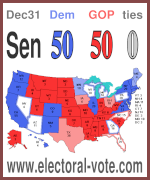
Dem pickups: AZ GA MI PA WI
GOP pickups: (None)
To Be Blunt, Roy's Out
Sen. Roy Blunt (R-MO) won three elections as a county clerk, two as Missouri's secretary of state, seven to the U.S. House of Representatives, and two to the U.S. Senate. He presumably could have remained in the Senate for the rest of his days, if he wanted to. However, at the age of 71, he's opted for retirement. And so, in something of a surprise, he announced that he will not stand for reelection next year.
In the video the Senator used to announce that he was stepping down, he did not directly explain why he's had enough. However, he did lead with some commentary on how nice it is to "get things done." Since he is an old-school, you-scratch-my-back-and-I'll-scratch-yours type of senator, he's presumably weary of gridlock and not too happy with the direction his party has taken under Donald Trump. And if he, as the Chair of the Senate Republican Policy Committee, and thus the #4 Republican in the Senate, is frustrated with spinning his wheels, one can only imagine how some of the less senior senators feel.
This will set off a feeding frenzy on the Republican side of the contest. Here are five potential candidates:
- Eric Greitens: The former governor of Missouri was forced to resign in disgrace in 2018,
after revelations of an extramarital affair, coupled with allegations of violent behavior, along with alleged blackmail
threats by Greitens against his paramour involving intimate photographs he had taken of her. He now wants to resume his
political career, and is positioning himself to be the Trumpiest of Trumpy candidates.
- Secretary of State Jay Ashcroft: He's the son of former governor, U.S. Senator and AG John
Ashcroft, which is presumably helpful, though note that the senior Ashcroft was unpopular enough that he lost his last
statewide election in Missouri to a dead person. In other words, we're not exactly talking a Brown running in California
or a LaFollette running in Wisconsin. Jay Ashcroft's signature issue is strict voter ID laws. Like Greitens, he would
run a Trumpy campaign.
- Lt. Gov. Mike Kehoe: Kehoe is close with the Blunt family, would be one of the favorites
to claim the Senator's endorsement, and would run as a more "traditional" Republican.
- Rep. Ann Wagner: She served as Ambassador to Luxembourg—which is about as much of a
sinecure as the federal government has to offer—during George W. Bush's second term. After all, nobody's ever
said: "We have just half an hour to prevent an international crisis—get the Luxembourger government on the phone
NOW!" Put another way, Wagner's a good fundraiser, and she earned a "thank you" from W. She has served as co-chair of
the RNC and chair of the Missouri GOP, and has represented her state in the U.S. House of Representatives since 2013.
Wagner, like Kehoe, is close with the Blunt family and would be one of the favorites to claim his endorsement. She would
also run as a more "traditional" Republican.
- Carl Edwards: Southerners do have something of a habit of electing sporting figures to office, and NASCAR driver Edwards is pretty popular. He's made noise about running for office before, and nearly ran for a U.S. Senate seat back in 2018. He's registered as a Republican, but worked on health and nutrition issues under the Obama administration, so who knows where his politics are?
What we have brewing here, not surprisingly, is a Trump vs. "traditional" Republican race, and one that is likely to get pretty ugly.
Meanwhile, the Democratic bench in Missouri is not empty, even though Jason Kander (who lost a close election to Blunt in 2016) and former senator Claire McCaskill have already reiterated that they are not running, even with the seat open. Anyhow, here are some potential Democratic candidates:
- State Sen. Scott Sifton: Sifton was the only serious candidate to enter the race
before Blunt announced his retirement. He served 2 years in the Missouri House and 8 in the Missouri Senate,
wresting the latter seat away from a Republican incumbent, before retiring to focus on his U.S. Senate run. During his
time in office, he fought abortion restrictions and right-to-work laws; before that he was a prosecutor who went after
drug dealers and corrupt public officials.
- State Auditor Nicole Galloway: She is currently the only Democrat serving in statewide
office in Missouri. Although she said she was not interested in running for the U.S. Senate, and endorsed Sifton, that
was before Blunt said he was retiring. Things can change in those circumstances, and Galloway noticeably did not
reiterate her lack of interest on Monday the way that Kander and McCaskill did. She won election to her current job as a
strongly pro-business Democrat.
- Chris Koster: Koster was the Missouri AG from 2009-17 before leaving office for the
private sector, which means he's won statewide election in Missouri twice. He's a centrist; in fact, until 2007 he was a
Republican. He does have some skeletons in his closet; his then-wife may have subverted campaign finance laws in 2008,
and he was credibly accused of giving favorable treatment to his campaign donors as AG.
- Kansas City Mayor Quinton Lucas: Lucas has been in office only since 2019, though two
years' political experience is more than current senators Tommy Tuberville, Raphael Warnock, and Jon Ossoff, among
others, had on taking office. He crushed his opponent in the mayoral election, winning 60% of the vote (it should be
noted that due to the jungle primary-style of election, his opponent was also a Democrat). He's young (36), dynamic, and
Black, and is likely to attract the interest of progressive Democrats. He's also known for his fanatical devotion to
Kansas City sports teams, which is undoubtedly a selling point in Missouri. Finally, Lucas has something of a compelling
connection to one of the key issues of the day; he nearly was not allowed to vote in last year's election because a poll
worker incorrectly input his name as "Lucas Quinton."
- Rep. Cori Bush: She is also young (44), dynamic, and Black, and just unseated 10-term congressman Lacy Clay. It would seem that four-letter names are a must if you want to run in that district. She is an outspoken progressive and a card-carrying member of the Democratic Socialists of America, and supports a $15/hour minimum wage, Medicare for All, police reform, and the Boycott, Divestment and Sanctions movement (in other words, she's critical of Israel). She also has a compelling personal story, having been homeless for a period of time after her divorce.
As with the Republican side, it's possible to see the outlines of a future internecine struggle, in this case between the centrist and progressive wings of the Democratic Party. That said, the two most obvious progressive candidates (Lucas and Bush) are quite early in their political careers, and might be persuaded to sit this one out, especially since it's hard to see how they can be successful statewide. Bush, in particular, might be hesitant to give up a hard-won House seat for a tiny chance at moving up. Of course, her campaign signs could just say "Bring Back American Greatness--vote for BUSH" and some low-information voters might think she was married to someone in that other Bush clan. It's also worth noting that Senate Majority Leader Chuck Schumer (D-NY) and DSCC Chair Gary Peters (D-MI) are going to put the full-court-press on McCaskill and Kander, so either of them could jump back in and (probably) clear out the field.
Of course, the question that is on the minds of everyone—Democrat and Republican—is whether the blue team can actually win this thing. On one hand, Donald Trump won the state by 19 points in 2016 and by 14 in 2020. On the other hand, in the last three U.S. Senate elections in Missouri, the Democrat won by 16 points (McCaskill over Todd Akin in 2012), lost by 3 points (Blunt over Kander in 2016), and lost by 5 points (Sen. Josh Hawley, R-MO, over McCaskill in 2018).
The Democrats' chances almost certainly rest on two things. The first is that Trump will not be on the ballot in 2022, and so some chunk of his voters might just stay home. The second is that if the Republicans get a lousy candidate (like Greitens) and the Democrats get a strong one (like Galloway), the blue team might just pull off the upset. Recall a similar dynamic in the 2017 Alabama Senate race (Doug Jones defeated Roy Moore), the 2018 Kansas gubernatorial race (Laura Kelly defeated Kris Kobach), and the 2019 Kentucky gubernatorial race (Andy Beshear defeated Matt Bevin), all of them waged without Trump on the ballot. Note also that two of those three states border Missouri, and the third comes within 150 miles of doing so. (Z)
Senate Retirements Complicate Things for the GOP
Roy Blunt is the fifth Republican senator to announce their retirement this cycle. Here are the four others:
- Richard Burr (NC)
- Rob Portman (OH)
- Richard Shelby (AL)
- Pat Toomey (PA)
It is unusual, to say the least, to have so many retirements so early in the cycle. And there may be more; Chuck Grassley (R-IA) will be 89 on Election Day, and Ron Johnson (R-WI) promised to retire after two terms (though he's a slippery character, so the odds are he will change his mind). Incidentally, no Democrats have announced their retirements so far, and the only one who is likely to do so—Pat Leahy of Vermont—is from a very blue state.
There's no sugar-coating it; this is bad news for the Republicans, for at least three reasons:
- Playing defense: If all five of these men remained in the Senate, then the Republicans
could reasonably expect to hold four of five seats, and maybe all five. Now, they are more likely than not to lose
Pennsylvania, and the odds are that they lose at least one of the other four. If Iowa, and in particular Wisconsin, come
open, then the loss of three seats is well within the realm of possibility.
The Republicans' only plausible flips are Nevada, New Hampshire, Georgia, and Arizona. The red team needs to win at least one of those to retake the Senate, plus an additional seat for every seat they lose. If the GOP surrenders one seat, then they would need two pickups, which is a tall order. If they surrender two, then it's all over, and Chuck Schumer gets to keep his job for another two years. There is no chance of them defeating three incumbents, especially given that incumbents win at better than a 90% clip. In addition, defending those seats—even if successful—will burn resources that the Party would rather spend elsewhere (like defending the seats of Sens. Marco Rubio, R-FL, and Lisa Murkowski, R-AK). - It's Trump's party now: The specter of Trump is going to linger over the Republican Party
for a while, especially since he is maneuvering aggressively to control the purse strings (as much as is possible), and
also because he is going to engage in some score-settling (e.g., with Murkowski). If there are a bunch of Trumpy
candidates trying to out-Trump one another, who knows what they might say, to the detriment of the party nationwide? And
who knows how Trump will react if his feelings get hurt and/or his preferred candidate fails to advance from the
primary? He could tell his voters to stay home, as he did in Georgia.
Or maybe he will tell them to cast a write-in vote for someone he likes.
Meanwhile, if the Trumpy candidates win, that's only small consolation for the GOP pooh-bahs. With the exception of Shelby (and Johnson, if he joins the list), all of the senators who are jumping ship are loyal party men who take direction from Senate Minority Leader Mitch McConnell (R-KY). A bunch of Trumpy senators will be difficult to keep on the same page, and will pull all sorts of stunts that could work to the detriment of the Party. Imagine if, instead of one Ted Cruz (R-TX) and one Josh Hawley, there were five of each? - There is none so free as one who has nothing to lose: In the last few years, Republican senators who have announced their retirements (Jeff Flake, Bob Corker, etc.) stuck with the Trumpy line, even if they sometimes criticized it. Maybe that will happen here, as well. On the other hand, with Trump out of office, maybe folks like Burr and Blunt will decide they would like to get something done on their way out the door, and will be available votes for the (slim) Democratic majority.
It short, it's not a great time to be Mitch McConnell. Which may help explain the next item. (Z)
McConnell at Work on Succession Plan
According to news reports on Monday, Mitch McConnell is taking a keen interest in who might succeed him should he vacate his office before his term is up in 2027. Specifically, he is lobbying for a bill under consideration in the Kentucky legislature (and sure to pass) that would take the privilege of appointing a replacement senator away from the (Democratic) governor and would give that responsibility to the political party of the departed senator. The Minority Leader also has a list of suggested replacements, with Kentucky AG Daniel Cameron at the top of the list.
It's possible that McConnell is just being a diligent party man, and covering all his bases, as a fellow who is about to turn 80. Not impossible, but certainly a bit unusual. Alternatively, given all the retirements among his GOP colleagues, he may have decided that he's out of gas, or that he will be if he doesn't get the Majority Leader's gavel back after the 2022 midterms. There have also been some unexplained signs of ill health, most obviously the discolored hands from October of last year.
This could very well be much ado about nothing. However, don't be too shocked if somehow, some way, McConnell joins the list of retirees. You'll know instantly if he's thrown the towel in, due to the immediate clearing of the clouds, the shining of the sun, and the singing of the birds. (Z)
RNC Will Not Cease and Desist Using Trump's Image
This weekend, Donald Trump and his lawyers told the RNC, the NRSC, and the NRCC to stop using his name and image in their fundraising. On Monday, the RNC responded with a polite but firm "no."
In their letter to the former president, the RNC's lawyers made two points: (1) Trump gave permission to Chair Ronna Romney McDaniel to use his image, and (2) he is a public figure, and the committee "has every right to refer to public figures as it engages in core, First Amendment-protected political speech." Never mind that, since Trump is a private citizen and is no longer the key functionary of the federal government, this is more a commerce issue than a First Amendment issue.
In any case, Trump does have the weaker side of the argument, so he may drop the matter. On the other hand, his core business these days is licensing his name, and if he cannot protect his trademark he may lose it. So, he may decide he has no choice but to fight the RNC (and associated organs) on this. That means that while this is a minor squabble at the moment, it could turn nasty. We'll see. (Z)
Vance Investigation Adds Second City
Of course, Donald Trump's trademark won't be worth too much if he goes to prison. Nobody's paying big bucks for the right to open the Bernie Madoff Hotel, Rio de Janiero or the Michael Milken Golf Course and Resort, Istanbul. And on Monday, we learned that the long arm of the law has stretched itself all the way from New York to Chicago. Thanks to subpoenas that were just made public, we now know that Manhattan DA Cyrus Vance Jr. is looking carefully at the Chicago skyscraper that Trump built, and the loans he used to fund that project.
The specific issue here, apparently, is that Trump was unable to pay back a $130 million loan, plus $20 million in interest, from Fortress Investment Management. And so, to salvage what they could from the deal, Fortress agreed to forgive $105 million in exchange for an immediate payment of $45 million. That forgiven $105 million counts as income, and so should have been included on Trump's tax returns.
According to The New York Times, Trump did declare the $105 million, albeit (legally) spread across several years. However, since Vance has more of Trump's returns than The Times did, it's possible he's aware of shenanigans that the newspaper could not document. Or, it could be that Vance's interest is in something else related to the loan forgiveness. In any event, it's another reminder that this is no longer merely an investigation of a couple of payments made to Trump's former mistresses. (Z)
The Republican War on Voting Has Commenced
One would think that, if a politician or political party was going to take strong steps to curtail voting rights, they would not do so in close proximity to the anniversary of "Bloody Sunday" (again, the American one). But one would be wrong, because Republicans in three different states decided that Monday was the perfect day to move forward with their voting-restriction initiatives.
To start with, in Iowa, Gov. Kim Reynolds (R) signed into law a bill that will reduce early voting days from 29 to 20 and will require polling places to close an hour earlier on Election Day (8:00 p.m. rather than 9:00 p.m.). The bill also forbids public officials from sending out absentee ballots unless they are specifically requested, and requires that absentee ballots be returned before polls close on Election Day.
Meanwhile, in Georgia, the state Senate approved SB 241, which significantly dials back absentee voting. Instead of the no-excuse absentee ballots that were available in 2020 (and 2021), voters will now have to be 65 years old or older, or absent from their precinct, or observing a religious holiday, or required to provide constant care for someone with a physical disability, or required to work as a front-line worker, in order to qualify for an absentee ballot. The bill also requires ID in order to request an absentee ballot and creates a hotline for people to report absentee ballot fraud. SB 241 now heads to Gov. Brian Kemp (R-GA) for his signature, which he is expected to append.
And finally, in Florida, Gov. Ron DeSantis (R-FL) announced several initiatives along these lines that he will try to get passed by the state legislature (which will certainly assent, since it is Republican-controlled). As in Iowa, DeSantis' proposed legislation would bar officials from sending out unsolicited absentee ballots. It would also require absentee voters to renew their requests every year. And it would significantly reduce the number of drop boxes for ballot collection.
In short, Republicans have decided that their problem in 2020 was high turnout. They are almost certainly wrong about that. Recall that the Party actually overperformed expectations in terms of the House, the Senate, and state legislatures. The only place they did poorly was at the very top of the ballot, which suggests that the actual problem was a stinker of a presidential candidate. And a new study from Stanford University seconds this. They looked at states that had no-excuse absentee balloting and states that did not, and found no meaningful difference in turnout rates. They also looked at 65-year-olds in Texas (able to vote absentee) and 64-year-olds (not able), and found the same thing. Their conclusion:
[T]he increase in Democratic absentee voting was offset by decreases in Democratic in-person voting...the results suggest that no-excuse absentee voting mobilized relatively few voters and had at most a muted partisan effect despite the historic pandemic. Voter interest appears to be far more important in driving turnout.
In other words, the Republicans shouldn't be focused on suppressing turnout, they should be focused on figuring out why 80 million people were highly motivated to cast a vote against the GOP presidential candidate. However, the modern GOP doesn't tend to be interested in introspection, or in listening to what pointy-headed academics have to say. So, they'll just go with what their gut tells them to do. (Z)
Biden Kinda, Sorta Wants to Keep the Filibuster
On Sunday, Sen. Joe Manchin (D-WV) did the tour of Sunday morning news programs and said he'd really prefer to keep the filibuster in place, though he's open to weakening it if that becomes necessary. As The Washington Post's Paul Waldman points out, it sure looks like the Senator is playing the long game here. By rebelling against his party on some high-profile issues (like the minimum wage) and "fighting" to save the filibuster, the Senator sets himself up to "surrender" and to be dragged, kicking and screaming, into weakening the filibuster. "It was the only option left, I'm afraid," is what he will say.
Joe Biden likes that game, and so he decided to join in on Monday. Asked about the filibuster, White House Press secretary Jen Psaki said: "The President's preference is not to get rid of the filibuster." She even pointed out that the COVID-19 relief package is going to be passed without changing the filibuster rules, conveniently "forgetting" that the only reason that is true is because a previous Senate already changed the filibuster rules to allow for reconciliation.
The careful reader will notice several things about the White House's statement on the matter:
- Saying "my preference is" falls rather short of the Full Sherman. In fact, it's about as flimsy as is possible while
still technically remaining in opposition. If Biden really wanted the filibuster to stay intact, the statement would be:
"The President absolutely opposes any change to the filibuster, no matter what."
- It's not Biden who is actually speaking here, it's Psaki, which softens things even more.
- Inasmuch as Biden is no longer a sitting senator, he doesn't actually have a vote here.
It is clear that, like Manchin, Biden is setting himself up to "reluctantly" support changing the filibuster. Actually, he doesn't even have to go that far. Manchin, of course, would eventually have to cast a vote on the matter. Biden can maintain his "opposition" to changing the rules and then, if they are changed, can claim that he certainly would not have changed things if he were still in the Senate, but it is up to the Senate to make its own rules and he doesn't have any say in that as a member of the Executive Branch.
We've seen this basic song and dance from Biden before, perhaps most obviously centered on the issue of gay marriage during the Obama years. During Obama's reelection campaign, he was polling poorly with progressives at the same time that support for gay marriage had grown to be a supermajority position among Democrats. And so, Biden went on the Sunday morning news shows and "accidentally" revealed that Obama's position on gay marriage was "evolving." And that Monday, Obama "admitted" that Biden had let the cat out of the bag, and that he (Obama) was now a supporter of legalizing gay marriage. Several years later, Obama adviser David Axelrod confirmed what politics-watchers suspected all along: Obama was always pro-gay marriage, and his "conversion" was a carefully staged kabuki play designed to make his change of course more palatable to voters.
The main audience for Manchin's and Biden's performances, right now, is actually Mitch McConnell and his Republican colleagues in the Senate. McConnell is very good at reading between the lines, and he is now on notice that if he and his conference continue with their obstructionist ways, the filibuster could be partly or wholly on the chopping block. What they do with that implicit threat will dictate how Manchin and Biden proceed. (Z)
Previous | Next
Main page for smartphones
Main page for tablets and computers