Previous | Next | Senate page
New polls: (None)
Dem pickups: AZ GA MI PA WI
GOP pickups: (None)
Republicans Are about to Replace a Conservative Leader with a Moderate
Until yesterday, House Minority Leader Kevin McCarthy (R-CA) had merely hinted that he wanted to dump Rep. Liz Cheney (R-WY) from the House Republican leadership. Yesterday, he made it official by telling Fox News' Maria Bartiromo that yes, he supports replacing Cheney with Rep. Elise Stefanik (R-NY). With his blessing now out in the open, Cheney is now officially dead meat. This reveals a great deal about the true state of the Republican Party.
To start with, Cheney is a true conservative. She has a 78% lifetime rating from the American Conservative Union. Stefanik's rating is 44%. The conservative Heritage Action Group gives Cheney 80% and Stefanik 48%. The conservative FreedomWorks gives Stefanik a score of only 37%. The liberal Americans for Democratic Action gave Cheney a 5% rating in 2019 and Stefanik 20%. So the replacement removes a staunch conservative and replaces her with a wishy-washy moderate.
What about Trumpiness? Cheney voted on bills that Trump wanted 93% of the time. Stefanik voted with Trump only 78% of the time. Among other things:
- At Harvard, Stefanik was an active moderate Republican, like many former Northeast Republicans
- In 2012, she was a top campaign adviser for vice presidential candidate Paul Ryan
- In Congress in 2016, she vocally opposed Trump's positions on Vladimir Putin, NATO, and Iraq
- She opposed Trump's withdrawal from the Paris Climate Accord
- She supported Robert Mueller's investigation into whether Russia helped elect Trump in 2016
- Stefanik voted against the 2017 tax cut bill
- In 2017 she introduced a resolution demanding action on climate change
- She opposed Trump's Muslim ban
- She didn't think Trump's border wall was realistic
- She blasted his comment about immigrants from "sh**hole countries"
On account of all these things, not all Republicans want to trade in Cheney for Stefanik. Groups that support conservative policy issues are the least likely to support the swap. The conservative Club for Growth is no fan of Stefanik. Its spokesman tweeted: "Elise Stefanik is NOT a good spokesperson for the House Republican Conference. She is a liberal with a 35% CFGF lifetime rating, 4th worst in the House GOP. House Republicans should find a conservative to lead messaging and win back the House Majority." The National Review had an editorial entitled: "Liz Cheney is Not the Problem."
Stefanik apparently noticed that she was not uniformly popular among Republicans and that she was simply a prop needed to provide cover in order to dump Cheney, per Dear Leader's orders. This put her in an awkward position, so she privately told her colleagues that she will serve only until Jan. 2023. So much for all the stories calling her a rising star in the GOP firmament. Sometime around the first impeachment in Nov. 2019, Stefanik decided to switch sides and support Trump strongly, which made her a star in Trumpworld. Such a switch was clearly a calculated move and such a break from what she had previously said and done made it clear she was faking it. This move may have fooled Trump and some pundits, but it didn't fool the people who know her.
This whole affair makes it clear that when the GOP is faced with a choice between:
- A lifetime conservative who believes that Biden won the election
- A moderate Republican who is willing to say Trump won in order to gain power (even if she actually knows better)
they will go with the latter. If you don't support Donald Trump's lie that he won the election, you are basically no longer welcome in the Republican Party, no matter how conservative you are and have always been. All that matters is worshiping Trump. We don't know how this will look by 2024, but we do see the parallels with Johann Faust, and things didn't come up roses for him in the end. (V)
Biden Will Settle for a Corporate Tax Rate of 25%
Sen. Joe Manchin said he was willing to support Joe Biden's infrastructure bill if it was fully paid for, but he was not on board with a corporate tax increase to more than 25%. What Joe (M.) wants, Joe (M.) gets. So now Biden has agreed to a rate of 25%. Of course, the shortfall has to be made up somewhere else. Biden didn't say where that would be.
If the rate is indeed set to 25%, all Republicans will oppose it, even though it is a huge win for them. It used to be 35%. Then they dropped it to 21%. If Biden pushes it back up to 25%, the net effect of the Trump and Biden administrations combined will be a 10% cut in the rate. That can't be seen as anything but a big win for the Republicans. After all, the Democrats could have put it back to 35% (or higher), but they don't have the votes.
There are plenty of other ways to raise enough money to fill the gap in Biden's plan. One constraint, however, is his promise not to raise taxes on people making under $400,000/year. Still, increasing the capital gains rate on millionaires, a higher estate tax on large estates, a stock-transfer tax, and other tools are available to raise money and still keep his promise. Before making a choice, Biden is surely going to ask folks at the OMB to crunch some numbers. (V)
Greene and Gaetz Begin "America First" Tour
Two of the most embattled House Republicans, Reps. Matt Gaetz (R-FL) and Marjorie Taylor Greene (R-GA), are not going gentle into that good night. They are doing the exact opposite: starting on an "America First" tour to demonstrate their Trumpiness. At the very least, it is a distraction from their other issues. Gaetz has been accused of transporting a minor across state lines for the purpose of engaging in sexual activity with her. This is a federal crime. Greene was stripped of her committee assignments for her racism and anti-Semitism.
On Friday, the pair appeared together at The Villages, a conservative retirement community north of Orlando. There Gaetz said: "Today, we send a strong message to the weak establishment in both parties: America First isn't going away. We're going on tour." They plan on attacking RINOs, which in their world means Republicans who do not worship Donald Trump. Gaetz also whined that there is no due process for conservatives. Of course, if he is formally charged with a crime, he will get all the due process he wants in court. So far, that hasn't happened, though.
Greene did her part, too. She asked the crowd if they thought Joe Biden actually won the election, which they answered with a resounding "no." She also attacked RINOs. The pair didn't say where their next stop would be. (V)
Texas House Passes Bill That Restricts Voting
Texas Republicans' effort to make voting more difficult is making progress. The Texas House has now passed S.B. 7, a modified version of its original bill, H.B. 6. Some of the changes the Texas House added make it slightly less restrictive, such as changes to the times of early voting and the lack of a ban on drive-through voting. However, the bill now goes back to the state Senate, which could tighten it up again.
One hot issue is what partisan poll watchers may and may not do. Historically, Republicans have used poll watchers to intimidate Black voters, so the exact wording here is important. One provision that everyone is watching is how far could a poll watcher go before being ejected from the polling place. The current version says that election judges can call law enforcement to remove a poll watcher who commits a "breach of peace." So a poll watcher who quietly and gently scares the hell out of a voter (perhaps by just quietly pointing to his not-very-well-concealed gun) can probably get away with it. And even if a poll watcher goes beyond that, if an election judge calls the police and no one comes, the poll watcher will probably get to stay.
Democrats are wildly against the bill, saying it serves no purpose other than to make it easier for Republicans to intimidate minorities. They aren't the only ones, though. Several corporations with large operations in Texas, including American Airlines, Microsoft, Dell, and Unilever, have vocally opposed the bill. In fact, a group of 50 companies sent the legislature a letter asking it to uphold democracy and equality. However, top Republican politicians, including Sen. Ted Cruz (R-TX), have told the companies to shut up. Initially they wanted to include language in the bill to penalize companies that speak up, but that didn't make it into the current bill. Probably somebody in the legislature realized that while those companies have office space in Austin, they don't have a lot of factories there and moving to, say, Atlanta or Charlotte would still give them an operation in the South and attract employees as well as Austin does. (V)
The States Are the Laboratories of Democracy
Or so it has been said. Curious what will happen if the Republicans get full control of the federal government sometime soon? Look at the states where they already have full control:
- Idaho: The last time the Democrats controlled even one chamber of the Idaho legislature
was 1959. Today the Republicans have supermajorities in both chambers and all the statewide officials, too. Gov. Brad
Little (R) has imposed some minor restrictions due to COVID-19 (but nothing like a mask mandate), so state Rep.
Heather Scott (R) has called him "Governor Little Hitler" and the legislature is trying to override even the minor
restrictions Little imposed. While Scott was at it, she opposed Idaho students reading To Kill a Mockingbird as an
example of racial indoctrination. The legislature also opposed the governor's attempt to raise teachers' salaries, which
are especially low in Idaho, because that would only encourage the teachers' union. The legislature also passed a law
limiting voter initiatives, even though that right is included in the state Constitution. Lt. Gov. Janice McGeachim
(R) created a task force "to protect our young people from the scourge of critical race theory, socialism, communism,
and Marxism," which she apparently believes are running rampant in Idaho schools. Idaho conservatism is characterized by
conspiracy theories, science denial, disdain for education, and a punitive social issue agenda.
- Kansas: The governor of Kansas is a Democrat because her 2018 opponent, Kris Kobach (R),
was too much, even for a state that has never given Democrats control of its state Senate in its entire history. But
Republicans have supermajorities in both chambers of the legislature, so they can rule with impunity from there. Among
other bills the legislature passed are ones (1) giving everyone the right to carry a concealed weapon, (2) banning trans
girls from high school sports, (3) restricting voting, (4) creating "Don't tread on me" license plates, and (5)
requiring all students to take a U.S. civics course, even though the design of the curriculum is (by law) up to the
state education board. The legislature has also opposed the governor on COVID-19-related measures and failed to fund
K-12 schools in the upcoming school year.
- Montana: Historically, Republicans have rarely held full control in Montana, but they
have that now. The legislature's top priority seems to be a bill endorsing religious freedom, even though that is
already in the U.S. and state Constitutions. Other big issues are banning abortion and dictating how doctors treat trans
patients. Also high on the agenda is investigating the state's judges, most of whom were appointed in the 16 consecutive
years when the governor was a Democrat. Also important to the legislature was a bill giving Gov. Greg Gianforte (R)
the sole power to appoint judges, a break from the 50-year practice of having an independent commission give the
governor a list of qualified people from which to choose. The state's largest newspaper, The Billings Gazette,
recently ran an editorial saying: "Both the legislative and executive branches of our state government seem to feel
there is absolutely no limit to their power."
These states are typical for what happens when Republicans get complete power. Some go even further. The Oklahoma and Iowa legislatures have passed bills absolving motorists who "accidentally" mow down protesters of a crime, effectively legalizing manslaughter. In other words, the legislatures don't seem to be trying to solve public policy issues in a conservative way. They aren't trying to solve them at all. All they want to do is throw red meat at their base and cement their hold on power. (V)
What is the Senate's Long-Term Equilibrium?
Tip O'Neill once said that all politics is local. That is no longer true. Now all politics is national. In particular, in nearly all states, if the state votes for Republicans for president, it generally also picks two Republican senators, and vice-versa. Based on this it should be possible to determine what the Senate's equilibrium partisan composition should be.
Larry Sabato's Crystal Ball has done the math. In 2020, 23 states went for Donald Trump by at least 5 points. At the same time, 19 states went to Joe Biden by least 5 points. That leaves eight "close" states: Arizona, Florida, Georgia, Michigan, Nevada, North Carolina, Pennsylvania, and Wisconsin.
However, the Ball argues that Iowa, Ohio, Texas, Minnesota, and New Hampshire are not really locks for either party, so the score is 20 Republican states, worth 40 Republican senators and 17 Democratic states, worth 34 Democratic senators. The other 13 states are battlegroundish. If those states' 26 senators are split evenly, the Senate "should" have 53 Republicans and 47 Democrats. This is the Republicans' base advantage, because Democrats are tightly packed into a small number of states.
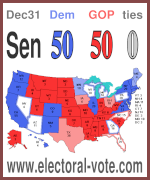
Right now the Senate is 50-50, because Sens. Jon Tester (D-MT) and Joe Manchin don't belong in the Senate according to the model, and both of the senators from the swing states of Arizona, Georgia, Michigan, and Nevada are Democrats. Republicans swept two of the battlegrounds: North Carolina and Florida.
Probably Democrats won't always be so lucky. Tester and Manchin, in particular, are living on borrowed time. If they are replaced by Republicans, the GOP will have a 52-48 advantage, only one off from the "theoretical" value it should have.
This calculation has implications for the filibuster. If Democrats are destined to be in the minority long term, they should want to keep the filibuster so they can block Republican bills. On the other hand, Democrats may believe that some of the bills they could pass if they got rid of the filibuster are so important that it's worth giving up future leverage.
However, one bill the Democrats want would change the equation: H.R. 51. If this were to pass, D.C. would almost certainly get two Democratic senators, so the new equilibrium would be 53 Republicans and 49 Democrats. That would mean the Democrats need poach only two Republican seats to get to a tie, which a Democratic vice president could break in their favor. Of course, candidates matter somewhat and the demographics of states like Arizona, North Carolina, and Georgia are changing. If they become blue states, then the long-term equilibrium would favor the Democrats, in which case they should favor getting rid of the filibuster (or make it painful) now that they have a chance. (V)
Democrats Are Agonizing Over Florida Senate Candidate
Democrats would love to beat Sen. Marco Rubio (R-FL) in 2022, but beating a popular incumbent would be tough—even if they were unified, which they are not. The problem, as usual, is that moderates and progressives don't agree on which kind of candidate would be strongest. Moderates are largely backing Rep. Stephanie Murphy (D-FL) (née Đặng Thị Ngọc Dung), who fled Communist Vietnam as a child. She won her seat by knocking off a 12-term Republican incumbent in FL-07, which has a PVI of EVEN. It covers parts of Orlando and the northeast suburbs going as far as Daytona Beach.
Progressives favor Aramis Ayala, a Black former state attorney. Ayala once had a run-in with then-governor Rick Scott over the death penalty, which is a pretty good qualification for many progressives. Like Murphy, she is also from Central Florida.
As usual, the issue is whether to pick a moderate, who might get Republican and independent votes, or a progressive, who will repel them but might energize young people. One factor that could play a role is that 29% of Florida Democrats are Black. Democrats are well aware that it was Georgia's Black voters who sent Sen. Raphael Warnock (D-GA) to victory in January. On the other hand, young Black progressive Andrew Gillum (D) failed to win his race for the Florida governor's mansion in 2018. And neither a Vietnamese woman nor a Black one is going to have special powers with the state's large Latino population. Other candidates are also eyeing the race, but these two are currently viewed as the strongest.
Former representative Alan Grayson might also enter the race, but he ran for the Senate in 2016 and was drubbed in the Democratic primary after accusations of domestic violence surfaced. Needless to say, if he challenged the two women, those accusations would be front and center in the 2022 primary.
In recent years, Democrats have done reasonably well in Florida senatorial races. Bill Nelson served three terms until Sen. Rick Scott (R-FL) knocked him off in 2018. Bob Graham won the other seat three times, but retired in 2004. Of course, against an incumbent Rubio, who has a strong base in South Florida and with Latinos statewide, any Democrat will be an underdog. (V)
Previous | Next
Main page for smartphones
Main page for tablets and computers