
Dem
47

GOP
53

Of course, the advantage the Republicans gain from mid-decade map redraws could possibly be canceled out by Democratic counter-maneuvers. Once Greg Abbott and other red-state governors started bandying about plans to squeeze their state maps, several blue-state governors responded in kind. That includes the governors of New York and New Jersey. In addition, House Minority Leader Hakeem Jeffries (D-NY) and the DCCC are trying to persuade Minnesota and Washington to get in on the shenanigans, as well.
But the loudest blue-state talk about redrawing district maps is coming from Gov. Gavin Newsom (D-CA). Currently, California has an independent commission that draws the maps. But Newsom has options. The first of those is to call the legislature back into session to write an initiative to abolish the commission and to hand redistricting power back to the legislature. Then he could call a special election to vote on the initiative, and rally voters around the notion that Texas is trying to rig the election, so California should fight back. There is a decent chance it would pass. Then the Calimanderers would get to work drawing a new map before the filing deadline next year.
The alternative option involves a shorter timeline—and time is of the essence here—and would be a bit less radical. Newsom could call a special election for November, but instead of voting to get rid of the independent commission, Californians would vote only to get rid of the current maps, and to replace them with "better" maps from 2026 through the next census and redraw (in other words, the state would go back to independent-commission-drawn maps in 2032). This looks to be the option that Newsom prefers. First, because it means the process of drawing and approving new maps would end in November, as opposed to just starting in November (or, more likely, December or next January). Second, because the people of California favored an independent redistricting commission for a reason, and might not be too happy to see it go the way of the dodo. Framing this as a temporary move, to combat Trumpism, is more salable—you know, "desperate times call for desperate measures," and all that.
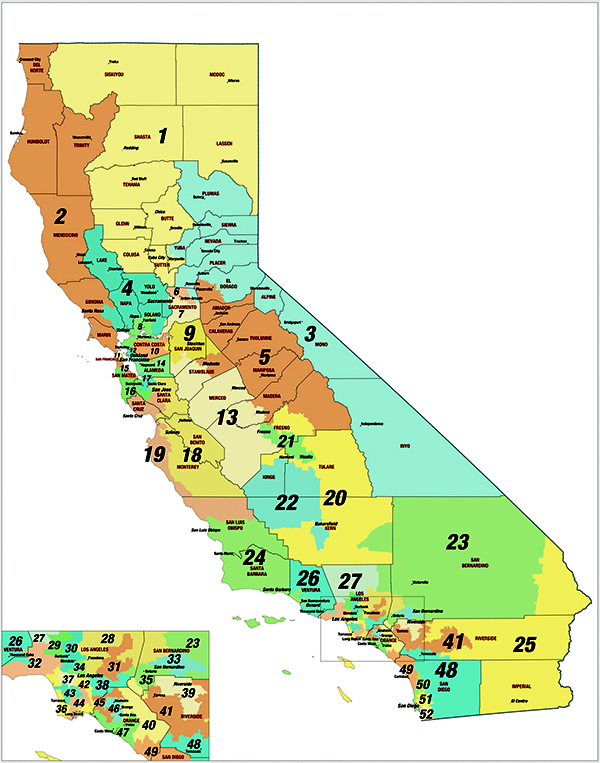
Here is the lay of the land for California's 52 House districts. The list of districts on the left is colored by who occupies the seat, not the PVI. The district map on the right below shows that the independent commission tried to keep counties together where possible, but sometimes that is not possible because districts must be close to equal in population:
|
|
This is a target-rich environment for the legislature. Four Republican seats, those occupied by Reps. Kevin Kiley, Ken Calvert, Young Kim, and David Valadao, could easily be made harder for the incumbents to hold by stuffing more Democrats in their districts. California has plenty of those. For example, David Valadao's R+1 CA-22 district could be made bluer by shedding some Republicans into Vincent Fong's R+15 CA-22 district on the east, and borrowing an equal number of Democrats from Salud Carbajal's D+13 CA-24 district on the west.
In addition, the three D+1 districts could be made bluer to protect the Democratic incumbents. With a bit of map-making skill, the legislature could pick up as many as four seats and protect three more. OK, that would result in strange-looking districts, but no stranger than some of the ones on the Texas map. If you want to try your hand at gerrymandering yourself, Dave's redistricting app is the tool for you.
When it comes to the war of the gerrymanders, it is generally accurate to say that the biggest obstacle the blue states face is political and legal, since the would-be gerrymanders are generally not legal under current state law, or are not acceptable to some Democratic state officials whose support would be necessary. The biggest obstacle the red states face is logistical; it's hard to gerrymander maps six-and-a-quarter ways to Sunday when they've already been gerrymandered six ways to Sunday. And both groups of states have the problem that if they guess wrong about their margins of error, they could end up giving away more seats than they gain. In other words, dummymander time. (V & Z)