
Dem
47

GOP
53

Good government groups like Common Cause have always supported, well, good government, including things like independent commissions to draw districts. The trouble is, blue states tend to go for these things and red states don't. Now even Common Cause has had it and is arguing that blue states should rejigger their maps too, to fight back against Texas and other states that are going for maximal gerrymanders now. This is a huge change of heart for Common Cause. This is akin to some anti-death penalty group saying "This crime is so horrendous that the perpetrator should not only die, but should die in the most painful possible way."
Nevertheless, Common Cause drew up some guidelines for fighting back:
It should be noted that not diluting the voice of minorities is in fact a call to use race when drawing districts—that is, a racial gerrymander, something the Supreme Court has already outlawed. We would like to have seen two other criteria. First, that districts are compact. Mathematically, that means the ratio of the perimeter to the area is as small as reasonable. For a circle of radius r, that ratio is 2/r. For a square with side s, it is 4/s. For a salamander-shaped district it is much higher. Second, counties should not be split up unless that is unavoidable. With 330 million people and 435 districts, the average district should have about 760,000 people. If a county has 600,000 people, it will be necessary to add in 160,000 people from some neighboring county. But in rural areas, putting entire counties in districts is desirable.
If the battle goes to the absolute max, it will favor the Republicans, because some blue states are already almost maxed out, like Illinois and Maryland. Squeezing another seat out there will be difficult, whereas Texas, Florida, Missouri, and Ohio can potentially each deliver one or more seats, in some cases many more. The only blue states that are treasure troves are California and New York, and the latter can't do it for 2026 but can do it for 2028 (because two sessions of the legislature have to approve). So if redistricting now becomes a thing and every state that can does it, it will probably mean a net gain for Republicans. Here is a map showing which states have trifectas. These are the states where redistricting is theoretically possible:
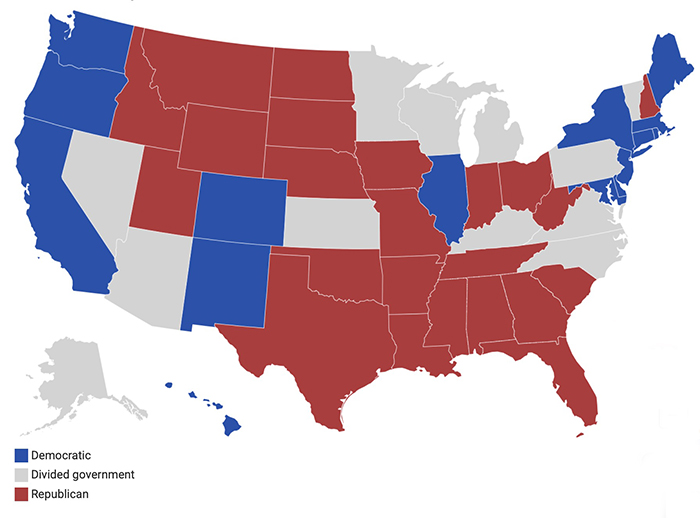
Redistricting could happen even in states where one party controls the entire House delegation. For example, Iowa has four representatives, all Republicans. Their districts are R+4, R+4, R+2, and R+15, respectively. One of them, IA-01, is R+4 but was extremely close last time. The Iowa legislature could redistrict and make them all about R+6 so none would be competitive.
Maximum redistricting would also mean that only a handful of districts will be competitive and those would be in states where neither party has the trifecta and the current map has such seats. The House could become like the Senate, where 43 states are irrelevant and all the fighting is in seven states. Only in the House, it could be 25 competitive seats and 410 seats that the other party would simply concede. Here are the competitive seats (R+5 to D+5) in states where neither party has the trifecta, so the map can't be changed right now.
| District | PVI | Incumbent |
| NC-11 | R+5 | Chuck Edwards (R) |
| PA-08 | R+4 | Rob Bresnahan (R) |
| PA-10 | R+3 | Scott Perry (R) |
| VA-01 | R+3 | Rob Wittman (R) |
| MI-10 | R+3 | John James (R) |
| WI-03 | R+3 | Derrick Van Orden (R) |
| MI-04 | R+3 | Bill Huizenga (R) |
| WI-01 | R+2 | Bryan Steil (R) |
| PA-07 | R+1 | Ryan MacKenzie (R) |
| MI-08 | R+1 | Kristen McDonald Rivet (D) |
| NC-01 | R+1 | Don Davis (D) |
| AZ-01 | R+1 | David Schweikert (R) |
| MI-07 | EVEN | Tom Barrett (R) |
| AZ-06 | EVEN | Juan Ciscomani (R) |
| VA-02 | EVEN | Jen Kiggans (R) |
| NV-03 | D+1 | Susie Lee (D) |
| PA-01 | D+1 | Brian Fitzpatrick (R) |
| NV-04 | D+2 | Steven Horsford (D) |
| KS-03 | D+2 | Sharice Davids (D) |
| VA-07 | D+2 | Eugene Vindman (D) |
| NV-01 | D+2 | Dina Titus (D) |
| PA-17 | D+3 | Chris Deluzio (D) |
| MN-02 | D+3 | Angie Craig (D) |
| MI-03 | D+4 | Hillary Scholten (D) |
| AZ-04 | D+4 | Greg Stanton (D) |
This is clearly where we are heading. One problem with it is that independents hate it, but it is hard to tell who they will blame. Democrats could campaign on: "Trump started this," but that is kind of inside baseball and might not stick. (V)