
Dem
47

GOP
53

The elections calendar is pretty bare this year, on the whole. However, there were two special elections for state legislative seats yesterday, and the news was somewhere between "good" and "really good" for the Democrats.
We will start in Iowa, where a special election in SD-01 was occasioned by the death of state Sen. Rocky De Witt (R) back in June. It's a pretty red district; in November of last year, Donald Trump won the vote there 55%-44%, while De Witt won by a very similar 55%-45% tally. So, let's say the Republicans won the district by 10.5 points. Yesterday, in the special election, Catelin Drey (D) defeated Christopher Prosch (R) 55%-44%. Obviously, that's a 21.5-point swing from last November.
Drey's victory was powered by a robust fundraising operation (she outraised Prosch $160,000 to $20,000) and a strong ground game. And once she is sworn in, there will be an immediate implication for Iowa politics, as the Republicans' two-thirds state Senate majority will be broken. By the terms of the Iowa Constitution, the appointments made by Gov. Kim Reynolds (R) have to earn the approval of two-thirds of the state Senate. So, Reynolds can no longer secure confirmations on a party-line vote.
More broadly, Drey's victory is another data point suggesting the Republicans could be in trouble next November. The usual caveat here applies, of course—special elections, especially for an area as small as a state legislative district, are wonky. So, you don't want to read TOO much into them. That said, the Democrats have been way overperforming 2024 in nearly every special election this year. That includes the previous special election for an Iowa state Senate seat, back in January, when Mike Zimmer (D) won 52%-48% over Katie Whittington (R) in SD-35. In November of last year, Trump won the same district by 21 points. So, Zimmer's victory was a 25-point swing; rather similar to the 21.5-point swing from yesterday.
The other special election yesterday, meanwhile, took place in Georgia SD-21. It was to replace state Sen. Brandon Beach (R), who resigned when he was appointed Treasurer of the United States. This election is the "tie" from this item's headline; we couldn't figure out exactly how to characterize it. Yesterday's result is that Debra Shigley (D) got 39.5% of the vote, Jason Dickerson (R) got 17.4%, Steve West (R) got 17.1%, Brian Will (R) got 10.3% and Brice Futch (R) got 8.2%. That's with "95%+ reporting," which is basically code for "we still have to count some mail-in and military ballots," so Dickerson and West could still flip places. In any event, by virtue of electoral rules that, when they were established, were actually meant to guarantee a Democratic victory, Shigley will face off on September 23 against whichever Republican ends up in second place.
It is a fool's errand to try to guess what will happen in the runoff election based on yesterday's results. There was zero question Shigley would advance, so she presumably held back on spending money, and some Democratic voters probably stayed home. That means she'll probably grow her support some. But, of course, if the Republican vote coalesces around the last man standing on that side of the contest, then the GOP will win. There's certainly no guarantee that will happen, though. Some Republican voters could stay home if "their guy" is out, or if they don't like the red teamer who advances to the runoff. For what it is worth, the two guys duking it out for second are both pretty hard-right and pretty Trumpy, though West seems to be Trumpier. He also lives, part-time, in a cabin that looks like a Bob Ross painting:

While he himself looks like Moses:
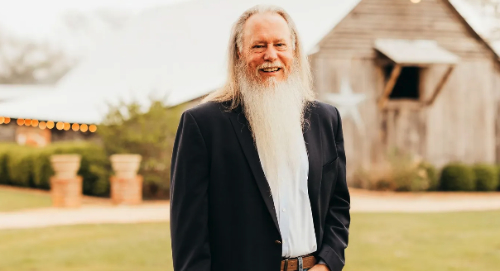
Those things are probably selling points in rural Georgia. Anyhow, Democrats are surely happy that their candidate got a large plurality of the vote, Republicans are surely happy that their party got a large majority of the vote, and beyond that, everyone gets to wait about a month to see what happens.
Georgia has a competitive Senate election next year, of course, and Iowa might have one, too, given Sen. Joni Ernst's (R-IA) severe case of foot-in-mouth disease. So, tea leaves from those states are of particular interest. If we assume that the Democrats' overperformance in special elections is not an illusion, and represents an actual shift in the electorate, then the next question is: What is the cause? The default answer is surely "A response to Donald Trump's policies, and particularly to the economic effects of his policies." That's probably some of it, though if that was the main driver, the Democrats' performance should be getting better and better, and it's actually pretty level. The other obvious explanation is that when Trump is not on the ballot, the Trumpy "swing" voters we wrote about earlier this week don't bother to show up to the polls. That seems to comport more with the available evidence. Of course, if it's Option 1, or Option 2, or both Option 1 AND Option 2, it would be very problematic for the GOP in 2026. And 2028, for that matter. (Z)