
Dem
47

GOP
53

Politico interviewed Doug Sosnik, a former adviser to Bill Clinton and now a global political analyst about the 2026 and 2028 elections. His take is that 2026 and 2028 could be quite different.
His first observation—and he is far from the only one making it—is that the most important determinant of how someone votes these days is educational level. His second observation is that most politicians are party regulars who gradually move up the ranks as time goes on, but a few are movement leaders first and politicians second. Donald Trump is a movement leader. So is Sen. Bernie Sanders (I-VT). Ronald Reagan was arguably also a movement leader.
The difference between the two is important. When people pull the lever for a regular politician, they are really expressing a preference for one of the parties. If the candidate died 3 months before the election and was replaced, all the votes would transfer smoothly to the new candidate. In contrast, votes for a movement leader don't transfer to other members of his party. If that candidate suddenly dies, his or her voters might vote for the other party or more likely not vote at all. The implication here is that try as he may, Trump will not be able to motivate all of his supporters to turn out in 2026 for Republican House candidates, because they are not actually Republicans. They are Trumpists. Presidential elections have a completely different dynamic.
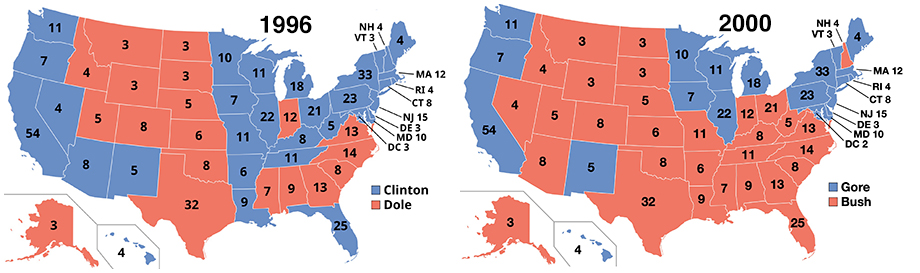
A very big difference between 2026 and 2028 is turnout. Midterm turnout is always much lower than presidential turnout. Low-information voters are barely aware what is at stake and don't bother to vote in midterms. It used to be that college-educated voters were Republicans and they showed up for midterms. Now most of the college-educated voters are Democrats, they are angry, and they will certainly show up on Nov. 3, 2026. It is not a coincidence that the most highly educated states are mostly blue and the most lowly educated states are mostly red. That wasn't always the case. As late as 1996, Arkansas, Iowa, Kentucky, Louisiana, Missouri, Ohio, Tennessee, and West Virginia were poorly educated but blue. By 2000, that had started to change, in part because Al Gore was seen as a snobby intellectual who thought the spotted owl was more important than Joe Sixpack. Joe Sixpack didn't like that so much. Now the process is essentially complete. Here are the electoral vote maps for 1996 and 2000. In 1996, the less-educated states were still blue. By 2000, that was changing:
Extensive midterm gerrymandering may flip a few House seats toward the Republicans, but the underlying dynamics—an unfavorable electorate and Trump not on the ballot—are still there. Sosnik thinks this bodes well for Democrats next year.
When asked about how the Democrats can get their mojo back in 2028, Sosnik said the party has to do three things:
The most important fact here is that 60% of the voters do not have a 4-year college degree. If Democrats write them off as ignorant racist sexist yahoos, they are lost as a party. They have to come up with an agenda that a large number of noncollege voters see as working for them. Putting together that agenda and finding a candidate who can sell it are the challenges they are facing. Note that: "Not being Donald Trump" is not on the list. (V)