
Dem
47

GOP
53

Many people are having a tough time with the current economy. Poll after poll shows that many people are struggling (and blaming Donald Trump for not lowering prices on Day 1, as he promised). It wasn't a foolish promise, since it got him elected, but on Nov. 3, 2026, he and his party may pay the price. Nevertheless, not everyone is barely keeping eggs on the table, even though they are down from $8/dozen last year. In fact, some people are doing just fine, or are at least optimistic.
According to the widely watched University of Michigan survey of consumer sentiment and data from the nonprofit Conference Board, some demographic groups are not unhappy at all with the economy. Who might these Pollyannas be? Take a look:
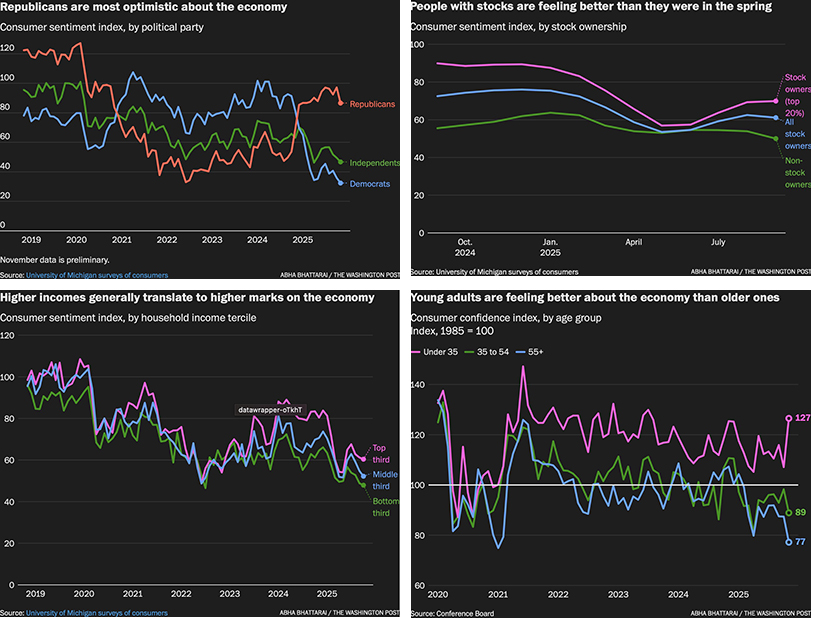
First, Republicans are much happier than Democrats. This is subject to rapid change. If a Democrat is inaugurated as president on Jan. 20, 2029, and the poll is conducted again, we predict that public opinion will switch instantly, with Republicans saying the economy sucks and Democrats praising it. It is always like this. The Black Plague of 1348 could come back and kill a third of all Americans and if a Republican is president Republicans would say the president's brilliant policies kept deaths down to only a third of the population, not half. And vice versa.
Second, people who own stocks (about 60% of adults, in some cases in 401k accounts) like how the stock market is treating them. This correlates with education and also race, since 70% of white adults own stocks vs. 53% of Black adults and 38% of Latino adults. Of course, if there is a recession and market crash, which some economists are expecting, this could flip quickly, especially for people who got into the market after the Dow Jones passed 40,000. What the stock market giveth, the stock market can taketh away.
Third, and not surprisingly, households with higher incomes are not feeling so pinched. So maybe vacation this year will be Disneyland instead of Paris, but Disneyland is also nice. People with higher incomes often have money left over every month to save or invest and if there is less of it for a while, that is not a disaster.
Finally, fourth, and very surprising, is that young people are far more optimistic than older people. This really wasn't expected. Younger people on the whole have lower-paying jobs, don't own a paid-off home, and don't have a lot in savings or stock. Yet people under 35 are far more hopeful than seniors. There is no clear explanation other than young people are often idealistic and hopeful. Also, some young people may be living with their parents and are being spared some of the brunt of rising costs, but that can't be a large fraction of the under 35s.
All in all, despite these groups, consumer sentiment is down, although the four groups together are a majority of the population. Of course, the Republicans don't really mean it when they say they are happy with the economy. Also, people with a retirement account can't spend their stock at the supermarket. Still, as always, there are almost always winners and losers in any economy. (V)