
Dem
47

GOP
53

Tip O'Neill famously said "All politics is local." Maybe then, but not now. All politics is national. One interesting way to demonstrate this is to compare the results of Senate races with presidential races in the same state. Here are scatterplots that do that. Each dot is one Senate race, with color indicating which party won it. The x-axis is the presidential margin. The y-axis is the Senate margin.
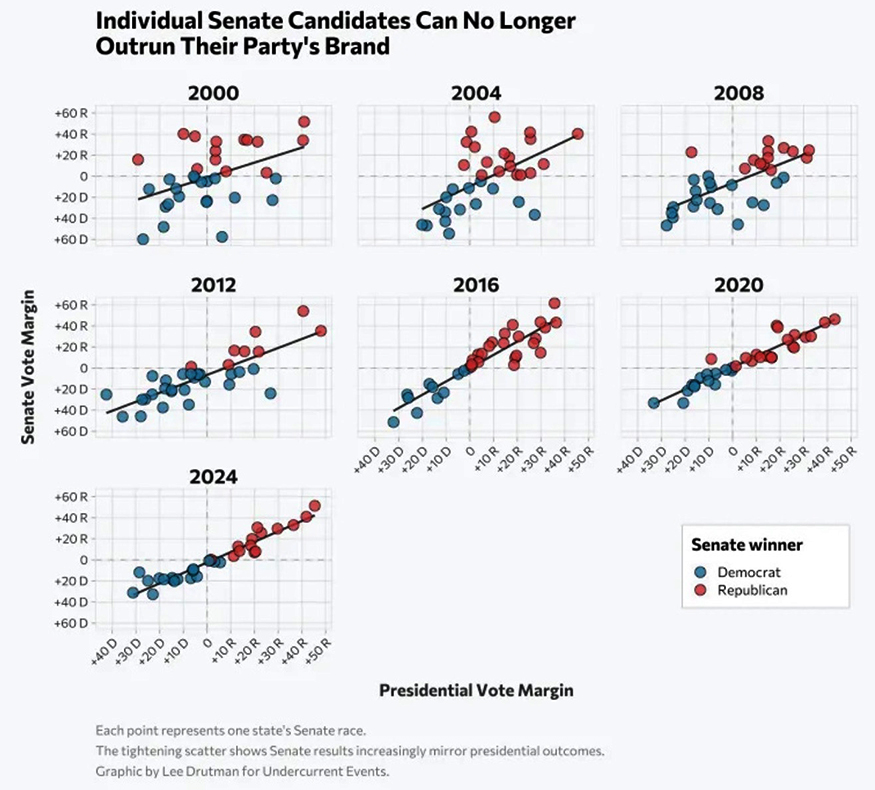
In 2000, it was all over the map. Democrats could win races in red states (blue dots in the lower-right quadrant). For example, Democrats won Senate races in Nebraska and North Dakota. Republicans could win Senate races in blue states (red dots in the upper left quadrant). For example, Republicans won Senate races in Delaware and Rhode Island. But in 2024, the correlation between Senate races and presidential races was 0.91. If the Democratic presidential candidate won a state by a margin of [X], the Democratic Senate candidate also won the state by a margin close to [X], and vice versa. Once in a while in a swing state, a truly bad candidate could underperform, but that was rare. In 2024, in 30 of the 33 Senate races (90%), the same party won both the Senate race and the electoral votes. The only exceptions were four swing states in which the presidential margin was very small and the Democrat won in a Trump state: Arizona, Nevada, Wisconsin and Michigan. In the first three, the Republican Senate candidate had a major candidate-quality problem. Only in the open-seat Michigan race did a normal Democrat beat a normal Republican in a state Trump won, and then she won by only 0.34%.
House races are just as linear as Senate races. Democrats rarely won in Trump districts and Republicans rarely won in districts Kamala Harris won.
G. Elliott Morris has the observation that asking if a candidate is moderate or progressive is the wrong question. Since the image of the Democratic Party among Republicans is frozen in amber ("all they care about are gay and trans people"), the only way for a Democrat to win in a red state is to put a lot of distance between his or her positions and the national party's.
A recent poll shows that working-class voters describe the Democrats as "woke, weak and out-of-touch." The Democratic brand is clearly suffering and changing it won't be easy or fast.
In practice, this means candidates in red states must stake out positions that are anathema to the national party. Good luck with the primary, though. What many Democrats haven't figured out is that a pro-life, pro-coal, pro-gun, pro-filibuster Democratic senator from West Virginia is still better than a Republican senator from West Virginia, since such a Democratic senator will contribute to a Democratic majority, vote for most of the nominees of a Democratic president, and vote for noncontroversial bills like the Inflation Reduction Act and the CHIPS Act. Democrats hated Joe Manchin although he voted with the Democrats much of the time. Are they better off with Sen. Jim Justice (R-WV), who votes with the Democrats 0% of the time? (V)