
Dem
47

GOP
53

We never really expected to write an item on the death of the penny, but last week, that is what we did. And now, it turns out the subject is worth writing a second item, thanks to this very interesting piece from The Atlantic's Caity Weaver, who has been on the penny beat for several years.
The main point of the piece is that America's pennies are dangerously close to being detritus. Actually, they pretty much ARE detritus. Nearly all of the pennies the Mint has created in the last decade-plus were not to replace coins that had worn out and needed to be taken out of circulation. It was to replace pennies that were removed from circulation by private citizens. Since so few people actually use pennies as a medium of exchange, they tend to just toss them in a drawer, or a change jar, or whatever. That reduced the penny supply to the point that, at least until last week, it had to be replenished.
Now that the last cents have been struck, the U.S. is left with a supply of about 300 billion pennies. Rounded to the nearest tenth of a percent, those pennies make up 0.0% of the United States' money supply (it's 0.03%, if you want the exact number). And they are involved in dangerously close to 0.0% of transactions. Most people don't use cash for most things these days, preferring either credit cards or debit cards or some form of electronic option, like Venmo or Zelle. Even among cash transactions, coins are often not involved. And even when coins are involved, pennies often are not. You cannot use them in vending machines or washing machines. You cannot generally use a bag of them to pay for your meal at McDonalds. And now, businesses are going to start rounding prices, so the pennies will be useful in even fewer contexts. Basically those machines where you put in a penny, and then pay a buck, and they crush the penny into a memento of whatever tourist attraction you are visiting. That's about it.
Obviously, those 300 billion pennies are worth $3 billion, which is a rounding error for the federal government. So, Uncle Sam doesn't really care about what happens to them. They are also not really worth recycling. Modern pennies are made mostly from zinc, which isn't terribly valuable. And the process of separating the zinc core from the copper coating is inefficient, and sucks up whatever small profit there might otherwise be.
And that is where the political angle comes in. Because the government doesn't care, the Trump administration has acted like, well, it doesn't care. The production of pennies was ceased and beyond that... businesses and private citizens are on their own to figure it out. As Weaver points out, in nearly any other country that has made this change (e.g., Canada, eh), there has been some government involvement in helping businesses and people to figure out what to do, and in publicizing why the changes make sense. When the 'Nades got rid of pennies, and started rounding to the nearest nickel, the Canadian government made it easier by promoting rounding with a public ad campaign. For American businesses, it is going to be harder, because you absolutely know there are going to be some people out there who are outraged at having to pay $9.35 instead of $9.33. And your average retail employee is not in a position to deliver a lecture on the finer points of micro-numismatics for every codgy old bastard who comes into their place of employment.
So, it's a reminder that even when the Trump administration does the right thing, it usually finds the sloppiest and most lackadaisical way to do it. It makes one nostalgic for the days of competent governance.
Incidentally, since we cannot access a big chunk of the Internet (see above), we might as well share some of the comments folks sent in response to the previous penny item:
J.S. in Phoenix, AZ, writes: You're probably getting murdered with e-mails, but you wrote: "The last time the U.S. retired a coin was in 1857."
For funsies, check out the following: (1) 2 cent coin, discontinued 1873; (2) 3 cent coin, discontinued 1889; (3) 20 cent coin, discontinued 1878 and (4) $2.50, $3, $5, $10, $20 gold coins, discontinued in 1929, 1889, 1929, 1933, 1933 respectively.
So 1857 was the last time inflation claimed a victim of a U.S. currency prior to the 1 cent/penny today, but we've definitely retired many coin denominations. And not to be pedantic, but... $1 coins of any value were not produced 1935-1971, in 1975, 1977-1978, 1982-1998, or in 2017.
Sorry... I'm a coin nerd.
J.H. in Lodi, NY, writes: Yes, the U.S. Mint halted the production of one-cent pieces on Wednesday, November 12. However, because of the separation of powers in the U.S. government, the penny is not dead. It takes an Act of Congress to abolish currency, and Congress has done no such thing with the (partly) copper coin. The penny remains legal tender. The one-cent piece will still circulate. And if there is enough pressure from penny aficionados, the U.S. Mint could decide to mint them again, or Congress could buckle to the outcries of its citizenry and tell the executive branch to use some cents.
M.S. in Canton, NY, writes: In your piece on the demise of the penny, you wondered if people would still use phrases like "a penny for your thoughts." A few days ago, I heard a radio interview in which the guest used the old expression, "I'll bet you dollars to donuts." Since earlier that day I had bought a half dozen donuts at 99 cents each, I'm thinking that's no longer quite the indicator of confidence that he was trying to convey.
Also, in the same item you mentioned that "the $2 bill is not commonly circulating." Very true, but I carry two of them in my wallet. I got them in change years ago when I paid the admission fee at Monticello—once when the fee was $3, and later when it had gone up to $8.
N.F. in Liège, Belgium , writes: There is already a relatively recent example of old sayings outliving expired currency, probably found in all the languages of the Euro Zone. For example, French retains its expressions about "francs" and especially about "sous" (old French pennies). Same for "lira" in Italian.
L.C.H. in Vancouver, BC, Canada, writes: Regarding the end of penny production, you wrote: "One interesting question... is if the old aphorisms that refer to the penny will survive..."
Canada stopped using the penny in 2012. The same aphorisms are in use as in the U.S., and I can confirm that it's often necessary to explain to our nieces and nephews born since then just what a penny is. Especially since the penny often turns up in children's books and songs like, say, a bad penny.
There was a transition period where cash registers (another near-anachronism!) weren't yet updated, so cashiers had to round to the nearest nickel themselves. Most people understood that, but occasionally there would be arguments.
J.S. in Phoenix is right; we did get inundated with e-mails on that point. We updated the item to reflect that we were just quoting the Treasurer of the United States, Brandon Beach. Another reminder that the Trump administration is not a paragon of competence. And in response to L.C.H. in Vancouver, does a Canadian argument REALLY count as an argument?
In that item, we also wrote this:
Finally, let us note that the reason that Abraham Lincoln was put on the penny, on the occasion of his 100th birthday in 1909, was to emphasize that he was the president of the common man. Now, he'll only be on the $5 bill, and George Washington will be the only president to appear on commonly circulating paper money AND coins (the $2 bill is NOT commonly circulating, and does not count). We think that the correct solution here is to boot Washington off the quarter, since that doesn't make much sense anyhow, and it's a nice pairing to just have Washington on the $1 and Lincoln on the $5.
If Washington is to be replaced by a president, we'd pick Theodore Roosevelt, who is surely the best president who has not been given his own coin (other than those presidential dollars, which every president got, even that lousy bastard Millard Fillmore). That said, it doesn't have to be a president. Benjamin Franklin was on the half-dollar for a long time, and Alexander Hamilton is on the $10. So, our actual pick for the quarter would be Rosa Parks. History does not record exactly how she paid for her bus fare on that fateful day in 1955, but fare was 15 cents, so she may well have paid with a quarter. That would be a nice parallelism with the Roosevelt dime, which was created because of his support for the March of Dimes.
We also invited readers to send in their thoughts. Here are some of those responses:
S.D.R. in Raleigh, NC, writes: In response to your question about who to put on the quarter, I have a perhaps radical suggestion: Get rid of the quarter.
In my opinion, we shouldn't have simply gotten rid of the penny, but should have actually gotten rid of the cent as a unit of currency. After all, a 2025 dime (and note that "dime" is actually a unit of currency, which is why the coin actually says "one dime" whereas the nickel says "five cents") is barely worth even half of what a 1925 cent was worth. We got by just fine without anything smaller than a cent back then, so we should be able to do fine without anything smaller than a dime today.
Pursuant to that, we would get rid of any coin whose value was not an integer amount of dimes—the penny, the nickel, and the quarter. We could just leave the existing coins and bills alone, but if we're making this big a change, I'd say it's the perfect opportunity to make money more diverse. Remove questionable figures like Jackson and Grant (admittedly, Grant's reputation is improving, but does anyone really think he's up there with Lincoln and Washington?), and add prominent Americans whose contribution came in some form other than being part of the government: protesters like Martin Luther King Jr. and Susan B. Anthony, artists like Duke Ellington and Mark Twain, and pioneers like Neil Armstrong and the Wright Brothers. The details of which person goes on which denomination are relatively unimportant, although I would suggest that as the values increase we alternate between government people and non-government people.
C.R. in St Louis, MO, writes: Getting rid of George on the quarter is approaching the problem wrong. It's nice that Washington and Lincoln are on the $1 and $5 bills respectively, but we don't need the $1 bill anymore. It's debatable if we should bother fixing our physical coinage and currency with electronic payments taking over, but if we do then we should have something like the Euro does with $1, $2, and maybe even a $5 coin. That would at least allow me to have enough coins in my pocket to buy a Big Mac meal that wouldn't require a large rattling pocket bulge. Phrase it in terms of an economic boost from all the work required to accept the new coins in machines!
There are also a lot of articles in the news concerning rounding up or down to deal with the penny disappearing. Why not have the final price with taxes be displayed like in most other countries I have visited? The prices then could all magically land on whole nickel increments. Problem solved. Let the businesses do the math before the sale.
E.S. in Providence, RI, writes: My choice for the quarter would be suffragettes Elizabeth Cady Stanton on one side and Lucretia Mott on the other.
E.L. in Dallas, TX, writes: I would put Andrew Jackson on the quarter, and simultaneously replace him (as was already decided in 2016) with Harriet Tubman on the $20 bill. Perhaps Jackson is not deserving of being on any U.S. currency, but Tubman certainly is. Tubman helped many slaves to freedom, worked as a spy for the North, led a military raid for the Union army against the Confederacy, treated soldiers as a nurse, and opened up a home to care for aged Black persons. If the American dream is truly about everyone having the "freedom" to achieve success and attain a better life, I doubt it is possible to find a better representative.
M.W. in Richmond, VA, writes: Who should be on the quarter? Nobody. Until the penny was redesigned in 1909 to honor the centennial of Lincoln's birth, the U.S. did not put real people on its coins. Portraits on coins was the sort of thing monarchs did, not republics. American coins were conceptual with Native Americans, the goddess Liberty, eagles, bison, the national shield, etc. Then the Lincoln Penny started an arm's race where politicians scrambled over each other to get their parties' various poster boys on coins.
J.K. in Portland, OR, writes: Instead, get rid of the $1 bill and go back to the dollar coin with the Native American mother and child on it. At the present time, the one dollar bill is the lowest-valued piece of paper money among comparable countries. In other places it's 5 Euros, 5 Pounds, 5 Canadian dollars, 5 Australian dollars—you get the picture. An exception is China, which pretty much does not believe in using any coins, but the trend is clear. And please no coins or paper money with still-living presidents or would-be kings.
D.G. in Carlsbad, CA, writes: I would suggest the head of the quarter be KJ Desperado, the all-time leading money earner in Quarter Horse racing history, with winnings over $2.7 million. And the tail of the quarter can be DJ Trump, the all-time leading horse's ass in our country's history.
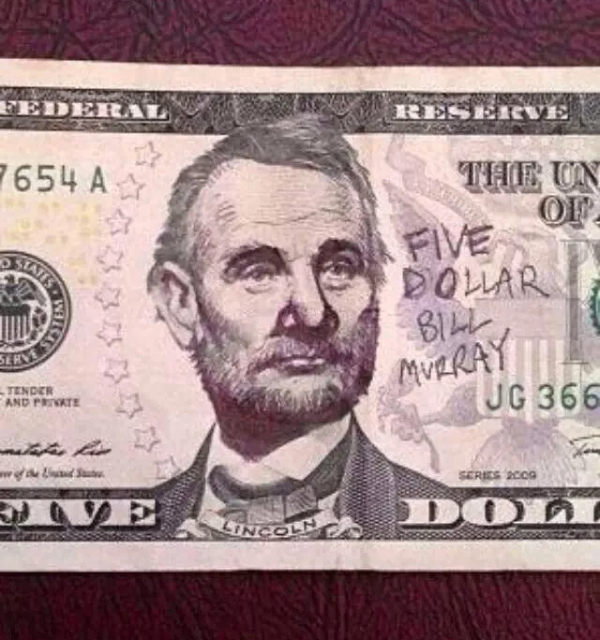
P.K. in Marshalltown, IA, writes: Replace Lincoln with this and find him the equivalent of a loonie or toonie coin, a la Canada:
S.G. in Chapel Hill, NC, writes: Put Epstein on the quarter. It will keep people talking.
We will end on that note (which is also where we began). Back to normal order tomorrow, hopefully. (Z)