
Dem
47

GOP
53

As we note above, the outcome of the Supreme Court's hearing on the Voting Rights Act could give red-state gerrymandering efforts a real shot in the arm. At the moment, however, things are not going so well for GOP gerrymandering efforts.
To start with, as we noted last week, the push to redistrict Kansas has stalled because legislators there are afraid the voters will punish them for trying to rig the election. This news is not as bad for the Republicans as it could be, since there's only one Democrat in the state's House delegation, and since they're not actually going to lose a seat—they're just not going to gain one.
Nearly the same is true in Indiana, excepting that there are two Democrats in the delegation instead of one (with one of those seats vulnerable and the other bulletproof). Donald Trump ordered the Indiana legislature to change the D+1 district of Rep. Frank Mrvan (D-IN) to make it hard for him to hold on. Indiana Republicans, having been given their marching orders, started the process there. Then, on the Friday before last, state Senate President Pro Tem Rodric Bray (R) made an announcement after taking a test vote in private. He said: "Today, I'm announcing there are not enough votes to move that idea forward, and the Senate will not reconvene in December." In January, the legislature could try again, but that seems unlikely. The period for candidates to file to run is Jan. 7 to Feb. 6. Candidates can't file if they don't know what the districts look like, so it appears Indiana won't redistrict.
And then there is Utah, where the news gets worse for the Republicans (and, thus, better for the Democrats). Judge Dianna Gibson threw out the map the Republican-controlled legislature drew at first and chose a different one. In the new map, Salt Lake County is not split up over all four districts, as in the current one. Instead, it is left together. In the precincts in the new UT-01 district, Kamala Harris would have won by 24 points. Here are the current map and the new map, side by side:
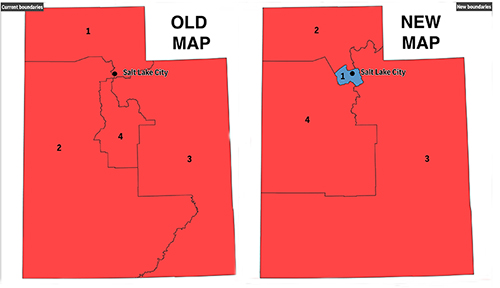
Of course, you can't beat somebody with nobody, but the Utah Democratic party has somebody. It is former Utah congressman Ben McAdams, who just announced his candidacy. He beat Mia Love (R) in what was then UT-04 in the Democratic wave of 2018, but lost in 2020. He served as mayor of Salt Lake County for 6 years, so he is very well known in the district and has a good chance of winning in such a blue district. Reportedly, if the Republicans can't find a way to be rid of the new map, then Rep. Burgess Owens (R-UT) will fall on his sword, so as to avoid an incumbent-Republican-on-incumbent-Republican primary in one of the three remaining districts (all of them red, obviously). Owens is only serving his third term in the House, but he's 74, so he can't feel too bad about retiring. In any event, in contrast to Indiana and Kansas, where the status quo will hold, the Republican setback in Utah is likely to result in the loss of a seat.
And finally, there is the big news that broke yesterday. A three-judge panel of the U.S. District Court in El Paso has issued a preliminary injunction prohibiting Texas from using the new legislative map drawn by the GOP to give itself an additional five seats in Congress. In a 2-1 ruling, the Court found that the map is racially discriminatory and that the Congressional election must be held under the 2021 map, which was drawn after the 2020 census. As if anticipating the case would be quickly appealed to the Supreme Court, the opinion, written by a Donald Trump appointee, Judge Jeffrey Brown, begins with a quote from Chief Justice John Roberts: "The way to stop discrimination on the basis of race is to stop discriminating on the basis of race." This case will put that concept to the test for the Supreme Court, to which Texas has already applied for an emergency stay.
According to the opinion, Trump initially asked Texas to redraw its map to create five additional Republican seats, but he got a cool response to the request to draw lines on purely partisan grounds. Then, on July 7, 2025, Harmeet Dhillon, Trump's former personal lawyer turned head of the Department of Justice's Civil Rights Division, got involved and told Texas that their current districts were race-based and, therefore, unconstitutional and had to be redrawn to avoid legal action. The DoJ letter targeted only non-white-majority districts, which the Court found was a race-based threat. The new 2025 map was drawn to address the DoJ's allegations and, thus, was based solely on race. In fact, in press conferences, the Governor admitted that the map was created to eliminate "coalition districts"—districts that are majority non-white but where no one race predominates—and create districts that are majority Latino.
The Court found that the DoJ letter, which was "challenging to unpack... because it contains so many factual, legal, and typographical errors," was simply wrong on the law. According to the Court, "Indeed, even attorneys employed by the Texas Attorney General—who professes to be a political ally of the Trump Administration—describe the DoJ letter as "legally unsound," "baseless," "erroneous," "ham-fisted," and "a mess." Instead, the Court ruled that the 2021 map, which contains coalition districts, passes constitutional muster and should continue to be used.
The opinion also found that there was still time before the candidate filing deadline to revert to the 2021 map and that any disruption is the Texas legislature's fault for waiting so long to redraw the map. "The Legislature—not the Court—redrew Texas's congressional map weeks before precinct-chair and candidate-filing periods opened. The State chose to 'toy with its election laws close to' the 2026 congressional election, though that is certainly its prerogative." Judge David Guaderrama, a Barack Obama appointee, joined the opinion. A dissent is to be filed later by a Ronald Reagan appointee, Judge Jerry Smith.
Needless to say, it will be very interesting to see how the Supreme Court handles Texas' appeal. The case is largely based on the Fourteenth and Fifteenth amendments prohibiting racial gerrymandering, and not so much on the Voting Rights Act. The Court's opinion came after a 9-day hearing where voluminous evidence was introduced. Of course, the Supreme Court tends to discount the facts of a case when it wants to rule a certain way and needs to do so quickly. But given that it has an important election law case already on its regular docket, it's plausible that it won't want to wade into this hornet's nest as well. Since this is just a preliminary injunction, it's also possible the Supreme Court could issue a stay on its shadow docket and claim that it's just maintaining the status quo until the case is further along. Of course, that would mean a win for Trump, since the district court would not have time to rule on the merits before the 2026 election is underway. Stay tuned.
When we heard about the ruling out of Texas, we were reminded of the old Dean Martin song "Ain't That a Kick in the Head." If the district court's ruling holds, then the net result of Gov. Greg Abbott's (R-TX) machinations will have been to gain nothing for the GOP, while also providing the impetus for California's Prop. 50, and the +5 Democratic seats it's expected to net. That would certainly be a kick in... well, some part of Abbott's anatomy. (V, L and Z)
P.S.: Yes, that is indeed the first time we have an item that three of us each wrote a part of.