
Dem
47

GOP
53

After Texas regerrymandered its congressional map in the summer, a Latino group named LULAC sued, claiming it was an illegal racial gerrymander. A three-judge federal district court last week ruled for the plaintiffs, agreeing that the map is indeed an illegal racial gerrymander and banning its use in 2026. Gov. Greg Abbott (R-TX) immediately appealed to the U.S. Supreme Court because the filing deadline is Dec. 8, and candidates need to know where the district lines are so they can file.
To the rescue rides Associate Justice Samuel Alito, who on Friday granted an administrative stay, meaning that Texas can use the new (highly gerrymandered) map until the Supreme Court has heard the case on the merits. Alito gave no indication when that might be.
Given the rapid approach of the filing deadline, if the Supreme Court delays ruling on the merits until after Dec. 8, de facto, the gerrymandered map will have to be used for 2026, although it could be voided for 2028. On the one hand, the Supreme Court should be against the new map, since it has previously ruled that racial gerrymanders are illegal and the new map is unambiguously a racial gerrymander. On the other hand, the current Supreme Court is basically an organ of the Republican Party, which wants the new map. We don't know which principle will win here.
One pro-Republican way out would be to hold that the new map is not valid, but to withhold that ruling until, say, January, or better yet, until June, so the 2026 election will be forced to use the new map, even if it can't be used in 2028. Abbott, mindful of the filing deadline, asked the Court to rule that the new map is OK by Dec. 1, but it is under no obligation to do so.
If the Court rejects the new map, that would be a huge blow to the Republican Party and Donald Trump, who asked for the new map. There are also lawsuits about the California map, but they are less likely to win because they are not racial gerrymanders—that is, they did not carve up Latino districts the way the Texas map did. Here is the current state of play:
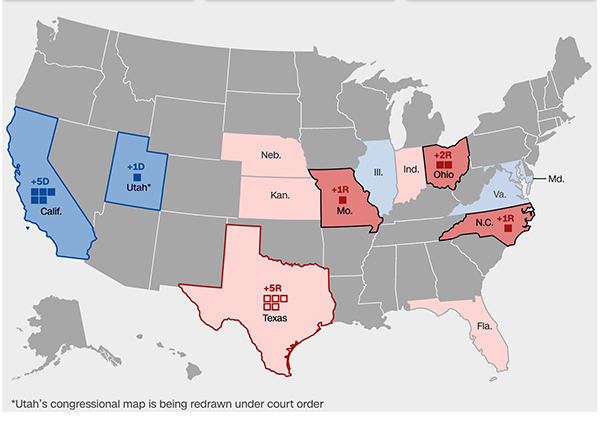
If the new Texas map survives, the net change in seats is probably R+3. If it does not, the net change is D+2. Of course, we are not done yet. Illinois, Maryland, Virginia, and Nebraska could yet change their maps. Virginia could probably net three seats for the Democrats and Illinois another two. Maryland could theoretically pick up another Democratic seat, but the map would be horrific. Nebraska could get another Republican seat. On the whole, if Virginia and Illinois draw new maps, together, that is D+5 and the whole exercise could be a wash if the Texas map holds and a net win for the Democrats if it does not. This goes to show that Donald Trump never thinks things through at all. He ordered Texas to change its map without thinking about blue states doing the same thing.
Florida is a wild card here. There are five Democrats in districts from D+2 to D+5. They are all potentially at risk if the legislature decides to go to town. So far it hasn't done anything, but the filing deadline is April 20, 2026, so it still has plenty of time. If Florida gave the Republicans five more seats, that would be a huge hit to the Democrats.
If the Democrats get the trifecta in 2028, all this monkey business might give them the backbone to genuinely do something about gerrymandering, such as requiring independent commissions along the lines of how it works in California. Or something more radical like making all representatives run statewide. (V)