
Dem
47

GOP
53

Next year will be the 6th year in which Donald Trump has been president, albeit over two nonconsecutive terms. Historically, the 6th year of an administration has been deadly in the Senate. Here are the Senate losses for the president's party in the sixth year of an administration since World War II:
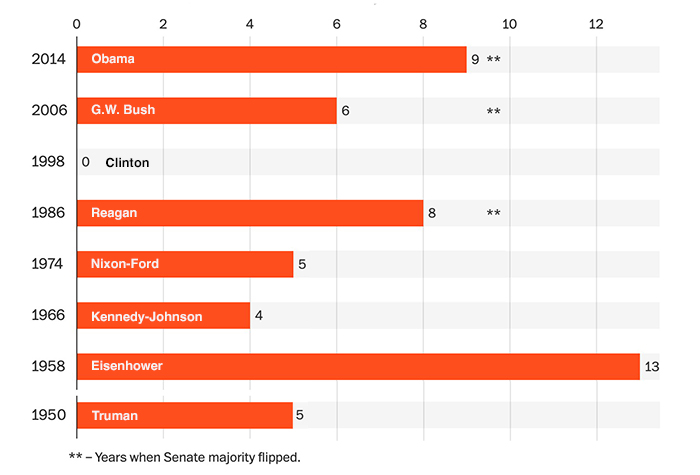
Going back 80 years, the most brutal Senate losses have been those a president suffered during the sixth year of an administration, including Kennedy-Johnson and Nixon-Ford. After 6 years, it is clear to the president's supporters that he is not going to achieve the things he promised and the opposition smells blood in the water. These factors combine for a very bad midterm. It even happened to Dwight Eisenhower, whose 8 years in office were marked by peace and prosperity and no scandals involving Ike himself, although there were a couple of minor ones involving other members of the administration. The biggest scandal involved his chief of staff, Sherman Adams, who accepted a vicuna coat (worth $900) for his wife from a Massachusetts businessman who was having issues with the FTC and SEC and wanted them to go away. A $900 gift was a Very Big Deal then. Nowadays, the president can openly accept a $400 million airplane likely stuffed to the gills with secret surveillance equipment from a foreign government and Congress doesn't say boo. How's that for inflation?
There are some parallels now with previous sixth-year elections, including corruption, an overreaching lame-duck president focusing on foreign affairs when the voters care about domestic affairs, and economic turmoil. Could Democrats pull off a big Senate win next year? History says it is possible. Here are the most likely seats to flip, ranked from easiest to hardest:
The other races are well nigh impossible for the Democrats. In addition, Democrats would have to hold their own tough seats in Georgia, Michigan, Minnesota, and New Hampshire.
There is one "interesting" scenario possible. Suppose the Democrats win the "easy" races (North Carolina and Maine) and Sherrod Brown manages to squeak by in Ohio. Then the Senate will be 50-50 and President of the Senate J.D. Vance will have something to do all day—hang around in the Senate chamber in case they need his vote. A problem here is that Sen. Lisa Murkowski (R-AK) is not at all Trumpy and would suddenly have a lot of power. She could threaten to vote with the Democrats and kill bills or nominations. Trump would go ballistic and use his weapon of first choice: threatening her with a primary. But she knows that in 2010 she lost the primary to Joe Miller, ran as a write-in candidate, and won the general election. She could also threaten Trump right back by saying she is considering becoming an independent and caucusing with the Democrats. This would turn Minority Leader Chuck Schumer (D-NY) into Majority Leader Chuck Schumer (D-NY), which would wreak havoc with all of Trump's plans.
If independent voters are in a foul mood, the election may not be so much Democrat vs. Republican, but incumbent vs. challenger. One omen is the Virginia gubernatorial election earlier this month. Gov.-elect Abigail Spanberger (D) won independents by 20 points. Four years ago, Gov. Glenn Youngkin (R-VA) won them by 9 points. Shifts of 29 points are not statistical noise.
Always important in the midterms is how popular the president is. Bill Clinton's party didn't take a drubbing in 1998 because he was personally very popular. Donald Trump is not and it could get worse. Here are some of the factors that could possibly take a toll on Trump:
KNOWN UNKNOWNSMaking predictions is always tough—especially about the future—but to the extent that history is a guide here, Democrats will probably pick up some Senate seats in 2026. The big question is whether they net four seats and take control. In January, bettors were putting the chances of Democratic control at 17%. It is now almost 30%. Democrats are at 73% on winning the House though. Here are a few other betting odds from that site.
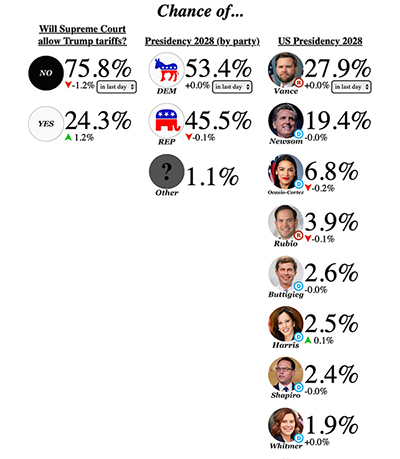
But take these with an adequate amount of sodium chloride and mucha agua. A lot of it is name recognition and/or aspirational. Rep. Alexandria Ocasio-Cortez (D-NY) is popular with some Democrats but she is not the third most likely winner, with a much greater chance than Secretary of State Marco Rubio. We really doubt she will even run for president when polls show her winning the NY Senate seat in 2028. She is smart enough to know that. And Gov. Andy Beshear (D-KY) doesn't even make the top 24 (because he isn't in the news much). We can safely assure you that Beshear's odds are better than those of Ivanka Trump (#11) or Andrew Cuomo (#22). (V)