
Dem
47

GOP
53

The Washington Post commissioned Ipsos to ask Americans what they think about billionaires spending money to buy elections. Here are the poll results. Broadly, it's not wildly popular for billionaires to be buying elections, but a substantial number of Republicans don't mind it, probably because they believe most of the billionaires are on their team. Here is a list of the big spenders in the billionaire class. It is true that more of them are Republicans than Democrats, but it isn't that lopsided. Three of the top four spenders are Republicans, but only 11 of the top 20 are Republicans.
On the subject of whether billionaires have too much influence, here are the results:

On the left, the question is about election spending. Democrats overwhelmingly (75%) think billionaires spending on elections is bad; with independents it is 60%; among Republicans it is only 42%.
On the right, the question is whether billionaires are useful at all. It is slightly better, but still 62% of Democrats, 46% of independents, and 23% of Republicans don't think billionaires are useful. So much for "job creators." Republicans aren't so much in favor of them (only 22% are), but they are more neutral (57%).
Still, billionaires aren't that popular, which suggests Democrats could have a campaign issue here: Tax the billionaires and use the money to shore up programs for ordinary Americans, like health care subsidies.
The most obvious thing for the Democrats to do if they get the trifecta is a direct wealth tax, as Sen. Elizabeth Warren (D-MA) has proposed. A number of European countries have such a thing, so it is technically doable. However, it would almost certainly require a constitutional amendment. Even the income tax required that. This is a bug in the Constitution. The founders could not have known what sources of income the government might have/want some day and should have simply said Congress has the power to levy taxes and left it to future Congresses to decide what to tax. Suppose travel to Mars becomes the cool thing for trillionaires to do some day. Shouldn't Congress be able to levy a transportation tax on it if Congress so desires? Note that the interstate commerce clause does not apply because Florida to Mars is not interstate commerce. It is interplanetary commerce and that is not covered in the Constitution.
Four easy fixes for a Democratic trifecta are these. First, only the first $176,100 of an individual's earnings are subject to FICA (Social Security) tax. Congress could simply remove the cap and subject all earnings to the FICA tax, which would shore up Social Security forever and allow greater payments. The impact would be felt very quickly.
Second, the top income tax rate could go back to the rates during the Eisenhower administration, when the top marginal rate was 91%:
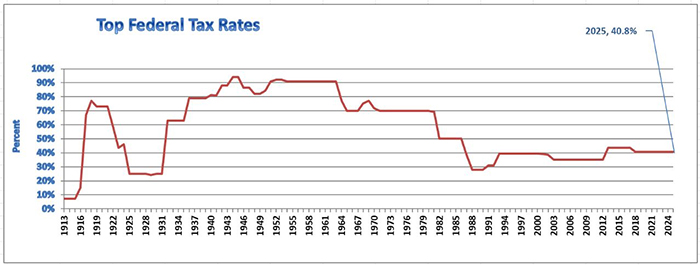
Third, the estate tax could go up to, say, 95% on estates of $100 million and more to prevent the children of billionaires from automatically becoming billionaires without having earned it. If someone is worth $10 billion, the kids would still get $500 million. They won't have to eat dog food.
Americans living abroad are subject to U.S. taxes with country-specific exemptions spelled out in individual tax treaties. Only when an expat has renounced his or her U.S. citizenship does U.S. taxation go away. So, fourth, the renunciation tax would need to be set to match the estate tax to largely defeat this loophole. (V)