
Dem
47

GOP
53

The federal government doesn't function—even when is technically open. Everyone knows this. A feeling of hopelessness abounds. People who were alive in the 1960s may remember that as a time of great hope, when all problems could be solved and even the moon was in reach. Not so anymore. A new Times/Siena College poll shows the hopelessness numerically.
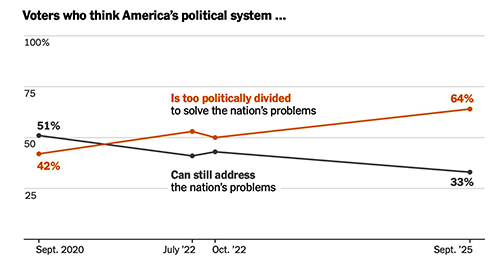
Almost two-thirds of the country think that the nation's problems are unsolvable. This is a steep rise over the last 5 years, as polarization has grown. Years ago, people differed on say, tax policy or foreign policy, but people saw other party's voters as Americans first and the enemy second, if at all. Now each party has a complete package for you. If you are pro-abortion, pro-immigration, pro-vaccination, pro-taxing the rich, pro-Medicaid, pro-Green New Deal, pro-gun control, pro-gay rights, but against trans girls playing in girls sports, you are the enemy for Democrats. It's all or nothing. Republicans are the same way, but reversed.
It's even worse in some ways. Forty-one percent of likely voters disagreed with the statement: "The U.S. is a democratic country." It is unthinkable that a poll 50 years ago would have anywhere near this number disagreeing.
Will this ever change? We don't know for sure, but in 1860, it looked like the problem of slavery could never be solved. It was, but the hard way. What might give some people (but not all people) hope, is demographic change. In 10 years, all the kids now 8-17 will be eligible to vote. Young people are notoriously more optimistic than old people. They see possibilities that old people reject as impossible because they know they didn't work in the past. Young people don't know this, so they try to accomplish them anyway and sometimes succeed.
In particular, young people tend to skew Democratic on the whole, despite Donald Trump's making inroads with young Black men and young Latinos. We think that is largely because they like Trump's machismo and don't especially like Black women in positions of leadership. We are not so sure that Trump's machismo transfers easily to people like J.D. Vance, Ron DeSantis, Gov. Brian Kemp (R-GA), or Gov. Glenn Youngkin (R-GA), the next generation of Republican leaders. If young people revert back to the norm of being Democrats, the 50-50 balance the country is now in could become 55-45 in 10 years giving the Democrats a working majority and allowing them to try out their ideas. Maybe the voters will like these ideas, maybe they won't, but it could be a different world than having a total stalemate all the time. There are already signs that young voters and Black voters are souring on Trump himself, let alone potential successors. We are not predicting this. Stuff happens. But it is a possibility. (V)