
Dem
47

GOP
53

Yes, America is becoming sorted by partisanship, but that is not by design. That is, when someone moves, it is not primarily to be in a blue sea or a red sea, depending on their political views. There are other factors at work. Additionally, the incentives that towns, cities, and states are offering to attract more residents are all wrong (and overly expensive). The data show that the conventional wisdom about moving and politics needs some updating.
About 9% of Americans move every year, a larger percentage than Europeans or Asians. It is thought that this high rate is good for the economy. It means if there are jobs somewhere, people are willing to uproot themselves and go there. In more static economies, people will stay put and the jobs will go unfilled. Nevertheless, even Americans draw the line at moving out of state. Only 2% do that in a given year.
The data show that 41% of movers preferred suburbs, 30% preferred rural areas, 16% percent preferred small cities, and only 13% preferred large metros. Some of these preferences are no doubt due to the fact that increasingly many jobs can be done from home, in which case all that is needed is a fast Internet connection. Suburbs and small towns often have that now, and even some rural areas do as well.
These two maps show the change over time. Remember, most counties are suburban or rural. The 100 biggest cities occupy roughly 100 of the 3,100 or so counties (New York City occupies five counties, but that is very unusual). This means that 3,000 counties don't have big cities in them. The map on the left shows inbound movement 2010-2013 for all counties. The map on the right shows inbound movement for 2020-2023:
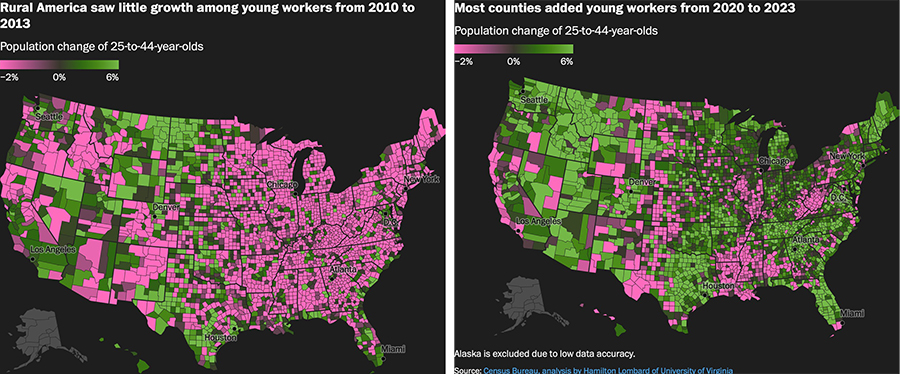
As you can see, in 2010-2013, virtually every county in the eastern half of the country lost young workers. In the later period, much of that loss was reversed, except for Appalachia and the deep South. Also in the West, losses were greatly reduced excepting the (expensive) California coast. Washington, Oregon, Idaho, and western Montana have completely turned around. These are blue areas and red areas.
When asked why they are moving, the top reasons were cost of living and housing, then safety, housing availability, short commutes, friendly locals and quality health care. Far behind are nightlife, the arts, culture and the "cool factor." Political and social fit and diversity are at the bottom. These views need to be taken with some salt, though. If movers think that Podunk County Hospital beats the UCSF or UCLA Medical Centers or Johns Hopkins, all we can say is that we hope they don't get sick.
Many dying cities and states are trying to attract more people by offering subsidies to companies to move there. Politicians are always trying to outbid each other by offering bigger and bigger tax breaks, which hollows out the local finances. And if that is not bad enough, the data show this approach isn't very good. One study showed that the boost to state and local tax receipts was 10x bigger from individual relocations than from corporate subsidies. Individual relocators tend to be above average in income and they start spending money and paying taxes the day they move in. Offering a huge break to some company to build a new plant there doesn't start delivering for several years at best. A better approach is for cities and states to advertise in ways to reach individuals, not companies, and extol their low cost of living, affordable housing, and less red tape to start a small business. We ran a letter earlier this year about a case study in which a small town pulled itself up from the bottom, not by offering a big tax break to some big company to build a plant there. That is just a race to the bottom.
The most interesting part of the Big Move is how it affects elections. If high-education, relatively affluent people leave big cities for the suburbs and rural areas, that reduces the size, and thus political clout, of the big cities. But it also increases the clout of the suburban and rural areas. In some suburban areas, a small push will move a House district (and maybe a couple of state Senate districts) from red to blue. The net effect is hard to estimate.
The 2030 census is expected to show a loss of population (and thus House seats) in the blue states of the Northeast and Midwest. This is bad news for the Democrats. On the other hand, those people have to go somewhere. If enough of them go to North Carolina, Georgia, and Arizona, those states could turn blue, just as the once-deep-red Virginia has. All we can say now is that change is afoot. (V)