
Dem
47

GOP
53

Yesterday, the Supreme Court heard oral arguments in what could be a landmark case striking down the little bit of the Voting Rights Act that it hasn't already struck down. It is a bit complicated, but here is the backstory. After the 2020 census, Republicans in the Louisiana legislature drew a congressional map with one majority Black district out of six, despite one-third of the state being Black. In 2022, Black voters sued based on the Voting Rights Act and won. In early 2024, the legislature drew a new map with two majority-Black districts. This time white voters sued. A three-judge panel agreed with the plaintiffs that drawing a map based on race discriminated against white voters. In March 2025, the U.S. Supreme Court heard the oral arguments. In June, instead of rendering a verdict, the Court ordered the parties to come back in October and give more arguments. Those additional arguments happened yesterday.
The question before the Court in Louisiana v. Callais is this: Was the Louisiana legislature engaging in racial discrimination when it intentionally drew a map with two majority-Black districts? And if so, is that constitutional? If you want more of the legal details, the Brennan Center has them.
The district at the heart of the case, the second majority-Black district, is an obvious gerrymander and a gerrymander to create a majority-Black district at that. Here it is. Chief Justice John Roberts has called it a "snake":
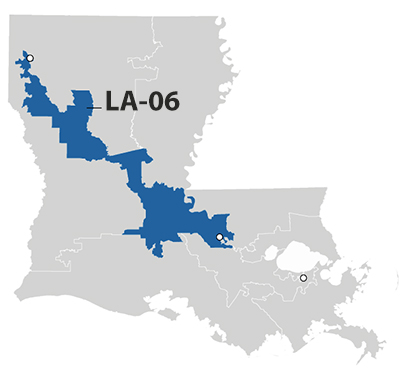
If the Court decides LA-06 is a racial gerrymander, it is likely to strike it down because the Court has previously ruled that while partisan gerrymanders are fine and dandy, racial gerrymanders are unconstitutional. If LA-06 is found to be a racial gerrymander, it will have to go.
It is always a bit tricky to infer votes from the justices' questions at the oral arguments, but Justices Clarence Thomas, Samuel Alito and Neil Gorsuch appeared to be against the idea of using race at all when drawing maps. Roberts has long said the way to stop racial discrimination is to stop discriminating based on race. That's four votes to kill the Voting Rights Act right there.
Justice Brett Kavanaugh, who may be the swing vote, suggested that remedies for past racial discrimination might be constitutional, but only for a limited period of time. The Voting Rights Act was signed by Lyndon Johnson in 1965. That was 60 years ago. Kavanaugh seemed to be asking whether 60 years was long enough. Justice Amy Coney Barrett was playing her cards close to the chest and didn't let on what she was thinking. The three Democratic appointees will no doubt vote to uphold the Voting Rights Act, so Kavanaugh and Barrett will be crucial.
The decision could have nationwide implications and greatly help the Republicans in 2026 and beyond. Many states in the South have drawn one, sometimes two, majority-Black districts in order to comply with the VRA. If they no longer have to comply with it, the Republican-controlled legislatures will be falling all over each other trying to be the first to eliminate all of the majority-Black districts. Since Southern Black voters are largely Democrats, eliminating these de facto Democratic districts will give the Republicans perhaps another dozen seats in the House. The New York Times' data guru, Nate Cohn, has worked out the potential map in the South if the VRA is struck down. Here it is, compared to the current map:
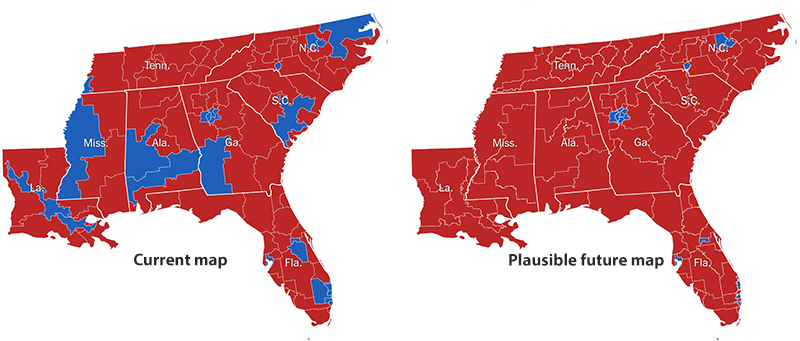
One thing to note here is that some Republican members of the House will be strongly against the map on the right above. The reason is this: The majority Black districts have a lot of Democrats in them. They have to go somewhere. In practice, they will probably have to go into neighboring districts, watering them down. If a (safe) R+8 district suddenly becomes a competitive R+4 district, the Republican congresscritter representing that district is likely to howl to the moon and make sure the state legislature hears it. The fear of turning safe-red districts into competitive pink districts could be a check on what the legislatures do.
Timing will play an important role here. If the Court renders its decision in June 2026, as it usually does, then the primaries will be underway already and even completed in many states. Having the legislatures create new districts in July, after the primaries have already been completed, would create enormous chaos. Donald Trump would probably suggest canceling the 2026 elections and just waiting until 2028, but he has no such authority. In any event, the blue states will hold elections on Nov. 3, 2026, as required by law.
If the Supreme Court wants to do its best to help the Republicans, it could issue its ruling in November or December 2025. In principle, that would give states time to draw new maps (or, more likely, simply vote on the new maps they have probably already drawn). It would be an unheard-of power grab but it could easily happen. Democrats would scream to the rooftops, but there is not much they could do other than trying to motivate their voters to be sure to vote in 2026, no matter how hopeless it looks. (V)