
Dem
47

GOP
53

Apparently, many CEOs from companies whose products are crucially dependent on rare earths have talked to Donald Trump and made it clear to him that if China cuts off the supply of rare earths, that would be a disaster for them, in some cases ending their companies. Rare earths are neither rare nor earths. Here is the periodic table. You might have seen it in high school chemistry class, but nobody ever talked about the rare earths because metals and noble gases were much more interesting. Here it is:
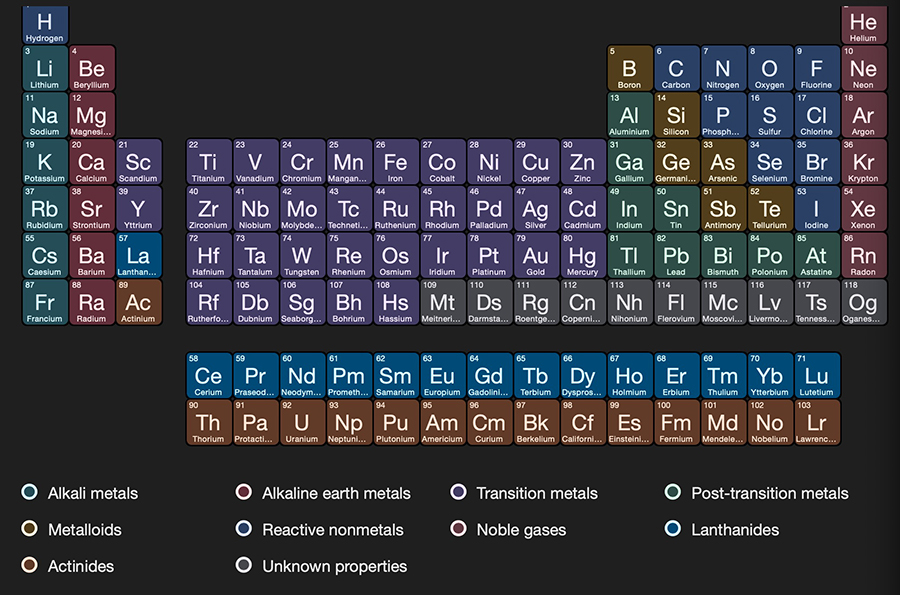
You never saw the periodic table in a political blog before? Always a first time for everything. Look at the 6th row. Note there is a gap between element 57 (lanthanum) and element 72 (hafnium). That is where the rare earths go. They are shown in the turquoise row below the main part of the table. They are lumped together because as you move across the periodic table from left to right, they fill their inner shells rather than their outer shells. This makes them chemically similar to one another, which also makes them hard to separate.
They all have some strange properties, including being magnetic but resistant to heat (which makes them useful in jet engines and motors) and luminescent (which makes them useful in electronic displays). They are also used in wind turbines, electric cars, semiconductors and other advanced products due to their specific properties.
Needless to say, Trump couldn't tell the periodic table from the kitchen table, but he does understand that China has a near monopoly on some weird sh** that American industry needs badly. On Monday, Australian Prime Minister Anthony Albanese visited the White House and patiently explained a few things to Trump. First, rare earths aren't rare at all. They have some rare properties, but they are not scarce in the earth's crust. Second, Australia has large deposits of them and would be happy to sell them to America.
The problem is that refining them is difficult, capital intensive and polluting. Albanese apparently convinced Trump, who announced an investment of billions of dollars in Australia to extract and refine the rare earths. The first U.S. mining company to suggest that the next batch of $TRUMP coins be made of terbium will probably get the contract (unless some other company proposes renaming terbium "trumpium" because it is so valuable). The deal with Australia is a very good idea, but it is not a short-term fix. Building the mines, refineries and factories will take years and parts need to be sourced from places other than China. Still, you have to start somewhere and the deal with Australia is a start. The U.S. also has some good deposits in California (the Mountain Pass Mine) and Wyoming (the Brook Mine), but no refining capability. Creating some, in addition to the Australia deal, would also be a good idea. (V)