
Dem
47

GOP
53

We have decided that, henceforth, the categories "fun" and "gallimaufry" will be combined into just "gallimaufry." That avoids having to make a lot of picky judgment calls about which is which. So, henceforth, the last Saturday of each month is Gallimaufry Day.
Note also that we pick the most appropriate staff member or members to answer the questions. For example, (V) is the best person to answer most science questions, since he was a science major and the rest of us really were not. True, he did not go to UCLA, but his alma mater MIT is basically passable in the sciences. After all, MIT professors have won 104 Nobel Prizes. On the other hand, he's not a TV watcher, so he's not ideally suited to answer those questions.
If you're still working on the headline theme, we'll ask: "Is that you, Yul Brynner? Or you, Sir Patrick Stewart?"
M.M. in San Diego, CA, asks: Asking for a friend: Are historians generally dismissive of military historians? If so, why? Friend perceives a bias.
(Z) answers: To start, many historians are very provincial, and think that only their type of history is useful. Many times, I have had a colleague who does Medieval Europe or Ancient Rome or some other long-ago period derisively dismiss all U.S. historians as people who study "current events." Some of them were joking, but some of them were not.
On top of that, there are many historians who see military history as old-fashioned, and dismiss it on that basis. A subset of those see it not only as old-fashioned, but also as "great white man" history—and, by (dubious) implication, politically conservative. That subset is openly contemptuous of military history.
In my experience, everyone who indulges in this kind of chauvinism is an a**hole, and can be safely ignored.
T.H. in La Quinta, CA, asks: Was Hitler a common surname in Germany and Austria 100+ years ago? Are there many people with that name today?
(Z) answers: It was not exactly common, but not rare, either. Think "Wood" or "Hughes" or "Myers" in the modern U.S.
There are no living direct descendants of Hitler, and less than half a dozen living relatives. All of those have changed their last names. Similarly, pretty much everyone in Europe who had the last name Hitler has made a change, as well. However, there are places where the name Hitler either emerged independently, or else was introduced during the colonial era, and where the name is not 100% toxic, as it would be in Europe/the U.S./Canada/Australia. So, there are still a few thousand Hitlers running around in Asia, Latin America and Africa. The country with the most is Nigeria, which has over a thousand Hitlers, followed by Bangladesh, Iraq, Tanzania, India, Nicaragua and Indonesia, all of which have between 100 and 400 Hitlers.
B.T. in Corpus Christi, TX, asks: If Operation Valkyrie had succeeded, what are the likely World War II outcomes?
(Z) answers: The attempt took place on July 20, 1944, by which time the D-Day invasion had succeeded and the Allies had definitively seized the initiative in Europe. This being the case, it's hard to see how the war in Europe would have ended much differently. There would have been less death and destruction, since there would have been no Battle of the Bulge and no bombing of Dresden, and the concentration camps would have been liberated earlier. However, it still would have ended with a complete German surrender and partitioning (even though the conspirators entertained the fantasy that they would not only be able to keep the nation together, but they would be allowed to retain Czechoslovakia, Austria and Poland).
Where it might have made a big difference is in Asia. The atomic bombs were most certainly not ready by July of 1944. And there would have been enormous political pressure on the leadership of the Allied powers to bring that part of the war to an end. So, instead of two nuclear bombs followed by a surrender, there might have been a massive invasion of Japan and its occupied territories by some sort of joint Russian-British-American force. That would have been bloody, indeed.
Meanwhile, if the world was not given a lesson in the destructive power of nuclear arms, that might well have come some years later, by which time the bombs were vastly more powerful. That would have been very bloody, as well.
M.M. in Leonardtown, MD, asks: Can you describe the sequence of events that made Los Angeles the movie and TV capital of America? And which "also-ran" would have taken the mantle, had it not been L.A.?
(Z) answers: The movie industry evolved into a viable business in the first two decades of the 20th century. In the very early years, it was not possible to screen films longer than 10-15 minutes (1 reel), because they hadn't yet figured out how to switch reels without stopping the film for 2-3 minutes. However, some enterprising folks opened up Nickelodeons, which would show several short films for the price (obviously) of a nickel.
A nickel, in the 1920s, was equivalent to about $2.00 today. That is a clue that the Nickelodeons were targeted at a blue-collar audience, as middle- and upper-class people of that era thought movies were a low-class art form. However, the Nickelodeons became profitable to the point that their owners could build much fancier and classier theaters known as "movie palaces." It did not take too long before movies became a socially acceptable entertainment for audiences of all economic classes.
As movie-making evolved from a hobby/experimental art form into a serious economic concern, it was necessary for filmmakers to get serious about the nuts and bolts of their filmmaking. In 1910, the director D.W. Griffith, who would later be known for Birth of a Nation (1915), made the first movie to be filmed in California—a short called In Old California (1910). For close to 100 years, this film was thought to be lost, but they found a copy a few years ago, and a restoration is reportedly underway.
Griffith basically made that film as a lark, while he was on vacation. However, he inadvertently ended up being something of an advance scout for the other filmmakers of that era (who were primarily based in New York and New Jersey). There were three really big selling points when it came to the Los Angeles area. First, film studios tend to need lots of land, and L.A. had that, at very good prices. Second, the film stock of that era would not respond to natural light, and required sunlight. L.A. has that, as well, with relatively few days that are overcast/rainy. This matters a lot when you have to pay your cast and crew whether they work or not. Third, long-distance passenger aviation was not really a thing until the 1940s and 1950s. So, in the 1910s and 1920s and 1930s, it was necessary to stay local, and to find places, accessible via automobile, that could stand in for various foreign locales. The geography in and around Los Angeles is very diverse. When I deliver my lecture on this subject, I show students this Paramount Studios map from 1927 (which I have shared here before):
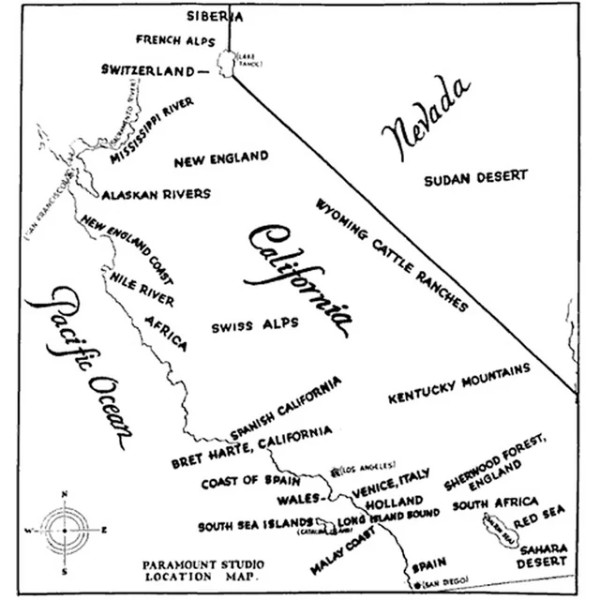
For these three reasons, in particular, most filmmakers decamped from wherever they were to Southern California. And since it is useful to be able to share equipment, personnel, etc., they pretty much all set up shop in and around Hollywood (though there is only one studio, namely Paramount, that is still actually located in Hollywood).
It's hard to come up with an alternative to Los Angeles that offered all of these very important benefits. But if we absolutely had to pick, we'd go with Miami. That city would have offered some of the same benefits, though the humidity would be a problem for both the film stock and for human comfort.
R.S. in Ticonderoga, NY, asks: These days, an executive producer credit on a TV show or movie seems to be a way to acknowledge a financial backer, but watching older TV shows or movies, there seems to be a single executive producer in most credits.
What was the role of the executive producer in the past, and when did the role morph into a mere way to thank a financial backer?(Z) answers: We will start with the caveat that the meaning of that title has always been somewhat fungible. In the film business, during the studio era, it was most common for the executive producer to be the studio head. The studio heads picked the directors and the scripts, and had some role in casting, and shaped their films in other ways, as well. However, they did not have in-depth, day-to-day, hour-to-hour involvement in the films. For example, legendary mogul (and legendary a**hole and lecher) Jack L. Warner executive produced something like 200 films between 1928 and 1948. Obviously, he could not have been investing vast amounts of blood, toil, sweat and tears into any individual film.
Since the decline of the studio era, the most important creative voice is usually the director of the film, who is generally far less of an "employee" taking orders than used to be the case. An executive producer might fulfill one or more of several roles: (1) raising funding, (2) providing funding, (3) attracting funding by allowing their name to be added to the list of creatives, (4) serving as a consultant, (5) helping to oversee and manage the nuts and bolts of production, like craft services and location scouting.
In television, back in the 1950s and 1960s, the executive producer was very often the key creative person on the show's staff, overseeing scripts, casting, direction, settings, overall philosophy/feel, etc. For example, Star Trek was most definitely the Gene Roddenberry show. However, even back then, the executive producer was sometimes just a consultant, or the person who created the show, and did not have much role in the day-to-day production of the show. To take one example, the top-rated show Bonanza was executive produced by David Dortort, who created the show and was deeply involved in its production for several years. But eventually, he moved on to other projects, and he became just a name in the credits who was drawing a paycheck.
Today, in TV, the executive producer might be a studio head, or a key creative (usually an actor) getting a vanity credit and some extra cash, or someone whose name might get a network (or might get viewers) interested (like Steven Spielberg or Tom Hanks or James Cameron), or might be a consultant, or might be someone who takes some meaningful role in creating the show (for example, reading and approving scripts). However, the key creative who is the final decision-maker, and who oversees everything, is called the showrunner. Usually that person is also given the title of executive producer, but not always. Oh, and "showrunner" is not a role that is recognized in a show's credits; it's basically just people in the business who know who the showrunner is (thought it's sometimes pretty easy to figure out who it must be; Bill Lawrence is pretty much always the showrunner on the shows he creates, for example, as is Tina Fey).
J.W. in Newton, MA, asks: Satirical movies about politics and governance bring me great joy, and are needed now more than ever. Some of my favorites include The Great Dictator, Dr. Strangelove, Election, and The Death of Stalin. Please expand my list of hilarious skewerings of those who seek to rule us. What are your favorites? Extra points for great movies that are under the radar.
(Z) answers: I will start by noting that you already laid claim to a lot of the best answers. I will further add that it can be difficult to know where the line between "political film with comedic elements" and "political satire" is, exactly. Finally, I will note that one of the most famous political satires is Wag the Dog, but I found that movie obvious and hamfisted, and so choose not to include it.
With that out of the way, here are ten films for you, in chronological order:
- Duck Soup (1933): Idiotic leaders, of the nations of Freedonia and Sylvania, get into an idiotic war. One wonders what might have put this notion into the minds of the Marx Brothers.
- The Candidate (1972): This is an obvious one, but we obviously have to mention this story of a person who has no business running for politial office, and who says only stupid and impolitic things, and who has no chance of winning... but does. The last scene features the candidate wondering what the hell he's supposed to do, now that he's actually been elected.
Needless to say, this is a work of fiction, and something like this could not happen in real life.- Nashville (1975): Not all of Robert Altman's films have aged well (ahem, MASH), and this film is not entirely about politics. But it's a major subplot, in the person of third-party candidate Hal Phillip Walker (only heard, not seen), and the country musicians that are recruited to support/endorse his campaign. We bet Lee Greenwood loved this movie.
- Monty Python and the Holy Grail (1975): I'm not ranking the films here, but if I was, this would probably be #1. It's not about American politics, of course, but it is a biting send-up of the often arbitrary nature of power (particularly in a hereditary system).
- The Princess Bride (1987): A famous film, but not one that shows up on lists like this. It really should, as it's about 50% Duck Soup and 50% Monty Python and the Holy Grail, along with some bonus observations about the folly of land wars in Asia.
- Dave (1993): When I wrote the bit about "the line between 'political film with comedic elements' and 'political satire,'" this is the film I was specifically thinking about. But it's a great little film, and it's very much about the cynicism that has permenated much of modern politics, and fighting back against that, so I decided it can be on the list.
- Dick (1999): Remember the scene in Forrest Gump, where Richard Nixon arranges for Gump to stay in the "much nicer" Watergate Hotel, and Gump becomes the linchpin in discovering the break-in that brought Nixon down? Well, that was probably lifted from this film. Dick was itself meant as a satire of All the President's Men, and portrays Bob Woodward and Carl Bernstein as louts who got credit for the (accidental) discoveries made by two naive high school girls.
- Le Placard (2001): This French comedy is not well known in the United States, but is great. An accountant is about to lose his job at a factory that makes condoms, and so comes out of the closet, even though he's not gay. It's a great send-up of gay panic, of corporations that just follow the political winds, and, through the character played by Gerard Depardieu, of meatheads who struggle to adapt to new milieus.
- Idiocracy (2006): This is another film that is obvious, but had to be added to the list. Everyone knows about the circumstances where the one-eyed man becomes king. Well, in the land of morons, the merely stupid becomes king. In this case, that is pro wrestler Dwayne Elizondo Mountain Dew Herbert Camacho.
- In the Loop (2009): This satire of the Iraq War is what Wag the Dog would be if Wag the Dog was, you know, funny. Beware, however, this film is very black, and is also very, very blue.
D.D. in Bucks County, PA, asks: (Z) mentioned Chariots of Fire, which is in my top 10 movies personally. I remember it was a surprise when it won Best Picture, and I think it might have been the biggest upset for Best Picture. What movie do each of you believe was the biggest upset/surprise to win Best Picture?
(L) answers: Coda, the best picture winner in 2021. I loved that film and was pleasantly surprised to see it nominated. But no one gave it any chance of winning.
(A) answers: I'm going with the somewhat obvious—Gladiator (2001). It was... fine? I saw it in the theater and didn't have any desire to see it again. With some highly praised movies that don't "do it" for me, I can kind of see how they might have had deeper meaning for others, but not this one.
(Z) answers: I agree with (A) about Gladiator. Other Best Picture winners from, say, the last 50 years that I found to be pretty mediocre include Ordinary People (1980), The Lord of the Rings: The Return of the King (2003), Slumdog Millionaire (2008), The Artist (2011), Birdman or (The Unexpected Virtue of Ignorance) (2014), and Everything Everywhere All at Once (2022). The people who vote on the Oscars love spectacle, and they love films that have a gimmick (e.g., the whole film is a single tracking shot, or the whole film is slient), and they love films that are artsy (but not TOO artsy), so I wasn't surprised by most or all of these wins. I just didn't share the views of the Academy.
The recent Best Picture winner that I actively loathed was Parasite (2019). The first part of the film was reasonably clever, if a bit overwrought. Then there was a "plot twist" (I won't reveal it, in case some reader still plans to see the film), and at that point the whole thing fell apart, and became both: (1) completely unbelivable, and (2) a hit-you-with-a-sledgehammer sermon on director Bong Joon Ho's cartoonish ideas about class struggle. I did not care for Snowpiercer either and, on the "fool me twice" theory, I have no plans to ever see another of his films.
If you want surprises, the two famous ones are Shakespeare in Love (1998) and Crash (2005). I know I shared the surprise of many people when those won. I didn't have an objection to Shakespeare in Love winning, mind you, as I liked it better than the film everyone thought would win, namely Saving Private Ryan. In 2005, on the other hand, I would have preferred the award to go to Good Night, and Good Luck, though most people wanted Brokeback Mountain.
M.S. in Raleigh, NC, asks: I'm curious if each of you might mention or list a couple television shows that you found (find, if still on the air) particularly interesting and enjoyable. Specifically, I'd be interested in shows that did not receive a lot of attention and did not necessarily excel in the Nielsen ratings game.
Basically, shows that were not really mainstream favorites like Roseanne or Cheers.
For a few examples, I have never been more entertained or enjoyed a show more than I did the 1980's NBC soap opera Santa Barbara. I also really enjoyed the short lived Fox shows Action and Parker Lewis Can't Lose.(L) answers: Smash, about the making of a musical based on the life of Marilyn Monroe, was one of my favorites. It only lasted a couple of seasons, and I suspect it was too niche to get a large following, but it was so true to the world of musical theater, which is one that I used to inhabit. Megan Hilty is incredible as Marilyn. The other one is Nashville, which ran for 6 seasons but jumped the shark when production was taken over by Country Music Television, which prompted Connie Britten to jump ship. But the original story of a powerful female country artist confronting a sexist and ageist industry while struggling to hold on to her fans, career and family AND while also dealing with an upstart, equally ambitious female singer who is tired of being marketed solely to pre-teens made for some amazing TV. The casting of both shows was impeccable.
(A) answers: Two of my favorite shows seem to have received very little recognition. Better Off Ted is a sitcom about Ted Crisp, the head of R&D at a soulless corporation. And Jeremiah, a post-apocalyptic drama about the world left behind after a virus wiped out everyone past puberty. The show picks up several years later, so the oldest people on Earth are in their early-to-mid-twenties.
I also really loved Journeyman, Almost Human and FlashForward, all of which were sadly canceled after only one season, making them just depressing to rewatch.
(Z) answers: I really liked Picket Fences, which had a heck of a cast (including Tom Skerritt, Fyvush Finkel and an early-in-his-career Don Cheadle), and was very quirky, before David Kelley decided to tone things down and reach a wider audience with shows like The Practice and Ally McBeal. It lasted three seasons. I also liked The Incurable Collector, which was hosted by John Larroquette (of Night Court fame) and featured two people per episode with really large, really specific collections (e.g., 800 antique toasters). It only made it to about 15 episodes. Both of those shows have been gone for 20+ years. For something more recent, I very much enjoyed Secret Chef on Hulu, which was set up in a way that the competing chefs were also the judges (they did not know whose dish was whose). It was on for one, 10-episode season in 2023, and no show is truly dead in the streaming era. However, I don't think it will actually rise from the grave.
S.B. in Winslow, ME, asks: Who does your favorite Donald Trump impression? And do you have a favorite single routine they've done that makes you laugh (or cry) every time you watch it?
(Z) answers: Not to be obvious, but I've not seen better than Alec Baldwin's take on Saturday Night Live. And I don't think the show has ever done better than the first sketch after he was elected, in which "Trump" is panicked that he now has to be president:
J.W. in Los Angeles, CA, asks: So... TV theme songs. I don't think you've tackled this pressing topic. It seems my YouTube feed has determined that I'm sentimental in my older age and delivered the theme song to The Courtship of Eddie's Father. Brilliant theme song (the "rubber d-ducky" bit is truly brilliant), which got me thinking about other great opening songs and it is a great list.
So, in two categories: Best TV theme songs... instrumental and with lyrics. Song must have more than 8 bars (the Seinfeld noodle is absolutely perfect, but that isn't really a song, right?).(Z) answers: I think a theme song should ideally do two things: (1) draw people into the program, and (2) somehow establish the basis of the show for those who have not seen it before (or who have seen it, but need a reminder).
Here are the five best instrumental themes, in my view, in ranked order:
- "Theme from Hawaii Five-O" (Hawaii Five-O): A perfect marriage of music and opening sequence, especially that little spin that Jack Lord does at the beginning.
- "Twin Peaks Theme" (Twin Peaks): This has to be the most avant-garde opening sequence in the history of television. And for a show like that, it works.
- "The Andy Griffith Show Theme" (The Andy Griffith Show): This almost doesn't count, since there are no actual instruments, just whistling and finger-snapping. But it's iconic. Note that the song is sometimes known as "The Fishin' Hole," but that refers to a lyrical version that was released as a single, not the version used on the show.
- "Theme from Star Trek" (Star Trek): If people weren't excited about the show before tuning in, they had to be once they saw the opening credits.
- "The Twilight Zone Theme" (The Twilight Zone): It uses the the devil's chord to great effect.
Here are the five best lyrical themes, in my view, in ranked order:
- "The Ballad of Gilligan's Isle" (Gilligan's Island): It's an earworm, yes, but it really does its job of setting up the concept of the show.
- "Five O'Clock World" (The Drew Carey Show): A catchy tune, and it really sets the tone for the show that was Dilbert before Dilbert came among. The other two theme songs the show used ("Moon Over Parma" and "Cleveland Rocks") were also quite good.
- "Welcome Back" (Welcome Back, Kotter): The show was supposed to be called Kotter, but nothing rhymes with that, so John Sebastian stopped trying. The producers thought the song was so perfect (and it was) that they changed the title of the show.
- "Those Were the Days" (All in the Family): As they sing, Edith and Archie are nostalgic. Most viewers, I think, were just sad—reminded that this is a man whose time has passed, and who is struggling to adapt to the entirely new world in which he finds himself.
- "Where Everybody Knows Your Name" (Cheers): This is, hands-down, the greatest TV theme of all time.
Clearly, the golden age of TV theme songs has passed, as the most recent of these shows (original incarnation) left the air in 2004. There are still very effective opening sequences, but the music just isn't the focal point it once was. If I had included a show that was entirely 21st century, however, it would have been Mad Men.
S.B. in Hood River, OR, asks: What was the first heavy metal song or, alternatively, the first heavy metal band?
(Z) answers: The second part of your question is easier to answer. Black Sabbath is clearly the first band to rely regularly on the power chords, the volume, and the dark imagery that formed the backbone of heavy metal. As to the first song, most of the contenders for that honor are from the year 1968, which suggests that is the year when those paricular ingredients first began to coalesce. I read an essay 20+ years ago that argued that The Beatles' "Helter Skelter" was the first heavy metal song, and I've never had reason to revisit that conclusion.
M.B. in Boxford, MA, asks: Did Shohei Ohtani, with 3 home runs, a win, and 6 innings pitched with no runs allowed and 10 strikeouts, have the best individual performance in any MLB game?
(Z) answers: Maybe?
Obviously, for a player to produce that much offense, and to twirl a gem of a start as a pitcher, and to do it in the same game, is almost entirely novel. Babe Ruth was a great pitcher and a great hitter, but rarely in the same game, especially in a postseason game.
In terms of memorable games, the best-known hitting performance is probably Reggie Jackson's three home runs (on three swings) in Game 6 of the 1977 World Series. And the best-known pitching performance is surely Don Larsen's perfect game in Game 5 of the 1956 World Series. On one hand, Ohtani's game was in the League Championship Series and not the World Series, and he also did not dominate on the mound the way Larsen did. On the other hand, neither Jackson nor Larsen produced on both sides of the ball. So, it depends on what is most important to each fan, utter dominance on one side of the ball (Larsen), World Series (Larsen or Jackson), or overall production/novelty (Ohtani).
There is also another way to measure this. The sabermetrics crowd has developed a stat called Win Probability Added (WPA), which measures how much of a "win" any one player added during the game. Ohtani's WPA for that game was 0.71, which means that he was personally responsible for adding .71 wins for the Dodgers (who obviously recorded a total of 1 win in that game). Because WPA is context-dependent, however, that is not the highest WPA ever recorded. The highest WPA ever, 1.503, was by the Reds' Art Shamsky against the Pirates, in a game where Shamsky hit multiple go-ahead home runs (note that the rest of his team had a negative WPA, such that they actually lost that game). Inasmuch as two of three Ohtani's home runs served only to extend the lead, they don't actually add that much to his WPA.
If we limit ourselves to playoffs, Ohtani is still not the record holder. The highest playoff WPA was 0.77 by Pablo Sandoval in Game 1 of the 2012 World Series. Sandoval also hit three HRs, and while he didn't pitch, two of his three round trippers put his team in the lead (and they did win the game). Ohtani is next on the list, though.
So, the number-crunching folks would not put Ohtani at #1. As to the "gut feel" folks, it depends on what they value most.
R.V. in Pittsburgh, PA, asks: After Shohei Ohtani's performance (plus all his other amazing regular season stats) do you think he is in conversation as one of top three greatest players in MLB history?
(Z) answers: No. Not yet.
When people talk about Mickey Mantle, they add the assertion that he was the greatest switch hitter in baseball history to his résumé, as if that is an accomplishment. It is not; it's a tool/advantage he used to maximize his value. The 536 home runs he hit (and the other things he did) would not be less (or more) valuable if they were the product of a player who only hit right handed. This claim is very much like giving Aaron Judge credit for his height, or Rickey Henderson credit for his speed. It's the production that matters; you don't get extra credit for how you got there.
The "Ohtani is the greatest player of all time" argument seems to have emerged from the following facts. First, the only two players in league history who were elite-level pitchers AND elite-level hitters are Babe Ruth and Ohtani. Second, Ruth is widely regarded as the greatest player of all time, or at least in the top three. Third, Ruth didn't have to face Black players (or Asian players, or dark-skinned Latin players). Fourth, Ohtani does have to face those players. Fifth, Ohtani is therefore as good as Ruth (or better), because they were both successful pitcher-hitters, but Ohtani did it against better competition.
Ohtani is certainly very, very good. And he's certainly novel. But doing both pitching and hitting is just the way he adds value to his team, just like Mantle's switch hitting or Henderson's speed. What matters is the actual value added, not how it was added. And Ohtani has basically provided about 3 seasons' worth of excellent pitching, and about 5 seasons' worth of excellent hitting. That is just not enough to knock off some of the players who were valuable contributors for 15-25 seasons, even if those players were "only" hitters or "only" pitchers.
The stat that is used to measure career value is Wins Above Replacement (WAR), which measures how many more games a player's team won because they had him, as opposed to having someone with the talent of a solid-but-not-great minor leaguer. Ohtani's career WAR, right now, is 51.5. The leaders in career WAR are Babe Ruth (182.6), Walter Johnson (167.8), Cy Young (163.6), Barry Bonds (162.8) and Willie Mays (156.2). As you can see, Ohtani isn't even in the same ballpark (as it were). He might get there, but he's not there yet. In fact, if he retired tomorrow, he wouldn't even be eligible for the Hall of Fame. You have to play 10 seasons, and he's only got 8. Admittedly, they would likely waive this for him if he stopped playing for reasons not of his own volition. Addie Joss is in the Hall despite playing only 9 seasons, for example, because he died of meningitis.
In short: Ohtani is a great, great player. But let's not get ahead of ourselves.
R.H.D. in Webster, NY, asks: I think I know who the world is rooting for to win the World Series. But you think the Blue Jays have a chance?
(Z) answers: Certainly. In a game between the worst MLB team and the best, the weaker team will still win 40% of the time. And, with those odds, it's certainly possible for the weaker team to take four of seven games.
And the Blue Jays are NOT the worst MLB team. They are one of the best. I would expect them to win maybe 48% of the time against the Dodgers. And if that is the case, then the Blue Jays would be expected to win the Series roughly one time out of three.
Note that this answer was written before the Jays won Game 1 last night. If we stick with the same 48% chance of winning any particular game, but we now specify they only have to win three of the next six games, their odds of winning the Series are up to about 45%.
C.V. in Leander, TX, asks: I will admit to not liking baseball very much (though I am making a renewed attempt to enjoy it). My reason had always been that I perceived there to be a lot of luck involved, due to the high number of games played in a season compared to the win ratio that the long season yields. I prefer games that reward skill.
Take, for example, the 2024 MLB season. It took 162 games to tease out the Dodgers as the highest ranking team, and they earned a .604 win ratio at 98-64. Take the number of wins above .500 (32 games) and divide that by the total number of games (162) to get .198 which is the ratio of games which contributed to their winning record.
Now take, for example, the 2023-24 NBA season. The best regular season team were the Celtics, who achieved a 64-18 record, which has a win contribution ratio of .537. This metric in isolation suggests to me that the winningest team in NBA has much more control of its destiny than the winningest team in the MLB.
Is there a better way to approach ranking sports by skill than the method above?(Z) answers: A better approach? There probably isn't one. However, I would say you are thinking about this in the wrong way. In a basketball game, a star player might get 30 or more shots. And they might be expected to convert at a rate of 50% or more. In a baseball game, a star player might get 5 at bats. And they might be expected to convert at a rate of 35% or 40% (including both hits and walks). When a sport's scoring is built around a smaller number of lower-probably events, then chance is going to play a much bigger role. That's the nature of the beast.
However, consider Las Vegas. Sometimes the player comes out ahead. Sometimes the casino comes out ahead. But the casino comes out ahead a lot more often than the player; those fancy carpets and ornate architecture and luxe decor aren't free. And the casino's edge comes from having the advantage far less than 19.8% of the time. In other words, sometimes the lesser team does win in baseball, even over 162 trials (i.e., a full season). But the better team comes out ahead a lot more often than not.
R.S. in Tonawanda, NY, asks: The 1994 World Series... the World Series that wasn't, due to the players' strike. I was sorely disappointed, as I thought it would have been one of the best series of all time, had it been the Yankees and my NL team, the Montreal Expos (it looked like that was likely to be the case as of August 11).
Who do you all think would have won?(Z) answers: I'll go with the obvious choice and pick the Expos. They had four more wins than any other team when the season ended prematurely, and their roster was very balanced—good hitting, good pitching.
D.S. in Layton, UT, asks: Pete Rose, Barry Bonds, Shoeless Joe Jackson.
Do any of them belong in the Baseball Hall of Fame?(Z) answers: Bonds is the easy one; he should definitely be in. First, he was a Hall of Famer before he started juicing. Second, it is laughable that we can somehow tell who was, and was not, juicing, and there are most certainly steroids users (not to mention amphetamine users) already in the Hall. Third, Bonds put up those video-game numbers against many pitchers who were also juicing. Fourth, the 'roids were not against the rules at the time, and ex post facto laws do not hold water in any other context.
Rose is a tougher call, but I think he should probably be in. He was a great player, and it's somewhat nutty that the career hits leader (Rose) and the career home runs leader (Bonds) are excluded. Further, by all evidence, Rose's crimes were committed when he was solely a manager, and not a player (or a player/manager). So, admit him as a player (and even maybe note his misdeeds on his plaque). Also, the harsh crimes for gambling were created as a "strong" reaction (or overreaction) to the 1919 Black Sox scandal. Other leagues do not punish players so harshly. And baseball (and the other leagues) are looking more and more hypocritical these days (especially this week) as they climb into bed with casinos and gambling operations, while at the same time making pariahs of players who gamble. This is not to say players who commit this crime should not be punished, but the fact that they can lose their whole careers, while the team can slap up yet another ad for DraftKings or Caesars Palace in their arenas, is incongruous.
Jackson is harder than Bonds, but not much harder. He should be out. By production, he was a borderline Hall of Famer. He could be in, he could be out, and neither would be terribly offensive. But, he participated in shenanigans that nearly destroyed the game. And exactly what he knew, and when he knew it, and how hard he tried to alert the authorities, and whether he allowed the scheme to influence his play, are all questions without clear answers. In the absence of absolutely incontrovertible exculpatory evidence, he does not get the benefit of the doubt.
B.H. in Southborough, MA, asks: I watched as the Buffalo Bills lost to the Patriots at home after going 4-0. The announcers said "They are breathing easier in Miami." Which leads to my question: Do you think the Dolphins' perfect 17-0 1972 season (including playoffs) will ever be matched?
(Z) answers: Well, a few teams have come close. Most famously, the 1985 Bears went 18-1, and the 2004 Patriots did the same. That might seem to suggest that a really good team, with a few more lucky bounces than the Bears and Pats got, could pull it off.
However, barring a change in the circumstances of the league, I do not think it will happen. First, teams play 17 regular season games these days, which means they would have to go 20-0 to "equal" the Dolphins. Those three extra games make it orders of magnitude harder. And soon, it will be 18 regular season games and 21 games overall.
Further, because of the salary cap and other "parity" maneuvers, it is nearly impossible to build a loaded roster like the ones of eras past. You'd probably need a team actually better than the Bears or Pats were, because of the additional games, and that's just not plausible under current conditions.
R.K.P. in Chicago, IL, asks: What games do you folks play on your phones?
(L) answers: I don't play any games on my phone. Unless Merlin Bird ID can be considered a game... I wonder if that makes me more of a geek or less of one? Wait, don't answer that.
(A) answers: The mobile games that have stood the test of time for me are: Words with Friends, Cubistry (all of my scores are in the top 5%; some are in the top 1%), Mario Kart Tour and Phase 10. I've spent the last few months hooked on one of those stupid "hole" games, All in Hole, but it's too early to know if it'll be a long-term thing.
(Z) answers: I once had a much larger phone and it got stolen because I could not keep it in my pocket. So now I have a smaller phone (an iPhone 8; the previous one was an iPhone 10), and the games that are playable on it and that are useful to kill 5 minutes here and 10 minutes there are Yahtzee, Gin Rummy, Checkers, Angry Birds, Plants vs. Zombies, Words with Friends and a game called Plague, Inc. where you have to try to develop a disease that wipes out mankind.
S.S.L. in Battle Creek, MI, asks: Any recommendations for board/card games my 10-year-old nephew and I can play together? Plot twist: I'm blind, he's sighted, and I'll almost certainly have to Braille or record any text and modify any board. Bonus points for games that are accessible by default.
(A) answers: This is a new challenge for me, I hope I can help.
In case you aren't already aware, I found this collection of tactile versions of classic board games.
I have a couple of suggestions for more modern games that may be easily modified for your needs. The first is River Valley Glassworks, a glass-collecting game. The instructions have players sometimes concerned only with the shape of the glass, and at other times concerned only with the color of the glass. I believe the game would be playable by only concerning oneself with the various shapes at all times, ignoring the colors. Another option may be to add, with your nephew's help, adhesive or glue dots or patterns to each piece of glass to indicate its color. I have the deluxe version of the game, its scoreboard has deep grooves for placing collected glass and tracking player turn progress. From the images online, it looks like the non-deluxe version's scoreboard is significantly less tactile, and therefore less helpful in this regard. Right now, the deluxe version is cheaper on the publisher's website than it is on Amazon.
Also, I wonder if DroPolter would work for you and your nephew. Each player holds five tactilely unique items in one hand. Each round, a card is revealed, indicating which items the players must drop from their hand to win. The required items are the same for all players each round, so your nephew could announce each round's items. I'd also suggest dropping items onto a tray or into a shallow box, to keep them from bouncing and flying across the room when they're dropped.
Please let us know if any of these suggestions work out. And if readers have suggestions of their own, send them to comments@electoral-vote.com, ideally with subject line Tactile Board Games.
T.F. in Dallas, TX, asks: Okay, so you just knocked over the Louvre. Now what do you do with your loot?
(Z) answers: There is an old urban legend that the great Mona Lisa heist of 1911 was actually successful, that the painting the authorities recovered was a copy, and that the real artwork is now held by some wealthy or criminal individual. This was even a plot point in some movies, like The Freshman (which is a parody of The Godfather). It was also the inspiration for the Star Trek: The Next Generation episode "The Most Toys" (although, in that episode, the famous artwork that Kivas Fajo has stolen is "The Persistence of Memory" by Dali).
Anyhow, if you believe that a situation like this could really exist, and that there is some rich and/or criminal person who would be willing to pay for a world-famous treasure that they could only show to their close friends, then you find that person and sell the loot to them. I don't believe that such a situation actually exists, however, which means you're left smuggling the loot (in this case, jewelry) out of the country, and having a crooked associate who is a jeweler cut them up into smaller gems that can be sold on the open market. A possible but risky option is to offer to return them if the right number of bitcoins magically appear in the right place at the right time.
C.R. in St Louis, MO, asks: With the weather finally turning autumn chilly here, the question for me becomes: when is it OK to start drinking eggnog? (A side benefit is eggnog french toast.)
(Z) answers: I have three answers for you, and you can pick the one you think works best: (1) You could start at Labor Day, which is the "official" starting point for cold-weather fashion, and could also be utilized as the starting point for cold-weather foods; or (2) you could start when stores start stocking it, which seems to happen in October, at least in Southern California or (3) if you are really eager to get started, you could do so when Starbucks starts selling Pumpkin Spice Lattes. That was August 28 this year, and it seems to be getting earlier and earlier every year. I foresee PSLs on the Fourth of July by 2028 or so.
M.G. in Fairbanks, AK, asks: Do you get upset if a reader doesn't do the headline game?
(Z) answers: Well, 99% of them don't do it, so I'd be pretty unhappy if that was the case.
The only thing that is a little aggravating is when someone writes in and says "I don't like the headline game. You should stop wasting time on it." Well, some readers do like it, and it's a little extra challenge to put together, which keeps things interesting for me. If folks don't like it, they can just ignore it.