
Dem
47

GOP
53

Since the Great Depression, rich people have tended to vote Republican and poor people tended to vote Democratic. FDR was a big hit with Democratic voters but not so much with Republican voters. This held as late as 2008, then the Great Switcheroo happened: Higher-income voters became Democrats and lower-income voters became Republicans. These two graphics, 2008 on the left and 2024 on the right, make this point clear:
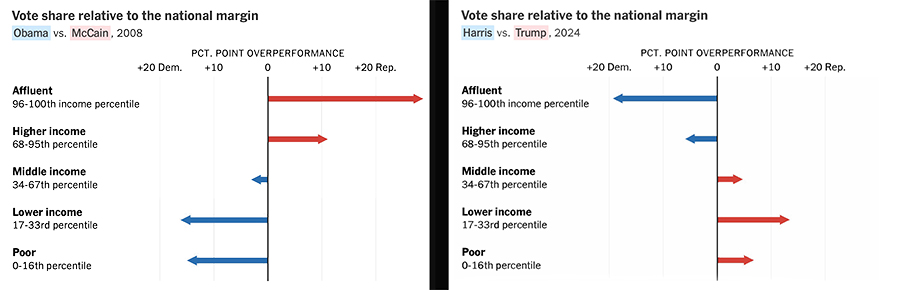
The Democrats have traded poor voters for rich voters. This is a mixed blessing. Rich voters can and do donate more to the party and are very reliable voters. On the other hand, there are fewer of them than poor voters. Electorally, that is not good. Why has this happened?
In part, at least, affluent voters aren't worried about having their money run out before the next payday. This gives them the luxury of worrying about things like climate change, women's rights, social justice and who should use which bathroom. Lower-income voters are focused on having enough money to pay the rent next month. As Democrats have come to focus much more on the things affluent voters care about, they are attracting more of them and driving away lower-income voters. Blue-team politicians see this and pander more to the concerns of upper-income voters. In this way, the Democratic Party has become gentrified. In 2023, the median income in Democratic House districts was $81,000, vs. $69,000 in Republican districts. FDR would be horrified. Hell, Lyndon Johnson would be horrified.
Unfortunately for the Democrats, this is not sustainable because there aren't enough high-income voters to win national elections. But it is worse than that. High-income voters tend to cluster in a small number of big coastal cities. Lower-income voters are spread over many House districts. Some of the issues the Democrats choose to fight for reflect this. For example, the SALT cap is something people making well over $100K in high-tax blue states care about, but working-class people don't. Fighting to raise or eliminate the SALT cap is not a winning issue for Democrats nationally.
As has been pointed out many times by now, Democrats need to focus on issues that working-class voters, especially men, care about: jobs and prices. This doesn't mean they have to stop being Democrats. Some of their pet projects can be salvaged. For example, downplay the climate effects of The Green New Deal and focus on jobs created by manufacturing, installing, and maintaining the equipment needed to use solar, wind, and other renewable energy sources. Sell it as a blue-collar jobs program. Ditto broadband Internet in rural areas. Talk about rebooting dying small towns.
Republicans talk about lowering prices but do nothing about it. Democrats could announce their new secret formula for pushing prices down. It's called "competition." Propose a new antitrust law that would break up big companies simply because they own > 10% of their market. Then the pieces created by the breakups would have to compete with one another for people's business. That would be a force to keep prices in check and it is a simple enough idea that voters could understand it easily. There are plenty of other examples of things Democrats actually want to do that could be retooled to be attractive to working-class voters, but this would require getting rid of all the consultants and hiring completely new ones. It requires a whole new mentality. (V)