
Dem
47

GOP
53

The Dutch parliament consists of two chambers. The lower chamber has 150 seats and nearly all the power. The upper chamber is chosen by the provincial legislatures (much like the U.S. Senate prior to the Seventeenth Amendment) and is somewhat vestigial and has little actual power. Yesterday there was an election for the lower chamber, which is filled by proportional representation. Very roughly, if a party gets [X] percent of the votes it gets [X] percent of 150 seats.
There were 23 parties and a total of 958 names on the ballot in the Haarlem area (not all parties run nationally). The voters were instructed to mark one name by filling in the little circle next to the name of the chosen candidate with the red pencil provided. For Americans who don't like either the Democrats or Republicans, this would be nirvana: 958 choices to pick from! Here is a sample ballot for the Amsterdam area. It measures 33 inches across by just a tad under 24 inches high. Using ranked-choice voting to rank all 958 candidates would be perhaps fairer, but is not used:
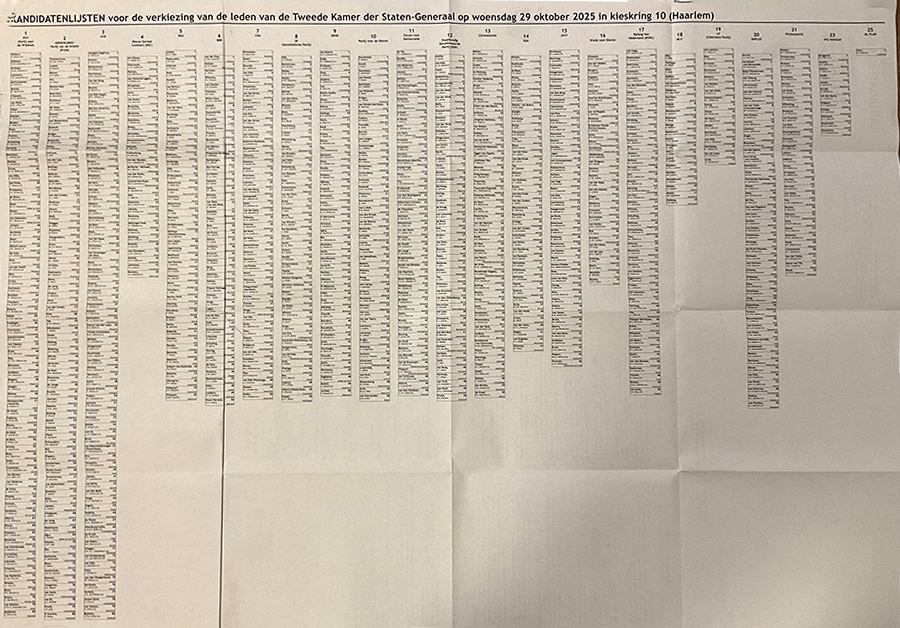
The ballots are counted by hand, but the raw scores then go into a computer program that figures out who was elected. If any candidate on the ballot gets more than 1/150th of the total vote nationwide, that candidate is elected. Excess votes that any candidate gets are applied to the party to elect candidates from the top of the list on down until there are not enough votes left for another member. In the end, each party has some number of votes left over and a complicated algorithm is applied to fill out the last few seats.
Years ago, the Parliament decided the counting software should be open source. Unfortunately, the nonpartisan election commission that conducts elections is made up of lawyers with roughly zero understanding of software or what "open source" even means. Nevertheless, due to EU rules, they had to write out a tender so that companies all over the EU could bid for the contract. They have to be given credit for knowing that they were in over their heads on this one, so they hired a consultant, (V), to help them write the tender. Simple questions from (V) like: "Do we want to allow the bidder to choose the programming language? What if the low bidder chooses x86 assembly language?" led to blank stares. This was years ago, but from memory, (V) thinks he insisted on Java, as Python was not as well-known then and picking Python would have limited the number of bids.
While being able to choose from 958 candidates may sound wonderful, it has its downsides. No party ever gets a majority, so after the election, many horses are traded and sausages made, with the voters out of the loop at this point. The process typically takes 6-12 months and the resulting coalition is frequently unstable. Here are the preliminary results with 99.6% of the domestic vote counted. Turnout was 78.4%. Overseas absentee ballots have not been counted yet.
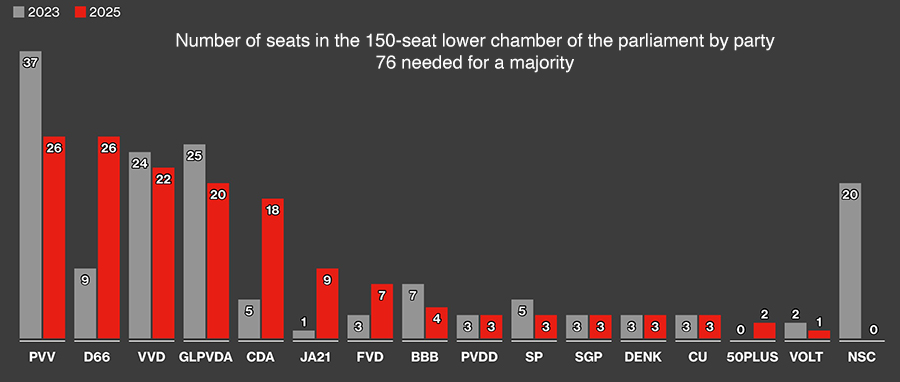
Here's the problem. The PVV, led by Geert Wilders, is a one-issue party: anti-immigrant. It wants to ban all immigration from outside the EU. It also wants to deport many immigrants already inside the country. Wilders also wants to close all the mosques and ban the Quran, but he got into trouble for saying this before, so hasn't said it out loud much recently. None of the other big parties want any part of this. Consequently, it will be necessary to cobble together 76 seats without the PVV.
D66 is a center-left party, led by an openly gay young man, Rob Jetten, and would be very happy to lead a new coalition. Its natural partner is the Green/Labor party (GLPVDA). Together they may have about 46 seats, so they need 30 additional seats from two or more partners. VVD is a center-right party but it doesn't agree with GLPVDA on anything. In a pinch after 6 months of arguments, it might agree to an unhappy coalition. With the VVD, then the three are at 68 seats. They could add the CDA (Christian Democrats), which is center-right. This would be enough, but a shaky coalition that nobody wants. Ja21 is an anti-EU, anti-immigrant, anti-tax, nationalistic party, all of which D66 strongly opposes. D66 would definitely prefer the Christians to these guys. FVD is a fascist party; nobody will deal with them.
BBB is a party for farmers. It opposes the EU environmental rules for farmers. That would be tough for D66, which is strongly pro environment. It is also not a possible replacement for CDA because it is too small. The PVDD (Partij voor de Dieren or animal rights party) wants animals to have rights. Since Fido can't vote, people have to take Fido's interests and feelings into account. Here is their website. It is in Dutch, but with Google translate, you should be able to figure it out. All the small parties are mostly one-issue parties and would be terrible and unreliable partners. It will take months and months of negotiations to hammer out a deal that nobody will like. But you did have a choice of 958 candidates. Be happy. (V)