
Dem
47

GOP
53

It has been known for about 10 years that there is a huge educational divide between Democratic voters and Republican voters. College-educated voters are mostly Democrats now and noncollege white voters are mostly Republicans. There are many more noncollege voters than college-educated voters and the only thing that makes Democrats competitive is that minorities skew Democratic, regardless of education level.
That's the voters. But what about the politicians? Fifty years ago, most politicians from both parties graduated from elite universities, like the Ivies, Stanford, Duke, Georgetown, etc. They all came from similar backgrounds, which made cooperation easier. Democratic Yalies didn't have a lot of problems working together with Republican Yalies, etc. This is part of why the government functioned back then.
This common educational background is much less true now. There are still politicians from Ivy League schools, most obviously Donald Trump (Penn), J.D. Vance (Yale Law School), and Sen. Ted Cruz (R-TX; Princeton and Harvard Law School). Here is a graph showing the percentage of Senate and House Republicans who went to an elite college from 1973 to 2021, when the study ended:
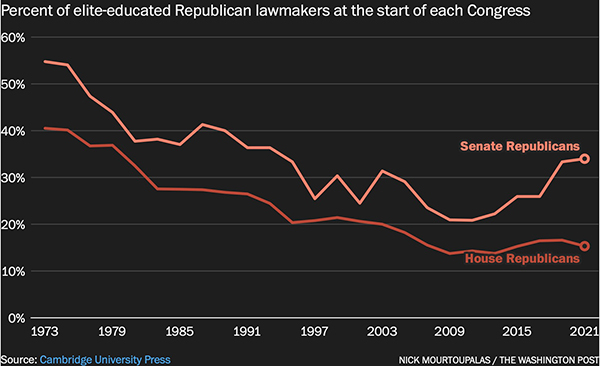
For the Senate, in this time frame it went from 55% to 34% in 2021 (and 26% now). For the House, it went from 41% in 1973 to 15% in 2021. Just looking at Harvard degrees in the House, Democrats went from 9% in 1973 to 15% in 2021. Republicans went from 10% in 1973 to 3% now. Yale degrees in the Senate went down from 12% to 0% among Republicans but 5% to 6% among Democrats. Other metrics are similar. Basically, it used to be that Democratic and Republican politicians had similar educational backgrounds. That is not true anymore. Democratic politicians are now appreciably more elite than Republican politicians.
This gap could have lasting consequences. If Democratic politicians come from elite backgrounds, they could be increasingly out of touch with their constituents whereas Republican politicians who went to state schools could be more in touch with them. This is not necessarily the case, though. FDR, who was one of the most pro-working-man presidents, went to Harvard. Still, Democratic politicians need to be aware of this problem and work consciously to avoid assuming that their constituents are like themselves. (V)