
Dem
47

GOP
53

There are many ways to try to read the tea leaves about control of the House. Broadly, the president's party usually loses House seats in the midterms, sometimes many House seats. Still, that is a very coarse measurement.
Another measurement is retirements. Members of the House are very tuned into how the wind is blowing. They all know that being in the House minority is horrible. They have no power at all. At least senators in the minority can filibuster, but House members don't even have that tool. As a consequence, when a member expects to be in the minority next time, that is often a signal to the member to get out, either by retiring from politics or running for some other office, usually the Senate or governor. So, comparing partisan retirements gives some feeling for how the members are feeling. The nice thing about retirements is that it is easy to go back and see how well this indicator has done in the past.
From our retirements page (see link to the left of the map), you can see that Senate retirements are split 5-5, but senators have long terms and can often buck a tide that House members cannot, so Senate retirements don't say much. House retirements are a better bellwether. Right now we have 16 Republicans and 12 Democrats saying they will retire. That is R-4. To get an idea of how that might play out, here is a historical scatterplot of net partisan retirements and net change in House seats going back to 1938.
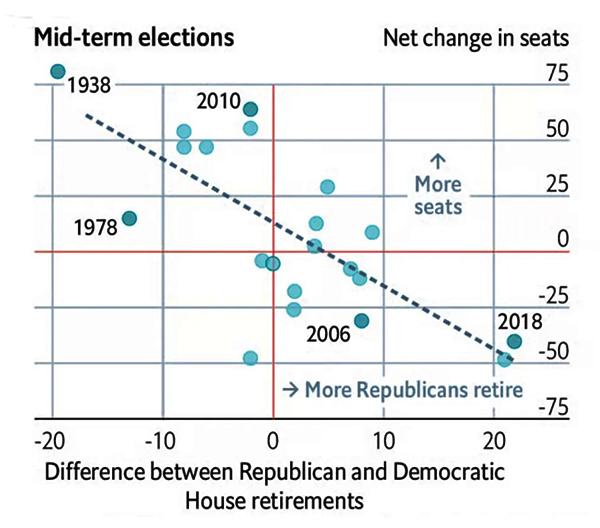
The slope of the regression line is clearly negative. The more Republicans who retire, the worse the Republicans do in the election. Of course, part of that is a self-fulfilling prophesy because the rate of incumbent reelection is over 90% and a Republican giving up a seat increases the chance that a Democrat could take it. With a net R-4 on retirements, the prediction is that the Democrats could pick up some 20 seats. Still, it is early in the season and there could yet be more retirements announced in the fall. (V)