
Dem
47

GOP
53

As we noted in yesterday's post, it's the last Saturday of the month. That means all non-politics questions.
If you are working on the headline theme, we'll tell you that a fair number of people have guessed something like "religious symbols." That's close, but it's not right. And it may help to know that the original headline for the first item was "The Iran War: What a Sh** Show." But we changed it because we thought that was unnecessarily vulgar.
R.P.E.H. in London, England, UK, asks: In his Decline and Fall of the Roman Empire, Gibbon said that "If a man were called to fix the period in the history of the world during which the condition of the human race was most happy and prosperous, he would, without hesitation, name that which elapsed from the death of Domitian to the accession of Commodus." That would be September 96 CE to March 180 CE, or about 84 years.
I can think of several periods where one or two countries have had happier periods (Victorian Britain and post-World War II U.S., for instance) but not one affecting the majority of the global population.
Can you think of an era that could beat Gibbon's choice?(Z) answers: I will start with two caveats. The first is that no historian really has the expertise to answer this question properly, as nobody can know what was going on in all parts of the world in all eras of human history. The second is that it must surely be a rare-to-non-existent situation where things are going well in all parts of the world at the same time. Even Gibbon was really only talking about Europe, which is what historians did in his time, since Europe was the only "important" continent.
That said, if a global "Golden Era" exists, it would be an era in which science and the arts are flourishing. Not only are scientific and artistic progress a big part of things being "golden," they are also an indication that things are going well enough that civilizations have the resources for things that go beyond mere survival. And that leads to the best answer I have to the question, which is "the 16th century." In Europe, at that time, you had the Renaissance. In the Middle East, you had the "Islamic Golden Age." In the Americas, the Mayan, Inca and Aztec Empires were at full flower, before the damage wrought by the Spanish and other Europeans. In Asia, the Ming Dynasty was at its peak, which meant a flourishing economic and artistic climate. And in Africa, you had the rise of powerful and important empires, most obviously the Songhai, right before that continent would be plundered for resources and slaves.
S.C. in Bellaire, TX, asks: I have long been fascinated with the fact that the Spanish used to own or control the Netherlands, and I wonder how that plays out in modern Dutch society. Is there animosity between the countries or a special friendship? Does Spanish cuisine play a role in Dutch cooking or Spanish architecture in Dutch buildings? Do Dutch children learn Spanish? Are there people and places in the Netherlands with Spanish names? Does the cultural impact also go the other way, with Dutch ways influencing Spain? And do Spaniards visit the Netherlands in high numbers or vice-versa?
(V) answers: I'm not an expert on this, but my understanding is that Spain ruled the Netherlands in the 15th and 16th centuries and the Dutch didn't like it one bit. They fought the Eighty Years' War to get free of Spain. Eventually they broke free. Asking whether Dutch people have a special affinity for Spain is like asking Poles whether they have a special affinity for Germany because Poland was under German management from 1939 to 1945. A few schools may offer Spanish, but many, probably most, do not, although all schools offer English, French and German. There are far more Italian and Chinese restaurants than Spanish ones. No one looks back on the Spanish occupation with fondness. It is common for Dutch tourists to go to Spain because they like the weather, but they also go to Turkey and Greece for the weather.
O.E. in Greenville, SC, asks: Since politics have been focused on Donald Trump for the past 11 years, we may have missed a lot of political stories. Way back in the late 90's, I picked up The George Book of Political Lists, which was a project of the late George magazine, and published not long after the death of John F. Kennedy Jr. It included lists of various political figures of past and present in Congress and the Executive Branch who were descended from others. One stood out: Rodney Frelinghuysen. His ancestors included Frederick Frelinghuysen (general and Federalist senator), Frederick T. Frelinghuysen (Whig/Republican Secretary of State and senator), Joseph S. Frelinghuysen (Republican Senator), and Rodney's dad Peter Frelinghuysen (Republican congressman). Unless I am mistaken, this length of a dynasty makes the Kennedys and Bushes look like small potatoes. Do you think this qualifies as the longest political dynasty in the United States?
(Z) answers: Generally speaking, political dynasties tend to peter out after 3-4 generations. But there are a few who kept it going for longer than that.
The closest analog to the Frelinghuysens is probably the Muhlenbergs, who primarily hailed from Pennsylvania. The Muhlenbergs also include a Founding Parent among their ranks, namely Frederick Augustus Muhlenberg, who helped secure ratification of the Constitution in Pennsylvania, and who served as the very first speaker of the U.S. House of Representatives. In addition to Frederick, there are two Muhlenbergs who were generals, seven who were members of Congress, and one who was a governor (though the governor was matrilineal, and so did not have the last name Muhlenberg). However, unlike the Frelinghuysens, the Muhlenbergs got out of the politics business around the time of the Civil War. Since then, those members of the family who have achieved prominence did so in other fields of endeavor, primarily architecture and academia.
Another family that's had a very long run is the Harrisons. Benjamin Harrison V was one of the signers of the Declaration of Independence, and of course the family had two presidents in the 19th century. There are many other Harrisons who held public office, but outside of the two presidents, those offices were almost exclusively state or municipal office. For example, Carter Harrison III and Carter Harrison IV were both mayor of Chicago. And the last Harrison to hold office, to date, was William Henry Harrison III, who spent much of his career as a state Representative in Wyoming, but also served five terms in the U.S. House, with the last ending in 1969. That's a run of close to 200 years.
The Tafts also had a nice, long run. The first Taft to hold high office was Secretary of War/AG Alphonso Taft, who took office in 1876. And the most recent Taft to hold high office was Gov. Robert Alphonso Taft III (R-OH), who left office in 2007. That's a little over 130 years, which is not too bad.
E.S. in Providence, RI, asks: In legacy media, I understand why the "Newspapers of Record" have been The Washington Post (political center of the U.S.) and The New York Times and The Wall Street Journal (financial center of the U.S.). Historically, have there ever been newspapers in any other cities to earn the "NoR" honorific? Have The Los Angeles Times or any of the Chicago dailies, for example, ever been considered on par with the Post and the Times?
(Z) answers: To start with, newspapers began to assume their modern form in the 1850s. So, there would be no real "newspaper of record" before then, because pre-antebellum-era newspapers were primarily driven by opinion, and were primarily party organs.
For the reasons you outline, since that time, there has always been at least one New York paper and at least one D.C. paper that was considered a "NoR," though not necessarily the modern ones. In the Civil War era, and the early decades of the Gilded Age, the New York NoRs were the New York Herald and New York Tribune. Eventually, those were succeeded by the New York World and the New York Morning/Evening Record. The Times began its ascendancy once Joseph Pulitzer and William Randolph Hearst had both exited the scene, so around 1950 or so. Meanwhile, over that same timeframe (1850-1950) the predominant Washington newspaper was not the Post, but the Evening Star. The Post's ascendancy began around the same time as the Times' did.
For some extended period of time, the Chicago papers were pretty important, as they spoke for certain key political and ethnic factions, and the Midwest tended to dominate presidential politics. The three papers that really mattered were the Chicago Tribune, Chicago Times, and Chicago Daily News. The first was a Republican paper, the latter two Democratic papers, and their period of importance lasted through the early decades of the 20th century. Thereafter, Chicago papers weren't quite as important, though in the latter portion of the 20th century, the Tribune and the Chicago Sun-Times were newspapers of record, of a sort, in the area of culture, thanks primarily to Gene Siskel, Roger Ebert and Mike Royko.
I am unaware of a time that the Los Angeles Times was a newspaper of record on a national level. However, just as the Chicago papers assumed a certain cultural importance, the L.A. Times was arguably the newspaper of record for sports for several decades. This was due to: (1) the work of prominent columnists like Jim Murray, (2) the presence of successful teams like the Lakers, Dodgers and Raiders, and (3) being on Pacific Time meant that the Times' daily information was much more complete than the papers in other time zones.
J.L. in Chapel Hill, NC, asks: When I was a kid in elementary school, teachers used to say, "George Washington had slaves, but he was nice to his slaves." As an adult, I've always assumed that was B.S. However, I was surprised when you wrote, "It is also true that [Washington] was more humane than most of his fellow slaveowners." So maybe it was true and not just a way to elide a complicated issue for second graders? Care to elaborate? In what way, or to what extent, was that true?
(Z) answers: Broadly speaking, Washington ran his plantation like he was the general, and his laborers were his army. So, he expected very high levels of discipline, and he preferred to use his words and the example he set personally to motivate and/or discipline his workers. He did not particularly favor harsher forms of imposing order, like physical violence and selling enslaved people south to more difficult work environments.
That said, sometimes a soldier requires something more than words and a role model. And so, Washington would allow his overseers to turn to the lash, as a last resort. He also sold a few runaways "down the river," though he did not consciously break up families, the way most large plantation owners did. He was not overly generous in providing for his enslaved workers' needs, giving them the bare minimum in terms of clothing, bedding, shelter and food, though he did allow them to accept tips from visitors, and to hunt/forage for themselves.
This is obviously not a sterling track record, but it's still more humane than most of Washington's slave-owning peers.
A.A. in Branchport, NY, asks: I live not too far from Rome, NY, where one can find Fort Stanwix. The fort was built by the British during the French and Indian War and was reoccupied by the colonials during the Revolution. Could you perhaps expand on the Fort's importance during the Revolution?
(Z) answers: The defense of Fort Stanwix, by the colonials, was a key element in frustrating the Saratoga campaign of Gen. John Burgoyne. Ultimately, Burgoyne was compelled to surrender his force, which in turn persuaded foreign nations, particularly France and the Netherlands, that it was worthwhile to render significant aid to the Americans. This development was one of the turning points of the Revolutionary War.
M.S. in Canton, NY, asks: In your item on the Iran War, you cited the two major sieges of the Civil War as Atlanta and Petersburg. I was surprised that you did not mention Vicksburg. How would you assess its importance in the flow and outcome of the war?
D.A. in Brooklyn, NY, asks: (Z) wrote, regarding Civil War military history: "But the truth is that the real drama was in the two major sieges of 1864: Atlanta and Petersburg." To put my question in Brooklynese: "And what's Vicksburg, chopped liver?".
Seriously, cutting the Confederacy in half, complete control of the Mississippi, and forcing Lee in an ultimately futile salient northward seem more than on par with Atlanta, though of course not as triumphant and decisive as Petersburg.
So my question to (Z) is: Why not "Vicksburg and Petersburg" instead of "Atlanta and Petersburg"?(Z) answers: I chose my words very carefully, and said nothing about the relative importance of Vicksburg. What I wrote was that Petersburg and Atlanta were where the drama was.
To the extent there was drama surrounding Vicksburg, it was whether Ulysses S. Grant would find a way to lay siege to the last remaining Confederate stronghold on the Mississippi River. However, once he was able to do so (May 1863), then it was only a matter of time until the town fell. There was limited drama, because the outcome was not in doubt, and because Grant and the Lincoln administration were not pressed for time—no election was imminent, and there was no possibility that Vicksburg might hold on until November 1864.
Splitting the Confederacy into two was critically important, but Vicksburg was not dramatic in the way Atlanta and Petersburg were.
R.C. in Des Moines, IA, asks: After reading (Z)'s history lesson on sieges and blockades from Friday, I wondered what if the successes of the 1864 sieges of Atlanta and Petersburg had been delayed long enough to cause Lincoln to lose the election. Assuming Lincoln is not the president at war's end and does not fall victim to Booth's assassination and the Civil War turned out virtually the same, what might Lincoln's postwar prospects have looked like, political or otherwise? Might he have been a political force or would he more likely have retired to private life?
(Z) answers: So, you're putting together a timeline by which: (1) the North wins convincingly, but (2) Lincoln is not killed and (3) Lincoln is not left to deal with the mess that is Reconstruction.
Lincoln's inclination, according to his wife, was to quietly return to civilian life and to resume the practice of law. Maybe he would have done that, which would have meant basically following the template that most ex-presidents followed in the 19th century. However, I am inclined to doubt it. Lincoln would have been much like Andrew Jackson—far and away the most towering figure in a political party of recent vintage. Plus, he loved to be in the arena, and to play the chess game. So, I think he would have emerged as an elder statesman, and his counsel and his endorsement would have been sought after.
That said, the two presidential elections after Lincoln were won by Ulysses S. Grant, who would have remained a hero in your scenario, and who would have had Lincoln's full backing in any case. That takes us to 1876. And Lincoln appears to have had health problems that would have shortened his lifespan, and would be pushing 70 by then. So, he might have been around long enough to influence the presidential election of 1876 (assuming Rutherford B. Hayes was not his preferred candidate), but that's probably the upper limit.
C.S. in Philadelphia, PA, asks: I was listening to a war briefing and the American forces on the map were in blue and the Iranian forces in red. Nearly every historical war map I can recall has the Americans/Allies/good guys in blue and the opposing forces in red. Does this date back to the simple fact that the Continental Army wore blue and the British were the redcoats? Do other countries have a different coloring scheme?
(Z) answers: You're on the right track, but not exactly for the reason you think. For a long time, the Brits used red on maps to indicate the extent of their empire because, you know, redcoats. But during World War I, when modern military cartography came of age, the French insisted that blue be used, because they did not want people to be given over to the (false) impression that Britain was contributing the largest number of troops to the war effort. The Brits acceded to the request/demand, and the convention caught on. It became even more firmly entrenched thereafter, particularly once the bad guys were Communists (aka "reds").
S.S.L. in Battle Creek, MI, asks: I tend to imagine history as a sort of fiction, rationally acknowledging something happened without being able to envision it with the same realism as I do the world today. How can we get a good sense of the texture of historical life? My only ideas are to watch films like Lincoln and visiting Colonial Williamsburg.
(Z) answers: There is a small but palpable movement in the field of history, particularly public history, to try to speak to all the senses. You are on target that living history and reenactment, done well, can convey insight that cannot otherwise be had. A well done movie can do the same, particularly if the filmmaker is detail-obsessed, as Steven Spielberg is.
I have two additional suggestions. First, try to track down historical music, particularly if you can find performances in the style that would have been characteristic of the era. For example, most people have heard "Yankee Doodle," but don't know that when it was performed in the 19th century, at least by professionals, it was done in operatic style.
Second, it is not too hard to find historical recipes. And if you execute them, you get some sense of what cooking was like in the past, and also what food tasted like. There are lots of cookbooks and websites along these lines; I particularly like Rare Cooking. And my favorite recipe on Rare Cooking is Maccarony Cheese, which gives you a pretty good sense of what macaroni and cheese was like when George Washington had it for dinner.
R.V. in Pittsburgh, PA, asks: Clarence Thomas was confirmed by a 52-48 vote.
TWELVE Democrats voted for him..
Why do you think 12 Democrats supported this man for Associate Justice? I realize judicial nominations were nowhere as polarized back then as they are now. But Thomas was seen as a controversial nominee and this was a Supreme Court seat. Shouldn't the Senate Democrats have forced President Bush to nominate someone in the mold of another David Souter ?(Z) answers: There were two dynamics in play. First, back then, members of the Senate tended to be pretty deferential to Supreme Court picks from the other party, because they wanted the other party to be deferential to THEIR picks when the time came.
Second, at that time, the whole "Southern Democrat" dynamic was still being sorted out. For example, one of the "Democrats" who voted for Thomas was Richard Shelby, who would officially flip to Republican just a couple of years later. Many other "Democratic" votes for Thomas were likewise Democrats in name only, or were answering to voters who were either Democrats in name only or who had already flipped to the Republican Party. The states whose "Democratic" senators gave Thomas their votes, in addition to Alabama, were Arizona, Delaware, Georgia (x2), Illinois, Louisiana (x2), Nebraska, Oklahoma, South Carolina, and Virginia. Some of those folks, like Sam Nunn of Georgia or Alan J. Dixon of Illinois, were bona fide Democrats (albeit Blue Dog Democrats). Most of them were not.
Note also that there was one vote that was the mirror image of this. The one Republican to vote against Thomas was Jim Jeffords of Vermont. Eventually, he registered as an independent and started caucusing with the Democrats.
D.S.A. in Parish, NY, asks: If—please, oh please, oh please—the blue wave washes many members of the Republican Party out to pasture, due to the aggressive re-gerrymandering, will "dummymander" have a shot as the Oxford English Dictionary's word of the year?
(Z) answers: Recently, OED has tended to favor words and phrases coming out of youth culture, like "Rage bait" (2025), "Brain rot" (2024), "Rizz" (2023) and "Goblin mode" (2022). Before that, however, they tended to favor words and phrases that were more in the vein of political issues like Vax (2021), Pandemic/Lockdown/Social distancing (2020) and Climate emergency (2019). Perhaps most instructive, the word of the year for 2016, when Donald Trump got elected, was "Post-truth." So, if the gerrymanders turn into dummymanders, I think "dummymander" has a puncher's chance.
S.M. in Watertown, MN, asks: Why didn't the episode of Star Trek: Deep Space Nine "Far Beyond the Stars" win ALL the Emmys?
(Z) answers: Because that show appealed to a demographic that doesn't much line up with the demographics of Emmy voters, and because awards voters in general do not give a whole lot of respect to sci-fi, horror, westerns, comedies, or several other genres.
R.C. in Denver, CO, asks: I love it when a movie has a great last line, either because it's just funny, or because it really completes the movie in a special way.
My favorites include: The last line of The Artist, "with pleasure," which is the first time we hear the main character speak, and it almost explains the whole movie by itself; the last line of The Lives of Others, "Das icht fur mich", which is a double-meaning that makes for a beautiful, touching ending; the last line of Sky Captain and the World of Tomorrow, "lens cap," which is just comedy and, perhaps my favorite of all, the last line of Fanboys, "What if the movie sucks?," which pretty much sums up the entire experience of being a Star Wars fan raised on the original trilogy.
What are your favorites?(Z) answers: I will start with six classic last lines, all of which are in the running for the most classic final line of them all:
- Casablanca: "Louis, I think this is the beginning of a beautiful friendship."
- Chinatown: "Forget it Jake. It's Chinatown."
- Gone With the Wind: "After all, tomorrow is another day"
- King Kong: "Oh, no! It wasn't the airplanes. It was Beauty killed the Beast."
- Sunset Boulevard: "All right, Mr. DeMille, I'm ready for my closeup."
- The Wizard of Oz: "There's no place like home!"
And now, six of my favorites that do not appear on the list above:
- Animal House: "No prisoners!"
- Back to the Future: "Roads? Where we're going, we don't need roads!"
- Full Metal Jacket: "I am so happy that I am alive, in one piece and short. I'm in a world of sh**... yes. But I am alive. And I am not afraid."
- The Princess Bride: "As you wish."
- Spider-Man: "This is my gift, my curse. Who am I? I'm Spider-Man."
- The Usual Suspects: "The greatest trick the devil ever pulled was convincing the world he did not exist. And like that... he is gone."
I am also a fan of movies that end with very appropriate musical numbers, like RRR ("Eng Kor Jap") or The Blues Brothers ("Jailhouse Rock").
L.B. in Bozeman, MT, asks: What is the best screen (movie or TV) adaptation of a novel? What is your favorite adaptation?
(A) answers: I don't have an answer, as I try to only read or see one or the other, as a rule. I realized at some point that, otherwise, I'm guaranteed to be disappointed, one way or the other. I think the last adaptation I saw for which I'd also read the source material was Interview with the Vampire (the 1994 film). It was a mediocre film, based on a mediocre book. I don't remember which disappointed me more. (The rest of Anne Rice's Vampire Chronicles books are fantastic.)
(Note: I specified the film because there was also a TV series by the same name, which I never saw.)
(Z) answers: In terms of best adaptation, a pretty good case can be made for Gone With the Wind, given the movie's runaway success and cultural impact. However, I will choose The Godfather.
Meanwhile, my favorite adaptation is To Kill a Mockingbird. Not too far behind that one is The Princess Bride.
R.V. in Pittsburgh, PA, asks: I haven't read any Stephen King books, but I've seen a ton of his movies. Do you think the books are generally better than the movies? Which Stephen King movies were your favorites? I think his two best movies are a tie between The Shining and The Dead Zone.
(Z) answers: I am not much a fan of horror, either in written or visual form. But I can still tell you that the near-universal consensus is that King's books are almost always better than the movie adaptations. The reason is pretty obvious, I think. In the books, King can leave certain key details to the reader's imagination. In the movies, that doesn't really work. The best-known example of this is It. In the book, the villain's nature is not specified. In the movie, they had to make a decision on how to represent "It," and they chose... a scary clown.
With only one or two exceptions, the best King adaptations are films that are: (1) not horror, and (2) based on King's short stories or novellas, rather than his novels. Movies that fit this description include The Shawshank Redemption, The Green Mile and Stand By Me.
D.S. in Layton, UT, asks: If you were to make a 15-track album of your favorite (not most ground breaking, or most popular, but personal favorite) Beatles songs, what would they be?
(L) answers: In no particular order:
- "And I Love Her"
- "Blackbird"
- "Eleanor Rigby"
- "Hey Jude "
- "In My Life"
- "Let It Be "
- "Love Me Do"
- "Lovely Rita"
- "Paperback Writer"
- "She's Leaving Home"
- "Something"
- "Taxman"
- "When I'm Sixty-Four"
- "While My Guitar Gently Weeps"
- "Yesterday"
(Z) answers: My list is also in no particular order, and has a lot in common with (L)'s list:
- "A Day in the Life"
- "Baby's in Black"
- "Being for the Benefit of Mr. Kite!"
- "Cry Baby Cry"
- "Eleanor Rigby"
- "Hey Bulldog"
- "In My Life"
- "Let It Be "
- "Norwegian Wood (This Bird Has Flown)"
- "Something"
- "Twist and Shout"
- "While My Guitar Gently Weeps" (Anthology version)
- "Yesterday"
- "You Really Got a Hold on Me"
- "You've Got to Hide Your Love Away"
M.B. in San Antonio, TX, asks: Since baseball has been an extensive topic in recent weeks, I wonder what you make of this meme that seems to pop up every late September or early October. Correlation is of course not causation, but among a certain set, this is a rife source of conspiracy theories:
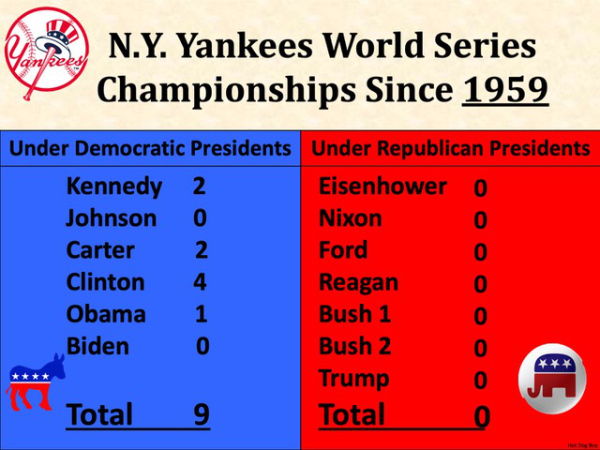
(Z) answers: I think it is a prime illustration of Mark Twain's observation: "There are three kinds of lies: lies, damned lies, and statistics."
First, the Yankees won four titles under Republican presidents in the 1920s, including at least one each under Warren Harding, Calvin Coolidge and Herbert Hoover.
Second, the Yankees won four titles under Dwight D. Eisenhower. They just didn't win in his last 2 full years in office (1959 and 1960).
Third, what on earth could be the cause-and-effect relationship between "president's party" and "Yankees World Series success"?
A.F. in Cincinnati, OH, asks: As of Friday night, the Cincinnati Reds are 17-9. Thoughts? Will it finally be a good season for them, or will it go just as it always has?
(Z) answers: I am sorry to be the bearer of bad tidings, but Bill James demonstrated conclusively, many years ago, that a team's record should correlate closely with their run differential. Over the course of a season, a team that scores as many runs as it gives up should be a roughly .500 team. Every +10 runs above even is +1 win above .500, every -10 runs below even is +1 loss below .500. So, a team that is +100 runs should end up around 91-71, a team that is -50 should end up around 76-86.
What this generally means is that if a team significantly outperforms its run differential, it's gotten an unusual amount of good luck of one form or another. The Reds' run differential right now is -1, which means that instead of 17-9, they should really be 13-13. The Chicago Cubs are also 17-9, but their run differential is +45, which means that they should really be 18-8.
It is not impossible for a team to outperform its run differential in the short-term, or the medium-term, but it's nearly impossible to do so over the course of a season. So, barring improved play, the Reds should be a .500 team going forward. And the Cubs should be... considerably better than that.
That is the bad news, now here is the good news. If a team stops having good luck, that does not necessarily imply they will have an equivalent run of bad luck. The good luck wins are already in the bank, and do not influence future events. So, if the Reds do become a .500 team from here on out, they will finish with a record of 85-77. Last year, that was good enough for them to make the playoffs (in fact, they made it with an 83-79 record).
R.S. in Ticonderoga, NY, asks: My beloved Mets finally won a couple games this week after a 12-game losing streak, and now their National League East compatriots, the Phillies, are on a losing streak of their own. What are some of the most futile teams in American professional sports history (I know there are some really woeful losing streaks in college sports)?
The Tampa Bay Buccaneers losing their first 26 games over the 1976 and 1977 seasons comes to mind, but they were an expansion team and might therefore get a pass. And it doesn't have to be losing streaks—some really bad teams win once in a while.(Z) answers: OK, here are the worst teams in the history of the Big Four sports, in my opinion.
MLB is easy. The worst team ever, somewhat legendarily, is the 1899 Cleveland Spiders. They were raided for talent by the St. Louis Cardinals, who were owned by the same person (it was within the rules for someone to own two teams back then). Bereft of all of their good players (among them Cy Young), the Spiders were terrible. They were so bad that few fans would show up, and so visiting teams began refusing play in their stadium (no money to be made). Consequently, the Spiders played their last 84 games on the road. They went 11-101 in their road games, 20-134 overall, lost 41 of their last 42 games, and had a run differential of -726 (a record). That was, mercifully, the final season for the team.
For the worst NFL team, I will go with the 1944 Chicago/Pittsburgh Cardinals/Steelers. The various NFL franchises had difficulty putting together rosters during World War II, and the Steelers had a temporary merger with the Philadelphia Eagles in 1943, during which time the combined team was known as the Steagles, and then the same arrangement with the Chicago Cardinals in 1944, during which time the combined team was known as the Card-Pitts. The Card-Pitts threw a staggering 41 interceptions, and lost by an average of 22 points a game. Those are both records, and it should be no surprise the Card-Pitts finished 0-10. Since the Cardinals also went 0-10 the previous year, they are the only NFL team to have consecutive winless seasons. They also lost their last six games in 1942 and their first three in 1945, to put together an NFL record 29 straight losses.
For the worst NHL team, I am going to give a slight edge to the 1992-93 Ottawa Senators over the 1974-75 Washington Capitals. Both were expansion teams, and both were terrible. But the Senators lost their first 39 road games (and, in fact, only won one road game all season), and they also lost 11 straight games at home. Both are NHL records. Their best goalie gave up 4.3 goals per game, and their worst gave up 7.2 per game. Their overall record was 10-70-4.
For the worst NBA team, I choose the Los Angeles Clippers. In this case, I am not picking a particular season, just their overall and very persistent lack of success. They are one of five NBA teams to never play in the NBA Finals, and they've been coming up short for 56 years, which means they've been at it for nearly 20 years longer than the next oldest team on the list (Charlotte Hornets, 38 years without an NBA Finals appearance). The Clippers are also the only team in the entire league that has not retired a number, other than that of Bill Russell, whose number has been retired league-wide. The team has the third-worst winning percentage among active franchises, at .428. This season, they spent $191,938,984 on payroll, which was ninth in the league AND they got caught cheating by paying star guard Kawhi Leonard under the table. And despite this, they had the 18th-best record in the league and got booted out of the playoffs during the play-in round. Leonard is aging, and the team is about to enter a rebuilding phase, so that 56 years is easily going to extend to 60+, especially since they traded away most of their high draft picks for the next 5 years.
M.C.A. in San Francisco, CA, asks: Just curious why there's been such a dearth of dominant male American tennis players in the past 15-20 years. Growing up, during Grand Slam events, I would always hear names like Jimmy Connors, John McEnroe, Jim Courier, Andre Agassi and Pete Sampras consistently in the mix for titles. Over the past 20 years, the Europeans have dominated the scene, with very few Americans contending. Conversely, the women's game has thrived, producing several Grand Slam winners (the Williams sisters, Coco Gauff, Sloane Stephens—all women of color, I might add). So, what led to the decline in the American men's game and the rise in the women's? Could we see a similar decline in the future of the women's game, since soccer, flag football, and especially basketball, are increasing in popularity and drawing more girls away from tennis?
(Z) answers: Many other countries have invested in tennis infrastructure, including ample courts for practice, and tennis academies. In the U.S., promising male athletes tend to be funneled into basketball, baseball or football, and the remainder who might pursue tennis don't have the support needed to make a serious run at a pro career. Basically, it is necessary to hire a personal coach, and to have a private practice court. It's estimated that the cost to train a potential pro tennis player in the U.S., up to the age of 21, is $1 million. Needless to say, this is well beyond the reach of most people, except the very wealthy.
The U.S. women's players actually tend to have more access to formal tennis academies, particularly if they are willing to move to Florida. The Williams sisters did not go to a tennis academy, but they WERE trained by their father (so, no expensive salary required). Further, other countries have largely not invested in women's sports in the manner they have invested in men's sports, so the competition is not so fierce.
I am not an expert, but I would not predict that women's tennis is headed for trouble in the future. Until fairly recently, it was only a relatively small percentage of girls who considered a career in sports. The success of the various tennis players, the WNBA, the U.S. Women's soccer team, etc., have a LOT more girls moving in a sporting direction. The much larger talent base should be enough to keep the various women's sports adequately supplied with talent.
I.S. in Cap Ferret, France, asks: We are about one month away from Roland-Garros, which begins the last week of May. It is one of France's largest annual sports events. It is the only Grand Slam played on clay. Despite the United States's long record of tennis success, this tournament is an unsolvable puzzle for most American players. In the past 25 years, there have been 3 female American champions: Jennifer Capriati, Serena Williams, and the current champion Cori Gauff. However, there hasn't been an American men's champion in that time. In fact you have to go all the way to 1999 to find a male American finalist, Andre Agassi, who won the title that year.
Why do so many Americans struggle to play on clay and why don't coaches emphasize more training on it to improve their results?(Z) answers: There are relatively few clay courts in the United States—generally no more than a few in any given city. That means younger players really don't have access during their formative years. And since clay plays much different than other surfaces (it favors volleying and tactical play over power and speed), it's hard-to-impossible to catch up, once you've fallen behind on that particular area of training.
K.R. in Austin, TX, asks: I know there's a movement to not focus on "the classics" in school as much. The idea is that most were written by white men and also because there are a great number of wonderful books written since "the classics".
My daughter is reading Dread Nation by Justina Ireland in school. I'm reading along and find it to be very good even though my one-sentence description might make it sound ridiculous: The zombie apocalypse meets the Civil War.
Anyhow, what are your thoughts about revisiting what we consider "the classics" and the idea that education should focus less on those books and broaden the scope to a wider variety of authors?(Z) answers: First of all, nobody can read all (or most) of "the classics." There are too many of them, and quite a few are really beyond the reach of most readers. Very few people can understand Ulysses, for example, or In Search of Lost Time.
Second, as I have noted before, Rush Limbaugh used to do an annual rundown of the most "outrageous" courses at the nation's universities. Maybe someone else has picked up the bit, I don't know. In any case, his list was usually about equally divided between two types of courses. The first type was courses that Rushbo did not agree with, politically, like "Lesbian Literature in Translation." The second type was courses that he thought trivial, like "I Love Lucy: A Critical Appraisal."
All Rush was doing, when he carped about those "trivial" classes, was show that he didn't really understand how higher education works. The goal, at least in most classes, is to teach students how to think and write. The fuel largely doesn't matter, as long as there's some substance there (and there certainly is, with I Love Lucy). And if a teacher or professor has the choice between fuel that will pique students' interest, and fuel that will not, it's generally best to go with the former. Because in that case, students are more likely to be engaged by the material.
So, if your daughter's teacher, or her school district, thinks that Dread Nation is going to pique students' interest more than, say, Ernest Hemingway or Nathaniel Hawthorne, then more power to them.
D.K. in Pataskala, OH, asks: My daughter—C.K. in Pataskala, OH—is about to graduate with a Bachelor's in History and Political Science. I find it interesting that a large part of the "History" component of her collegiate coursework was on "How to be a Historian," as opposed to History classes themselves.
Anyway, what advice would you give to the class of 2026, and especially to newly accredited historians?(Z) answers: First of all, congrats to her on her impending graduation!
Second, my main advice would be to think about if she wants to pursue a career directly related to her degrees. The American Historical Association has a pretty good webpage/booklet called Careers for History Majors, and the American Political Science Association has the same, under the title Careers for Political Scientists. The basic theme that runs through the two presentations is "think broadly about the kinds of jobs that a historian/political scientist might do, from teaching to librarian to research to political aide to... a whole bunch of other things."
If your daughter wants to cast her net more widely, then she will want to think about an effective way to communicate that her studies have given her broadly useful skills, like the ability to write and communicate, and the ability to synthesize information. Some employers—not all—view social sciences degrees as "soft" degrees, and so it's good to be able to make the counterargument.
S.B. in North Liberty, IA, asks: I'm curious if either of you have videos of your lectures. I'd be particularly interested in watching one of (Z)'s History lectures, as I really enjoy looking over your slides when you link to them occasionally.
I am aware of (Z)'s Ted Talk, and I've seen a few interviews with (V), but just wondering if there's something that's maybe not as easy to find on YouTube.(Z) answers: (V) is emeritus, and largely taught in a pre-video era. Nevertheless, there are a few of his conference talks on YouTube. I do have video versions of my lectures that I created during the pandemic, but they are a little rough (I had to crank out 2-3 lectures a week, and they take 20 hours each), and they are now a bit out of date.
One day, I have the idea of mounting some sort of course or courses that would be appropriate to the readers of this site, but that's a way-on-the-back-burner notion for the moment.
S.P. in Harrisburg, PA, asks: I have a behind-the-scenes question I have been wondering about for a while now. Are you actively working on updating the site up until it goes live for the day? With (V) overseas, it's logical he can work on the site during his morning and have it ready by his lunch time. I am more curious about (Z), in the Pacific time zone, with the posting ready by 7:00, 8:00 or sometimes 9:00 a.m. Eastern. Is (Z) an ultra night owl, working through the night to have the post ready by 4:00, 5:00 or even 6:00 a.m. his time? When do you sleep?
(Z) answers: You basically have it right. On the days (V) writes, the post is usually complete around 3:00 p.m. PT. Then I read it over and edit it sometime between 3:00 p.m. and midnight. Then (V) reads it again and posts it. On the days I write, I finish as early as I can, then (V) reads it, then it goes live. Sometimes, as few as 10 minutes elapse between "last word written" and "post is live."
Lateness is most likely on Tuesday mornings (because that post is written after a full day of teaching) and the weekends (because the Saturday posts are the most time-consuming of the week, and because I make time for social plans on weekends, since I cannot work ALL the time). Most days, it's not a big deal for me to stay up until 5:00 a.m. or 6:00 a.m., since I am always up until 3:00 a.m. anyhow. That said, that kind of lateness is a disaster on days where I have to be up at 8:00 a.m. in order to get to my first class of the day on time. So, when that is the case (Wednesday morning, at the moment), I will cut the posting short if I have to.