


 Welcome & FAQs
  Table of Senate polls
 Senate graphs
 Tipping-point-state
 Congress: retirements
 Governor's races
 Icons for bloggers
 Data galore


• Saturday Q&A
• Reader Question of the Week: Spock's Brain, Part III
Pirro Sounds the Retreat on Powell
Late yesterday, U.S. Attorney for Washington, DC, Jeannine Pirro announced that her office was dropping its criminal probe of Fed Chair Jerome Powell. And so, yet another Donald Trump enemy will not so much as see the inside of a courtroom, despite the President's desire to the contrary.
There were two major issues with the Powell prosecution, one of them legal, one of them political. The legal problem was that Powell did not actually break the law. The "charge" against him was that the ongoing renovations of the buildings that house the Federal Reserve were very expensive, and exceeded the original budget, and so—hand wave, hand wave—Powell committed fraud. This administration loves, loves, loves to level that particular charge against anyone and everyone, but declaring fraud and actually proving fraud are two very different things. Perhaps most obviously, if a government project going over budget meant it was time to convict one or more federal officials of fraud, then the prisons would be jammed to the gills with former Washingtonians.
The political problem was that some (maybe many) Senate Republicans were not happy with the investigation and (threatened) prosecution, and at least one of them was in a position to do something about it. That would be Sen. Thom Tillis (R-NC), who is not standing for reelection, but who IS sitting on the Senate Finance Committee, which means he gets a vote about whether or not to advance the nomination for Powell's replacement, Kevin Warsh, to the floor of the Senate. Tillis said he wouldn't do it as long as the Powell investigation was ongoing. And without his vote, there would not be enough votes in favor of supporting the nomination. It is certainly possible for the whole Senate to overrule the wishes of the Committee, but the other Republicans who were unhappy about the Powell situation weren't willing to do that. They might not want to defy Trump openly, at least not yet, but they are also not willing to bend over backwards, and to bend the upper chamber's rules, to accommodate his personal vendettas.
So, that is why Pirro threw in the towel. And naturally she did it on a Friday afternoon, so she could sneak it in under the radar as much as was possible. Like Acting AG Todd Blanche and a couple of other Trump insiders, she aspires to be the nominee to replace the departed Pam Bondi. Giving up on the Powell witch hunt won't help on that front, but perhaps helping Trump to save face by burying the story as much as is possible will compensate, at least a little.
Tillis already made clear that, once his demand was met, he would be willing to support Warsh's nomination. So, barring the unexpected, Warsh will be advanced to the floor of the Senate on a party-line vote, and then will be approved on a party-line vote, maybe with Sen. John Fetterman ("D"-PA) and a couple of other centrists crossing the aisle. Meanwhile, Powell said he would hold on to his seat (which he has until 2028, if he wants it) until the investigation was complete. Customarily, the Chair retires from the Fed when their time in the big chair is up, even if their term as governor is not over. Powell may well honor that tradition, especially since he's 73, has been on the Board for nearly 14 years, and has been Chair for 8. On the other hand, leaving would give Trump the opportunity to fill another seat with another possible flunky. So, Powell might hold on, just to stop that from happening. At very least, he might remain in place until November, to see if the Senate is going to flip to the Democrats. We would guess that even he doesn't know 100% for certain what he'll do at the moment. (Z)
Saturday Q&A
As we noted in yesterday's post, it's the last Saturday of the month. That means all non-politics questions.
If you are working on the headline theme, we'll tell you that a fair number of people have guessed something like "religious symbols." That's close, but it's not right. And it may help to know that the original headline for the first item was "The Iran War: What a Sh** Show." But we changed it because we thought that was unnecessarily vulgar.
Non-Politics Saturday
R.P.E.H. in London, England, UK, asks: In his Decline and Fall of the Roman Empire, Gibbon said that "If a man were called to fix the period in the history of the world during which the condition of the human race was most happy and prosperous, he would, without hesitation, name that which elapsed from the death of Domitian to the accession of Commodus." That would be September 96 CE to March 180 CE, or about 84 years.
I can think of several periods where one or two countries have had happier periods (Victorian Britain and post-World War II U.S., for instance) but not one affecting the majority of the global population.
Can you think of an era that could beat Gibbon's choice?(Z) answers: I will start with two caveats. The first is that no historian really has the expertise to answer this question properly, as nobody can know what was going on in all parts of the world in all eras of human history. The second is that it must surely be a rare-to-non-existent situation where things are going well in all parts of the world at the same time. Even Gibbon was really only talking about Europe, which is what historians did in his time, since Europe was the only "important" continent.
That said, if a global "Golden Era" exists, it would be an era in which science and the arts are flourishing. Not only are scientific and artistic progress a big part of things being "golden," they are also an indication that things are going well enough that civilizations have the resources for things that go beyond mere survival. And that leads to the best answer I have to the question, which is "the 16th century." In Europe, at that time, you had the Renaissance. In the Middle East, you had the "Islamic Golden Age." In the Americas, the Mayan, Inca and Aztec Empires were at full flower, before the damage wrought by the Spanish and other Europeans. In Asia, the Ming Dynasty was at its peak, which meant a flourishing economic and artistic climate. And in Africa, you had the rise of powerful and important empires, most obviously the Songhai, right before that continent would be plundered for resources and slaves.
S.C. in Bellaire, TX, asks: I have long been fascinated with the fact that the Spanish used to own or control the Netherlands, and I wonder how that plays out in modern Dutch society. Is there animosity between the countries or a special friendship? Does Spanish cuisine play a role in Dutch cooking or Spanish architecture in Dutch buildings? Do Dutch children learn Spanish? Are there people and places in the Netherlands with Spanish names? Does the cultural impact also go the other way, with Dutch ways influencing Spain? And do Spaniards visit the Netherlands in high numbers or vice-versa?
(V) answers: I'm not an expert on this, but my understanding is that Spain ruled the Netherlands in the 15th and 16th centuries and the Dutch didn't like it one bit. They fought the Eighty Years' War to get free of Spain. Eventually they broke free. Asking whether Dutch people have a special affinity for Spain is like asking Poles whether they have a special affinity for Germany because Poland was under German management from 1939 to 1945. A few schools may offer Spanish, but many, probably most, do not, although all schools offer English, French and German. There are far more Italian and Chinese restaurants than Spanish ones. No one looks back on the Spanish occupation with fondness. It is common for Dutch tourists to go to Spain because they like the weather, but they also go to Turkey and Greece for the weather.
O.E. in Greenville, SC, asks: Since politics have been focused on Donald Trump for the past 11 years, we may have missed a lot of political stories. Way back in the late 90's, I picked up The George Book of Political Lists, which was a project of the late George magazine, and published not long after the death of John F. Kennedy Jr. It included lists of various political figures of past and present in Congress and the Executive Branch who were descended from others. One stood out: Rodney Frelinghuysen. His ancestors included Frederick Frelinghuysen (general and Federalist senator), Frederick T. Frelinghuysen (Whig/Republican Secretary of State and senator), Joseph S. Frelinghuysen (Republican Senator), and Rodney's dad Peter Frelinghuysen (Republican congressman). Unless I am mistaken, this length of a dynasty makes the Kennedys and Bushes look like small potatoes. Do you think this qualifies as the longest political dynasty in the United States?
(Z) answers: Generally speaking, political dynasties tend to peter out after 3-4 generations. But there are a few who kept it going for longer than that.
The closest analog to the Frelinghuysens is probably the Muhlenbergs, who primarily hailed from Pennsylvania. The Muhlenbergs also include a Founding Parent among their ranks, namely Frederick Augustus Muhlenberg, who helped secure ratification of the Constitution in Pennsylvania, and who served as the very first speaker of the U.S. House of Representatives. In addition to Frederick, there are two Muhlenbergs who were generals, seven who were members of Congress, and one who was a governor (though the governor was matrilineal, and so did not have the last name Muhlenberg). However, unlike the Frelinghuysens, the Muhlenbergs got out of the politics business around the time of the Civil War. Since then, those members of the family who have achieved prominence did so in other fields of endeavor, primarily architecture and academia.
Another family that's had a very long run is the Harrisons. Benjamin Harrison V was one of the signers of the Declaration of Independence, and of course the family had two presidents in the 19th century. There are many other Harrisons who held public office, but outside of the two presidents, those offices were almost exclusively state or municipal office. For example, Carter Harrison III and Carter Harrison IV were both mayor of Chicago. And the last Harrison to hold office, to date, was William Henry Harrison III, who spent much of his career as a state Representative in Wyoming, but also served five terms in the U.S. House, with the last ending in 1969. That's a run of close to 200 years.
The Tafts also had a nice, long run. The first Taft to hold high office was Secretary of War/AG Alphonso Taft, who took office in 1876. And the most recent Taft to hold high office was Gov. Robert Alphonso Taft III (R-OH), who left office in 2007. That's a little over 130 years, which is not too bad.
E.S. in Providence, RI, asks: In legacy media, I understand why the "Newspapers of Record" have been The Washington Post (political center of the U.S.) and The New York Times and The Wall Street Journal (financial center of the U.S.). Historically, have there ever been newspapers in any other cities to earn the "NoR" honorific? Have The Los Angeles Times or any of the Chicago dailies, for example, ever been considered on par with the Post and the Times?
(Z) answers: To start with, newspapers began to assume their modern form in the 1850s. So, there would be no real "newspaper of record" before then, because pre-antebellum-era newspapers were primarily driven by opinion, and were primarily party organs.
For the reasons you outline, since that time, there has always been at least one New York paper and at least one D.C. paper that was considered a "NoR," though not necessarily the modern ones. In the Civil War era, and the early decades of the Gilded Age, the New York NoRs were the New York Herald and New York Tribune. Eventually, those were succeeded by the New York World and the New York Morning/Evening Record. The Times began its ascendancy once Joseph Pulitzer and William Randolph Hearst had both exited the scene, so around 1950 or so. Meanwhile, over that same timeframe (1850-1950) the predominant Washington newspaper was not the Post, but the Evening Star. The Post's ascendancy began around the same time as the Times' did.
For some extended period of time, the Chicago papers were pretty important, as they spoke for certain key political and ethnic factions, and the Midwest tended to dominate presidential politics. The three papers that really mattered were the Chicago Tribune, Chicago Times, and Chicago Daily News. The first was a Republican paper, the latter two Democratic papers, and their period of importance lasted through the early decades of the 20th century. Thereafter, Chicago papers weren't quite as important, though in the latter portion of the 20th century, the Tribune and the Chicago Sun-Times were newspapers of record, of a sort, in the area of culture, thanks primarily to Gene Siskel, Roger Ebert and Mike Royko.
I am unaware of a time that the Los Angeles Times was a newspaper of record on a national level. However, just as the Chicago papers assumed a certain cultural importance, the L.A. Times was arguably the newspaper of record for sports for several decades. This was due to: (1) the work of prominent columnists like Jim Murray, (2) the presence of successful teams like the Lakers, Dodgers and Raiders, and (3) being on Pacific Time meant that the Times' daily information was much more complete than the papers in other time zones.
J.L. in Chapel Hill, NC, asks: When I was a kid in elementary school, teachers used to say, "George Washington had slaves, but he was nice to his slaves." As an adult, I've always assumed that was B.S. However, I was surprised when you wrote, "It is also true that [Washington] was more humane than most of his fellow slaveowners." So maybe it was true and not just a way to elide a complicated issue for second graders? Care to elaborate? In what way, or to what extent, was that true?
(Z) answers: Broadly speaking, Washington ran his plantation like he was the general, and his laborers were his army. So, he expected very high levels of discipline, and he preferred to use his words and the example he set personally to motivate and/or discipline his workers. He did not particularly favor harsher forms of imposing order, like physical violence and selling enslaved people south to more difficult work environments.
That said, sometimes a soldier requires something more than words and a role model. And so, Washington would allow his overseers to turn to the lash, as a last resort. He also sold a few runaways "down the river," though he did not consciously break up families, the way most large plantation owners did. He was not overly generous in providing for his enslaved workers' needs, giving them the bare minimum in terms of clothing, bedding, shelter and food, though he did allow them to accept tips from visitors, and to hunt/forage for themselves.
This is obviously not a sterling track record, but it's still more humane than most of Washington's slave-owning peers.
A.A. in Branchport, NY, asks: I live not too far from Rome, NY, where one can find Fort Stanwix. The fort was built by the British during the French and Indian War and was reoccupied by the colonials during the Revolution. Could you perhaps expand on the Fort's importance during the Revolution?
(Z) answers: The defense of Fort Stanwix, by the colonials, was a key element in frustrating the Saratoga campaign of Gen. John Burgoyne. Ultimately, Burgoyne was compelled to surrender his force, which in turn persuaded foreign nations, particularly France and the Netherlands, that it was worthwhile to render significant aid to the Americans. This development was one of the turning points of the Revolutionary War.
M.S. in Canton, NY, asks: In your item on the Iran War, you cited the two major sieges of the Civil War as Atlanta and Petersburg. I was surprised that you did not mention Vicksburg. How would you assess its importance in the flow and outcome of the war?
D.A. in Brooklyn, NY, asks: (Z) wrote, regarding Civil War military history: "But the truth is that the real drama was in the two major sieges of 1864: Atlanta and Petersburg." To put my question in Brooklynese: "And what's Vicksburg, chopped liver?".
Seriously, cutting the Confederacy in half, complete control of the Mississippi, and forcing Lee in an ultimately futile salient northward seem more than on par with Atlanta, though of course not as triumphant and decisive as Petersburg.
So my question to (Z) is: Why not "Vicksburg and Petersburg" instead of "Atlanta and Petersburg"?(Z) answers: I chose my words very carefully, and said nothing about the relative importance of Vicksburg. What I wrote was that Petersburg and Atlanta were where the drama was.
To the extent there was drama surrounding Vicksburg, it was whether Ulysses S. Grant would find a way to lay siege to the last remaining Confederate stronghold on the Mississippi River. However, once he was able to do so (May 1863), then it was only a matter of time until the town fell. There was limited drama, because the outcome was not in doubt, and because Grant and the Lincoln administration were not pressed for time—no election was imminent, and there was no possibility that Vicksburg might hold on until November 1864.
Splitting the Confederacy into two was critically important, but Vicksburg was not dramatic in the way Atlanta and Petersburg were.
R.C. in Des Moines, IA, asks: After reading (Z)'s history lesson on sieges and blockades from Friday, I wondered what if the successes of the 1864 sieges of Atlanta and Petersburg had been delayed long enough to cause Lincoln to lose the election. Assuming Lincoln is not the president at war's end and does not fall victim to Booth's assassination and the Civil War turned out virtually the same, what might Lincoln's postwar prospects have looked like, political or otherwise? Might he have been a political force or would he more likely have retired to private life?
(Z) answers: So, you're putting together a timeline by which: (1) the North wins convincingly, but (2) Lincoln is not killed and (3) Lincoln is not left to deal with the mess that is Reconstruction.
Lincoln's inclination, according to his wife, was to quietly return to civilian life and to resume the practice of law. Maybe he would have done that, which would have meant basically following the template that most ex-presidents followed in the 19th century. However, I am inclined to doubt it. Lincoln would have been much like Andrew Jackson—far and away the most towering figure in a political party of recent vintage. Plus, he loved to be in the arena, and to play the chess game. So, I think he would have emerged as an elder statesman, and his counsel and his endorsement would have been sought after.
That said, the two presidential elections after Lincoln were won by Ulysses S. Grant, who would have remained a hero in your scenario, and who would have had Lincoln's full backing in any case. That takes us to 1876. And Lincoln appears to have had health problems that would have shortened his lifespan, and would be pushing 70 by then. So, he might have been around long enough to influence the presidential election of 1876 (assuming Rutherford B. Hayes was not his preferred candidate), but that's probably the upper limit.
C.S. in Philadelphia, PA, asks: I was listening to a war briefing and the American forces on the map were in blue and the Iranian forces in red. Nearly every historical war map I can recall has the Americans/Allies/good guys in blue and the opposing forces in red. Does this date back to the simple fact that the Continental Army wore blue and the British were the redcoats? Do other countries have a different coloring scheme?
(Z) answers: You're on the right track, but not exactly for the reason you think. For a long time, the Brits used red on maps to indicate the extent of their empire because, you know, redcoats. But during World War I, when modern military cartography came of age, the French insisted that blue be used, because they did not want people to be given over to the (false) impression that Britain was contributing the largest number of troops to the war effort. The Brits acceded to the request/demand, and the convention caught on. It became even more firmly entrenched thereafter, particularly once the bad guys were Communists (aka "reds").
S.S.L. in Battle Creek, MI, asks: I tend to imagine history as a sort of fiction, rationally acknowledging something happened without being able to envision it with the same realism as I do the world today. How can we get a good sense of the texture of historical life? My only ideas are to watch films like Lincoln and visiting Colonial Williamsburg.
(Z) answers: There is a small but palpable movement in the field of history, particularly public history, to try to speak to all the senses. You are on target that living history and reenactment, done well, can convey insight that cannot otherwise be had. A well done movie can do the same, particularly if the filmmaker is detail-obsessed, as Steven Spielberg is.
I have two additional suggestions. First, try to track down historical music, particularly if you can find performances in the style that would have been characteristic of the era. For example, most people have heard "Yankee Doodle," but don't know that when it was performed in the 19th century, at least by professionals, it was done in operatic style.
Second, it is not too hard to find historical recipes. And if you execute them, you get some sense of what cooking was like in the past, and also what food tasted like. There are lots of cookbooks and websites along these lines; I particularly like Rare Cooking. And my favorite recipe on Rare Cooking is Maccarony Cheese, which gives you a pretty good sense of what macaroni and cheese was like when George Washington had it for dinner.
R.V. in Pittsburgh, PA, asks: Clarence Thomas was confirmed by a 52-48 vote.
TWELVE Democrats voted for him..
Why do you think 12 Democrats supported this man for Associate Justice? I realize judicial nominations were nowhere as polarized back then as they are now. But Thomas was seen as a controversial nominee and this was a Supreme Court seat. Shouldn't the Senate Democrats have forced President Bush to nominate someone in the mold of another David Souter ?(Z) answers: There were two dynamics in play. First, back then, members of the Senate tended to be pretty deferential to Supreme Court picks from the other party, because they wanted the other party to be deferential to THEIR picks when the time came.
Second, at that time, the whole "Southern Democrat" dynamic was still being sorted out. For example, one of the "Democrats" who voted for Thomas was Richard Shelby, who would officially flip to Republican just a couple of years later. Many other "Democratic" votes for Thomas were likewise Democrats in name only, or were answering to voters who were either Democrats in name only or who had already flipped to the Republican Party. The states whose "Democratic" senators gave Thomas their votes, in addition to Alabama, were Arizona, Delaware, Georgia (x2), Illinois, Louisiana (x2), Nebraska, Oklahoma, South Carolina, and Virginia. Some of those folks, like Sam Nunn of Georgia or Alan J. Dixon of Illinois, were bona fide Democrats (albeit Blue Dog Democrats). Most of them were not.
Note also that there was one vote that was the mirror image of this. The one Republican to vote against Thomas was Jim Jeffords of Vermont. Eventually, he registered as an independent and started caucusing with the Democrats.
D.S.A. in Parish, NY, asks: If—please, oh please, oh please—the blue wave washes many members of the Republican Party out to pasture, due to the aggressive re-gerrymandering, will "dummymander" have a shot as the Oxford English Dictionary's word of the year?
(Z) answers: Recently, OED has tended to favor words and phrases coming out of youth culture, like "Rage bait" (2025), "Brain rot" (2024), "Rizz" (2023) and "Goblin mode" (2022). Before that, however, they tended to favor words and phrases that were more in the vein of political issues like Vax (2021), Pandemic/Lockdown/Social distancing (2020) and Climate emergency (2019). Perhaps most instructive, the word of the year for 2016, when Donald Trump got elected, was "Post-truth." So, if the gerrymanders turn into dummymanders, I think "dummymander" has a puncher's chance.
S.M. in Watertown, MN, asks: Why didn't the episode of Star Trek: Deep Space Nine "Far Beyond the Stars" win ALL the Emmys?
(Z) answers: Because that show appealed to a demographic that doesn't much line up with the demographics of Emmy voters, and because awards voters in general do not give a whole lot of respect to sci-fi, horror, westerns, comedies, or several other genres.
R.C. in Denver, CO, asks: I love it when a movie has a great last line, either because it's just funny, or because it really completes the movie in a special way.
My favorites include: The last line of The Artist, "with pleasure," which is the first time we hear the main character speak, and it almost explains the whole movie by itself; the last line of The Lives of Others, "Das icht fur mich", which is a double-meaning that makes for a beautiful, touching ending; the last line of Sky Captain and the World of Tomorrow, "lens cap," which is just comedy and, perhaps my favorite of all, the last line of Fanboys, "What if the movie sucks?," which pretty much sums up the entire experience of being a Star Wars fan raised on the original trilogy.
What are your favorites?(Z) answers: I will start with six classic last lines, all of which are in the running for the most classic final line of them all:
- Casablanca: "Louis, I think this is the beginning of a beautiful friendship."
- Chinatown: "Forget it Jake. It's Chinatown."
- Gone With the Wind: "After all, tomorrow is another day"
- King Kong: "Oh, no! It wasn't the airplanes. It was Beauty killed the Beast."
- Sunset Boulevard: "All right, Mr. DeMille, I'm ready for my closeup."
- The Wizard of Oz: "There's no place like home!"
And now, six of my favorites that do not appear on the list above:
- Animal House: "No prisoners!"
- Back to the Future: "Roads? Where we're going, we don't need roads!"
- Full Metal Jacket: "I am so happy that I am alive, in one piece and short. I'm in a world of sh**... yes. But I am alive. And I am not afraid."
- The Princess Bride: "As you wish."
- Spider-Man: "This is my gift, my curse. Who am I? I'm Spider-Man."
- The Usual Suspects: "The greatest trick the devil ever pulled was convincing the world he did not exist. And like that... he is gone."
I am also a fan of movies that end with very appropriate musical numbers, like RRR ("Eng Kor Jap") or The Blues Brothers ("Jailhouse Rock").
L.B. in Bozeman, MT, asks: What is the best screen (movie or TV) adaptation of a novel? What is your favorite adaptation?
(A) answers: I don't have an answer, as I try to only read or see one or the other, as a rule. I realized at some point that, otherwise, I'm guaranteed to be disappointed, one way or the other. I think the last adaptation I saw for which I'd also read the source material was Interview with the Vampire (the 1994 film). It was a mediocre film, based on a mediocre book. I don't remember which disappointed me more. (The rest of Anne Rice's Vampire Chronicles books are fantastic.)
(Note: I specified the film because there was also a TV series by the same name, which I never saw.)
(Z) answers: In terms of best adaptation, a pretty good case can be made for Gone With the Wind, given the movie's runaway success and cultural impact. However, I will choose The Godfather.
Meanwhile, my favorite adaptation is To Kill a Mockingbird. Not too far behind that one is The Princess Bride.
R.V. in Pittsburgh, PA, asks: I haven't read any Stephen King books, but I've seen a ton of his movies. Do you think the books are generally better than the movies? Which Stephen King movies were your favorites? I think his two best movies are a tie between The Shining and The Dead Zone.
(Z) answers: I am not much a fan of horror, either in written or visual form. But I can still tell you that the near-universal consensus is that King's books are almost always better than the movie adaptations. The reason is pretty obvious, I think. In the books, King can leave certain key details to the reader's imagination. In the movies, that doesn't really work. The best-known example of this is It. In the book, the villain's nature is not specified. In the movie, they had to make a decision on how to represent "It," and they chose... a scary clown.
With only one or two exceptions, the best King adaptations are films that are: (1) not horror, and (2) based on King's short stories or novellas, rather than his novels. Movies that fit this description include The Shawshank Redemption, The Green Mile and Stand By Me.
D.S. in Layton, UT, asks: If you were to make a 15-track album of your favorite (not most ground breaking, or most popular, but personal favorite) Beatles songs, what would they be?
(L) answers: In alphabetical order:
- "And I Love Her"
- "Blackbird"
- "Eleanor Rigby"
- "Hey Jude "
- "In My Life"
- "Let It Be "
- "Love Me Do"
- "Lovely Rita"
- "Paperback Writer"
- "She's Leaving Home"
- "Something"
- "Taxman"
- "When I'm Sixty-Four"
- "While My Guitar Gently Weeps"
- "Yesterday"
(Z) answers: My list is also in alphabetical order, and has a lot in common with (L)'s list:
- "A Day in the Life"
- "Baby's in Black"
- "Being for the Benefit of Mr. Kite!"
- "Cry Baby Cry"
- "Eleanor Rigby"
- "Hey Bulldog"
- "In My Life"
- "Let It Be "
- "Norwegian Wood (This Bird Has Flown)"
- "Something"
- "Twist and Shout"
- "While My Guitar Gently Weeps" (Anthology version)
- "Yesterday"
- "You Really Got a Hold on Me"
- "You've Got to Hide Your Love Away"
M.B. in San Antonio, TX, asks: Since baseball has been an extensive topic in recent weeks, I wonder what you make of this meme that seems to pop up every late September or early October. Correlation is of course not causation, but among a certain set, this is a rife source of conspiracy theories:
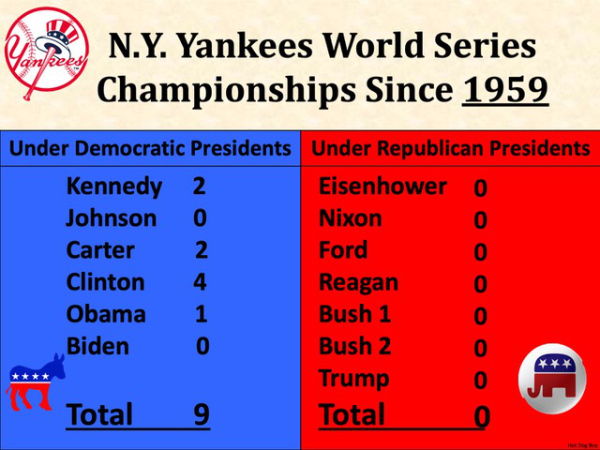
(Z) answers: I think it is a prime illustration of Mark Twain's observation: "There are three kinds of lies: lies, damned lies, and statistics."
First, the Yankees won four titles under Republican presidents in the 1920s, including at least one each under Warren Harding, Calvin Coolidge and Herbert Hoover.
Second, the Yankees won four titles under Dwight D. Eisenhower. They just didn't win in his last 2 full years in office (1959 and 1960).
Third, what on earth could be the cause-and-effect relationship between "president's party" and "Yankees World Series success"?
A.F. in Cincinnati, OH, asks: As of Friday night, the Cincinnati Reds are 17-9. Thoughts? Will it finally be a good season for them, or will it go just as it always has?
(Z) answers: I am sorry to be the bearer of bad tidings, but Bill James demonstrated conclusively, many years ago, that a team's record should correlate closely with their run differential. Over the course of a season, a team that scores as many runs as it gives up should be a roughly .500 team. Every +10 runs above even is +1 win above .500, every -10 runs below even is +1 loss below .500. So, a team that is +100 runs should end up around 91-71, a team that is -50 should end up around 76-86.
What this generally means is that if a team significantly outperforms its run differential, it's gotten an unusual amount of good luck of one form or another. The Reds' run differential right now is -1, which means that instead of 17-9, they should really be 13-13. The Chicago Cubs are also 17-9, but their run differential is +45, which means that they should really be 18-8.
It is not impossible for a team to outperform its run differential in the short-term, or the medium-term, but it's nearly impossible to do so over the course of a season. So, barring improved play, the Reds should be a .500 team going forward. And the Cubs should be... considerably better than that.
That is the bad news, now here is the good news. If a team stops having good luck, that does not necessarily imply they will have an equivalent run of bad luck. The good luck wins are already in the bank, and do not influence future events. So, if the Reds do become a .500 team from here on out, they will finish with a record of 85-77. Last year, that was good enough for them to make the playoffs (in fact, they made it with an 83-79 record).
R.S. in Ticonderoga, NY, asks: My beloved Mets finally won a couple games this week after a 12-game losing streak, and now their National League East compatriots, the Phillies, are on a losing streak of their own. What are some of the most futile teams in American professional sports history (I know there are some really woeful losing streaks in college sports)?
The Tampa Bay Buccaneers losing their first 26 games over the 1976 and 1977 seasons comes to mind, but they were an expansion team and might therefore get a pass. And it doesn't have to be losing streaks—some really bad teams win once in a while.(Z) answers: OK, here are the worst teams in the history of the Big Four sports, in my opinion.
MLB is easy. The worst team ever, somewhat legendarily, is the 1899 Cleveland Spiders. They were raided for talent by the St. Louis Cardinals, who were owned by the same person (it was within the rules for someone to own two teams back then). Bereft of all of their good players (among them Cy Young), the Spiders were terrible. They were so bad that few fans would show up, and so visiting teams began refusing play in their stadium (no money to be made). Consequently, the Spiders played their last 84 games on the road. They went 11-101 in their road games, 20-134 overall, lost 41 of their last 42 games, and had a run differential of -726 (a record). That was, mercifully, the final season for the team.
For the worst NFL team, I will go with the 1944 Chicago/Pittsburgh Cardinals/Steelers. The various NFL franchises had difficulty putting together rosters during World War II, and the Steelers had a temporary merger with the Philadelphia Eagles in 1943, during which time the combined team was known as the Steagles, and then the same arrangement with the Chicago Cardinals in 1944, during which time the combined team was known as the Card-Pitts. The Card-Pitts threw a staggering 41 interceptions, and lost by an average of 22 points a game. Those are both records, and it should be no surprise the Card-Pitts finished 0-10. Since the Cardinals also went 0-10 the previous year, they are the only NFL team to have consecutive winless seasons. They also lost their last six games in 1942 and their first three in 1945, to put together an NFL record 29 straight losses.
For the worst NHL team, I am going to give a slight edge to the 1992-93 Ottawa Senators over the 1974-75 Washington Capitals. Both were expansion teams, and both were terrible. But the Senators lost their first 39 road games (and, in fact, only won one road game all season), and they also lost 11 straight games at home. Both are NHL records. Their best goalie gave up 4.3 goals per game, and their worst gave up 7.2 per game. Their overall record was 10-70-4.
For the worst NBA team, I choose the Los Angeles Clippers. In this case, I am not picking a particular season, just their overall and very persistent lack of success. They are one of five NBA teams to never play in the NBA Finals, and they've been coming up short for 56 years, which means they've been at it for nearly 20 years longer than the next oldest team on the list (Charlotte Hornets, 38 years without an NBA Finals appearance). The Clippers are also the only team in the entire league that has not retired a number, other than that of Bill Russell, whose number has been retired league-wide. The team has the third-worst winning percentage among active franchises, at .428. This season, they spent $191,938,984 on payroll, which was ninth in the league AND they got caught cheating by paying star guard Kawhi Leonard under the table. And despite this, they had the 18th-best record in the league and got booted out of the playoffs during the play-in round. Leonard is aging, and the team is about to enter a rebuilding phase, so that 56 years is easily going to extend to 60+, especially since they traded away most of their high draft picks for the next 5 years.
M.C.A. in San Francisco, CA, asks: Just curious why there's been such a dearth of dominant male American tennis players in the past 15-20 years. Growing up, during Grand Slam events, I would always hear names like Jimmy Connors, John McEnroe, Jim Courier, Andre Agassi and Pete Sampras consistently in the mix for titles. Over the past 20 years, the Europeans have dominated the scene, with very few Americans contending. Conversely, the women's game has thrived, producing several Grand Slam winners (the Williams sisters, Coco Gauff, Sloane Stephens—all women of color, I might add). So, what led to the decline in the American men's game and the rise in the women's? Could we see a similar decline in the future of the women's game, since soccer, flag football, and especially basketball, are increasing in popularity and drawing more girls away from tennis?
(Z) answers: Many other countries have invested in tennis infrastructure, including ample courts for practice, and tennis academies. In the U.S., promising male athletes tend to be funneled into basketball, baseball or football, and the remainder who might pursue tennis don't have the support needed to make a serious run at a pro career. Basically, it is necessary to hire a personal coach, and to have a private practice court. It's estimated that the cost to train a potential pro tennis player in the U.S., up to the age of 21, is $1 million. Needless to say, this is well beyond the reach of most people, except the very wealthy.
The U.S. women's players actually tend to have more access to formal tennis academies, particularly if they are willing to move to Florida. The Williams sisters did not go to a tennis academy, but they WERE trained by their father (so, no expensive salary required). Further, other countries have largely not invested in women's sports in the manner they have invested in men's sports, so the competition is not so fierce.
I am not an expert, but I would not predict that women's tennis is headed for trouble in the future. Until fairly recently, it was only a relatively small percentage of girls who considered a career in sports. The success of the various tennis players, the WNBA, the U.S. Women's soccer team, etc., have a LOT more girls moving in a sporting direction. The much larger talent base should be enough to keep the various women's sports adequately supplied with talent.
I.S. in Cap Ferret, France, asks: We are about one month away from Roland-Garros, which begins the last week of May. It is one of France's largest annual sports events. It is the only Grand Slam played on clay. Despite the United States's long record of tennis success, this tournament is an unsolvable puzzle for most American players. In the past 25 years, there have been 3 female American champions: Jennifer Capriati, Serena Williams, and the current champion Cori Gauff. However, there hasn't been an American men's champion in that time. In fact you have to go all the way to 1999 to find a male American finalist, Andre Agassi, who won the title that year.
Why do so many Americans struggle to play on clay and why don't coaches emphasize more training on it to improve their results?(Z) answers: There are relatively few clay courts in the United States—generally no more than a few in any given city. That means younger players really don't have access during their formative years. And since clay plays much different than other surfaces (it favors volleying and tactical play over power and speed), it's hard-to-impossible to catch up, once you've fallen behind on that particular area of training.
K.R. in Austin, TX, asks: I know there's a movement to not focus on "the classics" in school as much. The idea is that most were written by white men and also because there are a great number of wonderful books written since "the classics".
My daughter is reading Dread Nation by Justina Ireland in school. I'm reading along and find it to be very good even though my one-sentence description might make it sound ridiculous: The zombie apocalypse meets the Civil War.
Anyhow, what are your thoughts about revisiting what we consider "the classics" and the idea that education should focus less on those books and broaden the scope to a wider variety of authors?(Z) answers: First of all, nobody can read all (or most) of "the classics." There are too many of them, and quite a few are really beyond the reach of most readers. Very few people can understand Ulysses, for example, or In Search of Lost Time.
Second, as I have noted before, Rush Limbaugh used to do an annual rundown of the most "outrageous" courses at the nation's universities. Maybe someone else has picked up the bit, I don't know. In any case, his list was usually about equally divided between two types of courses. The first type was courses that Rushbo did not agree with, politically, like "Lesbian Literature in Translation." The second type was courses that he thought trivial, like "I Love Lucy: A Critical Appraisal."
All Rush was doing, when he carped about those "trivial" classes, was show that he didn't really understand how higher education works. The goal, at least in most classes, is to teach students how to think and write. The fuel largely doesn't matter, as long as there's some substance there (and there certainly is, with I Love Lucy). And if a teacher or professor has the choice between fuel that will pique students' interest, and fuel that will not, it's generally best to go with the former. Because in that case, students are more likely to be engaged by the material.
So, if your daughter's teacher, or her school district, thinks that Dread Nation is going to pique students' interest more than, say, Ernest Hemingway or Nathaniel Hawthorne, then more power to them.
D.K. in Pataskala, OH, asks: My daughter—C.K. in Pataskala, OH—is about to graduate with a Bachelor's in History and Political Science. I find it interesting that a large part of the "History" component of her collegiate coursework was on "How to be a Historian," as opposed to History classes themselves.
Anyway, what advice would you give to the class of 2026, and especially to newly accredited historians?(Z) answers: First of all, congrats to her on her impending graduation!
Second, my main advice would be to think about if she wants to pursue a career directly related to her degrees. The American Historical Association has a pretty good webpage/booklet called Careers for History Majors, and the American Political Science Association has the same, under the title Careers for Political Scientists. The basic theme that runs through the two presentations is "think broadly about the kinds of jobs that a historian/political scientist might do, from teaching to librarian to research to political aide to... a whole bunch of other things."
If your daughter wants to cast her net more widely, then she will want to think about an effective way to communicate that her studies have given her broadly useful skills, like the ability to write and communicate, and the ability to synthesize information. Some employers—not all—view social sciences degrees as "soft" degrees, and so it's good to be able to make the counterargument.
S.B. in North Liberty, IA, asks: I'm curious if either of you have videos of your lectures. I'd be particularly interested in watching one of (Z)'s History lectures, as I really enjoy looking over your slides when you link to them occasionally.
I am aware of (Z)'s Ted Talk, and I've seen a few interviews with (V), but just wondering if there's something that's maybe not as easy to find on YouTube.(Z) answers: (V) is emeritus, and largely taught in a pre-video era. Nevertheless, there are a few of his conference talks on YouTube. I do have video versions of my lectures that I created during the pandemic, but they are a little rough (I had to crank out 2-3 lectures a week, and they take 20 hours each), and they are now a bit out of date.
One day, I have the idea of mounting some sort of course or courses that would be appropriate to the readers of this site, but that's a way-on-the-back-burner notion for the moment.
S.P. in Harrisburg, PA, asks: I have a behind-the-scenes question I have been wondering about for a while now. Are you actively working on updating the site up until it goes live for the day? With (V) overseas, it's logical he can work on the site during his morning and have it ready by his lunch time. I am more curious about (Z), in the Pacific time zone, with the posting ready by 7:00, 8:00 or sometimes 9:00 a.m. Eastern. Is (Z) an ultra night owl, working through the night to have the post ready by 4:00, 5:00 or even 6:00 a.m. his time? When do you sleep?
(Z) answers: You basically have it right. On the days (V) writes, the post is usually complete around 3:00 p.m. PT. Then I read it over and edit it sometime between 3:00 p.m. and midnight. Then (V) reads it again and posts it. On the days I write, I finish as early as I can, then (V) reads it, then it goes live. Sometimes, as few as 10 minutes elapse between "last word written" and "post is live."
Lateness is most likely on Tuesday mornings (because that post is written after a full day of teaching) and the weekends (because the Saturday posts are the most time-consuming of the week, and because I make time for social plans on weekends, since I cannot work ALL the time). Most days, it's not a big deal for me to stay up until 5:00 a.m. or 6:00 a.m., since I am always up until 3:00 a.m. anyhow. That said, that kind of lateness is a disaster on days where I have to be up at 8:00 a.m. in order to get to my first class of the day on time. So, when that is the case (Wednesday morning, at the moment), I will cut the posting short if I have to.
Reader Question of the Week: Spock's Brain, Part III
Here is the question we put before readers several weeks ago:
J.W. in West Chester, PA, asks: What do you think is the best episode of any of the Star Trek series?
Today's answers cover the "second generation" series, other than The Next Generation:
D.E. in Lancaster, PA: So, I feel they will take away my Trekkie membership card and fake Vulcan ears if I don't respond to this question. So, this week you're looking for the best episodes of Deep Space Nine, Voyager and Enterprise. Really the best of Star Trek lies in The Original Series, The Next Generation and Deep Space Nine (the closest episode that Voyager had to greatness is "Year of Hell," and Enterprise... well, the less said the better). Of all the series, Deep Space Nine is my all time favorite. There's so much that is excellent about it and it has a wealth of awesome episodes to chose from ("The Emissary," "In The Pale Moonlight," "The Visitor," "What You Leave Behind" and "Beyond The Farthest Star" will probably get the most mentions). As much as I love those episodes, and so many others, my top two favorites are from the first season and the last.
From the first season, the intense "Duet," that seems most prescient to today's issues. In it, Major Kira Nerys, a Bajoran, has to confront a suspected Cardassian war criminal, who ran a brutal labor camp where Kira's people were prisoners. The show brilliantly walks a fine line showing both sides of the story and ultimately explored the concept that war crimes can be just as detrimental to the side that commits them as it is to the oppressed. This is what was called a bottle show, in that it was written to be filmed on existing sets and with as little SFX (usually to save money for an effects heavy show). It proves that great science fiction doesn't always need cutting-edge effects and space battles. I dare anyone to watch this and keep a dry eye at the end. Part of what makes this episode so great is the writing by Peter Allen Field—it is always a gift when TV works on so many levels at once. The other is the star performance of Nana Visitor as Kira and Harris Yulin as Marritiza.
From the last season comes my favorite DS9 episode, "It's Only A Paper Moon." Being that this was in the last season, this puts it deep in the Federation/Dominion War and the episodes by this time were very serialized. In a previous episode, one of the regular characters suffers a pretty substantial injury that leaves them crippled. Being that this is Starfleet, their injury is healed but the character suffers from PTSD. In order to cope, this character escapes into the station's holosuite, where he begins to live in the crew's popular simulation of Vic Fontaine, a fictional lounge singer in 1960's Las Vegas. Fontaine, played beautifully by James Darren, realizes that this character, in their pain, is trying to run away from the world just as much as he (Fontaine) longs for his program to stay running as part of his growing sentience. This episode is masterfully written by Ronald D. Moore—if you have a list of your favorite Next Generation and Deep Space Nine episodes, I would be willing to bet that Moore's name is listed in the credits on most of them. When I used to pitch story ideas to Star Trek, I lived in fear that I would have to pitch to Moore, who I admired so very much, because I would have been reduced to blathering nonsense if I had a chance to talk to him. The reason why out of so many fantastic episodes that this is my favorite is I know what it's like when the thought of living in a TV show or a film is so much more enticing than the real world. Even a space station at the crossroads of a brutal war seemed safer than the real world. This episode appeared when I was still dealing with the after effects of when I was shot at 20 some times in a carjacking gone horribly wrong. And 5 years later, after the death of my Mom, I found comfort living on a moving Island with a Smoke Monster on it. So this episode of DS9 really struck a chord with me because even after almost three decades, there is still a part of me that still lives on that Cardassian Space Station, on that Island and in Westview, NJ. That is the strength of stories, they provide us with shelter when times get hard and a gentle nudge when it's time to leave.
R.L.D. in Sundance, WY: The Original Series is pretty cheesy, but did come up with some good episodes. The second batch, set in the TNG era, were better, especially after Gene Roddenberry was no longer in charge of anything. My favorite from this era is probably the DS9 episode "It's Only a Paper Moon." I'm sure the tears in my eyes right now are 100% related to all the cat hair in the air in this house and not the poignant story of a disabled veteran trying to reintegrate back into his regular life after a harrowing war experience. Especially so since Starfleet is primarily a scientific and exploratory organization with military operations being a secondary mission. This was also a wonderful use of the Vic Fontaine holodeck character, which was a great addition to the later seasons of the show. This is Star Trek done right.
J.P. in Fredericksburg, VA: While "Spock's Brain" does indeed have its charms, my personal favorite episode across the Star Trek Series is "Far Beyond the Stars." It's a magnificent examination of racism and sexism in the early days of pulp sci-fi magazines. Avery Brooks gives a bravura performance as Benny Russell. And we get the fun of seeing all of the regular (and many recurring) cast members without their alien makeup for an hour.
T.L. in West Orange, NJ: I've been so busy with various things over the past several weeks that I fell way behind on Electoral-Vote.com, but my wife made sure that I saw the TNG version of "best Star Trek episodes." The TNG list lines up very well with most of my own favorites as well.
And where Deep Space Nine is concerned, it's my favorite series among the Treks and I have a huge number of opinions on "best episodes.." I'll limit it to a top 3, with an understanding that there are probably half a dozen others that can rotate in and out depending on my mood. In fact, my apologies, but I actually have to make two separate "top 3" lists, because they fall into two very separate categories.
Category One: Episodes that are part of an overarching story. In chronological order:
"Duet": A first-season episode, but one of the first ones to really make it clear that DS9 was going to be a different kind of series than the ones we'd seen before. Incredible character work with Kira, a masterful performance from guest star Harris Yulin, and one of the first episodes to look fans straight in the face with a bleak ending and say "Yep, that's what we do sometimes. Deal with it."
"Improbable Cause": One of the two best episodes featuring plain, simple Garak ever. Densely plotted and yet coherent, Odo showing excellent detective work, and twists that were simultaneously surprising and ones that made you smack your forehead and ask why you didn't see that coming. It also features Garak's rather creative interpretation of "The Boy Who Cried Wolf," which I've quoted to people in a host of circumstances ever since.
"In the Pale Moonlight": The other one of the two best Garak episodes; here he plays the serpent in the garden that is Sisko's brain, with riveting results. To quote Garak, Sisko came to him because "[you] knew that I could do those things you weren't capable of doing"; if there's a better Trek-focused example of the phrase "the road to hell is paved with good intentions," than that moment, I certainly can't think of it.
And Category Two: Episodes that go very far off the beaten path into alternate realities or the equivalent, showing the strength of the cast and of some significant relationships. Again, in chronological order:
"The Visitor": An older Jake Sisko recounts seeing his father die and how it irrevocably warped the rest of his life. I don't think we'd ever seen a parent-child bond in Star Trek on the level of the one between the Siskos we get here, and it's both very sweet and very, very sad. Beautiful.
"Trials and Tribble-ations": Trying to revisit a classic original-series episode and even using footage from it screams "stunt episode," but damned if they didn't pull it off in virtually every detail. (The one place I'd quibble is that the music they put in for the bar brawl scene is a pale shadow of the music used in the original story.) So many brilliant and hilarious moments, and even though Enterprise tried to explain the different appearances of Klingons in a different way, I think Worf's "They are Klingons, and it is a long story... it is not something we discuss with outsiders" is still one of the best lampshadings of a retcon ever. (And my judgment is not at all affected by the fact that I happen to own a tribble that had been used on the set of the DS9 episode!)
"Far Beyond the Stars": Written by a fan of the pulp-sci-fi era, and it shows. Do all the details of "Benny's" publishing office ring true with the actual state of SF writing at the time? Of course not, but the tone feels dead-on, and it's convincing enough to charm the audience in that sense and to make us recoil at blatant racism on the part of some characters. A great way to look back while also looking forward, and a chance for the cast members to show off their chops by playing someone very different and yet very recognizable.
A wonderful trip down memory lane, this topic!
K.D. in North Vancouver, BC, Canada: I'd love to share with our community that I am married to someone who knows and has memorized every episode title of Star Trek, all series. Both of us are lifelong, autistic Trekkies. In fact, on our first date ever, he asked me what I thought was the best Star Trek series of all time. Knowing the stakes were high, I paused, reflected, and said, "Hands down the second half of Deep Space Nine." We are now married with two kids and two dogs. I guess my answer was good!
In that spirit, "In the Pale Moonlight" from season six of Deep Space Nine, in my opinion, is the best written Star Trek episode of all time. It delivers a flawless, character-driven morality play that shatters Gene Roddenberry's utopian ideals without ever feeling preachy or cheap. At its core, the episode is a razor-sharp two-hander between Sisko and Garak, a desperate Starfleet officer/Cardassian exile who together walk the road to hell paved with the best of intentions.
The episode is framed as Sisko's personal log—a raw, confessional monologue delivered with Avery Brooks' intensity. We watch a principled Starfleet captain, the man who has always found a moral third way, systematically dismantle his own ethics in the name of survival. The Dominion War is bleeding the Federation dry, the Romulans are staying neutral, dooming billions. Sisko decides the only solution is to manufacture evidence that the Dominion plans to invade Romulus.
Every step corrodes him:
- He releases a convicted murderer.
- He bribes Quark with latinum and threats.
- He lies to a Romulan senator.
- He watches his forged data rod get exposed as a fake.. and then learns the full truth.
By the end, Sisko is an accessory to murder, forgery, and the assassination of a head of state. His final log entry is devastating: "I can live with it... I can live with it."
That right there, that single line, delivered with quiet, shattered resolve, is one of the greatest closing monologues in Star Trek history. It doesn't celebrate the victory. It mourns the man Sisko used to be. No other Star Trek captain (not Picard, not Kirk, not Janeway and certainly not Archer) is ever allowed to fall this far and still remain the hero. The writing trusts the audience to feel the weight of that compromise.
F.Y. in Ann Arbor, MI: The Dominion War arc toward the end of Deep Space Nine featured some of the best work in the franchise. "It's Only a Paper Moon" stands out.
Nog—whose character showed remarkable growth over the series—loses a leg in combat. Unwilling to face the aftermath, he retreats to the fantasy of Vic Fontaine's holosuite casino. Eventually, Ezri Dax convinces Vic to coax him back into his life.
Apparently Aron Eisenberg—may he rest in peace—had combat veterans approach him and thank him for such a realistic portrayal of Post-Traumatic Stress Disorder.
The exchange at the end: "Are you OK?" "No... but I will be", is a superb acknowledgment of the fact that one doesn't just "fix" PTSD, especially over the course of a 45-minute TV show.
G.N. in Albuquerque, NM: Having grown up watching The Original Series, my favorite Deep Space Nine episode is "Blood Oath." In that episode they brought back three Klingons that appear in the original series—Kang, Koloth, and Kor, played by the original actors dressed up as the updated version of Klingons. I could still tell who they were even through all of that. All three have now passed on, I believe.
A close second would be "Trials and Tribble-ations," based on the above but I suppose all the tribble stuff is a little overdone and overwatched for me (though it's still cool), whereas "Blood Oath" was totally unexpected when I saw it.
A.J. in Mountain View, CA: You reminded me this morning that I had totally forgotten to put in a plug for "Best of Both Worlds." Oh well.
That's ok, because my favorite Star Trek series was really Deep Space Nine. The best storyline episode was arguably "In the Pale Moonlight," which was an excellent portrayal of a major overall theme in the whole show: the tension between the Federation's "high" moral ideals, and the brutal reality of the war they were experiencing.
The best lighthearted story was "Who Mourns For Morn?", in which Morn, a barfly at Quark's bar and up until then a completely minor character who had never had a spoken line of dialogue, is apparently killed, having bequeathed all his assets to Quark. Morn's death brings forth a number of old "friends" from Morn's past who come out of the woodwork to lay claim to Morn's assets. The "friends" turn out to have really been accomplices in a bank heist in which Morn had betrayed them all and kept the stolen latinum for himself. In the end, the accomplices turn on each other, and Quark is the only one left to take possession of a sizable number of gold-pressed latinum bars, only to discover to his horror that there is no actual latinum inside. "There's nothing here but worthless gold!" he exclaims. In the end, Morn shows up at the bar again, alive and well. It turned out that Morn faked his death so that the accomplices would expose themselves and he could be rid of them, and he gives Quark a small amount of latinum as compensation for his trouble. I really appreciated how the writers took a completely unimportant character and suddenly gave him a rich past just for humor value.
A.H.-S. in Brier, WA: I have a soft spot for Deep Space Nine. I've always found the writing and the acting to be compelling. And then, of course, there's Avery Brooks' voice, which ranks up there with Morgan Freeman's.
My favorite episode is the very first, "The Emissary." I really like the challenge that the writers set themselves. At the very start of that first episode, all of the regular characters loathe each other. Picard, Sisko, Kira, Odo, Gul Dukat, Quark... none of them can stand one another. And yet, by the end of that first 2-hour episode, without being obvious about it, you see the emerging respect among them. The entire episode is about building a team.
Or building a new series using the framework of its predecessor without being reliant upon it.
J.G. in Farmington, CT: "Emissary" (Deep Space Nine): Gene Roddenberry was optimistic about humanity to a fault, coming up with kooky ideas like no money, scarcity, selfishness, family issues, or politics. DS9 wisely dispensed with all of that and presented us with a grieving single father stationed on the frontier dealing with the aftermath of a brutal genocidal occupation of an ancient desert-dwelling culture (maybe they should have called this one "Parallels"), trying to balance a violent religious sectional insurgency, erstwhile collaborators, occupation hawks, meddling politicians, smug priests (played by Nurse Ratched!), all with a factional, multinational crew of subordinates. And this episode kicked it all off by killing his wife. No table stakes here.
J.C. in Norman, OK: I missed this Question of the Week when it was first proposed. I am glad you are extending its run.
I have seen most of the Star Trek series, barring the several animated series, and my favorite episode across the entire Trek universe is "The Visitor" from Deep Space Nine. It doesn't take on large issues, as Trek is wont to do. And it only relies on sciency stuff to set the premise. What it focuses on is the relationship between a father and a son and features some outstanding acting by the late Tony Todd. In particular, there is one scene (from 27:00 to 29:15, for anyone who has Paramount+ to watch) that hits its emotional marks without being maudlin.
There are plenty of other episodes across both second and third generation that I like well enough, but "The Visitor" is the only episode I watch over and over again.
J.L. in Los Angeles, CA: For me, asking "What do you think is the best episode of any of the Star Trek series?" is like asking "What is the best food of anything that is edible?" Best meat? Best fruit or vegetable? Best dessert? Best blending of ingredients or combinations of food (sandwich, pizza with toppings, hoagie)? So I need to define the category for which I answer. I mean, my favorite TOS episode is "The Doomsday Machine." But is it the BEST one? No, for me, that remains "The City on the Edge of Forever."
So let's take a brief moment to first define "best." Again, speaking only for myself, for a Star Trek episode to be best, it needs to both ground itself in Star Trek (in other words, it couldn't be done as well in any other TV series or genre) while also TRANSCENDING Star Trek. It needs to go (boldly) somewhere beyond where even the strongest episodes go. And most important of all, it needs to touch me emotionally.
That actually happened last night while my family and I were watching the latest episode of the vastly underappreciated new series Starfleet Academy. "The Life of the Stars" focuses mostly on the EMH Doctor, but you don't realize that until the very end. I won't spoil it beyond that, but the episode left my wife and me bawling our eyes out and my 15-year-old son Jayden spontaneously reaching out to hold my hand during the final five minutes. I said to my family when the episode was over, "This wasn't Star Trek, per se, but it was something so much more." So in that way, I think "The Life of the Stars" might just be the "best episode of any of the Star Trek series."
That said, Deep Space Nine is my favorite of all of the series, and I have to put "The Visitor" and "In the Pale Moonlight" up there with the best episodes of any of the Star Trek series. The former always leaves me crying (happy tears), and the latter defines Benjamin Sisko as someone willing to sacrifice his morals for the greater good of the galaxy and the United Federation of Planets. Kirk, Picard, Janeway... they would each give their lives to save the Federation without hesitation. But Sisko gave his soul.
J.P. in West Dover, VT: Because it is 2026 that we are living through, I have to go with "Past Tense" from Deep Space Nine. The American government housing their homeless and unemployed citizens in the ironically named and walled-off Sanctuary Districts has always been with me, but maybe more so now.
D.B. in Nixa, MO: This is an impossible question for me, since I have not seen enough of the modern series in order to judge them (and I never got fully into the later seasons of Voyager nor any of Enterprise).
As well, comparing best episodes across series is... tough. So instead of a single "best" episode across all series, here's my thoughts and favorites for each of the series I've seen enough to feel comfortable judging my favorite.
Deep Space Nine: I'm going with "Far Beyond the Stars." I'm a sucker for episodes that pull the actors into other characters and seeing so many without the prosthetics... Having a short story that everyone loves being essentially destroyed because the captain of the space station is Black.
Voyager: I stopped watching about halfway through the series (no cable, so no UPN). But from what I saw, "Tuvix." It was still episodic, so there was no doubt that by the end of the episode Tuvok and Neelix would both be restored, but the dilemma that this newly created person, whom everybody loved, had to be destroyed to bring Tuvok and Neelix back.
G.W. in Oxnard, CA: I wanted to go with my gut on second generation Star Trek, so the episode that sprang to mind was "Tuvix" from Voyager. Tuvok and Neelix are merged into a single being due to a transporter accident (the transporter was invented because they couldn't afford to do shuttle scenes in the original series, but became a frequent plot device). At first the merged being is eager to be split into the original two, but it takes a long time to figure out the technical issues and the merged being gets the name Tuvix and becomes a unique individual who is neither Tuvok nor Neelix and yet is both at the same time. When the technical issues are worked out, Tuvix realizes that who he has become in that time will cease to be and neither Tuvok nor Neelix will retain any of Tuvix' memories, because they are using the transporter versions when the accident happened so Tuvix will die in the procedure. Tuvix is unable to perform the duties of Tuvok and Neelix, and the crew's survival may well depend on those abilities, so Capt. Janeway performs the separation in defiance of Tuvix' will. The episode is an exploration of the concept of self and when is it right to take a life to benefit the group.
As a side note: From my perspective as a scientist and engineer, Capt. Janeway was the best Starfleet captain. Kirk, Pike, and Archer all fit the mold of not being interested in hearing the technical issues, just do something that has never been done, and get it done in 20 minutes! Picard would listen to the technical briefings, and as a trained archaeologist, understood maybe half of what was said, then demanded just do something that has never been done, and get it done in 20 minutes! As an engineer, that sort of thing has happened to me before, and I really resent the time I wasted preparing and presenting the technical briefing. Capt. Burnham from Star Trek: Discovery is a special case. She was a scientist, but she felt she was so brilliant that she was unable to delegate to her technical staff. Capt. Janeway was a scientist and had a collaborative working relationship with her technical staff.
G.S.C in South Pasadena, CA: One particular episode of Voyager caused me to drop my jaw. Really. It was "Nemesis." Chakotay crash-lands on a planet that's in some sort of war. The people who look human and speak English have a unique syntax and word order, and use uncommon words in the middle of a sentence, but it is easy to follow and understand. (On that alone, this episode is stellar.) Chakotay, who has lost his ship, joins their fight against those scary-looking aliens. However, at the very end, he learns that those whom he has assisted are, in fact, the bad guys in this war. In the fog of war, it can be difficult to know who to help and who not to: Regardless of how they look.
And, not to be surprised, Gene Roddenberry was one of the writers.
G.R. in Carol Stream, IL: "Survival Instinct" (Voyager), where Seven of Nine says that "survival is insufficient."
W.L. in Springfield, MO: Several years back, I decided to embark on a journey of seeing every Star Trek episode ever made. That journey took a few years and while I revisited a lot of episodes I had already seen, I got a better feel for each series by watching them in the order of release. In the late 80s/90s, I was first introduced to Star Trek. The Next Generation was my gateway but Deep Space Nine ended up being my absolute favorite. That remains so today.
I have seen every episode from The Original Series through Enterprise, but am only a couple of seasons into Discovery. The only other modern series I've invested time in so far is Prodigy. It is hard to imagine anyone watching that many episodes. I've seen, to this point, nearly 800 episodes total and that's out of nearly 1,000 to date. It's a lot and I can't keep track of that many, so I have a spreadsheet. I have every episode I've seen rated on a four-star scale.
Deep Space Nine
Since this is my absolute favorite of the series, you'll not be surprised that I have rated 48 of them at 4 stars.
"The Siege of AR-558" is set in the midst of the Dominion War, a bloody and brutal conflict that has seen the Federation suffer many defeats. Capt. Sisko and crew arrive at a remote Dominion communication relay where a morale-starved garrison is struggling through a five-month stay when the team is supposed to be cycled out every 90 days. Only 43 of the initial 150 troops remain and they are plagued by cloaked mines that detonate around the encampment. As the Dominion launches an assault to retake the relay, Capt. Sisko takes command and while there is victory it comes at a tremendous cost.
This is perhaps one of the most brutally dark episodes of the series, painting war in a harsh and horrifying light. It celebrates the courage of soldiers in the trenches who must often sacrifice themselves to protect others. It distills much of the essence of Deep Space Nine into a single narrative.
Voyager
Although Voyager is often seen as a step down from its predecessors, it started slow but ultimately built up an impressive list of 24 four-star-rated episodes.
I've been trying to avoid episodes that will be cited by others but "The Year of Hell, Parts 1 and 2" is just such a perfect pair of episodes, I couldn't avoid it. This time travel episode finds Voyager caught in a temporal wave that turns the alien Krenim species from an insignificant faction into a powerful force in the system. This is accomplished through the use of a time ship that can eradicate entire species from existence. As the Voyager fights to flee the faction's territory, they suffer immense losses and the ship is at risk of being destroyed. Through an inventive plan, they sacrifice themselves for a chance to reset the timeline. Although this was initially conceived as a season-long idea, ultimately condensing it down to a riveting two-part episode is probably for the best. Sometimes Star Trek is at its best when the idealism of the Federation is put to the test and their way of life is challenged. They have to make tough decisions that don't always guarantee success. It was a turning point for the series, shifting its focus in a direction that ultimately yielded some of its best seasons.
Enterprise
The series had fewer seasons than its three predecessors and faced a lot of frustrated Trek fans who weren't enamored with the idea of rewriting TOS history even though the series attempted to weave into it instead. It takes place prior and leading up to the founding of the United Federation of Planets (UFP). The ship contains a lot of experimental technology that hasn't been tested on long distance missions and the crew must make do with that limited technology and survive in the depths of space. It struggled through its first two seasons but ultimately ended up a solid effort. I gave 12 episodes four stars.
For this one, I'm going to focus on a three-part episode. "Babel One," "United," and "The Aenar." While the last episode is solid, the first two leading to it are terrific. "Babel One" is about an attempt to spur negotiations between the Earth/Vulcan alliance, the Andorians and the Tellarites. While we know they are successful canonically, the episode suggests it was a hard-fought peace. The trilogy deals with an attempt by the Romulans to thwart these efforts and prevent them from unifying and thus becoming a potent force in the quadrant. The dramatic tension ramps up through the first two episodes as they attempt to ensure a peace proposal is ratified. The episode employs many of the core ideals of the United Federation of Planets to showcase how the Trek universe as we know it came to be: the radical idea of peace through cooperation and strength through unity.
S.W. in San Jose, CA: From Voyager, my all-time favorite episode has to be "Scorpion," simply for its intro. It is the shortest intro of any Star Trek episode—about 15 seconds—but without a doubt the most impressive and impactful. Up until that episode, the Borg are the bad-asses of the galaxy, the most powerful race the Federation has discovered so far. We see two Borg cubes approaching with a voice-over of the Borg doing their usual spiel: "Your existence as you knew it is ended, you will adapt to service us, resistance is fut..." and then bolts of energy from off-screen completely obliterate the Borg cubes. Cut to title scene. We don't see the attackers. I've seen that episode many, many times and the intro still awes me for its visual impact and how succinctly it conveys the idea that there's someone out there worse the Borg.
D.E. in Atlanta, GA: For this exercise, I'll go outside the box to a series that wasn't nearly as good as the other three: Voyager (sorry, I don't believe that just because a show takes place on a space station, that it is inferior to one where a ship thousands of light years from the Federation almost never ran out of supplies and the holodeck runs nonstop featuring the Irish countryside). Concerning Enterprise, it may only have had five good episodes over its entire run and I can barely remember them.
"The Thaw" features one of my greatest fears in life: clowns. Played exceptionally well by Michael McKean, he is a (spoiler alert) computer program that was supposed to create a utopia for survivors of an event that destroyed their world. Instead, it plays on their fears and is able to kill them for its own amusement. Think Pennywise, but more articulate and a better dresser. It has some great interactions between the Doctor and the clown and ends with a badass Janeway scene.
Now that I've remembered this episode, I'm going to call my therapist and schedule an appointment.
P.J.T. in Raton, NM: Enterprise's "Dear Doctor" came to mind. Star Trek has thrived by posing difficult moral and ethical dilemmas, and the consequences of this one were catastrophic, whatever the outcome of Dr. Phlox's decision.
Also, Voyager's series finale, the two-part "Endgame," in which the conflict between Janeway (and 7 of 9) and the Borg Queen finally comes to a head.
Next week, we will have responses about the "third generation" Trek series.
Previous report Next report
If you wish to contact us, please use one of these addresses. For the first two, please include your initials and city.
- questions@electoral-vote.com For questions about politics, civics, history, etc. to be answered on a Saturday
- comments@electoral-vote.com For "letters to the editor" for possible publication on a Sunday
- corrections@electoral-vote.com To tell us about typos or factual errors we should fix
- items@electoral-vote.com For general suggestions, ideas, etc.
To download a poster about the site to hang up, please click here.
Email a link to a friend.
---The Votemaster and Zenger
Apr24 Redistricting Wars: Republicans Didn't See This Coming
Apr24 Legal News: Blanche Wants to Throw the Book at the SPLC
Apr24 Today in Marxism: Trump Administration Is Considering an Ownership Stake in Spirit Airlines
Apr24 I Read the News Today, Oh Boy: Vulcan Was Inspired by the Roman Emperor Nero
Apr24 This Week in Schadenfreude: Gold Card Program Is Going up in Smoke
Apr24 This Week in Freudenfreude: Clan of the Fiery Cross
Apr23 Trump Continues His Surrender as Iran Attacks Ships
Apr23 Trump Is Moving into Midterm Mode
Apr23 Trump Is Approaching the Bush Line
Apr23 What Can Be Done to Protect the Midterms from Federal Interference?
Apr23 Democrats Are Gearing Up for a Supreme Court Battle Anyway
Apr23 MAHA Will Get Its First Real Test in Louisiana
Apr23 Senate Rundown
Apr23 Why Is Abbott in No Hurry to Call a Special Election in TX-23?
Apr23 House Democrat David Scott Died Yesterday
Apr23 Trump Fires CEO of Trump Media after 90% of Former Value Is Wiped Out
Apr22 Virginia Wrestles with Redistricting
Apr22 Notes on the State of California
Apr22 Cherfilus-McCormick Falls on Her Sword
Apr22 Political Bytes: Paging Arlen Specter?
Apr22 The Trial of the Century... the 19th Century
Apr21 Another One Bites the Dust
Apr21 Notes on the State of Virginia
Apr21 Another Rebellion in the House
Apr21 Legal Bytes: TrumpWatch
Apr20 Virginians Go to the Polls Tomorrow to Vote on Redistricting
Apr20 Poll: Trump Has No Plan for Iran
Apr20 Trump in Talks with the DoJ about the Mother of all Grifts
Apr20 New Poll: A Quarter of Trump's 2024 Voters Think Deportations Have Gone Too Far
Apr20 Husted's Old Scandal May Come Back to Haunt Him
Apr20 This Is Where a Blue Wave Has to Start
Apr20 Trans Veteran and Rocket Scientist Booted Out by Hegseth is Running for Congress
Apr20 Source: Alito and Thomas Will Not Retire in June
Apr19 Sunday Mailbag
Apr18 Saturday Q&A
Apr17 New Jersey: No, the Longshot Did Not Win
Apr17 Fundraising News: ActBlue Is a Beast
Apr17 Legal News: In Court, Trump Has Lost His Mystique... if He Ever Had It
Apr17 I Read the News Today, Oh Boy: Gerald Ford Was a Michigan Wolverine
Apr17 This Week in Schadenfreude: Not-Exactly-Instant Karma
Apr17 This Week in Freudenfreude: The California Gambit?
Apr16 The Election in New Jersey Today Could Be Another Indicator
Apr16 Republican Senators Are Caught Between Trump and the Pope
Apr16 Vance's Bad Week Got Even Worse
Apr16 Trump's Small Tent
Apr16 Trump Wants Banks to Collect Citizenship Status of Customers
Apr16 Trump Promises Mass Pardons of Enablers before Leaving Office
Apr16 The First 2028 Cattle Call
Apr16 Data Centers Are Becoming a Hot Political Issue

