


 Welcome & FAQs
  Table of Senate polls
 Senate graphs
 Senate averages
 Tipping-point-state
 Congress: retirements
 Governors' races
 Icons for bloggers
 Data galore


• DesperationWatch 2026, Part I: Buying the People's Votes with the People's Money
• DesperationWatch 2026, Part II: Trump Gone Wild
• Local Bytes: A Michigan Deep Dive
• Today's Senate Polls
Donald Trump Is Accused of Rape... Again
Yesterday, the Democrats on the House Judiciary Committee released a report covering what they have learned, from their various investigations, about the Epstein files, and Donald Trump's presence therein. And the big news is that yet another woman has accused Trump of having raped her.
The new accusation comes from Beatrice Keul, who is Swiss, and is a former beauty pageant contestant. A couple of years ago, Keul told the Daily Mail that Trump had groped her while she was participating in one of his pageants back in 1993. According to the report released yesterday, she now says that it was, in fact, rape. And unambiguously so. Here is the key passage from the report (it's pretty rough, so proceed with caution):
Later that day, Donald Trump's representative invited Keul to go upstairs at the Plaza Hotel to meet with Trump. Believing this meeting to be a lucky break for the purpose of furthering her career and education, Keul accompanied Trump's representative upstairs. He ushered her into the suite, where upon entering, Trump reportedly grabbed Keul from behind and forcibly raped her; in the process, tearing her dress and causing bleeding and bruising on multiple parts of her body. Keul described the rape as "brutal." Following the assault, according to Keul's report, Trump sat her on the edge of the bed, repeated his promises to arrange for a visa and NYU admission, and made her promise she would keep quiet, saying, "[T]he show must go on."
Keul reports that she finished the pageant in a terrified "daze" as her passport had been taken from her on her arrival. She did not ask for her passport to be returned before the contest was over, lest she indicate to Trump that something was wrong. During the pageant, she was also summoned, along with four other models, to a private audition with John Casablancas, who made her walk for him and made similar promises about taking care of her. She returned to Switzerland, declining to participate in an additional Trump-sponsored pageant in Hawaii several weeks later. Several months after the assault, Trump called Keul in Switzerland and reiterated his offer to set her up with a visa and admission to NYU. She declined.
John Casablancas, who is now deceased, was a modeling agent who palled around with both Trump and Jeffrey Epstein, had a well-known penchant for "barely legal" women (for example, he dated a 16-year-old in a state where that was the age of consent), and was accused of sexual assault on several occasions.
For our part, we believe Keul is telling the truth. First of all, because Trump is not entitled to the benefit of the doubt anymore. He is a court-adjudicated rapist in all but name; as Judge Lewis Kaplan observed from the bench during the E. Jean Carroll case, New York state law of the era in which Trump assaulted Carroll said that rape must involve a penis, and Trump's assault was committed with his fingers. Trump has also been accused of rape by at least five women besides Keul, while the list of women who have accused him of sexual misconduct of any sort is so long there is an entire Wikipedia article titled Donald Trump sexual misconduct allegations. As to this specific case, Keul's account lines up with Trump's usual MO. The fact that they took the passports of the international models certainly feels like a trick to trap them and to create "keep this quiet" leverage. That Keul refused to be in Trump's presence again once she had escaped, even though there were potential rewards, also makes her account seem credible.
Of course, the case has not been adjudicated in court, and there is no contemporaneous evidence, since it was more than 30 years ago. Further, a White House spokesperson declared that Keul is lying. That same spokesperson then proceeded to remind reporters that Trump has been "fully exonerated of anything related to Epstein." Since that statement is a 100%, unequivocal, no-question-about-it falsehood, it seems fair to assume that the denial is also a falsehood.
Inasmuch as the case will never be adjudicated in a court of law, since the statue of limitations has long run (and that includes the loophole that allowed Carroll to sue long after her assault), then the question is what will happen in the court of public opinion. Clearly, the House Democrats think this will weaken Trump and the Republican Party heading into next week's elections. It's a little icky to use this for political gain, in such a ham-fisted way, but that's the choice they made.
We pondered the matter all day yesterday, and... we just can't see how this could possibly move the needle in a meaningful way. First, because Trump himself is not on the ballot. Second, because attitudes about Trump's sexual misconduct, and Republican enabling thereof, surely have to be baked in at this point, right? Anyone who thinks Trump is a serial sexual assaulter does not need any more evidence. And anyone who thinks he isn't is surrounded by a powerful reality distortion field that isn't going to be pierced by accuser #28 (give or take). Because we just cannot conceive of this having an impact, we almost didn't write this news up. But it seemed problematic to ignore it, and maybe readers will reach a different conclusion from us about the effect of the new revelations. (Z)
DesperationWatch 2026, Part I: Buying the People's Votes with the People's Money
Election Day is a week away. As we have written many times already, and will write many times more in the next week, the polls are overall grim for the Republican Party. The economy is bad in some very politically damaging ways, a subject we will discuss in an item planned for tomorrow. The Epstein files may be bubbling up again (see above), and are always lurking right below the surface. The situation in Iran is bad, and is on the cusp of getting worse (at the moment, we awaken every morning expecting to see news that the Iranians have launched some sort of massive assault). All of this is to say it's desperation time for Trump and his party, and the signs of that are ubiquitous right now.
To start, members of this administration are looking feverishly for ways to get in good with the boss right now. They know next Tuesday is going to be a bad day, and that Donald Trump will be looking for scapegoats that he can scream at, blame, and possibly fire. One good way to kiss the presidential hindquarters right now is to come up with some sort of trickery that will enable his overall strategy of trying to buy people's votes. There have been at least a dozen such schemes of various sorts in the last month, starting with the $5,000 checks that were teased at the faux convention. In the last few days, three additional schemes joined the list.
First up is what would theoretically be the largest cash outlay. Yesterday, Trump got on his social media platform for fraudsters to make this announcement:
Anybody reporting Voter Fraud in the past Elections, or the upcoming 2026 Midterm Election, will be paid $1,000,000 upon the arrest and conviction of those that created the Fraud! Thank you for your attention to this matter. President DONALD J. TRUMP
Sometimes we are interested in seeing what kind of comments a post like this generates. But we'd have to sign up for a Truth Social account, and that's not going to happen.
There is no information whatsoever as to where Trump is going to come up with this money, or under what authority he might award it. These days, he's not bothering with such niceties, since he has no intention of paying out anyhow. Obviously, this is just a backdoor way to put forth his claim that there is all kinds of voter fraud out there. Notice that, in the message, he doesn't even bother to tell people how to report fraud should they wish to do so. He knows full well that the website/tip line/whatever would promptly be flooded with hundreds of thousands of messages reporting the guy who, in 2020 (aka a "past election"), tried to conjure up 11,780 fake votes in Georgia.
Meanwhile, around the same time that Trump was making his pseudo-offer, J.D. Vance was given the privilege of bribing voters with a much smaller amount of money. Campaigning for the shouldn't-be-in-trouble-but-maybe-he-is Sen. Roger Marshall (R-KS), the VP announced that the Department of Agriculture would hand out $57 million in grants to ranchers for the purpose of hand wave, hand wave, hand wave. There were lots of big and impressive words about what the administration is calling the Meat and Poultry Processing Expansion Program, but what it amounts to is that beef prices being paid by consumers went up due to the Iran War, and then to fix that Trump dropped protectionist tariffs on foreign beef. Beef producers have been hit hard by the increased fuel (and other) costs triggered by the Iran War, and then they were hit again by the competition from foreign concerns. So, this is a $57 million band-aid/bribe.
And finally, Trump was performing one of his rallies last week, in Greenville, NC. That city is close to Camp Lejeune, the subject of a lawsuit, and nine-figure compensation fund, for veterans who spent years drinking tainted water while serving at that base. During his show, Trump warned/threatened that if the Democrats win control of either chamber of Congress, those vets who have not received their settlements yet probably never will. The implication was that Democrats would refuse to approve the money, but the truth is that the money has already been allocated, so the only way it would not be paid out would be if the Trump administration refused to do so.
So, that's the latest flim-flammery. The bribes are getting smaller and/or more indirect. We interpret that as a sign that Trump's minions are running out of ideas, and have largely emptied the bag of tricks. (Z)
DesperationWatch 2026, Part II: Trump Gone Wild
A sure sign that Donald Trump is feeling desperate and cornered is that he starts lashing out at various targets, like some sort of wild animal. Over the last several days, a significant uptick in this area has been detectable. Let's run down the most prominent targets the President has gone after:
Bill Maher: It may seem odd to start with someone who is a B-list celebrity, at best, but in this case it is appropriate. There was a dinner at the White House a week or so ago with a guest list that reads like a bad "walked into a bar" joke: Trump, Kid Rock, Bill Maher and sports talk windbag Stephen A. Smith. On the latest installment of his show, Maher addressed the dinner and said, to those who don't like his choice of dining companions: "You know what? F**k you."
It appears that Trump tuned in that night, so that he could hear firsthand the flattering things that Maher said about him. The problem is that Trump stayed tuned in, and so heard some things he did. not. like. In particular, Maher said that all the claims about illegal/fraudulent votes are nonsense. So, Trump got on his social media platform, and let Maher have it. The blast starts thusly:
Let's talk about this COMPLETE AND TOTAL LOSER, Bill Maher. He's got a Low Rated Show on equally Low Rated HBO, which was once, long ago, a Network of Quality and Excitement—But that's all gone. It's not "HOT" anymore!It goes downhill from there, both in terms of acridness and in terms of comprehensibility. In any event, what made this a particularly big story is that Trump apparently set a record for the longest Truth Social post he's ever written, at 1,323 words. Now that's angry; at the rate at which he writes, it must have taken him at least 90 minutes to knock that out. We don't know what poor intern got the miserable job of going through all of Trump's old posts to make sure there wasn't one longer than 1,323 words, but we are glad it wasn't us. For the fun of it, we asked Google's AI bot about this and it reports that indeed, this is the longest bleat ever, far exceeding the 723-word bleat in May about plumbing in the Kennedy Center and attacks on a federal judge and the Supreme Court's tariff ruling.
Barack Obama: Obama, of course, is also doing rallies right now. And at an appearance in Ohio, he poked the bear, telling the crowd:
He should be on HGTV. Guy's building a ballroom that's bigger than the White House. He's paved over the Rose Garden. Put a helicopter pad on the South Lawn, and there's gold everywhere. What's up with the gold? Everything, more gold! He's got the White House looking like Saddam Hussein opened a Cheesecake Factory!Obama knows how to play Trump like a fiddle, and knew full well that would trigger a response. It did, of course. The current president is pretty much always flummoxed by his predecessor, so the response was a little limp. Trump said: "Guys like Obama... for years, they were broken, and he wouldn't notice 'cause he doesn't notice that. He doesn't notice dirt and filth that hadn't been cleaned. The White House—we have to explain that to Obama 'cause he doesn't understand it." Hmmm... lives in filth, and not smart enough to understand the difference. That doesn't play into racial stereotypes at all. Nope, not one bit!
LeBron James: Trump does love to go after Black guys, in part because he has some retrograde views on race, and in part because his base eats it up when the President goes after "uppity" fellows who don't know their place. And so, a couple of days before slurring Obama, Trump went after basketball star LeBron James. Before the first game of the season, James continued to stretch and loosen up while the National Anthem was being performed. The footage, captured on someone's cell phone, was shared widely on right-wing media, and so Trump saw it, and responded thusly:
While listening to our National Anthem, LeBron James disrespects our Country! I said right from the beginning that he's no good, a TOTAL DISGRACE. LeBron James should apologize to all of those Great American Warriors and Heroes who died for the American Flag, and all that our Country stands for! President DONALD J. TRUMPNothing icky about a white man presuming to lecture a Black man on the proper way to behave. Nope, nothing at all. James, for his part, rolled his eyes when he heard about Trump's criticism and said, "Slow day at the office, I guess."
Fox: Trump thinks that Fox' "News" Channel should be as partisan as OAN or Newsmax. Sometimes, the folks at Fox disagree. And sometimes they agree, but they just aren't fanatical enough for Trump's tastes. On Sunday at 9:49 a.m.—so, presumably, right before heading out to church—Trump shared his thoughts on the matter: "FoxNews is spending far too much time putting on the OPPONENTS of Republican Party Candidates, people that love our Country, and have Great Policies and Ideas. These American Patriots are being absolutely "blurred out" by the Media, and Fox is doing little to help." How does he not know, at this point, that it's either Fox "News" or Fox News, but it's definitely not FoxNews? He's only been on the channel at least 2,000 times.
Norway: We find this very hard to believe, but apparently Trump really had deluded himself into thinking he would receive this year's Nobel Peace Prize. On Sunday, he let a crowd in Michigan know that he'd already told several people, including the First Lady, that the prize was in the bag. It was not, obviously, and now Trump blames the entire nation of Norway. After expressing his irritation and disappointment, Trump advised rally-goers that: "I'm not in love with Norway. Frankly, Norway sucks. Norway has become a sh**house country, actually." It is not clear to us if a sh**house country ranks higher than a sh**hole country.
Sen. Lisa Murkowski (R-AK): And finally, the "disloyal" senator who might be Trump's single-biggest bugaboo among currently serving Republican politicians. Murkowski was not pleased about the phony lawsuit that asks for the Senate election results to be injuncted if Sen. Dan Sullivan (R-AK) does not win. And Murkowski was happy to share with both reporters and constituents that she was not happy. Trump responded with yet another screed that lambasted the Senator as "The Republicans' Worst Senator, by far" and ranked-choice voting as a "TOTAL DEMOCRAT SCAM."
So, that's a little less than 3 days' worth. If the Republicans do lose bigly next week, as is generally expected, then Katy bar the door, because Trump is going to make Three Mile Island look like a Sunday picnic. Meanwhile, we have two more DesperationWatch 2026 items planned, but we'll run them tomorrow to keep today's post from getting overlong. (Z)
Local Bytes: A Michigan Deep Dive
We got a long and, we think, interesting report that we're going to start with, and then follow with a few brief responses to yesterday's Local Bytes:
D.E. in Ann Arbor, MI, writes: I've just returned from three hours of door-knocking, canvassing on an early Sunday afternoon, for statewide (Michigan) and local Democratic candidates on the maze-like streets of a suburban neighborhood in my hometown of Ann Arbor:
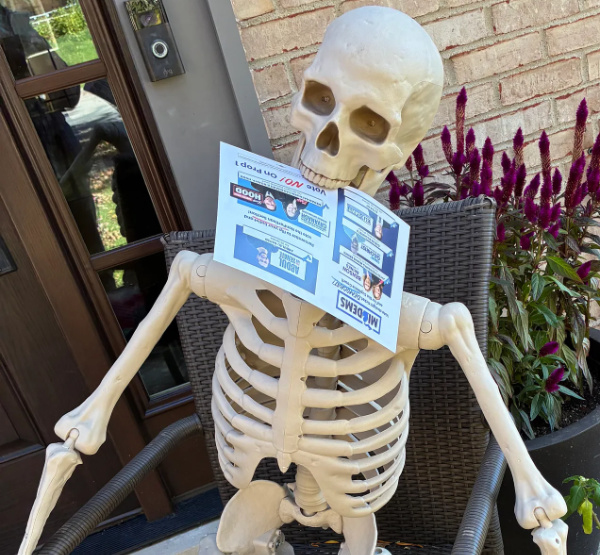
It was my third stint, out of a scheduled six before the election. The minority who answered their doors, or those I encountered outside working on lawn or car chores, were uniformly supportive of all the candidates I was touting, including Senate candidate Abdul El-Sayed. That isn't too surprising, since I was encountering voters from a list compiled on the Democratic canvassing app called Minivan, which is designed for volunteers to contact only voters deemed to be sympathetic.
All the voters I spoke with had plans to vote in the election, and quite a few of them had already voted. I would describe their mood as determined but subdued, buoyed by reports of polls showing Donald Trump to be extremely unpopular and (D) candidates winning in usually-red areas, but also cognizant of the sad state of our country and the many grievous losses our side has sustained over the last 10 years, sometimes unexpectedly.
I tried to be guided by what a canvassing trainer told me: "They may not remember exactly what you said, but they will remember how you made them feel. That's what will get them out to vote for our candidates."
I learned about how three little boys plan to dress for Halloween and how much a guy paid for the quarts he was using to change his oil. I listened to a guy reminiscing about a camping trip he and his wife took to the Maritime provinces of Canada a few years ago.
I listened as a fellow Ann Arbor teaching retiree told me how her husband dropped dead right after they retired: "We had plans; this was not the plan." I listened while an 80-something man, clearly lonely, told me about how he met his wife of 60 years on a blind date, how she was a polio survivor who wore a knee brace, how she eventually sank into dementia and recently died.
One can infer absolutely nothing from the level of support for Abdul in dark-blue Ann Arbor, and in fact I have spoken with a friend and a family member this week who were both deeply pessimistic about his chances, believing a Muslim candidate can't win statewide, given our purple state's large helping of racism and Islamophobia, amplified by lots of negative TV and Internet ads. One voter I talked to referred to the "lies the Republicans are spreading on their TV ads."
Ann Arbor is a prosperous small city, anchored by a premier research university, so on average citizens here aren't hurt as badly by high fuel prices as they might be in struggling postindustrial towns or rural areas. That isn't to say, however, that there aren't many folks who are struggling to keep up with their bills.
Still, the mood in the neighborhood I walked today was upbeat, lifted by the exceptionally nice fall weather we've had for the last few weeks and by kids' anticipation of Halloween fun and loot. Many houses were decked out in spooky decor to greet the upcoming holiday.
Since the folks whose doors I knocked on were so positive, I told the people I randomly encountered outdoors (those who weren't on my Minivan list) that I was getting out the vote for the Dems and offered them a piece of literature. Everyone took it, and I encountered no hostility.
As always, one wonders how accurate the Minivan lists are, though they got everyone's name right, at least. One also doesn't know exactly on what basis the list of those to be contacted is compiled. There were lots of houses with Abdul yard signs that weren't on my list to contact. Is that because HQ thought their votes were assured, or were they just missed?
I have one friend who I sometimes canvass with who is so distrustful of the Minivan lists that he just knocks on every door on the "turfs" he's given. He reports lots of interesting conversations with voters of all varieties. I'm not quite brave enough for that at this point.
Democrats always win handily in all local elections here, and the biggest drama locally surrounds a city ballot initiative that pits one stripe of progressives against another. It calls for the city to take control of our local utility (gas and electric) and run it as a public entity. There are many yard signs for and against this proposal, and the discussion about it goes on intensely on the Nextdoor app.
A 20-something woman who attended the school where I taught is a higher-up in the El-Sayed campaign. When I was trained for canvassing this year, the trainer said we need only inquire whether the voter was supporting El-Sayed, that if they were, it followed they were supporting all the other Dems. There seems to be real enthusiasm about his candidacy here, and in three days of speaking with Dem voters, I have only encountered one who was undecided about supporting him, as well as one who told me her daughter felt that way.
On my way one-mile bike journey home, I decided to count Abdul yard signs. I saw eight; there were no Mike Rogers signs (or any for any other GOP candidate). Again, not too meaningful here in lapis-lazuli Ann Arbor. Whatever else happens on election night, El-Sayed will win here in a landslide.
N.C. in Columbus, MS, writes: Thanks for all the work you are doing! As a Mississippi resident, I wanted to write in with a correction/clarification to the comment from T.G. in St. Paul. Mississippi does have runoff elections if no candidate wins a majority under many circumstances (primaries, elections for statewide offices, judicial elections, and special elections for state and federal legislative offices—which are run without party labels). This is how Cindy Hyde-Smith and Mike Espy ended up in a runoff in the 2018 Senate special election held after Thad Cochran resigned. Runoff elections are not required in regular elections for Congress or state legislature, however. Hyde-Smith or her Democratic opponent, Scott Colom, could win on November 3 with a plurality.
So yes, it's possible that third-party candidate Ty Pinkins could be a spoiler, and on the face of it he might seem more likely to take votes from Colom (Pinkins, like Colom, is a Black man and has run for office as a Democrat in the past). That said, as a Colom supporter I'm not too worried. Pinkins has not been visibly campaigning for the office, and I think the 6% of people saying they will vote for him in a poll are mostly either low-information voters picking at random or Republicans registering dislike for Cindy Hyde-Smith. In a different state, with a different electorate, he might pick up a few DSA types who don't like the fact that Colom was a prosecutor, but this is not a significant voting bloc in Mississippi. (Having served on a grand jury when Colom was a prosecutor, I believe that his reputation for fairness and reform is fully deserved.)
Fingers crossed! It's going to be a heavy lift because Mississippi has few true swing voters and a lot of people in traditionally Democratic constituencies who don't or can't vote, but statewide elections can be very close. I hope the rest of the South will trend in the same direction as Georgia and Virginia, with college-educated white voters starting to vote like they do elsewhere in the country. That is really all it will take to create several new swing states!
S.I. in Minneapolis, MN, writes: R.L.D. in Sundance writes that (among other things regarding political ads) "Until last night, that is, when I saw a new ad from Chuck Gray. I know he has internal polling, which makes me wonder why he's bothering to spend any money at this stage of the game. Like I said, my advice is not to bet on him losing this election, but I can't imagine why he alone would be spending any new money on this race unless he thinks there's a chance he might lose."
One reason to spend money on an ad at this late date, even when your win is secure, is to let the people who have sent money your way see that it is being used. If Gray wants to keep this seat, there is always a chance of a primary challenge in 2028—and he will be hitting up the same donors from 2026. Most donors like to think they are doing more than paying for the electric bill at Gray's election campaign offices.
J.D. in St. Paul, MN, writes: I know it's a small point in the grand scheme of things, and you cannot get everything right, but the welfare fraud scandal in Minnesota is real and was certainly not "manufactured by Republicans," as you have contended several times. Republicans have taken full political advantage, and the despicable Nick Shirley made a racist video about it, but the hard fact is that scammers in Minnesota audaciously defrauded the government (i.e., the taxpayers) of hundreds of millions of dollars over the course of several years, much of that money is now overseas and unrecoverable, and it happened on the Democrats' watch. Maybe if you're not from Minnesota you don't see how shameful this is. We pride ourselves on honest good government and we expect Democrats, in particular, to deliver it. I'm a lifelong, politically astute Democrat, and even I will vote for Lt. Gov. Peggy Flanagan (DFL) for the open U.S. Senate seat only with great reluctance because the future of the Senate matters nationally. She definitely could lose.
Again, we're doing this every day this week. If readers have a report on local races (Senate, House, etc.), please send them to comments@electoral-vote.com. (Z)
Today's Senate Polls
Abdul El-Sayed has a very small margin for error, by all indications. There is a new commercial, which we'll be writing about tomorrow, that is not going to help, we think. Meanwhile, that Nebraska poll has Dan Osborn (I) at 48%. Wow. (Z)
| State | Democrat | D % | Republican | R % | Start | End | Pollster |
| Michigan | Abdul El-Sayed | 48% | Mike Rogers | 46% | Oct 02 | Oct 19 | YouGov |
| Nebraska | No Democrat | 0% | Pete Ricketts* | 41% | Oct 15 | Oct 18 | Concord POP |
* Denotes incumbent
Previous report Next report
If you wish to contact us, please use one of these addresses. For the first two, please include your initials and city.
- questions@electoral-vote.com For questions about politics, civics, history, etc. to be answered on a Saturday
- comments@electoral-vote.com For "letters to the editor" for possible publication on a Sunday
- corrections@electoral-vote.com To tell us about typos or factual errors we should fix
- items@electoral-vote.com For general suggestions, ideas, etc.
- Guidelines for questions (Saturdays) and letters (Sundays)
To download a poster about the site to hang up, please click here.
Email a link to a friend.
---The Votemaster and Zenger
Oct26 Trump May Pardon Everyone in His Administration
Oct26 What If the Polls Are Off?
Oct26 Low-Information Voters Are Souring on Trump
Oct26 Republicans Are Split on Ramaswamy's Despicable Ad
Oct26 Here Are the House Races to Watch
Oct26 Is the Religious Left Rising?
Oct26 Local Bytes: The Last Frontier, and Beyond
Oct26 Brazil Is a Lula Lemon for Trump...
Oct26 ...While We Wait to See if He Gets the Yahu He Wants In Israel
Oct25 Sunday Q&A: Special Polling Edition
Oct24 Trump Files Suit in Alaska
Oct24 Today's Senate Polls
Oct23 Polling, Part I: Another Pollster Goes Up in Smoke
Oct23 Polling, Part II: With Experience Comes Wisdom
Oct23 Legal News: Republicans Go for Broke on Voter Suppression
Oct23 Political Bytes, National Edition: Basic Human Decency Really Is Alien to Trump
Oct23 I Read the News Today, Oh Boy: Lusitania Survivor Frank "Lucky" Tower Wasn't So Lucky
Oct23 This Week in Schadenfreude: Trump Is No Longer FIFA's Top Gun
Oct23 This Week in Freudenfreude: Hopefully This Cheers up Acton, Omar
Oct23 Today's Senate Polls
Oct22 Apocalypse Now
Oct22 Three Election Raters Move Races Mostly Toward the Democrats
Oct22 Dummymander Time?
Oct22 Mike Bloomberg Has Donated $80 Million to the Democrats
Oct22 Could 2026 Be a Harbinger?
Oct22 Some Data on North Carolina Early Voting
Oct22 Dems on House Oversight Committee Are Making Their Lists and Checking Them Twice
Oct22 Today's Senate Polls
Oct21 Believe Women?
Oct21 Today's Desperation News, Part I: The French Connection
Oct21 Today's Desperation News, Part II: Fighting Voter "Fraud"
Oct21 Today's Desperation News, Part III: Fighting Government "Fraud"
Oct21 Today's Senate Polls
Oct20 Trump Continues to Try to Buy the People's Votes with the People's Money
Oct20 The Truman Show
Oct20 Congressional Democrats' To-Do List
Oct20 Trump Learns about Dirty Pool, British-Style
Oct20 JB Pritzker Is In
Oct20 Local Bytes: Ranked-Choice Voting
Oct20 Today's Senate Polls
Oct19 Trump Waives Sanctions on Russia
Oct19 Tax Cuts Don't Cut It
Oct19 What to Watch on Election Night
Oct19 Texas is Tight
Oct19 It Is a Mixed Bag on Senate Fundraising
Oct19 Raphael Warnock Is Campaigning Hard--in Mississippi
Oct19 Let the Blame Game Commence
Oct19 The Year 2027 Will Be a Miserable One for Congressional Leaders
Oct19 Shapiro All but Officially Revs Up His Presidential Engine

