
Dem
47

GOP
53

Our first regular mailbag in a while!
If you're still working on the headline theme, think about what Darth Vader and James Earl Jones have in common, besides their voice.
M.O. in Metamora, MI, asks: In these trying times, I see warnings of fascism everywhere. I'm sold. I've been sold for years. Tens of millions of people are sold. I've got 99 people telling me how bad it is every day. What I don't have is anyone telling me the best way to fight back, or organizing us for resistance. Why is there such a vacuum from Democratic leadership on this? Where is our Million Man March? Where is our Selma Boycott of money interests supporting Trump? Where are our Vietnam black armbands? I see ordinary people doing heroic and small versions of these things every day, but it feels like we could do so much more with organization and leadership from people with knowledge of where the best pressure point would be. If we all were boycotting the same company at the same time. If we all were showing up at the same protest, or sustaining it in shifts.
Why are none of the people that want to be our leaders willing to lead?(Z) answers: Think of the most successful protest movements in history. Women's suffrage. Indian independence. The Civil Rights Movement. The leaders, in all cases, knew that it's a marathon, not a sprint, and that you have to move at a deliberate pace. First, because if you go too far, too fast, you risk a backlash. Second, because only a small percentage of people can pour their hearts and souls into a fight, day after day, without seeing immediate results.
The folks who CAN do that right now, who have the fortitude or the inner strength or whatever it is, are doing that. And they are building the infrastructure of a much larger resistance that will show itself later this year, we think (see our upcoming pieces on Minneapolis for more). Also, we think you might be overlooking some of the large-scale resistance that has already taken place. They may not have been in the same location, but far more than a million people took part in each of the various No Kings rallies.
Also, see the answers for next week's Question of the Week, which will run next Saturday.
A.G. in Bellingham, WA, asks: Colby Hall's recent Mediaite piece "Enough is Enough" articulates what many of us feel: We can't just wait out this term. The administration's flood-the-zone strategy buries negative news (Epstein is buried again by Powell and Minnesota) through constant attacks, constructed world events, and misdirection, and purely reactive coverage keeps the opposition perpetually on defense.
With Republicans now starting to push back, there's an opening. My question: Why aren't more widely-read sites like yours dedicating space to actionable opposition? Something like "How To Fight Back" or "The Daily Opposition"? You could highlight state-level investigations, legislative strategies, or historical parallels of effective resistance. Can you maintain party neutrality while still opposing constitutional attacks? If every piece is reactive, we're playing their game.(Z) answers: It is interesting that you mention Colby Hall. He does not regard his site as an advocacy site. We do not regard our site as an advocacy site. However, we draw our lines in very different ways, such that Hall and (Z) have had a couple of rather pointed e-mail exchanges about Mediaite's editorial practices. Specifically, that site allows its "reporters" to also write op-eds under their own name. So, you'll have a staffer write a few news pieces, like "Trump Reportedly 'Leans Toward' Iran Strike as JD Vance Urges Talks" and then publish a piece with the headline "Three Cheers for Donald Trump's Monumental, Moral Achievement in Venezuela."
How can anyone take this person's "reporting" seriously? This crosses a line that goes uncrossed at any serious publication; either you're reporting, or you're opinion, but you're not both (with the exception of collective, unsigned pieces from the editorial board). (Z) pointed out the problematic nature of this arrangement, and Hall said he likes that it gives the site "balance." Uh, OK.
In any event, here is where our line is drawn:
- We engage in direct advocacy on only one issue: Voting rights/access. This was the reason the site was founded in the first place, and it is, or should be, a non-partisan issue with universal support.
- Consistent with our academic training, we are willing to be critical, even hyper-critical, when the evidence supports it. Pointing out obvious fascist, or proto-fascist, proclivities, for example, would fall within this rubric.
- We give significant coverage to acts of resistance, because that is a part of the overall political milieu.
- We are willing to answer readers' questions, to the best of our ability, including questions on the subject of resistance/protest/pushback. See next week's Question of the Week, for example.
- We are willing to share information about resistance/protest/pushback, for those readers who might want it.
What we will NOT do is: (1) tell readers what they should think, (2) advocate for or endorse specific politicians, (3) advocate for or endorse specific policies, outside of voting rights/access, (4) tell readers how we think they should be resisting the Trump administration.
You might make a good guess as to our personal feelings on some subjects, but if we begin to indulge in direct advocacy/activism/electioneering, then it becomes nearly impossible to take our analysis seriously, because you cannot know if it's actually analytical, or it's just thinly veiled advocacy. This is why (Z) thinks Hall and Mediaite have made a big mistake in the choices they've made.
All of this said, we do have plans to start a new weekly feature in which we highlight an example of resistance each week. It's been in the hopper for a while, and its time is coming soon.
V.H. in Lexington, MA, asks: On 1/6, Donald Trump managed to gin up a mob and get it to attack congress. It wasn't successful, inasmuch as Mike Pence, of all people, stood up to Trump, and the certification went as planned, if a few hours late.
This time, apparently, he doesn't want to leave anything to chance. So he has put together an armed and slightly trained mob in the form of ICE that is invading cities. My friend from Minneapolis says that there are 600 police officers in Minneapolis. ICE sent 2,000 agents there, and then more after the murder of Renee Good. That indicates to me that there are a lot of ICE agents. So, how big is ICE and are we going to see them turn their focus away from immigration, as soon as the stakes are "winning" elections?(Z) answers: This administration is not known for its transparency, but ICE has been expanded from roughly 10,000 agents to 22,000 agents in the last year. It currently has a budget of about $30 billion per year.
To put that in context, the U.S. Marine Corps' budget is about $55 billion per year, to support 173,000 active-duty personnel. Or, to give a somewhat more parallel example, the FBI has 38,000 personnel, and is budgeted at $11 billion per year. So, cash is being lavished on ICE.
We tend to think ICE is part of a larger plan to try to acclimate Americans to the militarization of blue cities. If that is successful (doubtful), the next step is... unclear. However, since the United States does not hold one national election, but tens of thousands of local elections, using force to steal political offices is not as easy a task as Stephen Miller might think it is.
D.H.E. in Culpeper, VA, asks: Any real police officer who fires a weapon is usually put on immediate administrative leave, or at least moved to an administrative position while the expected investigation is underway. I have not seen any mention of whether or not Jonathan Ross, the ICE agent who fired at Renee Good, has been suspended from his routine armed enforcement duties. Can you find out?
(Z) answers: By all accounts, Ross and his family are in hiding in some unknown location, and have at least temporarily abandoned their residence. This is presumably to keep him from being targeted for some sort of vengeance, but it does have the de facto (if not intended) effect of temporarily suspending him from service. And it's hard to see how he could possibly be put on the front lines again anytime soon; the administration doesn't much care if he shoots or kills someone else, but putting him into tense circumstances could certainly cause someone to "accidentally" shoot him in the heat of the moment.
M.M. in Seattle, WA, asks: In your item "Freedom of Suppress," you described the FBI's confiscation of Hannah Natanson's phone, two computers and a smartwatch. What is the point of this? In the modern cloud-based world, most devices are expendable and, as noted in the posting, most any competent professional who deals in sensitive information has top-level encryption of the device itself. Presumably, Natanson could get a new set of devices and be back to work without any real interruption and the FBI would be left with some inaccessible hardware. Besides intimidation and making a public statement, is there any point to such a raid?
(Z) answers: Well, the FBI is pretty good at squeezing electronic devices for information. And many journalists are very good at data hygiene, but they're not perfect at it. So, the FBI might find something, particularly from the smartwatch they took, since those are a bit tougher to encrypt.
But, that said, the primary purpose was indeed to intimidate, both reporters and potential leakers.
E.C. in Seattle, WA, asks: You noted that targeting a reporter could backfire by prompting reporters to double down. Could the real objective instead be to intimidate leakers?
(Z) answers: Yes. However, leakers tend to be a brave sort, and are motivated by a sense of duty, purpose and/or righteousness. Some of them might be intimidated, but the majority will just become even more careful, and thus even harder to identify.
J.A. in Monterey, CA, asks: According to YouGov, Republican support for an invasion of Venezuela went from 43% before the invasion to 74% after it. This may be due to how smoothly it went. But I wonder two things: (1) Should we expect a similar huge bump in Republican support for an invasion of Greenland, from a current level of 35%, if we invade Greenland? and (2) What can be concluded from this? Is this a sign that we're in a cult—that if Trump does it, it must be a good thing?
(Z) answers: There is some of "if Trump does it, it must be a good thing," although it does not necessarily indicate a cult mentality. It could, but there are plenty of Democrats who will reflexively support anything that, say, Barack Obama supports. And we don't think there's a good case for the Democratic Party as a cult.
The fundamental dynamic is that, when you've gone all-in on a person or idea or political program, especially to the extent MAGA has, it's hard to say that the leader or the movement was wrong about [THING X]. Because if they were wrong about [THING X], then what else were they wrong about? It throws the whole worldview into question. Same reason it's hard for some religious adherents to accept that their church might be wrong about [BELIEF Y].
Undoubtedly, if Trump invades Greenland, some MAGA folks will decide that taking over Greenland is a pretty good idea, after all. But we think it will not be accepted nearly as broadly as Venezuela was. Maduro is a legitimate bad guy, and he and his fellow Venezuelans are brown. Greenland and its leaders are not bad guys and gals, and the country to which it "belongs" is full of white people (even if Greenland itself is mostly populated by Inuits).
L.H. in Acton, MA, asks: Do you think Donald Trump is trying to take over Greenland because Vladimir Putin told him to?
(Z) answers: If so, it's not quite that simple. Assuming Putin had the power to give Trump direct orders, the first order would surely be "Turn your back on Ukraine NOW." However, Putin is a slimy bastard, and a master manipulator, and he may have planted a seed in Trump's brain along the lines of "I sure wish Russia had as many natural resources as Greenland does! Do you know how much money we'd make?"
M.M. on Bainbridge Island, WA, asks: Will NATO come to Denmark's defense if/when The Convicted Felon (TCF) invades Greenland? I have read articles saying it would be the end of NATO, though I don't see why they couldn't just evict the U.S. from the treaty and continue on without us. My son has friends who live in Denmark, and he tells me the mood in the country is to put Danish troops on the ground in Greenland to prepare for an eventual invasion. I support that—I would hate to see them give up without a fight, as much as I don't want to see any Americans die in an attempt to take it over.
(Z) answers: It is hard to accept that there would be direct, armed conflict between the U.S. and the other NATO powers, because that would lay the groundwork for a long, ugly, destructive war. Also, it is not outside the realm of possibility that Trump would start using nukes in such a conflict, since he likely has a dim understanding of nuclear fallout, at best.
No, what would surely happen, if Trump took Greenland by force, is there would be limited (or no) military resistance. However, there would be massive passive resistance from the people of that Island. Meanwhile, the other NATO powers would shut down the alliance, re-create it under another name without the U.S. (and probably without Turkey and Hungary), and would begin turning the screws on the U.S. in other ways, including no more intelligence-sharing, no more military bases in places like Germany, and probably economic sanctions or boycotts. It would be ugly, even if it wasn't bloody.
K.H. in Scotch Plains, NJ, asks: While you all understandably, from what I know, have a very low opinion of Donald Trump's first term, you did seem to look favorably upon his appointment of Jerome Powell as Fed Chief. The man stayed on through the pandemic and through the Biden administration, and now, for some reason, the man who appointed him is holding a grudge against him. I have a few theories, partially based on what I've read from you: Powell's unwillingness to back down and acquiesce to what the President wants, for one. But what exactly is it that Powell did right since he was appointed to the Fed that makes you think he was the right man for the job, and one of the few bright spots of the first Trump administration? What do you think he did right, and what is a good way to convey that to people who may not be experts on the economy and finance?
(Z) answers: Of the four of us, only (A) has any serious knowledge of the world of finance, and even then, it's self-taught.
The point is, we are not qualified to do an in-depth assessment of Powell's leadership of the Fed. However, we do know that finance in general, and leadership of the Fed in particular, are results-based businesses. And during Powell's time at the helm, the U.S. stock market has set record after record while inflation has remained lower than in other western countries. Given the things that he and the other governors have actual influence over, that's pretty solid.
J.H. in Peterborough, ON, Canada, asks: If Fed Chair Jerome Powell's term ends in May and he becomes again a run-of-the mill Fed Governor, will the new chair have to be chosen from among the remaining already seated Governors? Will that nomination be for a further 10 years? When a space on the board does come up—say, when Powell's term is complete—could that new Governor also be appointed to the position of chair? Could Trump expand the number of Governors beyond seven?
(Z) answers: First of all, a term on the Fed Board of Governors is 14 years, not 10. A person can only be appointed to one such term, though the 14-year appointment can come after they have completed someone else's unfinished term (because that person died or resigned).
Second, the first seat that will come open is that of Stephen Miran, who is currently completing one of the aforementioned unfinished terms (that of Adriana Kugler, who resigned last year to return to academia). Miran is done at the end of this month, so Trump will have an opportunity to nominate a new person, and everyone is going to assume that new person is the Chair-in-waiting. What this means is that the biggest obstacle for Trump is not the lack of opportunity, but the fact that any nomination he makes for the open seat, and later any nomination he makes for Chair (likely to be the same person both times), has to get past the Senate. And several Republican senators (and all the Democrats) are in a not-approving-anyone kind of mood, right now.
Trump cannot legally add seats to the Fed Board of Governors. That said, he also cannot legally change the names of the Department of Defense, the Kennedy Center, or the Institute for Peace, either.
D.E. in Lancaster, PA, asks: I know you guys have a backlog of topics to get through but I was wondering what you thought of the Clintons deciding to ignore the House's subpoena? Yes, I know it was issued by that mentally challenged political hack, Rep. James Comer (R-KY) but I think it's a mistake for Bill to ignore it. For one thing, Bill Clinton can run circles around Comer without breaking a sweat. And if he was involved in the pedophilia orchestrated by Jeffrey Epstein, then tough luck Bubba, it's time to pay the piper. Clinton looks awfully like Trump in deciding to ignore the subpoena.
As far as Hillary, I don't understand why she was given a subpoena in the first place. Maybe they can ask her about her e-mails again. Does Comer really think she can attest to anything? Somehow I doubt Bill ever said to Hillary, "Hey Hill, I'm going to have sex with some underage girls at a tropical island. Wanna tag along?"(Z) answers: There are several reasons that occur to us. First, both Bill and Hillary Clinton are both considerably smarter than Comer and Rep. Jim Jordan (R-OH) combined, with a fair bit of room left over. However, they are both pushing 80, and surely aren't quite as sharp as they once were. Being grilled, under the lights, by hostile people is not easy for anyone, even when they are at the top of their mental game.
Second, Jack Smith was fielding questions about material that he knows inside and out, backwards and forwards. By contrast, the Clintons have no idea what Comer & Co. might come up with, especially since only a tiny fraction of the Epstein Files has been made public. It's also not impossible that the Republicans might create fake evidence, either by using AI, or by taking something wildly out of context. This adds an X-factor that Smith did not have to worry about.
Third, there are many people who are inclined to dislike the Clintons on a personal, visceral level, to a far, far greater extent than is true with Smith. Even the smallest misstep, like an eye-roll, could provide a week of programming for Fox and its entertainers.
Fourth, playing Comer's game implicitly endorses his framing, namely that this is a Clinton story, and not a Trump story. I have no doubt that if there was an agreement that Trump would also be put under the microscope, with Democrats on the committee being allowed to ask questions, the Clintons would be there with bells on.
Finally, if Bill Clinton says "no testimony," then it's a headline for a few days and then... it's kind of not news anymore. If the person dodging the subpoena was, say, Kamala Harris, that might hurt the Democrats. But Clinton left office nearly 3 decades ago. Is anyone really going to say "I was going to vote for [Democrat X] in 2026, but I just can't now, because Bill Clinton didn't testify!" We doubt it; anyone who is motivated by Clinton's failure to appear was not voting Democratic anyhow. And this way, Comer doesn't get to own a whole bunch more news cycles thanks to his shenanigans.
M.S. in Canton, NY, asks: As (V) probably knows, one of the coolest things you can encounter when walking around the UC Berkeley campus is parking spaces reserved for Nobel Prize winners:
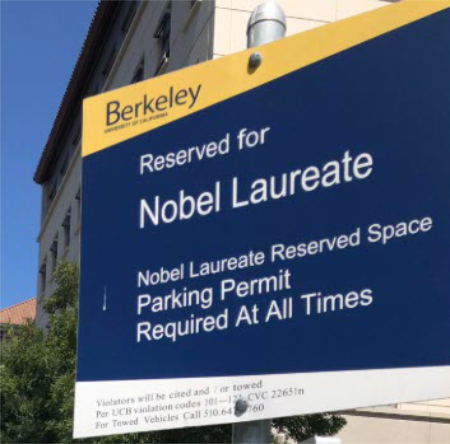
Can the latest Nobel "winner" park his limo there? Asking for a friend.(Z) answers: There is a fairly well-known story about Lyndon B. Johnson; perhaps we've shared it before. One day, LBJ was leaving the Oval Office to make a trip via Marine One, but he headed toward the wrong helicopter. A young Marine, trying to help, said, "Sir, that's your helicopter over there." Johnson replied: "Son, they are ALL my helicopter."
Similarly, with a sitting president, those are ALL his parking spaces. Once Trump is out of office, though, we doubt he could get a parking permit good within 5 miles of campus.
C.J.P. in Fife Heights, WA, asks: Is Donald Trump getting custody of someone else's Nobel Prize the ultimate participation trophy?
(Z) answers: No. The people who receive participation trophies at least get them from whatever organization or authority was responsible for the main awards, meaning that the organization or authority felt there was some effort there worth recognizing, even if that effort was not wholly successful.
This is like those people who spend thousands (or tens of thousands) of dollars to buy Super Bowl/World Series/NBA Championship rings that they had absolutely no role in earning.
E.H. in Washington, DC, asks: I'm not expecting a flip in the Senate, but your item on Mary Peltola running got me to thinking.
If there's a blue wave and a flip, will the most Senior conservative SCOTUS Justices (Clarence Thomas, Samuel Alito, and John Roberts) retire to get a Trumpy replacement? They would have to all leave in November of 2026 and have replacements appointed and confirmed by January 2, 2027.
I'm just wondering if you think some or all of them would stick around hoping for a Republican win in 2028 and the Senate flips back, since they all seem to believe they are immortal.(Z) answers: It is not easy for someone to not only admit that the end is somewhat near (or very near), but to also give up the thing that keeps them busy, and is the source of their prestige and power and influence. Many people would be thrilled to write books that sell tens of thousands of copies, and to be the most in-demand professor at [X top-tier law school], but for a former justice, it's big a step down. It is surely even harder to accept these things when you are doing so for the benefit of "the team" and not really yourself or your family. Get out your Ouija board and ask Ruth Bader Ginsburg, if you doubt it.
My guess is that Thomas is the most likely to retire strategically, since he's the oldest and he's never particularly enjoyed the job, and there are still many RV trips to be taken. Roberts is the least likely to do so, since he's the youngest of the three, and he would be giving up the most, and he's the least devoted to the Republican Party. Alito is somewhere in the middle, but I'd guess his ego is big enough that he would decide he'll have no problem making it to the next era of GOP trifecta.
R.L. in Alameda, CA, asks: Jonathan V. Last (JVL) from the Bulwark posited that normie, retiring and libertarian Republicans who are tired of Trump could start caucusing with the Democrats in order to hand the gavels to Senate Minority Leader Chuck Schumer (D-NY) and House Minority Leader Hakeem Jeffries (D-NY). He's thinking about Sens. Lisa Murkowski (R-AK), Rand Paul (R-KY), Mitch McConnell (R-KY) and Thom Tillis (R-NC), along with Reps. Thomas Massie (R-KY) and possibly Don Bacon (R-NE) and/or Lauren Boebert (R-CO). He qualified this by noting that this is unlikely, but possible. Tillis has already broken with Trump in stating that no Fed Governors will be approved until he stops attacking Jerome Powell and the Fed itself.
Has this ever happened before? Have members of one party ever caucused with the other in order to change the nature of leadership in either the House or the Senate? After all, it was the threat of impeachment from his own party that finally convinced Nixon to resign.(Z) answers: This sort of hypothetical mass (or semi-mass) act of rebellion is bandied about anytime the partisan balance of one chamber, or both, is close. Until evidence to the contrary is provided, it's a fantasy. Remember, these folks have all been in office for most or all of a decade of Trumpism, and yet they are all still members of the Republican Party. If they were open to flipping, either in name, or at least in deed, they would have done it before now.
As to your question, there were a couple of instances in the Antebellum Era when there were more than two parties represented in Congress, and what Europeans call a "coalition government" was formed. However, the only modern example of what you're talking about is the occasion, in 2001, when Jim Jeffords of Vermont switched from Republican to independent, and started caucusing with the Democrats. It had been 50-50, giving Republicans a de facto majority thanks to VP Dick Cheney's tiebreaker vote. Jeffords made it 51-49 for the Democrats, and the gavel was handed off from Trent Lott (R) to Tom Daschle (D).
C.F. in Waltham, MA, asks: I am constantly seeing polls that show young people (18-24), independents, Latinos, and suburban women moving away from approving of Trump at a magnitude between 20 and 40 points. Even Republicans moved from 95% to 85% approval. How is it mathematically possible that Trump's overall approval remains at 40%?
(Z) answers: There are two explanations. The first is that Trump's approval rating has dropped about 15 points since he was sworn in last January. So, the shift away from him, among these groups, IS showing up in his numbers.
The second is that there is no president, not even Richard Nixon, that does not win over SOME people while they are in office. So, Trump surely has at least some new "approvers" who are offsetting some of the defectors. In particular, we can imagine there are folks who did not think he was quite far-right enough, but are now satisfied.
P.J. in Quakertown, PA, asks: In response to "Elizabeth Warren Is Donating $400,000 to State Democratic Parties," could you please inform us of how we can contribute to each and every state Democratic Party? I personally live in Pennsylvania, but I am sure many of your readers would consider contributing to their state Democratic Party as well.
(Z) answers: Initially, we understood your question to mean you wanted an easy way to donate to all Democratic state parties at once. But even Elizabeth Warren didn't do that; she targeted 23 state organs, since she knows full well that giving money to the Oklahoma Democratic Party is no different than just throwing it into the fireplace.
On re-reading, we presume that you were asking how to find your state's Democratic organ, so you can donate. ActBlue, which handles most of this kind of business these days, does not have a convenient "list of state parties" page, unfortunately. So, the best thing to do is Google "[YOUR STATE] Democratic Party." That will certainly give you your state's Democratic party as the first match. And then the state party's webpage will have a DONATE button/link very prominent on their front page, usually at the top right.
Alternatively, you could send money to the DNC's State Party Victory Fund or to SwingLeft. The former gives money to the state parties/races that need it most, in the judgment of the DNC, while the latter gives money to Democrats running for the House in swing districts.
M.M. in San Diego, CA, asks: How does the government eliminate an executive branch department? If the next Democratic administration wanted to get rid of a department—oh, say, the Department of Homeland Security—would it require a Senate supermajority to pass, or just a simple majority? Would it be possible to keep the TSA by shifting it to another department, while dismantling the rest of DHS? Just asking...
(Z) answers: What Congress giveth, Congress taketh away. The legislature has sole power to create, or eliminate, federal agencies.
It is certainly possible to eliminate DHS. After all, it wasn't really a new department with new duties as much as it was a new superstructure imposed on existing federal agencies. However, assuming the filibuster lives on, any reorganization would require 60 votes in the Senate.
R.M.S. in Lebanon, CT, asks: Since (Z) brought up the issue of canceling music and plays at the Kennedy Center because they offend MAGA sensibilities, I have a question about a related issue.
Michael Jackson has been dead since 2009, and his music is still widely played on radio stations, at sports events, in stores and in other public places. Since his death, several men have come forward and said Jackson sexually abused them as children. A few years ago, two men went public with allegations that Jackson raped them. This was discussed in an HBO documentary, and also with Gayle King on CBS.
I think it is very unlikely these men are making up these claims. Very few false allegations of rape are made, and most men in particular find it embarrassing or shameful to share these kinds of abuses. Jackson still has many fans, however. Some of them have used online platforms to attack and smear these men, who could very well be victims of abuse.
My question is why has Jackson's music escaped cancellation, when many others have been canceled for far less than what Jackson is accused of?(Z) answers: I would guess there are two reasons. The first is that the case against Jackson is... shaky. He had a very odd relationship with underage boys for a very long time. However, he was only formally accused of sexual misconduct by four of them. One of those four reached a settlement. One of them lost in court. And the other two are the men who accused Jackson after he was dead and could not defend himself.
It is true that most men are not eager to talk about being victimized, sexually. But it is also true that the possibility of millions of dollars will cause people to do out-of-character things. That creates some doubt. So too does the fact that there aren't more accusers, given how very many young boys Jackson palled around with. And so does the testimony of his most famous boy "pal," the actor Macaulay Culkin, who said nothing untoward ever happened. Compare to the British serial sexual predator Jimmy Savile; once that dam broke, accusers were coming out of the woodwork.
This is not to defend Jackson, merely to say that a person could very well conclude that Jackson was an odd and emotionally stunted person, but that he was asexual more than anything else, and that sexual predation was not on his mind. Certainly, the story is considerably fuzzier than it is with, say, Harvey Weinstein or Bill Cosby.
The second reason, and probably the more important one, is that Jackson is dead. Anyone who plays his music or buys an album doesn't have to feel like they might be enabling ongoing bad acts. To take a parallel example, many John Wayne movies had appearances from Ward Bond and/or Walter Brennan. Well, Wayne was dangerously close to a white supremacist, while Bond and Brennan were that and were also rabid antisemites. And all three were homophobes, too, and communist witch hunters, and war hawks. But those movies still show up on TV, quite bit, because that trio can't harm anyone with their bigotry and their warmongering and their witch hunting any more.
D.V.T. in Anchorage, AK, asks: In your post on Mary Peltola running for Senate, you wrote "Alaska is notoriously tough to poll, because it's hard to reach people. That is extra true in the dead of winter." Is it really any harder than other states? Alaska is a geographically large but low population state, but people here have phones and Internet connections just like the rest of the country. And why do you think it is harder in the dead of winter? If anything, I would say that people tend to be at home more during the coldest part of the year. Please explain.
(Z) answers: We have read that, in winter, it is difficult to communicate with more remote (often Inuit) villages, which require either in-person interactions, or interactions via postal service. If you don't know how many of Alaska's most rural voters are going to show up, and which candidate they are leaning toward, you don't have an accurate picture of the electorate.
F.S. in Cologne, Germany, asks: Were all the Founding Fathers rich, white, male, Anglo-Saxon Protestants? If not, who doesn't fit in this category? And who are the 10 most influential Founding Fathers?
(Z) answers: The Founding Fathers were all somewhere between "upper middle class" and "upper class." Those were the only kinds of people back then who could take weeks or months away from their professional concerns to engage in governance. Not all of them ended their lives that way, of course; a number of them were left broke as the result of the Revolutionary War, or garden-variety business reverses.
They were all white and male, because those were the only people allowed to wield political power back then, at least in any sort of official capacity.
Most of the Founders were Anglo-Saxon, because it was an overwhelmingly Anglo-Saxon country back then. However, several of them, like James Wilson, were of Scottish heritage, and others, like John Jay, were of French extraction. And Alexander Hamilton, who was not born in the U.S., of course, was both Scottish (father) AND French (mother). I assume that is why he looks Puerto Rican when he's portrayed on stage.
The only Founder known to practice a non-Protestant religion was Charles Carroll of Carrollton, who was the only Catholic signer of the Declaration of Independence. However, a number of the Founders were not at all observant, and there's a general consensus that several of them, most notably George Washington and Thomas Jefferson, were deists.
Finally, in 1973, the historian Richard B. Morris published Seven Who Shaped Our Destiny: The Founding Fathers as Revolutionaries, in which he argued that George Washington, John Adams, Thomas Jefferson, Benjamin Franklin, Alexander Hamilton, John Jay and James Madison were far and away the seven most important Founders. That convention has been embraced, almost universally, since then. So, asking for a list of Top 10 Founders is like asking for a list of Top 10 dwarfs in Disney films. It's the Big Seven, and then all the others.
D.O. in Sudbury, MA, asks: Is it fair to say that Turning Point (collegiate) and Club America (high school) are today's Hitler Youth Groups? Don't all these entities have the same goal: to build support for and to normalize a dictatorship?
(Z) answers: I do not think it is fair to say that.
I am comfortable with the notion that the Trump GOP is fascist, or fascist-adjacent. And obviously, TPUSA and CA support Trump and Trumpism. However, Hitler Youth was an actual organ of the Nazi Party, founded by Adolf Hitler and his minions. It was also a paramilitary organization. And membership went from being "strongly encouraged" by the government to being mandatory. None of these things are true of TPUSA and CA.
TPUSA and CA are more like the Great Japan Youth Party or Nationale Jeugdstorm, which were supportive of, and closely aligned with, an authoritarian/fascist regime, but were not actually a part of that regime.
T.A.O. in Minneapolis, MN, asks: My impression is that the antebellum parties, the Whigs and the Know-Nothings, split over issues of their day, resulting in election losses and the rise of the Republican Party. Are there any lessons to be gained, or hope to be found, in the example of parties splintering and failing? I am astonished at the components of the modern Republican Party and wonder if it can sustain all of the racist, isolationist, populist, anti-immigrant, nationalist, religious factions and stay intact.
(Z) answers: The Know-Nothings were not a party of national importance, except maybe in one election, and so should not be a part of the analysis any more than Ross Perot's Reform Party.
The lesson of the Whigs, and the Democrats, and now the Republicans is that whatever party wants the South has to adopt extreme positions on issues that will effectively lead to minority or near-minority status at the national level. The Whigs were the minority while kowtowing to slavery, and then when they couldn't do it anymore, they collapsed. The Democrats were the minority while kowtowing to white supremacy, and when they finally stopped, the South jumped ship. Now the Republicans are the Southern Party, and it's a near-miracle when they win the popular vote in a presidential election.
The thing that is keeping the Republicans more viable than the Whigs, and than the Democrats during that party's "wilderness" years (basically, 1861-1932), is that a fair bit of the Midwest, and much of the Mountain West, has now become an annex of the South. So, Republicans today control a whole bunch of Senate and House seats that would have been longshots for Democrats in, say, 1914, or the Whigs in, say, any year. If some of the states that do not actually have all that much in common with Alabama or Mississippi end up jumping ship, then the GOP is in big trouble.
L.M.S. in Harbin, China, asks: You mentioned the quote "it's not the people who vote that count, it's the people who count the votes" and debunked its attribution to Stalin. But who said that?
(Z) answers: The problem here is that there have been a lot of people who did a lot of thinking about these kinds of subjects, with the result that the same basic insight has been had, probably independently, many different times. It's also been expressed in different ways, often in different languages. So, it is near-impossible to find the original source.
What is certain is that this remark, in various forms, was frequently associated with New York City urban boss William Magear Tweed (1860s/1870s). He certainly uttered some version of it, and probably did so many times. He also was not known for his gifts of self-expression, so he certainly got it from someone or somewhere else. It's been attributed to Napoleon, so maybe he was the first to think of it, but there's no contemporaneous source that credits the Little Corporal with saying it, so maybe not.
Oh, and it's also reasonably certain that Joseph Stalin also uttered a version of it, though again, he couldn't possibly have been the first.
J.E. in San Jose, CA, asks: I believe you mentioned Gandhi being the last movie to feature an intermission on first release in the U.S. One of the reasons for the disappearance of intermissions was that longer running times means fewer showings.
My question is: Don't theaters make their money on concessions, breaking even on showings, similar to how gas stations make money in the convenience store, not at the pump? If so, I would think we would see more intermissions, as we do at plays.(Z) answers: There was an awful lot of feedback about that point, such that if time allows next week, there will be an item about the evolution of the movie business.
But for now, the answer to your specific question is this: These days, first-run movies are booked by big theater chains under agreements that some enormous percentage of ticket sales (as high as 90%) go to the studios, at least early in the run. So, the studios have a vested interest in making possible as many showings per day as they can, and zero interest in selling concessions. That means it was the studios who (largely) ended the intermission tradition, theater owners be damned.
In theory, a theater COULD stop a film and create an ad hoc intermission. But that would violate their contracts with the studios, in many cases, and would also aggravate customers, who would know full well that it's not an actual intermission. Further, people don't usually buy concessions multiple times during a movie, in part due to the less-than-healthy nature of the food, and part due to the high costs. They usually get one round before the movie starts, and that's it. So, an intermission would not actually move as much product as you might think. The trick the theaters DO use is to offer free refills on popcorn or soda. This costs them next to nothing, and they hope that when you come out to get some more popcorn/soda, maybe you'll grab a $5 candy bar.
D.W. in Arden, NC, asks: My daughters are planning to move to the Netherlands by the end of this year to finally be able to live year round with their husbands, who are both Dutch. Do you have any advice regarding: (1) the process, (2) what to expect as a new resident there, (3) necessity of learning the language/assimilation, (4) ease of finding work (both are currently pastry chefs) and (5) general do's and don'ts?
(V) answers: The rules have changed since I came. According to this website, you have to pass a Dutch language test BEFORE you can get permission to live here. In the past, the Dutch were pretty open to immigrants, but those days seem to be over. The exam is intended to make it difficult to come. In daily life, the butcher, the baker and the candlestick maker all speak perfect English. So you may have to learn Dutch just to pass the exam. Also, if you get in and want to work, most small companies operate in Dutch. My guess is that in a commercial bakery or restaurant, most people speak English and if there is a shortage of pastry chefs, it won't be a problem. If there are many applicants, probably a Dutch-speaking person will win out. I simply don't know that job market, but Dutch people do love pastries. There are stores that sell only pastries (banketbakkerij), like a patisserie in France. These are different from regular bakeries (broodbakkerij). Note "ij" is one letter and is like a "y" in English. If you see "bakkerij" as "bakkery" you can probably figure out what business they are in. Learning Dutch is probably a little easier than learning German.
When you get here, you will discover that housing prices have gone through the roof in recent years. Nearly all houses for sale and apartments for rent are on funda.nl/en. It is partly in Dutch, but "Koop" means "Buy" and "Huur" means "Rent." Pick one and enter a city name to see what is out there. Do this while sitting down. You are not going to like what you see. In the center of Amsterdam, you can rent an apartment of 800 sq. ft for €3000/mo. On the outskirts of Amsterdam, you might find one 1000 sq ft for €2000/mo. Very roughly to convert m² to ft² multiply the number given by 10.
Don't get a car if you are in any city. Buy bikes and a sturdy chain. The only crime you are likely to run across is bicycle theft. Public transit is extremely good. Uber is available everywhere in most cities.
Telling people that you are a Trump refugee will win you friends quickly.
Be polite and respectful to people. For appointments, be on time. Coming at 15:05 for a 15:00 appointment is VERY late. (Forget this a.m. and p.m. business. Nobody has a clue what that is.)
Find a G.P. (huisarts) quickly. Ask people. The entire medical system is based on them. Medical care is probably better than in most of the U.S. All doctors speak excellent English.
Once you have all the permits, open a bank account with ABNAMO, ING or RABO. These are the biggest banks and have the most offices. However, practically all banking is done online. The normal way to pay your dentist is to wire him the money. Wires are free and take 5 sec. to arrive. Checks were abolished 30 years ago as being obsolete technology. Cash is going the way of the dodo. The normal way to pay in stores is electronically, using a bank debit card. Very few businesses take credit cards except in tourist areas. Debit cards work only if you have enough money in your account.
The country is very bureaucratic. Don't fight it. If you fill in all the forms the way the bureaucrats want, everything works pretty well. Don't bother giving a sob story to any bureaucrat about why you didn't follow some rule. It won't work.
It snowed last week for the first time in years. It is never hot and never cold here. Think: Seattle.
If someone invites you to their home for tea or dinner, bring a small gift (wine, small box of chocolates, flowers, etc,)
Internet at 1000 Mbps up and down is common in cities, but not everywhere.
The quality of life here is very good.