Harold Wilson was wrong. He said: "A week is a long time in politics." The new slogan should be: "A day is a long
time in politics." And what a day it was. If back in January 2026, anyone had openly said: "Democrats will capture the
House, the Senate, a majority of governorships, and will romp up and down the ballot in Texas," observers would
have gotten on their phones to call for the men in white coats to come pick up a new patient.
Where to begin? Let us look at some of the themes and broader takeaways from what
happened on Tuesday
Shellacking: In 2010, Barack Obama was humbled by the
"shellacking"
his party took in the midterms. Donald Trump is never humble, but boy, oh boy was this a shellacking. Up and down the
line. The Senate, the House, governorships, statewide offices, state legislatures and more. It wasn't eking out a narrow
win in 10 competitive House districts. Democrats won nearly all the marbles everywhere in everything. And the few places
they lost, it was by inches (like the governorship of Florida and maybe the Senate races in Mississippi and Alaska,
depending how those end). One GOP operative said: "Richard fu**ing Hudson lost his seat." Rep. Richard Hudson (R-NC) is
chairman of the NRCC, the committee whose job is to win House seats for Republicans. He couldn't even hold his own R+8 district.
The chairs of the NRCC and DCCC are always people in seats so safe that they don't need to campaign so
they can spend all of their time raising money for other House members in their party who need help.
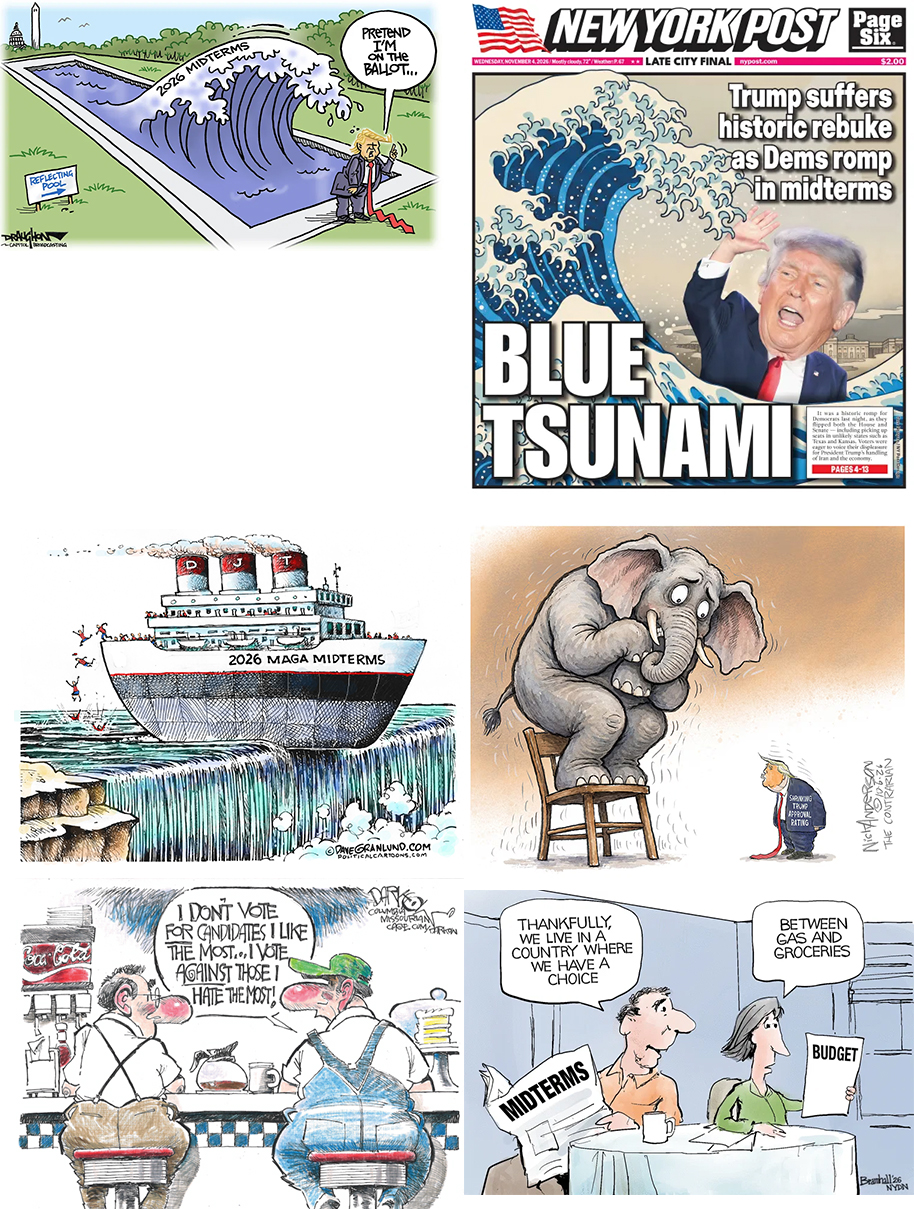
Cartoonists are having a field day today
Cults: It turns out that cults have a shelf life and when the cultist-in-chief falls, he
takes the whole cult down with him. Republicans are about to learn this the hard way. In 2028, they can offer more of
the same, but the voters don't want more of the same. But that is all the Republicans have. Going back to a kinder,
gentler George H.W. Bush party would be quite a trick. That isn't what the Republican Party stands for anymore. Does it stand
for anything? In 2020, the Republican Party
didn't even bother
writing a platform. It just said: "Whatever Donald Trump wants, that's what we want." That's not a political party.
That's a cult of personality. Does the institutional Republican Party actually stand for anything? It used to stand for
three things:
Anticommunism
Free trade
Small government
Does it still? Well: (1) Trump loves Russia and Vladimir Putin, (2) he loves tariffs
and hates free trade and (3) he supports
government ownership
of the means of production, which is the actual definition of communism. What Trump wants, the Republican Party wants.
We don't envy the RNC members assigned the job of writing the 2028 Republican Party platform because the Party doesn't
stand for anything anymore. Fixing that is going to be messy.
The Guardrails Held: On Saturday, we wrote about the
nine ways
Trump might try to subvert the elections. On Sunday, we wrote about how the
judiciary
and the
states
would try to stop him. In the end, the landslide, tsunami, avalanche, or whatever you want to call it was so great, even
Trump saw it is futile and didn't resist. He had no chance and even he knew it. Nevertheless, being vigilant was not a
luxury. Thomas Jefferson didn't say: "Eternal vigilance is the price of liberty," even though he knew that in his bones,
but is it just as true as if he had coined the phrase, which has an ancient history. The guardrails held this time, but maybe, just maybe, it is time to rebuild
them out of titanium wrapped in a shell of graphene for next time.
Trump's Endorsements: Donald Trump's superpower used to be his power to wave his magic...
wand and bestow victory on candidates by endorsing them (See: Greg Abbott, Susan Collins, Darline Graham, Monica De La
Cruz, Ashley Hinston, Jon Husted, Roger Marshall, Max Miller, Ken Paxton and Vivek Ramaswamy). Oh wait. Maybe don't see
them. They all had that Trump stamp of approval. And they all lost, most of them big time. He also blessed Julia Letlow
and she almost lost. In some cases, such as Graham, Letlow, and Paxton, he personally recruited them and stuffed them
down the elephant's throat, with the elephant gagging the whole time. Do you think Republicans in the next 2 years will
be cowed when Trump threatens them with: "If you do that, I won't endorse you in 2028?" We don't.
Holy Mills: There are many variants and many purported authors of the saying: "The mills
of God grind slow, but they grind exceeding fine." Boy is that true now. Trump, members of the administration, and
various corporate titans acted like they were undisputed masters of the universe and no one could challenge their might.
As Democrats take over the chairmanships of House and Senate committees, these people are going to start suddenly discover the
meaning of the words "accountability" and "hubris." Even the ancient Greeks knew about the latter. It is not a new
concept. If the AG in 2029 happens to be a Democrat, are they ever going to understand that kryptonite is on sale at
Walmart for $1.99/lb.
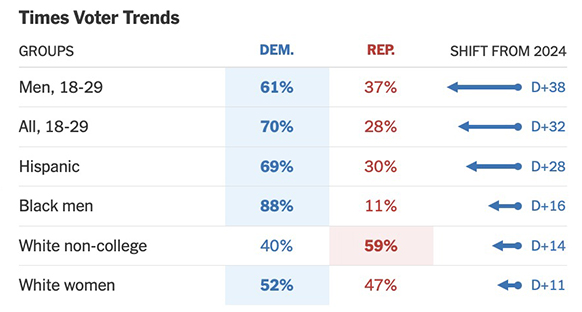
Trump's Coalition: Trump threw his coalition in the wood chipper. Maybe democracy isn't
as dead as the dodo, as some people thought. It was just hibernating for a while, got poked in the eye, didn't like that
one bit, and awoke in great fury. The unlikely coalition Trump assembled in 2024 has shattered into more pieces than
Pete Hegseth's precious globe. And it isn't going to be reassembled anytime soon, if ever. It took them a while, but the
voters he seduced in 2024 have discovered the hard way that the pig in a poke he sold them has trichinosis and a bad
attitude. They are heading for the hills.
Look:
This could be the end of the Age of Trump. And it sure went with a bang, not a whimper.
Hubris: Democrats read the wrong message into the midterms at their peril. They didn't
win. The other guys lost. There is a huge difference. People don't like the Democrats. Millions of people see them as
weak and woke and think they can't even tell the difference between a boy and a girl. They got more senators,
representatives, governors, and state legislators because the voters thought the other guys were corrupt and raised the
price of gas. That is not a winning formula for 2028.
If they get cocky, they will lose in 2028 because this was not a Democratic wave. It was an anti-incumbent wave. It was a
throw-the-bums-out wave. Next time the Democrats could be the bums if they don't deliver—or at least make a
convincing case that they tried hard to deliver but the Republicans blocked them at every turn. What the Democrats must
resist is impeaching Trump right off the bat. That is not what the voters asked them to do. What they can do is use
child psychology on him. Do things that the voters want but they know Trump hates and watch him react as they planned.
For example, pass a bill rolling back all of Trump's tariffs and change all the laws giving the president emergency
powers to require Senate confirmation to declare emergencies. When he vetoes the bill, loudly proclaim: "We tried to
lower prices but Trump vetoed the plan. What we need is a Democratic president in 2028 who will sign the bill next
time." Ditto with healthcare and prescription drugs. Pass bills giving huge subsides for electric cars made in America powered by
heavily subsidized American-made home solar panels to reduce transportation and electricity costs. Then exploit the expected vetoes to
the hilt.
Dummymandering: Until we have the final House map, we won't know for sure if the
Republicans drew gerrymanders or dummymanders in the eight states where they tried out their cartological skills.
However, some
initial evidence
shows there were at least some dummymanders in Alabama, Florida, and Texas. The idea was to draw maps where Republicans
had thin margins in many districts instead of solid margins in fewer districts. They would have worked in a D+3 House
election, but this one looks like a D+13 one. The "safe" districts were often packed with Latinos on the assumption they
were Republicans. Surprise. They aren't.
In Texas, the whole project backfired. The Republicans
lost
four of the five seats the new map was expected to deliver them and they lost two of their own to boot. In TX-23, Katy
Padilla Stout (D) beat gun nut and YouTuber Brandon Herrera (R) and in TX-15, Tejano singer Bobby Pulido (D) crushed
Rep. Monica De La Cruz (R-TX). The Texas legislature was expecting an 8D, 30R split. They got a 14D, 24R split. And if
Democrats get the trifecta in Texas, they could redraw the map again or maybe even pass a law mandating an independent
commission to draw both the federal and state maps. Wouldn't that be a kick in the [insert body part here]? But the
trifecta is a longshot.
In Florida, there were eight Democrats in the 119th Congress. In January, there will be
eight Democrats
in the 120th Congress, for a net gain of zero. Florida Democratic Reps. Kathy Castor, Pia Dandiya, and Jared Moskowitz
were put in Republican-leaning districts but they all were reelected anyway. In North Carolina, Rep. Don Davis (D-NC)
was put in a district that Trump would have won by 12 points, but Davis won anyway.
In Alabama, Rep. Shomari Figures (D-AL) was given an extremely hostile district—and he still won. These are not
exactly dummymanders, but more neutimanders. The big dummy this time was Gov. Ron DeSantis (R-FL).
Diversity: If there is anything that Donald Trump and Stephen Miller hate hate hate it is
diversity—that is people who don't exactly fit in Sarah Palin's idea of "real Americans." But it turns out these
"nonreal Americans" (which a mathematician might call an "imaginary Americans") exist and even vote. And some of them
even win elections. And some women, perish the thought, are being elected to run entire states. Look at this list of
governors-elect:
Person
State
Party
Milestone
Amy Acton
Ohio
Democratic
First Jewish governor in the Upper Midwest
Xavier Becerra
California
Democratic
First Latino governor of California
Marsha Blackburn
Tennessee
Republican
First female governor of Tennessee
Keisha Lance Bottoms
Georgia
Democratic
First Black female governor of any state
David Crowley
Wisconsin
Democratic
First Black governor of Wisconsin
Byron Donalds
Florida
Republican
First Black governor of Florida
Aaron Ford
Nevada
Democratic
First Black governor of Nevada
Deb Haaland
New Mexico
Democratic
First Native American woman governor of New Mexico, second overall
Gina Hinojosa
Texas
Democratic
First Latina Governor of Texas
Amy Klobuchar
Minnesota
Democratic
First female governor of Minnesota
And it doesn't end there. History was also made in Congress:
Person
State
Party
Milestone
Annie Andrews
South Carolina
Democratic
First elected female senator from South Carolina
Abdul El-Sayed
Michigan
Democratic
First Muslim senator
Peggy Flanagan
Minnesota
Democratic-Farmer-Labor
First female Native American senator
Hakeem Jeffries
New York
Democratic
First Black speaker of the House (presumably)
Chris Pappas
New Hampshire
Democratic
First openly gay male senator
Cultural Flop: As usual, Republicans tried to use the culture wars and name-calling in
many races—because that's all they had. It didn't work (except in a few ballot measures banning boys in girls'
sports). Republicans called James Talarico (D) James Talafreako. They called Annie Andrews (D) Trannie Annie. It didn't
work. None of the culture wars stuff worked against candidates.
Ideological War: The incipient ideological war within the Democratic Party is going to
stop. Yay!, right? Unfortunately for them, it will be replaced by a full-blown ideological war. Progressives will point
to Sens.-elect Abdul El-Sayed and Troy Jackson and say: "See, progressive can win!" Moderates will say: "Yeah, but
apparently not in Florida. Also, Roy Cooper, Adam Hamilton, and James Talarico are not exactly flaming liberals." In
state elections, there doesn't actually have to be a winner in this debate. It's nonbinary. For each state or district,
the candidate should be a good fit for that jurisdiction without worrying whether the candidate is a good fit for
other jurisdictions. For national elections, that trick doesn't work, but there is a different rule: Only
nominate candidates who are a good fit for states that together have at least 270 electoral votes. People making
proposals for candidates should come equipped with maps showing exactly where those 270 electoral votes will come from,
with some history-based evidence.
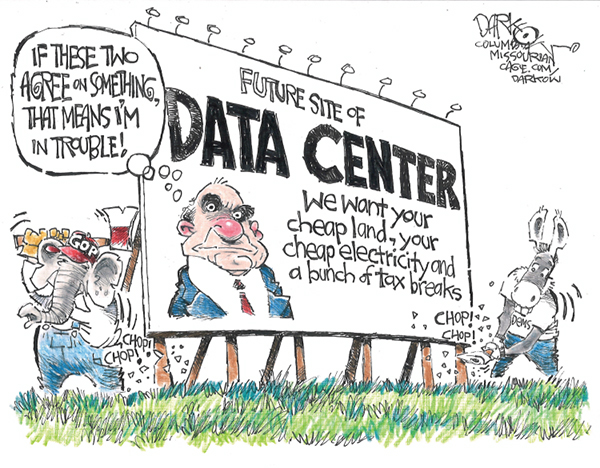
Data Centers: The tech bros may not like it, but opposition to data centers (and AI) is
now a permanent fixture of campaigns. And it will be both parties targeting them, with the candidate opposing
them the most having the edge.
Swinging Together: As we have pointed out many times, swing states often all (or nearly
all) go in the same direction in the end. In 2024, Trump won all seven swing states. This time the Democrats won the
eight of the nine swing states, namely Georgia, Iowa, Maine, Michigan, North Carolina, Ohio, South Carolina, and Texas,
and might win the ninth one (Alaska) as well.
The October Surprise: The famous October surprise was a bit late this year. It arrived on
Nov. 4. At the end of counting on Election Day, Scott Colom (D) was leading in the Mississippi Senate race by 28 votes.
We don't know how that one will end, since Mississippi does not have any laws discussing recounts. But the mere fact
that a Democrat—and a Black one at that—could get within shouting distance of a win, even if he ends up
losing by 1,000 votes, is a seismic shock (and he's actually leading right now by about 1,100 votes, with 98%
reporting). And Democrats won Senate seats all over the South, including Virginia, North Carolina, South Carolina,
Georgia and Texas. They came quite close in Florida and Louisiana. They also won in Kansas, and their proxies came close
in Nebraska and Montana. Howard Dean famously had a 50-state strategy in which he believed that Democrats should
actively field and support candidates in every state. Now it is clear he was sort of right. With well-chosen candidates,
Democrats could run a plausible 40-state strategy. As Wayne Gretzky observed, you miss 100% of the shots you don't take.
This is a very important message. Also for the Republicans. Gov. Phil Scott (R-VT) got another term because he is nice
guy and a good match for his state. Gov. Kelly Ayotte (R-NH) also got another term because she is a nice gal and a good match
for her state. There is a lesson here.
2032: Let's be visionary, skip 2028, and go right to the 2032 presidential election. The
Democrats' traditional strategy is to win the blue states and the blue-wall states of Wisconsin, Michigan, and
Pennsylvania. In 2028 that will work. In 2032, that will not work because the blue wall states will have lost so much
population to the South that the blue states plus the blue-wall states won't have 270 electoral votes combined after the
2030 census. This means to be viable in 2032 and beyond, Democrats must win in the South. The blue states plus
the blue-wall states plus Arizona will be enough, but that is hanging the Party's future on a very thin reed. But
Tuesday's results show that Democrats can win in the South with the right candidates, right platform and some
luck. It is not impossible, but it requires some serious thought about the direction of the Party going forward.
Turtle was Right: Candidate quality matters. Ken Paxton was a horrible, terrible
candidate, as corrupt as the day is long, an awful fundraiser, a poor speaker, and he looks bad on television. Vivek
Ramaswamy has a tin ear and does not belong within a country mile of public service. He hates the very idea of serving
anyone other than himself. On the other hand, Annie Andrews and Amy Acton are extremely warm and sympathetic figures.
They are also decent human beings, which Paxton and Ramaswamy are definitely not. Voters eventually figured this out.
Amy Acton inadvertently demonstrated this in public during her victory speech. When someone in the audience fainted, Dr.
Acton stopped and went to help that person:
Can you imagine Ramaswamy even noticing that someone fainted, stopping, and asking: "Is there a doctor in the audience?"
We can't. Acton is a candidate who suffered abuse as a child and had the most disgusting mud thrown at her during
the campaign. And her first reaction when someone needed help was to go there personally and help. People notice that.
And don't forget it. It tells them more about the candidate than 100 paid ads.
Money: It matters, but only so much. If the candidate is fundamentally flawed, no amount
of money can save him or her. Ken Paxton and Vivek Ramaswamy discovered that the hard way. Elon Musk did too, but he
couldn't care less about half a billion dollars more or less. Richard Uihlein spent $150 million in Wisconsin and
Illinois and got nothing in return. Most of the other
Republican megadonors
also got roughly 0% return on their investments.
Polling: Pollsters did a great job. They called the winners in most top races. And in the
few where they didn't (like the governor of Texas), it was usually saying it was too close to call rather than proudly
announcing that the wrong candidate would win. The aggregators also did a fine job. Nate Silver called all the key
Senate races correctly, except maybe Mississippi if Scott Colom ultimately wins. G. Elliot Morris gave the Democrats an
80% chance of winning the House and an 80% chance of winning the Senate. Our final map called every state already
decided right except South Carolina. We called Alaska for Mary Peltola (D) and Mississippi for Cindy Hyde Smith (R) so
ultimately we will be batting between .914 (32/35) and .971 (34/35). Do you realize what kind of contract we could get
if we were baseball players? Eat our dust, Shohei Ohtani.
Smart Crowds: How did the wisdom of the crowds do? In the poll of our readers, they said
the Democrats would get 54 seats in the Senate. Currently they have... 54 seats in the Senate, but two races haven't
been called yet. Political Wire's readers predicted 53 Senate seats for the blue team. The readers predicted 234 and 237
House seats for the Democrats, respectively but the final numbers aren't in yet.
The Easy Part: For the Democrats, winning was the easy part. Governing will be the hard
part. They achieved a Fetterproof majority in the Senate, something they didn't have in the Manchin-Sinema era. But its
a big tent and getting all the donkeys pointed in the same direction will be a big challenge. Getting Abdul El-Sayed on
the same page as Adam Hamilton will be tricky and will limit what they can agree on. Getting anything past a Republican
filibuster will be trying and anything making that far will be vetoed by Donald Trump. Other than trying to pass some
bills to show voters what the Democrats could do in 2029 if they get the trifecta, most of the next two years will be
doing investigations and holding hearings. Expect to hear the name of Rep. Robert Garcia (D-CA) quite a bit next year.
He will be chairman of the powerful House Oversight Committee, which can oversee just about anything the chairman wants
to oversee and Garcia wants to oversee roughly everything.
Bright Spots for the GOP: Despite a dismal night, the Republicans did have a couple of
bright spots, mostly (naturally) in the Sunshine State. Byron Donalds was elected governor and Ashley Moody won an
election, something appointed senators (see: Husted, Jon) have a decidedly mixed record at.
Vance and Rubio: Poor J.D. He is in a terrible bind. He wants to be president more than
anything in the whole world and Tuesday's elections throw a barrel of monkey wrenches into the gears of his campaign. If
he sticks close to Trump in the next 2 years, in 2028 he will have to run with all of Trump's defects (mean,
vindictive, hateful) without any of the charisma Trump's supporters see in him. And he will have to defend Trump's
unpopular record. If he breaks openly with Trump, Trump will cut him to ribbons and endorse someone else. Marco Rubio is
going to get saddled with the war in Iran whether he likes it or not. It is entirely possible that the 2028 Republican
nominee could be someone other than these two, possibly Brian Kemp, Glenn Youngkin, Chris Sununu or some dark horse.
A long write-up but this won't be the last one. (V)
This item appeared on www.electoral-vote.com. Read it Monday through Friday for political and election news,
Saturday for answers to reader's questions, and Sunday for letters from readers.