Previous | Next | Senate races | Menu
New polls:
Dem pickups: (None)
GOP pickups: (None)
Note: The events in Venezuela were too important to wait, so we wrote up a long item on it yesterday. If you missed it, you might want to take a look.
2025 in Review, Part I: The Democracy Demolition Derby
Donald Trump's second term is probably the most significant presidential term since, at very least, Lyndon Johnson's term. And maybe even since Franklin Delano Roosevelt's first term. And not in a good way. Democracy took a real beating. In the best case, it will take years to recover, and only then if the price of eggs goes up. Pray or hope for a major chicken flu epidemic requiring chicken farmers to cull their flocks. If eggs get more expensive, the American people will come to their senses and "throw the bums out." The rising cost of health care could also play a role. If inflation says low, by contrast, maybe democracy will survive, maybe not.
Let's take a look at the many ways Democracy, and government as the founders had intended it, took a big hit in 2025. It is partly about the formal rules (e.g., violations of the separation of powers), but it is also Trump's views and actions concerning "liberal society" and the rule of law, for which he has only contempt. We have tried to group his major actions in a few broad categories, but the boundaries are fairly vague. Some other articles on this theme are those by Kim Wehle and CREW.
Nullifying Checks and Balances
The founders very intentionally created the system to set power against power to prevent any one branch from dominating the others. In particular, they were worried about the president becoming a king. Donald Trump would just love to be a king and is doing what he can to keep the other branches down and out:
- Executive Power: Trump does not recognize any
checks
on his executive power. If the Supreme Court made an unambiguous ruling on some minor thing he did—for example, on
birthright citizenship—he might acknowledge it. Otherwise, he will let no one and nothing stand in his way
to become all-powerful. He wants this largely to monetize the presidency for himself. It isn't that he has some clear
ideological framework. Authoritarians often don't. It is power for the sake of power (and money, and ego).
- Usurping Congress' Power:
To Trump, Congress is just a nuisance to be ignored. Power of the purse?
No way.
He and OMB Director Russell Vought wrote a Big Beautiful Bill and ordered Congress to rubber stamp it, which it
obediently did. Trump has also illegally
impounded funds
for projects he doesn't like. After Richard Nixon did this, Congress passed a law making it impoundment specifically
illegal. So what?
There is more. The Constitution gives Congress the power to levy tariffs. Trump could care less. "Tariff" is his favorite word and he levies tariffs on a whim, often changing them within a week, without even consulting Congress. The power to declare war? Quaint idea. He doesn't like Iran, and so ordered it to be bombed, without Congress' first declaring war or otherwise authorizing the use of force. He didn't especially like Nicolás Maduro, so he attacked Venezuela and captured him. These are acts of war and Trump just ignored Congress and did them. He also believes in government by executive orders rather than by having Congress pass laws. It is so much simpler that way. So far he has signed 225 XOs.
- Sidelining the Senate:
Besides ruling by XO instead of legislation, Trump often bypasses the Senate's clear power to advise
and consent. He asked Elon Musk to exercise executive power and dismantle the government. That power
made Musk an officer of the United States, which requires Senate confirmation. Trump didn't even try
to get approval. He has repeatedly violated federal law by
appointing
people to acting positions for longer than the law allows without Senate confirmation—Alina Habba in New Jersey,
Lindsey Halligan in Virginia, and Sigal Chattah in Nevada come to mind. All three were illegally appointed to be a U.S.
attorney after the clock on interim appointments ran out.
- Firing Federal Officials with Fixed Terms: Federal law establishes fixed terms for some
officials to make them span presidencies and thus not be political. Trump has thumbed his nose at those laws. He
fired
Gen. Charles Q. Brown as Chairman of the Joint Chiefs halfway into his 4-year term. He was about to fire FBI Director
Christopher Wray (his own appointee!), but Wray beat him to it and resigned on Jan. 20, 2025.
- Capturing Independent Agencies: Congress created independent agencies to keep them out of
politics and let experts in the various fields make decisions about their work based on what is best for the country.
Trump hates anything or anyone independent of himself. He fired an FTC commissioner he doesn't like (Rebecca Slaughter)
as well as commissioners at the NLRB (Gwynne Wilcox) and the MSPB (Cathy Harris). He fired two at the EEOC (Charlotte
Burrows and Joceyln Samuels). There are
many more.
Federal law prohibits the president from firing members of agency boards without good cause. For Trump, being appointed
by a Democratic president is good enough cause. He ordered the FEC to submit regulations to him in advance for approval.
He ordered the SEC to take its marching orders from Vought at the OMB. He gutted the CFPB by installing his own toadies
there, slashing its budget, and laying off staff. The crown jewel here is the Fed, which he is also trying to take over,
starting with trying to fire Fed Governor Lisa Cook.
- Firing the Inspectors General: After Watergate, Congress created the post of inspector
general in most federal departments to root out fraud, waste, abuse and corruption. They were the first DOGEys! Trump
didn't like the idea of independent federal officials sniffing around when his appointees were corrupt or misbehaved, so
he has
fired
17 IGs so far. This is almost certainly illegal.
Abuse of Power
Here we have things that Trump has done to push his legitimate power to the breaking point and beyond. Yes, he has the authority to declare emergencies to get special new powers, but the intent of Congress was that the president could declare an emergency only when there actually was an emergency:
- Declaring Emergencies: There are numerous laws, some dating back
over 200 years,
that give the president special powers in an emergency. Remember that in 1789, if the U.S. were invaded, Congress could
not be called into session the next morning at 9 a.m. to deal with it. It would take some members days or weeks to get
to D.C. Then, as now, there was no Internet voting. More recently, travel times have decreased, but the power and speed
with which bad guys can do bad things have increased. For these reasons, over the centuries, Congress has granted the
president special powers to deal with emergencies. Trump has used one emergency law after another to get special powers.
For example, he has claimed the U.S. has been "invaded" by undocumented immigrants. Usually "invaded" means an organized
foreign army has shown up, uninvited. Trump has pushed the emergency powers far, far beyond what Congress intended to
grant the president.
- Creating a Secret Police Force: The president controls ICE, but the intention was to have
ICE officers close to the border looking for people who just snuck over, so as to try and catch them. It was not
intended for ICE officers to
show up
en masse at a meat-packing plant in Omaha, 900 miles from the border, and arrest people who have been in the country
working quietly for years, if not decades. Furthermore, ICE officers have taken to wearing masks, so they can't be
identified and potentially be held accountable later if their actions are deemed illegal. Trump is effectively using ICE
as a personal secret police.
Every authoritarian wants his own personal secret police force. It is one of the perks of the job.
- Blackmailing Corporations: It is nearly impossible for a large corporation nowadays to
operate without interacting with the government from time to time. This can involve regulatory issues, government
contracts, permission for a merger, etc. Trump has seized on these points of contact to blackmail companies. CBS' 60
Minutes interviewed Kamala Harris after the election. Trump didn't like what she had to say about him. Initially, he
just fumed. But when CBS' parent company, Paramount, wanted to merge with Skydance, Trump saw his chance and made
Paramount
pay him
$16 million to allow the deal to go through. This was essentially extortion. And now, he does it all the time.
He made Intel
sell
the government 10% of its stock in return for him not blocking a Biden-era law that granted Intel $8.5 billion to help
fund a chip factory in America. Having the government own the means of production has not been a Republican talking point in
the past. It came from Karl Marx, not Adam Smith. Trump made NVIDIA
agree
to give 25% of its revenue on certain chips to get permission to sell them to China. This definitely wasn't NVIDIA's idea.
- Extorting Potential Opponents: Trump has used his powers to threaten all potential power
centers that might oppose him. He has demanded that big law firms do free work for him, or risk him yanking their
security clearances, killing their federal contracts, and banning them from entering federal courtrooms, none of which
is legal. Many firms have agreed, although that hasn't always
worked out
well for the firms (partners have left, etc.). But many have decided that it is better to surrender than fight, even
though they have large teams of top lawyers who could probably win the cases in court.
Trump has also sued or threatened to sue media companies whose coverage displeases him, including ABC, The New York Times, The Wall Street Journal, and the BBC, with varying results. Sometimes they pay up, sometimes not. He has also barred reporters from outlets he doesn't like and has cut funding where possible (PBS). At the very least, it makes all media companies think twice about publishing anything critical of him. Just last month, CBS News, now owned by Trump friends the Ellison family, and run by the Trump-friendly Bari Weiss, killed a segment about the CECOT prison in Guatemala even after CBS' own lawyers cleared it for broadcast.
Trump has also gone after universities, threatening them in many ways. For example, he has blocked payments for cancer and other research already in progress under a signed federal contract unless the universities agreed to basically let him run the school. He has threatened to take away their tax-exempt status. He has blocked visas for foreign students who have been admitted to top universities (and who usually pay full freight, which is important to the schools' bottom lines). All they have to do to stop this is let him decide what is taught, by whom, who may study there, and what policies the university has. In other words, he wants to run the universities as he sees fit. Some have capitulated, but not all.
- Pardoning Acolytes: There is one sentence in the Constitution granting the president to
pardon offenses against the United States. Previous presidents have used it when people have been wrongly convicted of
crimes. It has occasionally been abused, but Trump has taken this to an entirely new level, pardoning 1,500 people who
help stage an attempted coup, as well as cronies like Rudy Giuliani who helped plan the coup. There is a
long list
of people Trump has pardoned even though they definitely committed crimes. The underlying thread here is that if someone
commits a crime but supports Trump, a pardon will be forthcoming. This effectively weaponizes the pardon power. He can
ask someone to commit a crime for him and then pardon the person for doing it. This was not the intention.
- Occupying American Cities:
Trump has federalized the National Guard and ordered it to
occupy
American cities, the way a foreign conquering power would do. Among the cities targeted have been Chicago, Los Angeles,
Memphis, and Portland, all heavily Democratic cities. In virtually all cases, this was against the express wishes of the
governor and mayor. It is a show of force intended to intimidate the citizens, especially those citizens who happen to
be of a color he dislikes. This almost certainly violates the Posse Comitatus Act. In some cases, Trump has removed the
troops, but the point is made: He can send them back whenever he wants to. Some people suspect this was a dry run for
occupying Democratic cities on Election Day to scare off the voters.
This could backfire though, it Democrats, who are used to voting absentee, do it en masse but Republicans don't and end up
afraid to vote on Election Day as usual.
- Purging the Military: Chairman Mao once said: "All power comes from the muzzle of a gun."
Trump is in agreement with the Chairman. He wants a military that is loyal to him and not to the Constitution. Suppose
he does something so blatantly illegal that the generals might decide to intervene. He wants to make sure that doesn't
happen by making sure they are his generals. So he is
purging
the top ranks of officers who might refuse to obey an illegal order, and replacing them with flunkies loyal to him. All
autocrats do that. But if personal loyalty to Trump is the man criterion for holding a top position (rather than
military and leadership experience), that weakens the military. Having a former Fox News host as secretary of defense doesn't
exactly help.
- Breaking Federalism: Unlike many other countries, the U.S. does not have a unified
national government that runs the country as it sees fit. It is a union of 50 states, each with their own powers. In
fact, the Constitution explicitly enumerates the powers of the federal government and reserves all other power to the
states and the people, as stated in the Tenth Amendment. This is called federalism. Trump wants to break it and make the
states subservient to his will. He is doing this by refusing to make
payments
to the states, despite his having a legal obligation to do so, unless they agree to do things he wants them to do. This
strikes at the very heart of the Constitution, the relationship of the federal government to the states.
- Buying Votes: No, he is not buying individual votes, but the effect is similar. Trump's
(possibly illegal) tariffs have caused great problems for many large and small businesses. He has decided to buy off one
group—farmers, who vote strongly Republican—by giving them
free money
($12 billion). The tariffs have affected other businesses, like auto companies, but they are clustered around Detroit,
which is a blue city, so they don't get a bailout like the farmers do. Giving government money to your supporters and
not to your opponents is not exactly what James Madison & Co. had in mind when drafting the Constitution.
- Destroying the White House: All presidents redecorate the White House to suit their own tastes. But Trump's destroying one-third of the White House to create a gilded palace to hold his balls goes way beyond that. It may also be illegal because he did not follow the normal procedures for changing a historic federal building. At the very least it is a metaphor for what he is doing to the entire government and country.
Destroying the Justice System
In a democracy, the system of justice needs to be fair and, well, just. You remember the nice lady with the blindfold and scales? She is not a blind tomato vendor at an outdoor market somewhere. If people think the system of justice is rigged against them, then there can be no democracy. Trump has gone to great lengths to make sure the system of justice is rigged for himself and his cronies:
- Using the DoJ as His Personal Law Firm:
Trump seems to view the Department of Justice as his
personal law firm
and "Attorney General" Pam Bondi (who is primarily taking cues from Stephen Miller) as his personal lawyer. When Trump
says "jump," the only acceptable response is "how high, sir?" This is not the way it is supposed to be. The DoJ is
expected to operate at arms length from the Oval Office (well, if you have long arms, since the DoJ is in the Robert F.
Kennedy building about a mile down Pennsylvania Ave.). Joe Biden was not conspiring with his AG, Merrick Garland, every
day, the way Trump is with Bondi. The amount of collusion here is so massive that even Richard Nixon must be rolling in
his grave.
- Prosecuting the Innocent: One of the many ways the DoJ has been corrupted is that Trump
uses it to go after his political opponents and other people he doesn't like. One of the highest profile cases was the
indictment of Letitia James (for allegedly claiming a second house to be a personal residence rather than a rental
property—which it never was) because Trump was furious with her getting a judge to fine him $450 million for bank
fraud. Interestingly enough, Trump did the
same thing
himself with two Florida properties he claimed as primary residences. Another victim was James Comey, for supposed lying
to Congress. Oddly enough, the indictment doesn't mention the false statement—because there was none. In other
cases, a mere "investigation" can upend the "suspect's" life and cause him or her to spend a lot of money on lawyers.
Some other people being hounded for not being on Team Trump
include
John Bolton, John Brennan, Lisa Cook, David Huerta, Sen. Adam Schiff (D-CA), Miles Taylor and
many others.
- Protecting the Guilty: One of the other ways the DoJ has been subverted is its habit of
letting Trump's allies off the hook. For example, border "czar" Tom Homan was caught red-handed taking a $50,000 bribe
from federal agents posing as businessmen who wanted a government contract. Not only did the DoJ drop the case, but
Homan got a high-profile job in the administration, and may even have been able to
keep the money.
Former New York City Mayor Eric Adams was offered a sweetheart deal if he cooperated with Trump on immigration. Rep.
Andy Ogles (R-TN), a Trump supporter, got his campaign finance charges dropped. Notorious sex trafficker Ghislaine
Maxwell was convicted but then moved to a Club Feb facility in Texas after having a chat with Deputy AG Todd Blanche.
- Ignoring Due Process: Trump has deported over half a million people so far. This includes
some American citizens, who may not be deported. Almost none of them have had the
due process
that the Fourteenth Amendment guarantees them. In many cases, they were swept off the streets or at a business, put on a
plane, and shipped out of the country. They should have been brought before a judge and allowed to make their argument why
they should not be deported. Then the judge should have ruled on their case. In nearly all cases, this did not happen.
- Defying the Courts Trump or his underlings have been taken to court many times. Often
they have lost, in which case they generally appealed. In some cases they slow-walked the judge's orders, and in other
cases they simply
defied
the courts and waited to see if anything would happen. One judge in particular, James Boasberg, ordered a plane full of
deportees to turn back in midflight and the administration just ignored him. He started the process for holding the
administration in contempt, but the D.C. Court of Appeals
paused
the process. Sometimes Trump claims to be complying but actually isn't. So far, he hasn't openly defied the Supreme
Court, but he also hasn't ruled out doing so in the future.
- Disbanding the Guardrails: The system has some guardrails in place to detect and stop
misuse of the DoJ. Trump has found them and is dismantling them, one by one. Trump fired David Huitema, the director of
the
U.S. Office of Government Ethics,
despite his 5-year term that began Nov. 14, 2024. That office roots out ethical violations in the
Executive Branch. Trump also
killed
the DoJ's anti-kleptocracy team, after it had ensnared some of his cronies. While Trump didn't fully close the DoJ's
Public Integrity Section, he reduced its attorney count to 15% of what it was. He also
fired
Hampton Dellinger, head of the Office of Special Counsel, which protects government whistleblowers. And Trump slashed
the DoJ's Civil Rights Division, too. The list goes on and on. At least one-third (107) of the DoJ's top leaders
were fired, or resigned
last year. It could take generations to rebuild the department.
Corruption
The core of corruption is using government power for someone's personal gain. Trump has done corrupt things time and again, for his benefit, and for the benefit of friends and allies. In fact, it often appears that the main reason he ran for president in 2024 was to monetize it. Here are a few of the more egregious cases of corruption:
- Taking Emoluments: The Constitution is very explicit about this. The president is to get
a salary from the Treasury as specified by Congress and that's it. He is not allowed to accept $400 million airplanes from
foreign governments, not even if the quid pro quo is not explicit and is merely currying favor for future use. Trump has
issued a memecoin, $TRUMP, and anyone wishing to get in his good graces can buy lots of it and he will hopefully take
note. In May, he held a
dinner
for the biggest holders of the $TRUMP coin, who together had purchased $148 million worth of the near-worthless
cryptocurrency. The whole thing is an open-ended bribery scheme to buy favors to be cashed in later as needed.
- Taking Money for Explicit Favors: The $TRUMP coin game is generally just to get in
Trump's good graces. But he also is open to explicit cash-for-favors transactions. As one example, Paul Walczak was a
nursing home executive who pleaded guilty to tax crimes. He took $7 million of employees' payroll tax money and spent it
on an extravagant lifestyle instead of sending it to the IRS. He also failed to give the government $3.5 million in FICA taxes
he deducted from his employee's paychecks.
Just after Trump was inaugurated, Walczak applied for a pardon. Nothing happened, even though hundreds of other people were
pardoned. Then his mother, Elizabeth Fago, a Republican fundraiser, was invited to Mar-a-Lago for a $1 million-per-plate
rubber-chicken dinner. She happily bought a ticket and got a chance to speak to Trump. Three weeks later her son got a
full pardon from an 18-month sentence and fine of $4.4 million. Similarly, a South Florida woman gave $2.5 million to
MAGA Inc. Shortly thereafter, her father got a sweetheart deal from the DoJ to settle charges that he bribed Puerto
Rico's then-governor.
- Rejuvenating the spoils system: The spoils system, pioneered by Trump's favorite
president, Andrew Jackson, died a quiet death but is being brought back to life by Trump. He uses the power of
government to reward his friends, cronies, allies, and people who pay him tribute in one form or another. And he barely
tries to hide it. When explaining why he went into Venezuela last week, Trump tried a few explanations but eventually
settled on "they stole our oil and I am just taking it back." Of course, the oil never belonged to the U.S. since it was
in the ground in Venezuela, but the most probable real reason for kidnapping Nicolás Maduro is that the big U.S. oil
companies contributed big-time to his campaign last year and this is the payback.
The oil industry is just one that bought "favors" from Trump. The New York Times published a study last month showing that 346 donors gave Trump's slush fund more than half a billion dollars in return for many favors, including have cases dropped, getting favorable regulatory decisions, pardons, and more. The newspaper included his composite photo of some of them: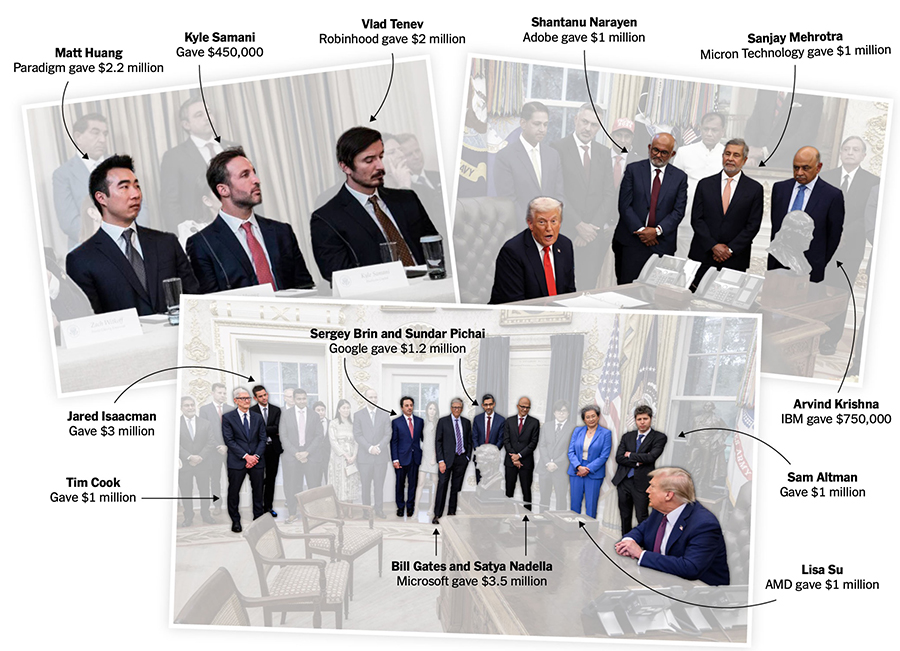
The list of who gave money, and what they got, is long. Peter Thiel's firm Palantir gave $10 million to the ballroom project and $5 million to America250. It got hundreds of millions in federal contracts, in part to help ICE deport people. Coincidences do happen, of course. Parsons Corporation gave $2.5 million to the ballroom project and is now a contender to get some of the trillions for Trump's Golden Dome anti-missile system, which is unlikely to work if it is ever needed. A couple that donated $1 million for Trump's inauguration and $500,000 to MAGA Inc. got their son a nice job: ambassador to Finland. The list goes on and on.
- Weaponizing the Courts: A favorite technique Trump loves dearly is suing big companies
for hundreds of millions or billions of dollars, based on some bogus cause of action, and then letting them settle for a
mere tens of millions. This is one of his favorites because when he sues them personally, he can make them pay them pay
him directly (or sometimes to his presidential library), instead of sending the money to one of his super PACs. For
example, Disney
settled
with him for $15 million and Paramount settled for $16 million.
- Suing the Government: This one really takes the cake. Trump is in the process of suing the federal government for $230 million because it investigated him years ago and that upset him. As president, he could order the government to settle the claim by simply paying it, or maybe negotiating with himself for a slightly lower amount.
Transparency
Transparency is a hallmark of Democracy, so the people know what government officials are up to. Transparency is not Trump's strong suit:
- Hiding Information: Trump didn't like some numbers he was getting about the economy, so
he shot the messenger, so to speak. He decided that Erika McEntarfer, then commissioner of the well-respected Bureau of
Labor Statistics, was responsible, so he took to his low-information social media site and
fired
her. That sent a shockwave though the media and financial world. U.S. government statistics were the gold standard and
all of a sudden the assumption was that henceforth they would be corrupted to make Trump look
good. It is hard for the Fed and companies to make plans if the input data is fake. Democracy
requires a situation in which people can trust the government to not lie to them.
Also on the subject of hiding information, in June, the National Climate Assessments were mysteriously removed from government websites, even though federal law requires a study to be done every 4 years and published. No explanation was ever given for the disappearance.
Also on the information front, the Department of Energy has announced that the way it will deal with the backlog of FOIA requests is to throw out all the old ones (pre Oct. 1, 2024) out and anyone who still wants the information requested has to request it again. Providing information to the public is clearly not a priority with this administration.
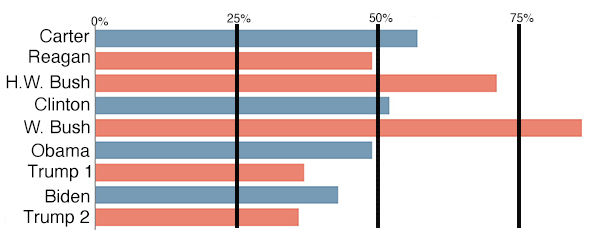
Despite all this, around 40% of the country still approves of Trump. For any other president, even 10% of the this would have been fatal, with calls from both sides of the aisle for impeachment. Here are the comparisons of their approval rates after 1 year in office:
Can anything be done to prevent another strongman who disdains democracy in the future? Laws can be passed (as happened after Watergate), but if the president corrupts the DoJ, they won't be enforced. What about constitutional amendments? The Constitution is not self-enforcing. If the only remedy is impeachment and conviction, that is never going to work if the president's party controls at least one chamber of Congress. It is too heavyweight. Imagine if the criminal law allowed only one penalty: death. Parking ticket? Death! Ran a red light? Death? Stole a candy bar from a store? Death! Punched someone who insulted you? Death!
The only thing we can think of offhand is a law or amendment stating that no one is above the law, including the president, vice president, members of Congress, judges, and justices, and that any of them can be prosecuted for their crimes up to 10 years after they leave office. That might give a president some pause, knowing a future president of the other party could put him or her on trial for crimes committed while president. This might require a future Supreme Court to change its mind on presidential immunity. To encourage that, a future Democratic president could simply arrest the Republican justices and give them a free two-week, all-expenses-paid vacation at lovely Guantano Bay just to make it clear to them why presidential immunity is a bad idea. (V)
How Does Trump Get Away with It?
How does Trump get away with so much corruption that would have sunk any other politician long ago? If Ronald Reagan, either of the Bushes, Bill Clinton, or Barack Obama had started a multi-billion-dollar crypto business supported by foreign governments, or pardoned drug dealers, campaign contributors, or political supporters to the extent Trump has, they would have been toast. Clinton's pardon to fugitive financier Marc Rich on the last day of his presidency sparked outrage for years. Just one questionable pardon to the ex-husband of a big Democratic donor was a story people are still talking about. Clinton knew that there would be a huge reaction, so it saved it for his last day in office when he couldn't be impeached for it. Trump has issued hundreds of much more problematic pardons and it is just business as usual. How has he gotten away with behaving so much worse than any previous president?
Thomas Edsel, of The New York Times, wrote a column about this and has some possible ideas, as follows:
- No Guilt: Clinton knew that what he was doing was wrong, which is why he tried to bury it
on the last day of his term. Trump has no concept of right and wrong. He has only a concept of a transaction. What will
you give me and what do I have to give you in return? If he is getting something more valuable than what he is giving,
he is for it, otherwise no. Morality plays no role at all with him. He does not feel guilty when it is pointed out what
he has done is wrong. It just bounces off him when it might upset another politician.
- The Media: The news media—and everyone else—are much more polarized than even
in the recent past. To Democrats, every Republican is a crook. To Republicans, every Democrat is a crook. If a Democrat
criticizes Trump it is brushed off as partisanship. If a Republican were to criticize Trump, it might be taken
seriously, but few do. The media report criticism this way, indulging in botesidesism, so it has no effect.
- Wokeness: The Democrats' alleged attachment to wokeness has poisoned many people's view
of them. This makes others inclined to write off all their criticism of Trump to wokeness. A recent poll showed that the
average Republican voter thinks that all Democrats care about are gay people and trans people. Under these conditions,
they don't take anything the Democrats say seriously.
- Structural Frailty: The Constitution was not designed to deal with a rogue president and
a supine Congress. The only penalty is impeachment and conviction. That is too hard to get. Imagine if the only penalty
in the criminal law was the death penalty. Parking ticket? Death! Stealing a newspaper from a newsstand? Death! Punching
someone who insulted you? Death! Maybe there should have been some other penalties, like having a majority of each
chamber of Congress be able to fine the president, but that isn't in there.
- Supreme Court: The Court has enabled Trump by not slapping him down hard when it could
have. When he signed an XO revoking birthright citizenship, the Court could have instantly responded with: "Is the
president off his rocker? This is a complete violation of the Constitution. Case dismissed 9-0." Didn't happen.
- Cowardly Republican Senators: The founders thought the Senate will be full of wise men
who were free from having to run for reelection every 2 years and would do what was best for their states and the
country. They were completely wrong. Republicans in the Senate could easily rein Trump in if they had the spines for it.
"You want this judge approved? First tear up XO's [X], [Y[, and [Z], or no judge" They have less courage than the
cowardly lion in The Wizard of Oz. Heck, they have less courage than Trump, which is really saying something.
SACO.
- Skewed Economic Growth: Conservative areas of the country, mostly rural and exurban, are stagnating. Urban areas on the coasts are doing fine. This makes make Republican voters think that urban liberals are stealing their prosperity somehow, and Trump has convinced them he can fix it.
A key problem is that the Executive Branch is unified under a single president, but all the sources of opposition are terribly fragmented. When the big law firms were attacked, they could have all adopted a tough stance together. If every one agreed to defend the others in court if need be, they would have been much stronger. If the universities had formed a pool of funds from their endowments to keep the lights on and research going while court cases played out, they could all have stood up to Trump and he would have backed down. That is true in every sector. This is why workers formed unions 100 years ago. They were much stronger that way. The threatened actors now didn't get the memo.
Sean Westwood, a political scientist at Dartmouth, writes: "The Democratic Party and its cultural vanguard have spent nearly a decade hyperventilating over every transgression, enforcing a rigid cultural orthodoxy misaligned with average voters, and gaslighting the public about the visible cognitive decline of the previous president. They have cried wolf so often, and with such performative hysteria, that the American electorate has gone deaf."
While Westwood points to partisan failure, Jacob Grumbach, a political scientist at Berkeley, disagrees and says the problem is structural failure. Congress no longer has an incentive to criticize a president of its own party for many reasons. The Supreme Court has a large conservative majority that both aligned with the current president and also afraid of him. Those checks and balances turned out to be very weak when really tested.
Both Westwood and Grumbach could be right. (V)
The President Is in Prison
Can a president go to prison for commiting crimes? Let's look.
In late October of last year, former French president Nicolas Sarkozy checked in at a French prison after being convicted of seeking campaign contributions from a foreigner—in his case, former Libyan dictator Moemmar Gaddafi. Sarkozy went on trial, was convicted, appealed, and lost. He spent a few weeks in prison, and then was released while his appeals play out. Still, the rule of law holds in France.
In Brazil, Donald Trump's buddy and imitator, Jair Bolsonaro, was sentenced to 27 years after staging an unsuccessful coup. Initially he was serving time under house arrest, but when he tampered with his ankle monitor, the courts didn't trust him and ordered him to prison. He has a relatively good deal, with a 130-square foot cell with a bed, desk, private bathroom, TV, and air conditioning. But it is still prison for a while. The rule of law holds in Brazil.
In South Korea, former president Yoon Suk Yeol is in prison after having been convicted of criminal insurrection and abuse of power, among other charges, after he declared martial law in order to circumvent an opposition-led legislature. He is the only South Korean president arrested while in office. The rule of law holds in South Korea.
In Thailand, former prime minister Thaksin Shinawatra, a billionaire, is in prison. His family dynasty has led the country for decades. But that wasn't enough for him. He abused his power to benefit his family's businesses. He was in exile but when he returned was granted clemency by the king and his 8-year sentence was reduced to 1 year. The rule of law holds in Thailand.
Former Philippine president Rodrigo Duterte is in prison, but not in the Philippines. He is in prison in The Hague waiting for trial on charges of crimes against humanity. His successor had him arrested in March. The rule of law holds in The Philippines.
As you probably have heard, American exceptionalism is a real thing. (V)
The Epstein Saga Continues
No posting is truly complete these days without a touch of Epstein news. The news today isn't big (well, in a sense it is very big, though) but it has real potential. The DoJ has announced that it is reviewing 5.2 million pages of Epstein-related files. This is a much larger number than previously reported.
So far, the DoJ has released 100,000 pages of material and previously said it was reviewing 1 million more. Now that number has jumped 5x. It is trying to enlist 400 lawyers to help in the process. If this is true, it could take weeks before it is all out there.
If this number is correct, that is probably bad news for Donald Trump. With so many pages tor review and such a big hurry, things that Trump doesn't want out there might slip through. The instructions to the lawyers are probably to black out the names of victims. Maybe they are also under orders to search for items harmful to Trump and put them in the nearest paper shredder. The trouble with that kind of instruction is that with 400 lawyers involved, that instruction might leak out. If the lawyers are simply blacking out victims names and no one is actually reading the documents, just skimming them looking for names, the odd bit of truth here or there could end up being released.
After that it will be up to reporters to go through the 5 million documents. That could take years. The Internet is going to come to the rescue, though, as there are several projects already in place that involve farming the scrutiny out to an army of volunteers. A total of 5 million documents divided by 400 people is a lot—12,500 documents each. But 5 million documents divided by 50,000 people is much more manageable—100 documents each. Or, if you assign each document to two or three people to make sure there's no cheating and that nothing is missed, 200 or 300 documents each. Obviously, a person can work their way through hundreds of documents with greater thoroughness AND more quickly than an overworked government lawyer can work their way through 12,000+ documents.
And there is more. A recent batch of surveillance videos from jail where Jeffrey Epstein was found dead in his cell raises new questions about whether officials have been telling the truth about Epstein's death. The new footage contradicts some of the prior statements made by prison officials.
The new footage contains over 400 1-hour clips from the time a month before Epstein's death. According to official statements, videos are kept for only 30 days. So, why are videos from July 5 showing up now? One expert noted that the videos were written to a hard disk and the system was set up to avoid overwriting old data unless it ran out of space. Something is fishy here.
Also, the new footage includes several hours from a camera that officials said was broken and not recording. It provides an unobstructed view of the entrance to the stairs leading to Epstein's tier. Some of it was from Aug. 12, 2019. However, officials said that camera stopped recording on July 29 and was not repaired until Aug. 14. This was clearly a lie. The new footage raises the question of which cameras were recording and when, and whether officials are telling the truth and whether all relevant video has been released. (V)
Americans Are Initially Split on Venezuela
The Washington Post sent text messages to U.S. adults selected from the SSRS Opinion Panel to get an idea of how they feel about the capture of Nicolás Maduro. Very briefly 40% approve of it, 42% disapprove, and 18% don't know what Venezuela is (just kidding—sort of). The results break along partisan lines, like everything else in America, with 74% of Republicans approving and 76% of Democrats disapproving. Among independents, disapproval won 42% to 34%. Almost two-thirds think that Trump should have gotten approval from Congress in advance.
Please note that we are now in the "Mission Accomplished" phase of this operation. If everything goes well from now on, Marco Rubio is a good viceroy, Delcy Rodriguez is a pliant and capable president of Venezuela, and there is no civil war in Venezuela that pulls the U.S. in, Americans will continue to be split evenly along partisan lines. But history, even recent history, shows that if things go south, public approval drops swiftly, especially among people who want the president to concentrate on getting their cost of living down. Consider this poll a snapshot of a moment in time. It is not carved in stone for the history books. (V)
Previous | Next
Main page for smartphones