Regular Updates to Start Next Week
Permalink
Labor Day is the traditional kickoff for political campaigns in the U.S. so we will begin our detailed coverage
of the 2010 midterm elections next week. Before September, most voters are more interested in hot dogs than hot air
and don't pay a lot of attention to politicians. That will start to change next week. Accordingly, the site will be
updated (almost) every day from next week to election day.
Party in the White House Nearly Always Loses Seats in the Midterms
Permalink
With very few exceptions in the past half century, the party occupying the White House loses seats in both
the Senate and House during the midterm elections. The President's opponents see the midterms as away to register
their unhappiness with him. But usually enough of his supporters are more disappointed by what he didn't do than
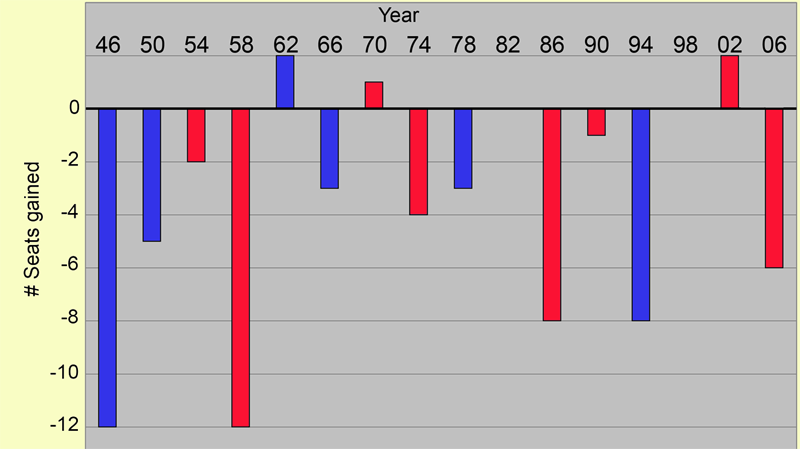
by what he do and stay home, which makes a difference. Here is a chart showing the results of all the Senate midterms
since WWII. Bars going down from the horizontal black line mean the President's party lost seats in the Senate. Bars going
up showed that it won. Only three times in more than a half century has the President's party gained ground, and
then only one or two seats. The colors indicate which party was in the White House at the time of the midterms.
The average loss in the Senate is 7 seats.
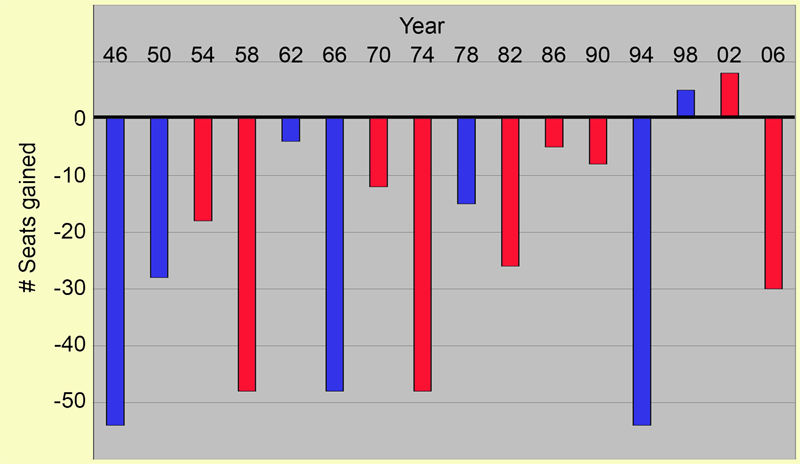
The situation in the House is even more bleak for the Democrats. Only twice has the "in" party won seats,
once in 1998 (when people were angry with the Republicans for impeaching Bill Clinton) and once in 2002 (right
after 9/11, when George Bush's popularity soared). Here is the chart for the House. The average loss is 28 seats.
The Republicans need 39 seats to capture the House. While such a loss is not common, it has happened five
times since WWII.
Midterm Election is Not a Done Deal
Permalink
While it is virtually certain that the Republicans will pick up seats in both the Senate and House, the number
of seats they win is still very much up in the air. Remember in politics a week is a long time. There are a
variety of factors that could play a role greatly affecting the size of the Republicans' victory.
Here is quick rundown of some of them.
- The Economy. Unemployment is still high and the economy is in poor shape. Under these conditions,
many voters will blame the Democrats, and rightly so. With the White House, 60 seats in the Senate, and 257
seats in the House, the Democrats could have ridden roughshod over the Republicans and done what was necessary,
but they tried to meet the Republicans half way, only to hit a stone wall. Nearly all economists said that
a stimulus of $900 billion was too small, but President Obama wanted desperately to keep it under 1 trillion
(over 10 years) so the Republicans couldn't accuse him of a trillion-dollar spending spree. He got his way but
the result is that the economy is still in the toilet. He should have gone for a stimulus that was twice as big
and when the Republicans began screaming about the deficit, should have said: "When George Bush took office, the
budget was in surplus and we were finally paying off the national debt. How come you voted for tax cuts that
prevented us from paying off the debt?"
- The Health Insurance Bill. The country is split on the bill, but very few people know what is in it.
Very few members of Congress even read it. What Obama could do is go traveling around the country pointing out
the popular features of the bill. For example, he could go to a state with a hotly contested Senate race and
interview some adorable 6-year old girl with cancer, her parents, and her doctor. The parents could thank him,
saying their daughter can now get insurance for the first time (the law makes it illegal starting Sept. 23
for insurance companies
to deny payment to policyholders under 19 with pre-existing conditions) and can have that
operation she needs to save her life.
Obama could then add that the Democrats care about children, the Republicans care only about insurance company
profits. If done right, half a dozen stops like this could turn public opinion on the bill around.
- The Tea Party. With Joe Miller's win in Alaska (see below), the tea party now has candidates for the
Senate in Kentucky, Nevada, Colorado, and Alaska so far, with primaries still to be held in Delaware and New Hampshire.
The Democrats could adopt as their slogan:
"The once-great party of Abraham Lincoln, Teddy Roosevelt, and Dwight Eisenhower has been taken over by the
crazies." By harping on some of the more extreme positions some of these candidates have taken, the net result
could be to convince a lot of voters that bad as the Democrats are, the Republicans are worse. In particular,
fear works well in midterm elections and the Democrats could say the Republicans want to eliminate Social Security,
something various tea party candidates have said over and over so there is plenty of footage to use.
- Mobilizing the Democratic Base. There is currently an enormous enthusiasm gap. Republicans are all fired
up about the election and will vote in great numbers. In contrast, the Democratic base is moping and sulking because
Obama gave away so much to the Republicans on the stimulus, health insurance, banking reform, and more and got
nothing in return. Once Al Franken (D-MN) was seated and Arlen Specter (D-PA) jumped ship, they expected Obama
to carry out his campaign promises and ignore the Republicans. He didn't, which made many of them quite unhappy
with him. There are still things he can do to fire them up, but he has to act quickly. One is to nominate
Elizabeth Warren to run the new consumer protection agency. The base wants her because they know she will regulate
the banks. The banks are violently opposed to her because they know she will regulate the banks. Another is to
let the Bush tax cuts expire and support a new bill that keeps the tax cut only for those making under $250K. If
the Republicans filibuster this middle-class tax cut, the Democrats could run on a platform of "we tried to cut
your taxes but the Republicans care only about the rich."
For a political team that ran a brilliant campaign in 2008, the Obama team seems incredible blind and deaf
to the mood of the country now. While it is true that the President is the head of the executive branch, he is also
the leader of his party and is expected to be out there cheerleading for his team. So far, he hasn't done that at all,
but there is still time for him to act--if he wants to--which is by no means sure.
His problem is that midterm elections are about motivating your own base, not trying to win over independents.
Doing so requires playing hardball, and that is not a sport that comes naturally to him, with possibly catastropic results.
If the Republicans capture the House--which is certainly within the realm of possibility--the new Republican committee chairmen, armed
with subpoena power, will begin investigating everything from his birth certificate to his vegetable garden.
But a lot can still happen
between now and November that will determine the size of the Republicans' almost certain big gains.
Murkowski Throws in the Towel in Alaska
Permalink
Sen. Lisa Murkowski (R-AK) has
conceded
defeat in her campaign to be renominated in Alaska.
At the end of election day, she was trailing tea partier Joe Miller (R) by 1668 votes. She had pinned her hopes on
the 10,000+ absentee ballots. But as the the early counts starting coming in, it was immediately clear that she
wasn't going to make up the necessary ground, and conceded defeat to her Sarah Palin-endorsed opponent, lawyer
Joe Miller, who is the heavy favorite to beat Sitka mayor Scott McAdams (D) in the general election.
Tea Party Moves on to Delaware
Permalink
Fresh off a stunning upset victor in Alaska, the teap party is moving on to the Republican primaries in
Delaware and New Hampshire.
The Delaware primary has not attracted any attention because everyone there assumed that Rep. Mike Castle (R-DL)
would get a promotion to the Senate. But after Alaska, nothing is sure any
more and several tea party groups are planning to
spend
upwards of $250,000 to support the candidacy of Christine O'Donnell (R) against Castle. O'Donnell is young (41),
good looking, and a real right-wing firebrand, not unlike Sarah Palin, who has not yet endorsed anyone in the race.
Castle is old (71), not so good looking, and extremely moderate for a Republican.
Many tea partiers see this race as a potential rerun of the Alaska primary, where a totally unknown, but true-blue
conservative, upsets an establishment moderate Republican. The primary is Sept. 14.
New Hampshire Primary Gets New Life
Permalink
People in New Hampshire are used to having everyone pay attention to their presidential primary but not so
used to the spotlight for their midterm primary. This year that may change. It was expected that appointed
Attorney General Kelly Ayotte, the establishment choice, would easily win the GOP nomination. But after Miller's
upset in Alaska, tea partier Ovide Lamontagne's campaign against her has
taken off.
He is a somewhat better chance than O'Donnell because (1) Castle has won more than a dozen elections and is very
well known in her state whereas Ayote has never won an election and (2) New Hampshire is full of curmudgeons who just
who delight in upsetting the applecart whereas Delaware is a reliably blue state in general.
It could be interesting.
If you like this Website, tell your friends. You can also share by clicking this button

-- The Votemaster
|
Your donation is greatly appreciated. It will buy ads to publicize the site.

|



 Welcome
 FAQs
FAQs Donations
 Icons for bloggers
 Previous elections
 Animated maps
 Data galore
 Senate races
 Hot House races
 Political websites
 Articles and books
 Political humor