New Poll: California Latinos Still Heavily Democratic
Permalink
A long-term trend that has to be encouraging to the Democrats and worrying to the Republicans is the GOP's
continuing inability to attract Latino voters, nationally the most rapidly growing demographic group.
A new LA Times poll
shows Latinos backing Sen. Barbara Boxer (D-CA) over Carly Fiorina (R) for senator by 38% and Jerry Brown (D) over
Meg Whitman (R) for governor by 19%. Latinos are overwhelmingly Democratic and even a moderate Republican like Whitman has no chance
with them while a somewhat conservative Republican (by current standards) like Fiorina gets completely trashed. Had tea party favorite
Chuck DeVore (R) won the senatorial primary, Boxer's lead might have been 50% among Latinos. Thus as the Republican party moves to the right,
as evidenced by tea party candidates beating the establishment favorites in Colorado, Kentucky, Nevada, Utah, and elsewhere, it loses
more and more Latino votes. Currently 21% of California voters are Latinos and this percentage is growing. There are also large and rapidly growing
Latino populations in Nevada, Arizona, New Mexico, and Colorado, which are going to affect elections for years to come.
Koch Brothers Profiled
Permalink
The publicity-shy Koch brothers, who together have the third biggest fortune in America, trailing only Bill Gates and Warren Buffet,
are in the spotlight today, as the LA Times has a long
article
about them. They have been the primary funders of many of the tea party groups and also
FreedomWorks,
which is run by the former Repubican House majority leader, Dick Armey. Their father was one of the original members of the John Birch
Society and they have picked up the baton from him, donating millions of dollars to conservative causes. Although one of them lives
in Witchita and the other in New York City, they seem to be taking an unusual interest in California politics this year, for example,
putting $1 million into Proposition 23, which would gut California's strict air pollution laws.
New Study Released on Reapportionment
Permalink
As soon as the new state legislatures are seated in January, one of their first tasks will be redrawing their congressional districts.
This task is most crucial in those states that have gained or lost House seats. In the other states, the boundaries can stay the same unless
one party controls all the levers of state government, in which case, with the aid of more data and better computer software, the legislators will try
to further gerrymander the state to increase their number of representatives in Congress. But, when seats are gained or lost, new boundaries
are required and a
new study
pinpoints where the gains and losses are likely to be. Texas is the big winner, with four new seats and Florida will get two new ones.
Arizona, Georgia, Nevada, South Carolina, Utah, and Washington will each gain one new seat.
Ohio and New York will each lose two seats, as people continue to leave for better meteorological and economic weather in the South and West.
Illinois, Iowa, Louisiana, Massachusetts, Michigan, Missouri, New Jersey, and Pennsylvania will each lose one seat. All in all, this is
good news for the Republicans as blue states are losing population and red ones are gaining it. The only potential problem is that
when people from blue states move to red states, they often take their political views with them. For example, the Texas governor's
race between Gov. Rick Perry (D-TX) and Bill White (D), the former mayor of Houston is quite competitive. As more people from the
north move in and the Latino population explodes, in 5-10 years Texas is likely to become the mother of all swing states.
Filibuster Reform May be on the Agenda in January
Permalink
The Republicans have been using the filibuster to block even routine motions to begin debate, which has angered many Democratic senators.
In the current (111th) Senate, there have been over 100 filibusters,
compared to 27 filibusters in the period 1919 to 1960, which comes up to fewer than 1 per year, so the rate for this Senate is 100x the
average for the first half of the 20th century. In the entire 19th century there were about 20 filibusters, roughly one every five years.
In other words, the filibuster has historically been used only for very, very major battles, of which the debates over slavery, secession,
and reconstruction weren't even important enough.
Sen. Chuck Schumer (D-NY), who is chairman of the Senate Rules Committee, is studying
filibuster reform.
If the Democrats manage to hold onto about 52 or 53 seats in the Senate, reform might work like this. At the start of the 112th Senate,
some (Republican) senator will say that the 112th Senate is a continuation of the 111th Senate and thus the old rules still apply.
Then some Democratic senator could object and say, no, the 112th Senate is a new body and has to adopt its own rules by majority vote.
Much debate would ensue. Eventually, the President of the Senate, Vice President Joe Biden, would ask the Senate Parliamentarian, Alan
Frumin, for his opinion. But no matter what Frumin (who has no legal authority but is merely an advisor to the chair) said, Biden could
rule that the 112th Senate is indeed a new body and needs to adopt its own rules. Many (Republican) senators would no doubt object to
the ruling and it would be put up for a vote. If a majority supported the ruling, it would be sustained; otherwise, it would be overturned.
If the ruling is sustained, then the Senate would have to adopt new rules by majority vote, with no filibuster possible.
It is these possible
new rules that Schumer is working on. The possibilities range from simply abolishing the filibuster outright
(making the Senate like the House, which has never had a filibuster), to instituting a series of votes several days
apart, with 60 votes needed to invoke cloture on the first one, 57 on the second one, 54 on the third one, and 51 on the fourth one.
Such a system would make it impossible for the majority to ram stupid legislation through overnight, but prevent the minority from
actually blocking a determined majority.
Schumer fully understands that some Democratic senators, such as Sen. Nelson (D-NE), oppose changing the rules, so he has to come up
with a set of proposals that would pass if the Democrats have 51, 52, 53, etc. seats in the new Senate. With 54 seats, he can probably
tighten the rules considerably, but with only 51 he may not be able to do anything.
Also a factor is the Nevada Senate election. If Sen. Harry Reid (D-NV) defeats tea party favorite Sharron Angle, Reid will continue
as majority leader. Although Reid used to be an amateur boxer, he doesn't like fighting the Republicans much and tries to work with them,
although there is no chance they will cooperate on this issue. If Reid loses, Schumer and Sen. Dick Durbin (D-IL), the #2 ranking Senate
Democrat, will battle it out for the post of majority leader. Both of them strongly support filibuster reform. So oddly enough, the
Democrats may get a lot more through the 112th Congress if Reid loses. Polls show him running neck and neck with Angle now.
Results of Polled House Races
Permalink
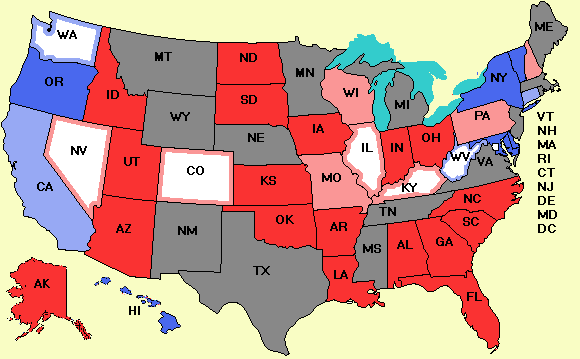
Unlike the Senate races, most of which are polled regularly, only 45 House races have been polled
by a nonpartisan pollster. While everyone is expecting a Republican romp in November, the actual
polling data to date don't reflect that entirely. All the polled races are shown below, with the incumbent
party shown first and the color indicating which party led in the poll.
Admittedly, this is not a scientific random sample of all races, but most of the races polled are
competitive--otherwise nobody would have paid to have them polled.
The results can be stated as follow:
- Democratic holds: 23
- Republican holds: 11
- Democratic takeovers: 1
- Republican takeovers: 10
In other words, based on this sample, the Republicans look to pick up a net of about 22% on the
competitive districts. No one knows how many districts are really competitive, but few people think
it is more than 100, which would scale to a net gain for the Republicans of 22 seats. Again, this
set of districts may not be representative of the country as a whole, but these districts do represent actual data.
| AK-AL |
Don Young* (R) |
Harry Crawford (D) |
49% |
34% |
| AR-03 |
Steve Womack (R) |
David Whitaker (D) |
55% |
31% |
| AR-04 |
Mike Ross* (D) |
Beth Anne Rankin (R) |
49% |
31% |
| CA-03 |
Dan Lungren* (R) |
Ami Bera (D) |
46% |
38% |
| CA-19 |
Jeff Denham (R) |
Lorraine Goodwin (D) |
63% |
30% |
| CA-20 |
Jim Costa* (D) |
Andy Vidak (R) |
48% |
46% |
| DE-AL |
Glen Urquhart (R) |
John Carney (D) |
37% |
48% |
| FL-08 |
Alan Grayson* (D) |
Dan Webster (R) |
38% |
46% |
| ID-01 |
Walt Minnick* (D) |
Raul Labrador (R) |
46% |
36% |
| ID-02 |
Mike Simpson* (R) |
Mike Crawford (D) |
51% |
23% |
| IN-02 |
Joe Donnelly* (D) |
Jackie Walorski (R) |
52% |
35% |
| KS-01 |
Tim Huelskamp (R) |
Alan Jilka (D) |
65% |
23% |
| KS-04 |
Mike Pompeo (R) |
Raj Goyle (D) |
50% |
40% |
| KY-03 |
John Yarmuth* (D) |
Todd Lally (R) |
53% |
30% |
| KY-06 |
Ben Chandler* (D) |
Andy Barr (R) |
51% |
37% |
| ME-01 |
Chellie Pingree* (D) |
Dean Scontras (R) |
53% |
29% |
| ME-02 |
Mike Michaud* (D) |
Jason Levesque (R) |
48% |
28% |
| MI-15 |
John Dingell* (D) |
Rob Steele (R) |
49% |
30% |
| MN-06 |
Michele Bachmann* (R) |
Tarryl Clark (D) |
49% |
40% |
| NC-08 |
Larry Kissell* (D) |
Harold Johnson (R) |
41% |
35% |
| NC-11 |
Heath Shuler* (D) |
Jeff Miller (R) |
45% |
44% |
| ND-AL |
Earl Pomeroy* (D) |
Rick Berg (R) |
45% |
48% |
| NJ-03 |
John Adler* (D) |
Jon Runyan (R) |
35% |
28% |
| NM-01 |
Martin Heinrich* (D) |
Jon Barela (R) |
47% |
41% |
| NM-02 |
Harry Teague* (D) |
Steve Pearce (R) |
45% |
42% |
| NV-03 |
Dina Titus* (D) |
Joe Heck (R) |
47% |
43% |
| NY-20 |
Scott Murphy* (D) |
Christopher Gibson (R) |
54% |
37% |
| NY-24 |
Mike Arcuri* (D) |
Richard Hanna (R) |
47% |
40% |
| NY-29 |
Matt Zeller (D) |
Tom Reed (R) |
30% |
44% |
| PA-03 |
Kathy Dahlkemper* (D) |
Mike Kelly (R) |
38% |
44% |
| PA-08 |
Patrick Murphy* (D) |
Mike Fitzpatrick (R) |
35% |
49% |
| PA-10 |
Chris Carney* (D) |
Thomas Marino (R) |
36% |
40% |
| PA-11 |
Paul Kanjorski* (D) |
Lou Barletta (R) |
32% |
43% |
| PA-15 |
Charlie Dent* (R) |
John Callahan (D) |
49% |
38% |
| RI-01 |
David Cicilline (D) |
John Loughlin (R) |
49% |
26% |
| RI-02 |
Jim Langevin* (D) |
Mark Zaccaria (R) |
54% |
20% |
| SD-AL |
Stephanie Herseth Sandlin* (D) |
Kristi Noem (R) |
47% |
45% |
| VA-05 |
Tom Perriello* (D) |
Robert Hurt (R) |
35% |
61% |
| VA-09 |
Rick Boucher* (D) |
Morgan Griffith (R) |
50% |
40% |
| VT-AL |
Peter Welch* (D) |
Paul Beaudry (R) |
64% |
30% |
| WA-02 |
Rick Larsen* (D) |
John Koster (R) |
46% |
50% |
| WA-03 |
Denny Heck (D) |
Jaime Herrera (R) |
43% |
52% |
| WA-08 |
Dave Reichert* (R) |
Suzan DelBene (D) |
54% |
41% |
| WA-09 |
Adam Smith* (D) |
Dick Muri (R) |
49% |
46% |
| WY-AL |
Cynthia Lummis* (R) |
David Wendt (D) |
59% |
29% |
Today's Polls: AL GA ND PA SC PA-10 PA-11
Permalink
| Alabama |
William Barnes |
30% |
Richard Shelby* |
58% |
|
|
Sep 21 |
Sep 21 |
Rasmussen |
| Georgia |
Mike Thurmond |
36% |
Johnny Isakson* |
52% |
|
|
Sep 21 |
Sep 21 |
Rasmussen |
| North Dakota |
Tracy Potter |
25% |
John Hoeven |
68% |
|
|
Sep 20 |
Sep 21 |
Rasmussen |
| Pennsylvania |
Joe Sestak |
38% |
Pat Toomey |
44% |
|
|
Sep 18 |
Sep 23 |
Muhlenberg Coll. |
| South Carolina |
Alvin Greene |
21% |
Jim DeMint* |
64% |
|
|
Sep 22 |
Sep 22 |
Rasmussen |
| PA-10 |
Chris Carney* |
36% |
Thomas Marino |
40% |
|
|
Sep 22 |
Sep 23 |
Critical Insights |
| PA-11 |
Paul Kanjorski* |
32% |
Lou Barletta |
43% |
|
|
Sep 22 |
Sep 23 |
Critical Insights |
If you like this Website, tell your friends. You can also share by clicking this button

-- The Votemaster
|
Your donation is greatly appreciated. It will buy ads to publicize the site.

|



 Welcome
 FAQs
FAQs Donations
 Icons for bloggers
 Previous elections
 Animated maps
 Data galore
 Senate races
 Hot House races
 Political websites
 Articles and books
 Political humor