Pres polls: (None)
Dem pickups: (None)
GOP pickups: (None)
Previous | Next
Shutdown Inches Closer to Either Resolution or "National Emergency"
On Thursday, the Senate held votes on two different proposals for ending the government shutdown, one of them advanced by Donald Trump, the other by House Democrats. Predictably, both proposals fell well short of the 60 votes needed to overcome a filibuster, and so both are dead in the water.
Even though both votes failed, there were nonetheless some worrisome indications for Trump. For his bill, the final tally was 50-47, with just one Democrat (Joe Manchin of West Virginia) breaking ranks to vote with the President, and two Republican immigration hawks (Mike Lee of Utah and Tom Cotton of Arkansas) voting nay. The total for the Democrats' proposal, on the other hand, was 52-44, with none of their caucus defecting (though Jacky Rosen of Nevada, who just had surgery, was absent). Meanwhile, six Republicans crossed the aisle to vote with the blue team: Lamar Alexander (TN), Susan Collins (ME), Cory Gardner (CO), Lisa Murkowski (AK), Johnny Isakson (GA), and Mitt Romney (UT). These are folks who knew the bill would fail, and yet they chose to break ranks anyhow. Clearly, they were trying to send a message to...someone. For Collins and Gardner, the target of that message might have been the voters they will face in 2020. Anticipating a tough reelection campaign, they could be doing whatever they can to avoid responsibility for the shutdown. But Alexander, Murkowski, Isakson, and Romney do not need to be worried about 2020, so the obvious target of their message is the President. Something along the lines of, "You better come up with something soon, as a veto-proof majority isn't far from becoming a reality."
That wasn't the only bad sign, either. GOP senators held a private lunch on Thursday, with VP Mike Pence in attendance, and it was not a pretty scene. Several members of Majority Leader Mitch McConnell's (R-KY) caucus unloaded on him, with Ron Johnson (R-WI) shouting: "This is your fault," to which the Majority Leader snapped: "Are you suggesting I'm enjoying this?" Several of the senators who were present also unloaded on Pence. Most notable among them was McConnell himself, who made clear that, in his view, the shutdown is not working, that it is poor political strategy, and that Trump needs to come up with something quickly.
The White House, for its part, recognizes that it is losing the shutdown fight, and is searching desperately for a way out. On Thursday afternoon, CNN reported that the administration has drafted a national emergency proclamation, and has identified the $7 billion in funds that it will redirect from other projects. Needless to say, once the groundwork for something like this is laid, such that the President can pull the trigger at any time, it is dangerously close to becoming a reality. He could wake up with a bee in his bonnet, reach for his iPhone, and it's a done deal (as happened with the banning of transgender soldiers, the withdrawal from Syria, and the early termination of John Kelly, among other major decisions). That said, it looks like this may have been a knee-jerk response, because later in the day, members of the administration floated the idea that Trump would be willing to reopen the government if he gets a "down payment" on his wall. That is very close to acceding to the Democrats' insistence that the order of events be: (1) Reopen the government, (2) Discuss wall funding.
If Trump does back down, he will be flayed alive by Ann Coulter, Rush Limbaugh, and maybe even the previously 100%-loyal Sean Hannity. However, polls continue to make clear that he's being wrecked anyhow. CNN's Poll of Polls, which aggregates data from many different polling houses, reveals that the President is averaging 37% approval in current polls, a drop of four points since the shutdown began. Particularly worrisome for him is that much of the drop reflects a loss of support among non-college white voters, which is one of his core constituencies. On top of that, close to three-quarters of voters do not think that it is worth it to shut down the government in order to build the wall, while Trump and the GOP are getting the blame over the Democrats by a 2-to-1 margin.
Not helping Trump on the PR front are members of his team who are apparently unfamiliar with what happened to Marie Antoinette. In an interview Thursday, Secretary of Commerce Wilbur Ross wondered what the big deal is about going without paychecks, and why federal workers are going to food banks, since they're eventually going to be paid, and in the interim they can take out loans. Meanwhile, Trump daughter-in-law Lara opined that the 800,000 furloughed workers should be honored to feel "a little bit of pain...for the future of our country." These remarks aren't quite "let them eat cake," but they're not helpful from two people who have access to tens of millions of dollars (or more), and have not had to worry for a long time, if they ever have, about where the money for rent or their next meal will come from. Unforced blunders like these bring to mind the old line: "With friends like that, who needs enemies?" (Z)
Shutdown's Effects Grow More Serious Every Day
The politics of the shutdown are undoubtedly turning the screws on Donald Trump, and on other Republicans. However, so too are the actual effects on the ground, which are becoming more pronounced, and are affecting more people, every day.
In terms of national security, for example, the picture is not pretty. This week, all five former homeland security secretaries, including John Kelly, sent a joint letter to the President and Congress urging an end to the shutdown, arguing that it not only makes the country less safe in the short term, but that it will cause skilled professionals to quit, thus making the country less safe in the long term, as well.
The FBI also chimed in with a 72-page report that says much the same thing as the secretaries' letter. The report specifies, in great detail and with evidence, the functions that are not currently being performed, or are being under-performed. Among other things, the Bureau has postponed indictments and undercover operations, canceled the training of state and local law enforcement agencies, put off meetings with informants, delayed interviews with child sexual-assault victims, and suspended payments for investigative collaborations with local police. Needless to say, bad guys don't conveniently hang out at the local mini-mall until the feds have the needed resources to deal with them, so many investigations may be permanently compromised. Meanwhile, the report also notes the likelihood of experienced agents leaving the Bureau permanently for private sector employment. Particularly likely to do so are the agents whose bank accounts are so low that they are receiving donations of canned food from their better-heeled colleagues.
And it is not just FBI agents who are short on money and food. The U.S. Coast Guard is military enough to be "essential," but not military enough to be covered by the appropriations bills that pay sailors, soldiers, and marines. And so, many USCG families have been forced to ask for charity, including food from both friends and food banks. On top of that, if a current or former Coast Guard member dies, they will not receive the death benefit to which they are entitled. At least, they will not receive it until the government reopens. The problem, as anyone who has planned one knows, is that funerals are not cheap, and they are quite time-sensitive, for various reasons. Particularly if the deceased is, say, a practicing Jew (no embalming allowed; quick burials). In those circumstances, "we'll get you your money eventually" is not going to get it done.
The situation at airports is also degrading rapidly. TSA absenteeism is now above 10%, and there is talk of a mass sickout, which could drive that number into the 50s or 60s or 70s. Also affected by the shutdown (and, quite often, going without pay) are air traffic controllers, transportation security and law enforcement officers, safety inspectors, and air marshals. On Thursday, the unions that represent air traffic controllers, pilots, and flight attendants issued an unprecedented joint statement, in which they warned that, "In our risk averse industry, we cannot even calculate the level of risk currently at play, nor predict the point at which the entire system will break."
Of course, national security isn't the only place where Americans are getting shorted. This week, the Trump administration ordered 30,000 IRS agents to return to work, so that tax refunds would be processed on time. However, almost half of those 30,000 did not report, often with permission from their supervisors, either as a form of protest, or because they are working some other temporary job in order to make ends meet. The problem will only get worse from here on out, meaning that if the shutdown does not end soon, many tax refunds will indeed be delayed.
The shutdown is also negatively affecting scientists, many of whom rely on federal funding for their research. Last year, in the month between Dec. 22 and Jan. 22, the government disbursed over $127 million. This year, in that same period, it was, of course, $0. And again, this is both a short-term and a long-term problem. In the short-term, for example, some kinds of research cannot be stopped and started, which means some projects may be permanently derailed. In the longer-term, researchers cannot plan out their futures, since they do not know when they will be funded (in the case of those with approved grant proposals), or if they will be funded at all (in the case of those waiting for approval). This means that research assistants cannot be hired, materials cannot be acquired, and the academic summer (May-August), which is just four months away and is prime research time, is in limbo. The result, according to one scholar, is "a slow strangling of the American scientific enterprise."
Last week, a Trump administration official suggested (anonymously) that the shutdown would have the effect of showing voters how much of the federal government is unnecessary. Given all these different news stories, it's hard to see how that could possibly be the lesson folks take from this. (Z)
Roger Stone Arrested
At 6 a.m. EST this morning, Donald Trump's adviser Roger Stone was arrested at his home in Florida. The FBI knocked on his door, announced their presence, and demanded that he open it, which he did. He is being charged with seven felonies, including obstruction of an official proceeding, making false statements, and witness tampering.
Stone has long said that he expected to be arrested and charged, and now it has happened. He also has said that he would never rat on Trump, but that will soon be put to a test as special counsel Robert Mueller is about to give him a choice: Your neck or Trump's. If Stone decides he would prefer Trump to go to prison rather than himself, he probably can do a lot of damage to the President, as Stone has known him for years and is a dirty trickster, right up there with Lee Atwater. Trump appreciates people like that and may well have bragged to him about all the nefarious (and possibly illegal) things he has done. If Stone gets into bean-spilling mode, he will be right up there with Michael Cohen and Rick Gates in terms of Trump's exposure. Of course, if he decides that G. Gordon Liddy is his hero and keeps his mouth shut, all bets are off.
Needless to say, there are relatively few details at this point, including what proceeding he might have obstructed, or what witness he might have tampered with. Stone was once business partners with Paul Manafort, who has already been indicted and convicted, so that might be it. He also has connections to Wikileaks' Julian Assange, and thus the DNC e-mail hack, through a currently unknown intermediary. Then there is Jerome Corsi, who is quite close to Stone, and is himself dangerously close to being indicted. However, it's hard to see how these particular charges could involve someone who has not actually been indicted. In any event, with the possible exception of Manafort, Stone is the closest person to Trump to be pinched so far.
The fact that the FBI raided Stone's house in the wee hours, denying him the opportunity to surrender himself (or to flee the country) suggests that Mueller expects this to be a hostile relationship, and that he's not planning on much cooperation. And if Stone is regarded as a flight risk, he may not get bail, and may remain behind bars, like Manafort. In any event, maybe we will learn more details later today. Although, given how tight-lipped Mueller is, maybe not. (V & Z)
Cohen Subpoenaed by the Senate Intelligence Committee
On Wednesday, Michael Cohen reneged on his promise to testify before Congress, saying that he was cowed by threats levied against him by Donald Trump and his TV lawyer Rudy Giuliani. Since Cohen was not under subpoena, it was his right to pull out like this.
At least, it was temporarily his right to pull out, because as of Thursday, he is now under subpoena. Interestingly, it was not House Oversight Chairman Elijah Cummings (D-MD) or House Intelligence Chairman Adam Schiff (D-CA) who issued the subpoena, it was Senate Intelligence Committee Chairman Richard Burr (R-NC). Burr was closemouthed about what he wants from Cohen, but it probably doesn't matter. As long as Cohen is in town, anyhow, and as long as he's visiting Congress involuntarily, anyhow, Cummings and Schiff are likely to issue their own subpoenas.
For a few hours on Thursday, it was possible that Cohen might resist the subpoena, since he's going to prison anyhow. However, late Thursday afternoon, Cohen's lawyer announced that he would indeed appear. So, if Cohen actually has new dirt to dish on Donald Trump, then it will presumably be dished when Cohen visits Washington in February. (Z)
Koch Network Won't Back Trump in 2020
The 2020 campaign is already underway, and it's not just the potential candidates who are declaring their intentions, it's also the donors. On Thursday, it was reported that Charles Koch, leader of the GOP's most powerful and well-heeled funding network, has made clear that he and his associates will not back Donald Trump in 2020 (though they will continue to back candidates in state and congressional elections).
This is not a terribly surprising development, since the Kochs and Trump essentially hate one another, as they agree on tax cuts, and judicial picks (sometimes), and not much else. The Kochs did not back Trump in 2016, either, so this is not a loss to the President, per se. It is, however, a sign that despite the tax cut, he has not expanded his base of support. It is also not impossible that the fundraising network, which is transitioning to new, younger leadership, could back Trump's Democratic rival, if he or she is to their liking. A Michael Bloomberg or a Sen. Amy Klobuchar (DFL-MN) might just pique their interest. (Z)
NBA Champions Visit President
The Golden State Warriors, who are the reigning NBA champions, were in Washington, D.C., for the first (and only) time this season. And so, consistent with custom, they made a presidential visit. Here's the picture:
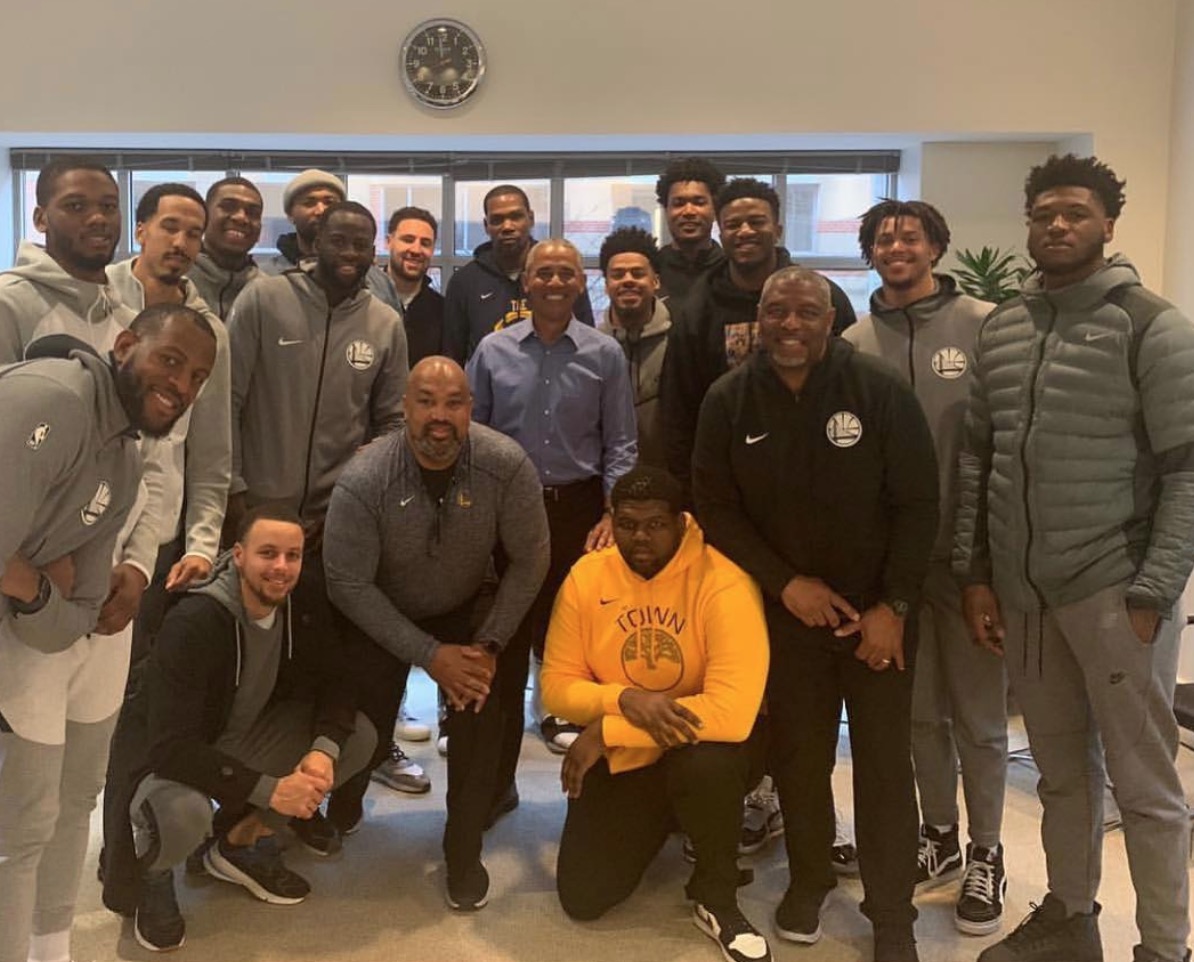
You may notice rather fewer white folks and rather fewer Big Macs than one would expect for a team visit to the current White House. That is because the president the Warriors chose to visit was Barack Obama. Trump has not yet responded to this obvious thumbing of the nose, though the news may have broken after his bedtime. On Friday, we will see if he is able to let it pass without comment.
Democratic Presidential Candidate of the Week: Pete Buttigieg
Sen. Cory Booker (D-NJ) looks to be pretty close to declaring, so he was almost on deck this week. However, Mayor Pete Buttigieg actually pulled the trigger, so he jumps to the front of the line.
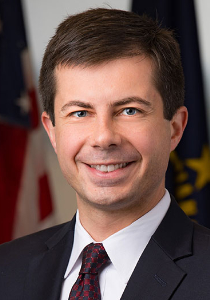
- Full Name: Peter Paul Montgomery Buttigieg (it's pronounced BOOT-edge-edge)
- Age on January 20, 2021: 39 (he will celebrate that birthday one day earlier)
- Background: A lifelong Hoosier, Buttigieg was born to parents Joseph
and Jennifer Ann, both of them professors at Notre Dame. His résumé seems almost too
perfect to be true: class president and valedictorian at St. Joseph High School, Bachelor of Arts in
history (magna cum laude) from Harvard, Rhodes Scholar, and U.S. Navy veteran with a tour in
Afghanistan. He remains a lieutenant in the U.S. Navy reserve. In addition to his military career,
Buttigieg was employed by several consulting firms and worked on several political campaigns,
including John Kerry's 2004 presidential bid.
- Political Experience: Buttigieg's first run for public office came in
2010, when he tried to get elected as State Treasurer of Indiana, and lost to Richard Mourdock (R).
That was before Mourdock had publicly shared his view that rapes are part of God's plan, however. In
2011, at the age of 29, Buttigieg was elected mayor of South Bend, making him, at that time, the youngest
mayor in America of a city with over 100,000 inhabitants. He ran for reelection in 2015, and won
with over 80% of the vote, several months after publishing an
op-ed
in which he came out of the closet. He took a shot at becoming DNC chair in 2017, but it didn't go
anywhere. He has a year left in his second term as mayor, and has already announced he will not run
for a third.
- Signature Issue(s): Urban renewal. During his mayoralty, he has focused
(with some success) on reinventing parts of South Bend's economy and landscape for the 21st century.
Most notable was
1,000 Houses in 1,000 Days,
which focused on abandoned housing, and did exactly what it sounds like. Buttigieg made the deadline
with a few days to spare (but 1,000 Houses in 992 Days doesn't quite roll off the tongue as well).
- Instructive Quote: "Life is short, and we do not have much time to
gladden the hearts of those who travel with us; so be quick to love, make haste to be kind, and go
in peace to follow the good road of blessing." (This is the quote that accompanied the photo of his
wedding to husband Chasten Glezman that Buttigieg posted to Twitter.)
- Completely Trivial Fact: Buttigieg's last name is Maltese, which is
apropos, because his father is a Maltese immigrant. If elected, he would be the first
Maltese-American to serve in any elected position in the federal government. He would also be the
second president with ethnic roots outside Western Europe (Obama), the second president who was once
a Rhodes Scholar (Bill Clinton), and (very possibly) the second gay president (James Buchanan).
- Recent News: As noted, Buttigieg threw his hat into the 2020 ring this
week, officially
forming
a presidential exploratory committee. The first
reviews
of his campaign biography,
Shortest Way Home: One Mayor's Challenge and a Model for America's Future,
also hit the newsstands; the book itself will be available in early February.
- Three Biggest Pros: (1) Consistent with his age cohort, he is a very skilled
user of social media (but in an uplifting way), in particular getting much mileage out of his rescue dog
Truman's
Instagram
account; (2) His profile is similar to Sen. Sherrod Brown's (progressive, but also in touch with
the concerns of Midwestern working-class folks) but is considerably more charismatic; and (3)
Although there's a lot of difference between a city with 102,245 people and a country with 325.7
million, it cannot be denied that Buttigieg has an impressive track record.
- Three Biggest Cons: (1) Inasmuch as evangelicals have decided that
Leviticus 18:22
is far and away the most important sentence in the entire Bible (while ignoring what Leviticus has to say about ham and cheese sandwiches), they would be roused in great numbers to
vote against Buttigieg; (2) Buttigieg may have troubles with black voters, since they are the
Democratic constituency that is most socially conservative, and because the Mayor butted heads with
(and ultimately fired) his black chief of police; and (3) As we noted with Julián Castro,
Americans rarely elect mayors as president (only three times, and the most recent of those was
Calvin Coolidge, who was nearly a century ago, and who had several elective jobs in between mayor and
president).
- Is He Actually Running?: Yup.
- Betting Odds: He's not on the books' radars yet, so no odds are
available. Candidates similar to him are getting 100-to-1 to 50-to-1, implying a 1% to 2% chance of
getting the nomination.
- The Bottom Line: Buttigieg's candidacy is a longshot; if he somehow gains traction, it will be in the same way as Donald Trump—by being an outlier among a crowded field of folks who ignore him and spend their time beating one another up. That said, it is not likely that he actually expects to win this thing. This has all the hallmarks of a pre-presidential run designed to get his name out there and to get Americans thinking about the possibility of having a gay president. While he would not admit it publicly, his eye is surely more on 2024 or 2028 than it is 2020.
You can access the list of candidate profiles by clicking on the 2020 Dem candidates link in the menu to the left of the map. (Z)
Back to the main page