Pres polls: (None)
Dem pickups: (None)
GOP pickups: (None)
Previous | Next
Our Long National Nightmare Is Over (For Three Weeks, at Least)
On Friday, in a 180-degree change of course, Donald Trump announced that he would sign the appropriations bills passed by the Democratic-controlled House. With that promise in hand, Senate Majority Leader Mitch McConnell (R-KY) brought the bills up for a vote in the Senate, where they passed. Trump applied his signature Friday night, which means that the government will resume normal operation, and the Dept. of Homeland Security will be funded for three weeks while Republicans and Democrats try to hammer out a compromise on border security. The President warned that if something doesn't get done in three weeks, he may either shut down the government again (or, at least, DHS), or declare a national emergency.
Trump gave a speech on Friday, and also sent out a series of tweets in which he insisted that he did not back down. For example:
I wish people would read or listen to my words on the Border Wall. This was in no way a concession. It was taking care of millions of people who were getting badly hurt by the Shutdown with the understanding that in 21 days, if no deal is done, it’s off to the races!
— Donald J. Trump (@realDonaldTrump) January 26, 2019
It is hard to know what caving would look like, if not this. He played chicken with Speaker Nancy Pelosi (D-CA) over the State of the Union address and folded within just hours. Then, a day later, he reopened the government on the exact terms the Democrats demanded. From where we sit, the only way he could have surrendered more completely is if he also agreed to personally detail Pelosi's car, free of charge. Trump didn't even get an agreement to deliver the State of the Union address on the usual date; Pelosi—who is apparently calling all the shots right now—says they'll determine that once the government is reopened. Or, as an anonymous former Trump staffer put it, "I'm assuming Nancy Pelosi will be giving the State of the Union now, since she's running the country."
Of course, it is not our opinion, nor those of anonymous former staffers, that matter in this little drama. No, the key is the right-wing media's take. First, because Trump revels in their praise, and shrinks in horror at their (rare) criticism. Second, because he (rightly) perceives them as a barometer of how the base is feeling. And the response from that quarter was pretty brutal. Some examples of the commentary, headlines, and tweets:
- Fox News:
"To this point, the president's base has stayed with him. He hasn't started to eat into his
base. Those folks believe that he is fighting for them and fighting for this wall. That's why
whatever he says today, he's not going to be able to get it back with persuadable voters,
necessarily. He has to make sure that what he's doing here does not cost him with these core
supporters, who will think that he's betrayed them if he's capitulating."
- RedState:
"This is not a good look if Trump is serious about getting the money for the wall. Already last
evening he was showing flopsweat by floating a "down payment" idea. This is called "negotiating with
yourself," and it is what desperate people do...I really hope that Trump knows if he backs down on
this that a lot of his base voters might have urgent business on November 3, 2020, like taking a
dump or something, and not bother to vote."
- The Gateway Pundit:
TRUMP CAVES! Ends Shutdown with NO BORDER WALL--Pelosi's SECOND BIG WIN This Week--VIDEO PELOSI
DANCING
- Daily Caller:
TRUMP CAVES: President Will Temporarily Reopen Government With Zero Funding For The Wall
- Breitbart:
Trump 'Got Rolled' -- 'A Victory for Nancy Pelosi'
- Mike Cernovich:
"Trump is a broken man. It's over for him."
- Ann Coulter:
"Good news for George Herbert Walker Bush: As of today, he is no longer the biggest wimp ever to serve
as President of the United States."
- Erick Erickson: "Donald Trump caved to Nancy Pelosi on shutdown, now the wall will never be built."
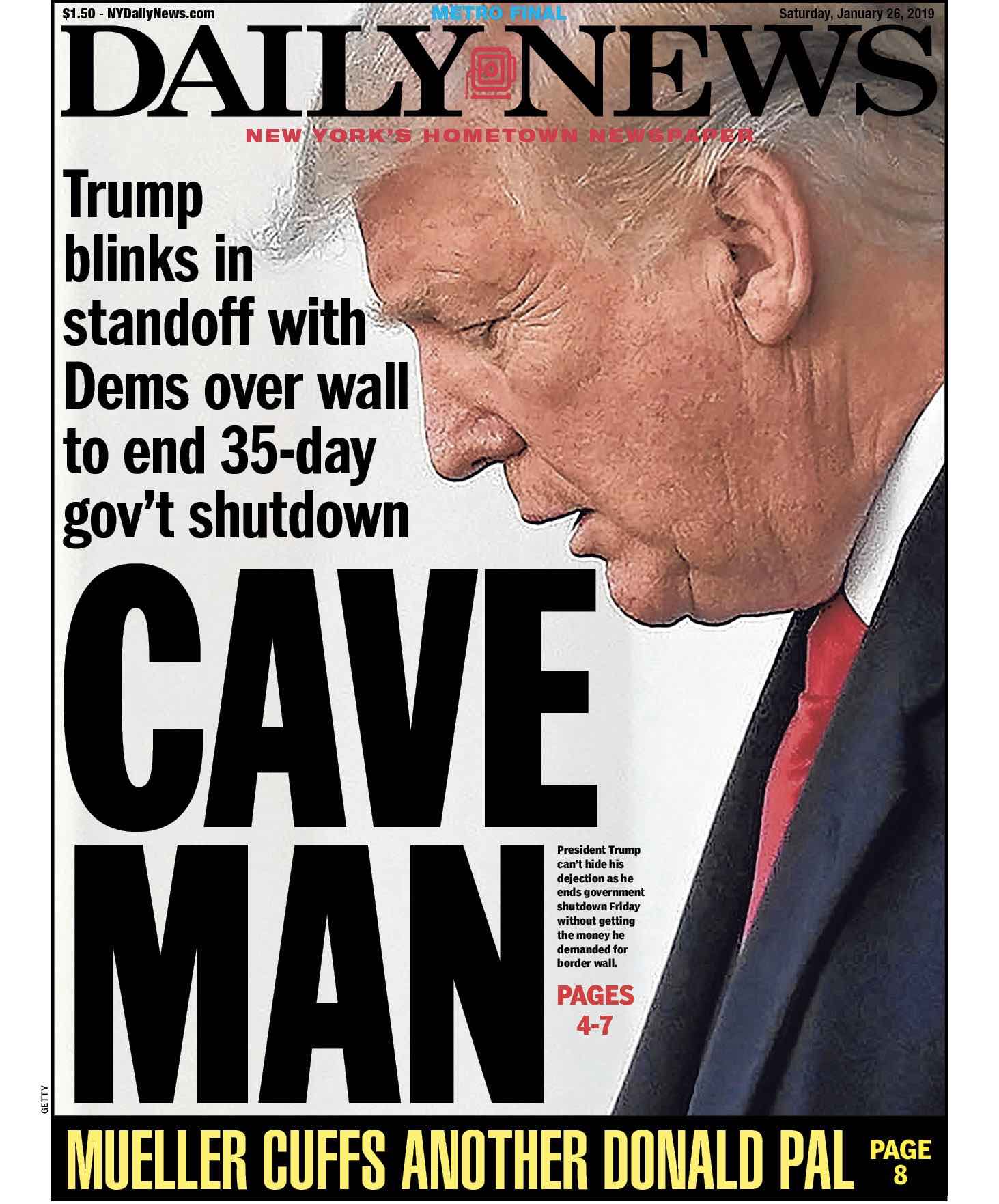
Though they're not a right-wing outlet, the New York Daily News' cover certainly captured the general tenor of the day:
It should be noted that some of the right-wing punditry is closing ranks around Trump. For example, Bill O'Reilly tweeted: "Political chess game continues. President Trump reopens government—a good thing. Gives Dems three weeks to make a border security deal. Reasonable. Advantage Trump today." Clearly, Bill's no longer in the "no spin zone." Then there is Laura Ingraham, who weighed in with this: "Trump's re-opening the gov't fostered such goodwill!" Still, Trump hasn't been lambasted by so many of his ostensible supporters since...well, maybe ever. Though the day he ordered airstrikes against Syria probably came close. In any case, it's probably a good thing he signed the bills before his Saturday-morning review of the media coverage of his administration, because he might have changed his mind (as happened back in December).
The first big question that this turn of events raises is: Why now? How did Trump go so quickly from sticking to his guns to capitulating? Some possibilities:
- Reading the Tea Leaves: The votes held in the Senate on Thursday,
along with the tense GOP-only luncheon, made clear that there were serious cracks in the foundation
of Trump's support. Specifically, it is possible that someone—Mike Pence? Mitch McConnell?
Lindsey Graham?—got the President one-on-one and did their best Barry Goldwater impersonation,
telling him that he wasn't going to win this thing, and the time had come to fold his hand.
- Timing: If Trump was planning to surrender anyhow, Friday was the best
possible time for it. First, because the Roger Stone and "Trump caved" stories serve to blunt one
another and drown each other out, and second because Saturday is the deadest day of the news cycle
(see Massacre, Saturday Night).
- Unknown Intel: Perhaps someone that Trump trusts on these
matters—Mike Pompeo? John Bolton?—advised him of some possible threat against the United
States that the intelligence pros are aware of, and warned the President that if that threat does
somehow come to pass while the government is shut down and national security is weakened, it could
be the end of his presidency. For example, what if ISIS somehow managed to down an American
passenger airliner at a time when the TSA, air marshals, etc. are spread thin? That would be the
political equivalent of a nuclear bomb landing in Trump's lap.
- 3-D Chess: Team Trump may have concluded that a "national emergency"
is his only way out of this (more below), and set in motion the necessary chess moves to give them
as much political cover for that as possible. "We tried to give the Democrats a chance,"
Trump & Co. may be getting ready to declare in three weeks.
- Taking His Medicine: Alternatively, it could also be that Trump realizes he painted himself into a corner, and concluded that he might as well put as much distance as possible between the bitter medicine of surrender and next year's elections.
Only the President knows for sure, but it could be any of these.
The second, and more important, question that this turn of events raises is: What next? Here are the four basic possibilities, as we see them, listed from most to least likely:
- Congress Finds a Compromise: As part of Friday's agreement, the two houses of Congress will form a
committee
to try to hammer out a compromise on border security. While not all of the appointees have been
identified, they are pretty much all members of the two chambers' appropriations committees, and
none of them is an immigration hawk (i.e., no Mike Lee or Mark Meadows). At this point, Trump needs
something to take back to the base. However, the Democrats are still strongly opposed to the wall,
continue to hold most of the cards, and just learned that they can hold firm, while the President
cannot. The dozen or so folks on the committee are going to have to try to carefully massage this,
with a proposal that includes some of the measures that Democrats are ok with (x-rays, drones, more
border patrol officers), and yet something that Trump can point to and call a wall. Maybe he and his base
will buy into Rep. Steny Hoyer's (D-MD) verbiage about how $5 billion in high-tech devices
represents a "virtual wall," but probably not. It's probably going to have to be some actual, new
wall—maybe slight improvement and expansion of existing fencing.
- Trump Declares a National Emergency: If Congress doesn't throw Trump a
bone of some sort, this is not such a bad option for him, politically. He declares the emergency,
which he and his base can celebrate as "strong" action. Then, the Democrats sue, and the matter gets
tied up in the courts for...who knows how long? If the President can stretch it out, then the
situation could remain in stasis for months or years. It would be bad for him to run for reelection
in 2020 with no wall, and even worse if and when SCOTUS ruled against him. However, those things
would be in the future, and in the present he'd be a "winner" and "strong" and the government would
stay open, so that he wasn't taking any further political damage. If you don't know by now what
Trump's choice is when he has a chance to goose his present-day popularity at risk of suffering
major negative consequences down the road, you haven't been paying attention for the last two-plus years.
- Shutdown v2.0: In theory, this is still on the table, but it's a real
longshot. First of all, most of the government is now funded; the only thing that Trump can still
theoretically shut down is the Dept. of Homeland Security. That would be really bad optics, at best,
and if there happened to be a security incident during a second shutdown, it would be disastrous. On top of
that, Trump tried everything in his bag of tricks during the first shutdown—threatening,
giving speeches from the Oval Office, photo-ops at the border, deploying Fox News, etc.—and
none of it worked.
- Trump Forgets About It: There have been quite a few issues where Trump
made a big scene, accomplished what he wanted in terms of the base, and then basically dropped the
issue. When was the last time he talked about Muslim Travel bans, for example? Or the true capital
of Israel? That said, this is the least likely option only because Trump has invested so much
political capital in the wall, and has made it so central to his political and personal identities,
that he really can't walk away.
Anyhow, as with the Roger Stone story (see below), this matter presumably enters into a holding pattern for at least a short while. (Z)
Stone Indictment Is Bad News for Team Trump
Republican dirty tricks guru and Donald Trump intimate Roger Stone was arrested in an FBI raid early Friday morning, not too many hours after a grand jury indicted him on seven felony counts. There was every chance that the story would be fleshed out much more during the day on Friday, and indeed it was.
Now that the indictments have been made public (they were kept secret until Stone had been arrested), certain secondary questions have been answered. For example, one of the felony charges is witness tampering, and the witness in question is radio host Randy Credico, whom Stone tried to stop from talking to Congress. However, the key part of the indictment, and the portion that everyone is talking about, is this, which addresses Stone's interactions with Wikileaks (a.k.a. "Organization 1"):
After the July 22, 2016 release of stolen DNC emails by Organization 1, a senior Trump Campaign official was directed to contact STONE about any additional releases and what other damaging information Organization 1 had regarding the Clinton Campaign. STONE thereafter told the Trump Campaign about potential future releases of damaging material by Organization 1.
This implicates not one, but two members of the Trump campaign: The person who contacted Stone, and the person who directed the senior official to contact Stone. Since special counsel Robert Mueller's indictment goes to great pains to avoid providing any identifying information about the person who gave the order, it was presumably someone who was very high up in the campaign (and thus could give that kind of order), and someone who has not yet been indicted (so, no Paul Manafort). The obvious candidates are the members of the Trump family, with the President himself as candidate #1 (or, probably more accurately, individual #1). Meanwhile, CNBC is reporting that the person who received the order, and thus served as the intermediary between Stone and the campaign, was Steve Bannon. If CNBC is correct, that would add additional credence to the notion that Trump himself gave the order, since very few other people, if any, were in a position to tell Bannon what to do.
So, the central charge of the indictment is very bad for Team Trump. The timeline that is coming into focus is none too good, either. By the time Stone was contacted about Wikileaks, it was already publicly known that the Russians had hacked the DNC and given the information to Wikileaker Julian Assange. Thereafter, not only did the Trump campaign ask Stone to talk to Wikileaks on its behalf, but Trump himself called on Wikileaks to hack Hillary Clinton (July 27), and raised questions about Hillary Clinton's health after a currently unknown person who was in touch with both Assange and Stone suggested that Trump do so (August 15), and then mentioned Wikileaks more than 160 times in the span of a month (October 10 to November 8). In short, we don't know everything that Mueller knows, but there is—at very least—overwhelming evidence that Stone not only contacted Wikileaks on the campaign's behalf, but that he established a line of communication between the two entities that reached all the way to Trump himself. If true, that would make Trump guilty, at the very least, of both violating campaign finance laws, and conspiring to violate campaign finance laws. Depending on how clear the chain from Russia to Assange to Stone to the Trump campaign is, it could also be part of a grand conspiracy with the Russians.
Stone, for his part, is in deep doo-doo. It is clear that Mueller does not trust him, given the secrecy surrounding both the indictments and the early-morning raid. Stone made bail Friday, but it's likely that by the time he got home, sizable quantities of evidence (including his computer) had been seized. He's also drawn the same federal judge, Amy Berman Jackson, that Paul Manafort did. Jackson did not hesitate to toss Manafort in the hoosegow, and she surely won't hesitate with Stone, either, if she thinks it's called for. His arraignment is Tuesday.
Stone, of course, is deeply exposed here. He lied to Congress about his interactions with Wikileaks, and Mueller has proof, some of it contained within the indictment. Stone announced late Friday that he will not testify against the President, suggesting he's willing to go the G. Gordon Liddy route and take his secrets to prison with him. That would be consistent with the Nixonian pose that Stone struck for reporters on Friday:
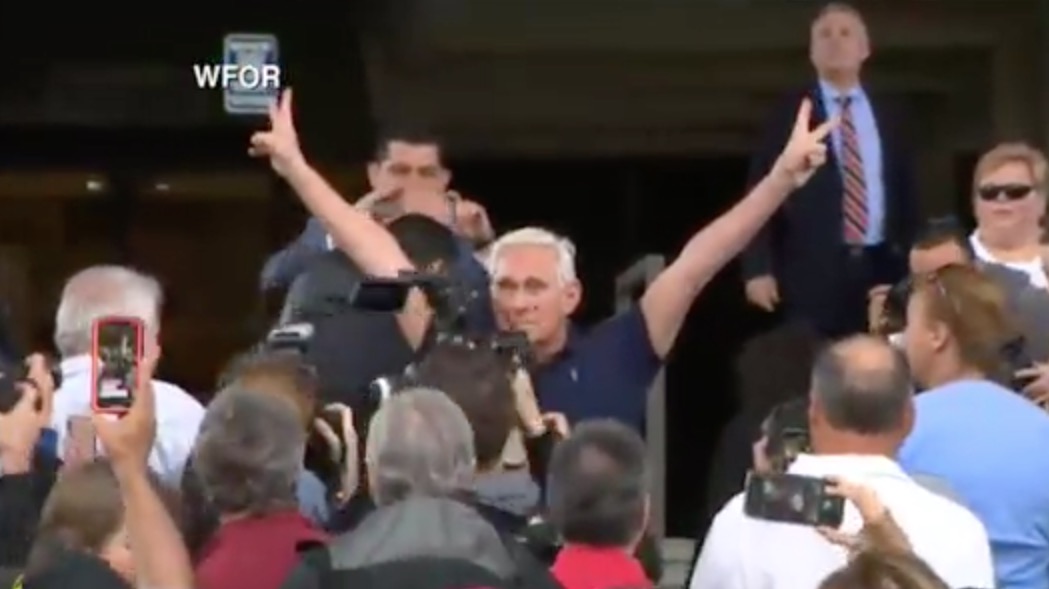
Stone is a well-known Nixon fanatic; he even has a tattoo of Tricky Dick's face on his back. He's also a fan of Frankie Pentangeli, the Godfather, Part II character who chose suicide over betraying Don Michael Corleone before Congress. In fact, as the Mueller indictment explains, Stone tried to evoke Pentangeli in his (unsuccessful) efforts to pressure Credico not to testify before Congress. All of this is to say that maybe Stone really will keep his lips zipped, regardless of the consequences. However, we cannot know exactly how serious he is until prison ceases to be an abstraction, and he's actually staring at years or decades in the clink. Further, it's possible that Mueller doesn't actually need him to sing like a canary, and already has all the evidence he needs. We will presumably know more on Tuesday. (Z)
Invisible Primary Claims Its First Victim
There have been a few candidates that were rumored to be running for the Democratic nomination in 2020, or who hinted they were interested, but then took themselves out of the running. Billionaire Tom Steyer, who is using his money on a quixotic quest to get Donald Trump impeached pronto, is the most obvious example. However, none of the candidates who actually declared a run, or who formed an exploratory committee, had dropped out.
Well, none of them had dropped out as of Thursday, that is. On Friday, however, well before most candidates had even declared "it's on!," former West Virginia state senator Richard Ojeda (D) declared "it's off!" As a Latino, a military veteran, a Southerner, and a populist, he checked a lot of boxes, which is what persuaded him to throw his hat in the ring. However, the odds were poor that someone on one of the lower rungs of the political ladder, and from one of the smaller states in the union (and one of the reddest), could get traction. In fact, while a fair number of presidents served as state legislators during their careers (including, of course, Barack Obama), none of them made the jump directly to the White House. Ojeda saw the light; his announcement noted that, "I don't want to see people send money to a campaign that's probably not going to get off the ground." So that's one down, forty or so to go. (Z)
Back to the main page