Previous | Next | Senate page
New polls: VA
Dem pickups: AZ FL GA MI NC PA TX WI
GOP pickups: (None)
We have many readers in the Gulf States. You may or may not be able to see this today, but if you somehow do, good luck, be well, and our thoughts are with you.
Conventional, Night Three
While the Trump campaign mixed it up a bit on night two, they were back to a very standard convention format on night three: long/longish speeches, only a few of them from "regular folks," with the occasional video clip interspersed. Anyhow, here are our impressions:
- The 800-pound Gorilla in the (Virtual) Room: In the 24 hours prior to last night's
convention, things developed dramatically on the Kenosha front. Tensions remained high in the city, with protesters and
police taking to the streets following the news that Jacob Blake will likely be a paraplegic as a result of being shot
multiple times in the back. As Tuesday turned to Wednesday, shots were fired into a group of protesters, and two were
killed.
On Wednesday, an arrest was made based on cell phone footage of the shootings, which pretty clearly shows the perpetrator. He's innocent until proven guilty, of course, and he's a minor (17), so we won't repeat his name (it's in the linked story, if you want to know it), but he's white, a big fan of guns (naturally), a Blue Lives Matter activist, and a big fan of Donald Trump.
At roughly the same time that the alleged shooter was being arrested, meanwhile, the Milwaukee Bucks announced that they would not play their playoff game scheduled for Tuesday, in protest of police violence against Black people in general, and against Blake in particular. Ultimately, all three of the day's NBA games were scrubbed, as were three WNBA games and three MLB games. This was not merely a one-off symbolic act, either. The NBA players, at very least, are scheduled to meet with league management today, and there is much talk that the season could be over. Already, many prominent people have lined up behind the athletes, none more prominent than the Obamas.
The story developed even further while last night's RNC was underway. There is now footage of Kenosha police interacting with heavily armed white militia members on Tuesday night, possibly including the accused shooter, in a very collegial way, up to and including giving the militiamen bottles of cold water. The obvious subtext: If an AK-47-toting Black Man, or Muslim, or Latino had approached a police vehicle in the midst of mass unrest, they wouldn't have been given a bottle of water and a pat on the head. Making this whole situation look even worse in terms of police behavior is that Kenosha Police Chief Daniel Miskinis effectively blamed the two victims, observing that if they had followed curfew, they would not have been out on the streets protesting, and so would not be dead right now. The obvious question: If the curfew is to be taken so seriously, why were armed white violators given bottles of water as opposed to citations (or worse)?
This is a very difficult situation for the Republicans to triangulate. If they don't mention it at all, it will look tone deaf, but if they do, they run the risk of alienating either the Black men/suburban women they're trying to reach out to (more below), or the pro-police folks (which is most of the base). On Tuesday, the woman performing the invocation mentioned Blake, and then it never came up again, which solved the problem because the subject did get mentioned, but by someone who is not part of Team Trump, and so can't be linked directly to him. But that is not likely to work forever. And the President may not be able to resist wading in, given his love for culture wars stuff, especially now that the hated Obama has lined up on the side of the protesters.
A related problem is that while the President isn't responsible for every nefarious deed committed by one of his supporters, his rhetoric has very much pointed in the direction that an impressionable 17-year-old appears to have taken. Praising the violent white supremacists in Charlottesville, who brandished arms at protesters, did not help. Nor did giving a prime RNC speaking spot to Mark and Patricia McCloskey, who also brandished arms at protesters. Should the accused perpetrator be proven guilty, there's a fair case to be made that some of his victims' blood is on the President's hands.
One last thing: Kenosha is in Wisconsin, one of the most critical of the swing states. And for what it is worth, the city is located in the R+5 WI-01, once represented by Paul Ryan, and now represented by Republican Bryan Steil. WI-01 also went for Trump by 11 points (53% to 42%) in 2016. - The Category-5 Gorilla in the (Virtual) Room: If the situation in Kenosha (which has also led
to protests in many other cities) were not enough of a headache for the RNC, Hurricane Laura is
bearing down
on the Gulf Coast. It's actually Category-4 as we write this (06:00 a.m. ET), and while it might weaken, it's generally
expected to reach Cat-5 status sometime today. Whatever happens, it is already among the 10 strongest hurricanes in U.S.
history.
Donald Trump would prefer not to address this at the convention. First, because he doesn't want to talk about anything that is not Donald Trump. Second, because any mention of hurricanes brings to mind some of the biggest failures of his administration, among them the inept and heartless handling of Hurricane Maria, as well as Sharpiegate. To some, it might even be a reminder of his consistent anti-climate change posture. Oh, and as a grim subtext, many folks in the path of the hurricane are foregoing shelters because...they are frightened of getting COVID-19, and would rather take their chances with a Cat-4 hurricane.
Needless to say, ignoring the hurricane would be a very bad look, especially since the states being hit are either swing states or Trump states. It will cause many media outlets to note that when Hurricane Katrina was destroying New Orleans, George W. Bush was out in sunny Arizona wishing John McCain a happy birthday, leading to this now-iconic photo. It will remind people that Republicans don't do empathy well, especially when poor people or people of color are the ones being hurt.
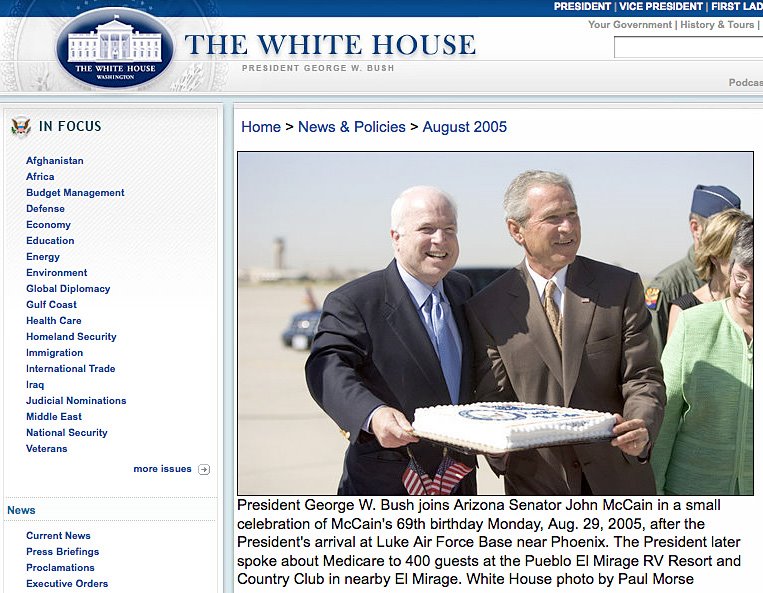
On the other hand, figuring out what and how much to say, in view of all these political pitfalls, will not be easy. It's not impossible that the final evening of the convention, or at least Trump's speech, gets postponed or canceled entirely. After all, simply holding the event in the midst of not one but two national crises would be a tad bit tone deaf (or more than a tad bit), regardless of what is said. Scotching it, or perhaps replacing it with a brief Oval Office address expressing concern for folks in the hurricane states and announcing federal support, would surely be more of a PR victory than anything that might take place on Thursday. - Pence Speaks: The two developing stories outlined above had only a nominal impact on
Wednesday's proceedings, as everyone but Mike Pence was pre-taped, and so could not respond to events on the ground.
That meant that all anyone could talk about, as the convention started, was what Pence
might say
about either Kenosha or Laura as he delivered his remarks from the gateway of Fort McHenry in Baltimore.
The hurricane came up early, and got about 15 seconds along with 91 words' worth of good wishes and promises to help. Kenosha came up later—reportedly a last minute addition—and got a tad bit less attention: 40 words, and about 8 seconds. Pence's exact words: "Let me be clear: the violence must stop—whether in Minneapolis, Portland, or Kenosha. Too many heroes have died defending our freedoms to see Americans strike each other down. We will have law and order on the streets of America." At best that walks a fine line between different factions and political outlooks. At worst, it completely fails to acknowledge Jacob Blake and the two dead men, as well as the protesters' legitimate concerns about racism. And given that Pence otherwise stuck with his prepared text, which included lengthy portions about how wrong it is for Joe Biden to call America a racist country, and how the men on the Thin Blue Line are heroes who keep us safe from danger, the overall position of the Vice President on what's happening in Kenosha (and elsewhere) was made abundantly clear.
Beyond that, it was a boilerplate kinda speech from a guy who's not a very engaging speaker. There was the usual opening of a Pence speech, which involves kissing up to the boss. That was followed by a greatest hits of modern-day conservative politics (Protect our guns! Outlaw abortion! Freedom of worship!) and the usual braggadocio about the Trump-Pence record of governance. In general, the commandment against bearing false witness (#8 or #9, depending on which version of the Bible you're holding up for your photo op) appeared to be in temporary abeyance. That was particularly the case during the "attack dog" portion slamming Joe Biden, which was just falsehood after falsehood. It's one thing to paint the opposition's policies in the least flattering light possible; it's another to say things that just aren't true. For example, the Democratic nominee does not want to defund the police, throw the border open to all comers, abolish all fossil fuels, or raise taxes on the middle class by $4 trillion. If you'd like to read more about Pence's casual relationship with the truth, see here, here, and here.
As with Melania Trump's speech on Tuesday, Pence was given the privilege of an audience, this time about 130 strong. And the President and First Lady made a "surprise" appearance at the end, marking the Donald's only appearance of the whole evening. The First and Second couples mingled with the crowd which was, of course, maskless and not socially distanced. Attendees were also not required to undergo COVID screenings. They're playing with fire here, obviously. Oh, and if Trump gives his speech tonight, the audience will exceed 1,000 people. They are gonna find a way to turn the RNC into a superspreader event, damn it, even if it kills them. - Others Spoke, Too: As with the DNC, the RNC is starting to lose a little steam three days
in. Here are some of the other notable speakers last night:
- Rabbi Aryeh Spero gave the most overtly political invocation in recent memory. Maybe
ever, actually.
- Clarence Henderson, a rank-and-file Civil Rights Movement activist, was the GOP answer to
John Lewis.
- Karen Pence's lack of enthusiasm was palpable. Even if you didn't know of her disdain for
Donald Trump, you should have been able to guess based on her address.
- Lou Holtz
presumed
to judge Joe Biden and Kamala Harris to be "Catholic in name only." That will be news to Harris, since she is a
Baptist.
- Rep. Dan Crenshaw (R-TX) gave the most engaging
speech
of the night:
He's emerging as the GOP's most likely foil to AOC. - Madison Cawthorn, the NC Congressional candidate who lost the use of his legs in a car
accident, finished his speech by using a walker to stand for the flag, thus sticking it to those ungrateful, kneeling
athletes.
- Kayleigh McEnany was very brave to share the story of her choice to undergo a double
mastectomy because of the high probability that she would have developed breast cancer.
- Lara Trump became the latest family member to give a stump speech and to say nothing to humanize her father-in-law.
That list probably covers about half of the total number of folks who spoke. - Rabbi Aryeh Spero gave the most overtly political invocation in recent memory. Maybe
ever, actually.
- Theme 1: Donald Trump, Feminist: Many themes of this convention are recurrent (e.g., "the
media sucks!"). One of the two themes that was particularly emphasized on Wednesday was that Trump is the most pro-woman
president in American history. There was a lengthy video about women's suffrage that made much hay out of the fact that
the President just pardoned Susan B. Anthony for trying to vote in 1872. Then, Lara Trump, Kellyanne Conway, McEnany,
and others talked about how much the President respects women, and how much he values their opinions.
Team Trump is clearly scared witless about the gender gap in this year's election (some are calling it a "gender chasm"), as polls tend to have Joe Biden leading Trump among women by 22-25 points. So, the campaign is doing everything it can to reduce that gap, pitching Trump as a latter-day feminist, while also talking about all the scary people Biden would allow to move into the suburbs. We will be interested to see how many women place more value on "Trump listens to Kellyanne Conway sometimes" than "Trump has taken steps that make it harder to get birth control" or "Trump is still a pu**y grabber." (more below) - Theme 2: Trump Is No Racist: The other point of emphasis on Wednesday was that, no matter
what you may have heard (including from the President's own mouth), Donald Trump is no racist. The aforementioned
Henderson, several other Black speakers on Wednesday, and several on previous nights all made nearly identical
arguments: I am Black, I grew up in the South, I know what real racism looks like, and Donald Trump isn't it. One
speaker on Wednesday (Jack Brewer, of Black Voices for Trump) went so far as to say Trump is "no Klansman" and "no
skinhead." That's true, as far as it goes, but of course the line between "racist" and "not racist" is not bright-red,
and in any case is not drawn one millimeter to the left of David Duke.
The supposition among much of the commentariat is that Team Trump is scared to death of Joe Biden's lead among Black voters (Biden is +80), they think they have to make some headway there too, and so they are aggressively trying to peel off some Black men (there have been many Black male speakers at the RNC but no Black women). We remain dubious. How many Black men are going to buy this argument, especially given Trump's past words and actions, as well as his apparent indifference to what's going on in Kenosha right now? And if you're looking at a group that's already 10% of the electorate, and then you target only half that group (i.e., the men), then you're really looking at limited returns. Our view remains that the focus on Trump's being "enlightened" is actually an aspect of trying to sell him to the white, suburban women.
Anyhow, the stage is set for a very interesting, and potentially fraught, night four—if it happens. (Z)
No Convention Bounce for Biden
Historically, candidates get a small bounce after their conventions. A new Reuters/Ipsos poll is the latest to show that Joe Biden didn't get any at all. He leads Donald Trump 47% to 40% among registered voters after the convention, the same as before the convention.
In contrast, Hillary Clinton got a 4-point boost from her convention in 2016 and Trump got a 4-point boost from his convention in 2016 as well. These almost always fade within a few weeks, though. Probably the reasons that Biden didn't get a boost are: (1) fewer people watched this year than last time, (2) nearly all of them were Democrats anyway, and (3) views are so hardened now that they are not likely to move much at all, barring a major unexpected event. Also significant is that only 14% of the voters are undecided this year vs. 22% last cycle. Many polls have shown even fewer undecideds than this one.
The poll also found that 41% of Americans approve of Trump's performance in office vs. 55% who disapprove. Voters see Biden as stronger on fighting the pandemic and restoring trust in government. Trump is stronger on the economy. (V)
Trump Goes Dark
No, we don't mean more talk of American carnage, or gloom and doom. In fact, as noted, he didn't even talk during last night's festivities. What we mean is that he's stopped advertising on TV. In the past 2 weeks, Joe Biden is outspending him 5-to-1 on the air nationwide. In the key states of Michigan and Pennsylvania, Trump has ceded the airwaves entirely to Biden. In Wisconsin, Biden is outspending him 8-to-1. And Trump has no plans to go back on the air until September.
Part of the reason is that Biden has raised so much money that Trump's long-standing cash advantage has dwindled to just $20 million. Also, Republican strategists see no point in advertising during their own convention. Of course, the great majority of Democrats and independents aren't watching the GOP convention, so all they are seeing are Biden ads. Some Republicans have noticed this and are angry at the Republican super PACs that haven't picked up the ball. Corey Lewandowski, Trump's first 2016 campaign manager, and one of the only ones to be un-indicted, said: "With 70 days to go in a campaign, all of the people who have raised money on behalf of Donald Trump's name should be spending it to support his campaign right now." David Bossie, Trump's former deputy campaign manager, also called out the super PACs and told them to get going. On the other hand, new campaign manager Bill Stepien said he intentionally paused all the ads to reassess the situation. He intends to focus very soon on the early voting states rather than on the swing states.
Still, Stepien had better step on it. Biden is also dominating advertising in the early voting states. In fact, he has outspent Trump by a factor of three in North Carolina, where absentee voting begins next week. Biden has also outspent Trump in Arizona and Florida. To some Republicans, the situation is an eerie throwback to 2012, when Barack Obama was on the air all summer and Mitt Romney wasn't. Romney never caught up. Biden spokesman Michael Gwin observed that the other guys promised the Death Star and instead we got the Titanic. (V)
What Do Trump Supporters Care About?
Supporters of Joe Biden typically read, watch, and listen widely. The New York Times, the Washington Post, MSNBC, CNN, NPR and other sources are popular with them. Still, despite all this information, they can't figure out how Trump supporters could stand someone they see as a gross, racist, misogynist, dangerous, authoritarian buffoon. Those who have read this article in the Times will find out. If you missed it, here is the executive summary.
Times reporters scoured the country to conduct lengthy interviews with Trump supporters, some of whom were quite happy to be named and even photographed for the story. None of them fit the stereotype of a redneck yahoo with 6 teeth living in a trailer park. Many were normal suburbanites. From the interviews, the reporters distilled some of the reasons these people voted for Trump in 2016 and will enthusiastically vote for him in November. These include:
- They want to harden the border with Mexico
- They like the conservative justices and judges he has nominated
- They feel kneeling at sports events is disrespectful to the flag and the country, and Trump says that out loud
- They know he puts Americans ahead of refugees, immigrants, and people oppressed in some distant country
- They like him pointing out that the police killing a Black man is not an excuse for looting and burning stores
- They believe that there are good cops and bad cops and the George Floyd thing has been blown out of proportion
- They "know" that Black women have a high abortion rate (and implicitly ascribe it to promiscuous behavior)
- They credit him with building a strong economy until the Chinese virus wiped it out
- They got better jobs when Trump restricted H-1B visas, keeping Indian job seekers out of the country
- They dislike unions, just like Trump does
- They love it when he "whoops some butt" on politicians they hate
- They believe, as Trump does, that Democrats behave like spoiled brats
- They don't care about his personality and believe he did the things any Republican president would have done
- They don't believe in climate change and applaud him for withdrawing from the Paris climate accord
- They adore him for speaking at the annual March for Life anti-abortion rally on the National Mall
- They know he lies but feel that all politicians do it, so what?
- They are still incensed that Hillary Clinton's use of a private e-mail server put national security at risk
- They were disillusioned about Barack Obama's presidency
That's not all of it, of course, and there are some things nobody was willing to own up to, but other reporters have often noted. In particular, Trump hates the people they hate. No other politician has had the guts to mock liberals, media reporters, scientists, experts of all stripes, academics, and all other elites. They simply don't see that he is a billionaire New Yorker who for decades tried mightily (without much success) to ingratiate himself with precisely the elites they hate. Now it is the time for revenge. (V)
"Suburban Housewives" Aren't Buying What Trump Is Selling
Donald Trump never misses an opportunity to try to scare suburban women, who he thinks are all "housewives," with stories of hordes of Black marauders coming to their idyllic communities to burn, loot, and pillage everything in sight. One of the things he keeps repeating is that Joe Biden wants to destroy the suburbs. What he is referring to is an Obama-era program that would encourage the construction of low-income housing in suburban areas. Presumably, this is where the marauders would be based. Trump often warns the women about low-income housing being "forced down their throats." On Monday, Mark and Patricia McCloskey spoke at the Republican National Convention to make the point that what happened to them could happen to you.
The only problem with this approach is that it is not working. Politico sent some anthropologically minded reporters out to the suburbs to see if the natives were quaking in their (garden) boots. Short answer: They weren't. One woman they talked to, Susan Sandler (59), was actually mugged by a Black man in a parking garage a few years ago and even she didn't take the bait. She said: "It's just Trump's rhetoric to try to scare people." Camerin Allgood McKinnon (36), who, like Sandler, lives in suburban Charlotte, was asked if she was afraid of the city. She said: "Afraid of the city? I'm here because of its proximity to Charlotte." Sue Rankin-White (72) said: "I haven't heard anyone voice concerns about being afraid that angry mobs are going to come out this way." Connie Searle (61) said: "It's not something I'm afraid of." These women are all Democrats and Trump is not peeling them off. What about Republican women? Meredith Wolverton posted a string of pro-Trump comments on her Twitter timeline. When the reporter asked if she was scared of an "invasion" of crime from Charlotte, she flatly said "no." In short, the reporter didn't find anyone who was frightened by Trump's dark threats.
Going into the 2018 election, the Charlotte suburb was represented in the state House, state Senate, and county commission by three Republican men. Now it is represented by three Democratic women. One of them, state Sen. Natasha Marcus, said: "I want affordable housing. Because guess who lives in affordable housing? Teachers. Police officers." Another of the three new Democrats, state Rep. Christy Clark, said: "What I am hearing is a lot of people are concerned about coronavirus and how that's going to impact their families." A North Carolina Democratic strategist, Morgan Jackson, said Trump "is having a conversation that frankly only exists on Fox News. It doesn't exist in any neighborhood in the suburbs." A political scientist at nearby Catawba College, Michael Bitzer, said: "It's appealing to June Cleaver ... when June Cleaver is dead." So at least in the Charlotte suburbs, and probably in many other ones, Trump is getting no traction at all with the "housewives," except, of course, among those who are already voting for him. (V)
LeBron James Is Launching a Multimillion-Dollar Campaign to Recruit Poll Workers
One of the problems that plagued the primaries was the lack of poll workers. In Milwaukee, a city of 600,000, there were only five polling places, rather than the usual 180, due to a shortage of poll workers. Couple this with a fear among some Black voters that there will be voter intimidation at the polls, and all of this could add up to seriously suppressing the Black vote.
NBA star LeBron James, among the nation's most prominent Black men, is setting up a group to do something about this. The group, More Than a Vote, is going to recruit young Black folks to work as poll workers, especially in Black communities in Florida, Georgia, Michigan, North Carolina, Ohio, Pennsylvania, Wisconsin, and other states. James has lined up corporations to buy TV, radio, and digital ads recruiting young poll workers. He is also working with sports teams to allow their fields and arenas to be used as polling places, where many people could vote and still observe social distancing. In addition, James said that the group would pay the fees of some of the former felons in Florida who needed to pay their court fees in order to vote. Having such a high-profile and widely respected Black star athlete leading the effort will undoubtedly give the group plenty of PR. (V)
Hundreds of Thousands of Seniors in Nursing Homes May Not Be Able to Vote
Over 2 million Americans live in nursing homes or assisted living homes. All are over 18 and nearly all are citizens. Americans over 65 are very engaged in politics, with a turnout rate of 66% in 2016, compared to a mere 35% for the 18-to-29 crowd. But this year, many of them won't be able to vote.
The problem, of course, is COVID-19, which is running rampant in nursing homes and has killed 68,000 residents so far and counting. In past years, friends and family helped them vote, for example by taking the absentee ballot mailed to the nursing home and bringing it to the post office. This year, most nursing homes have banned visitors, so even if a resident gets an absentee ballot, there is no way to turn it in. Many states prohibit nursing home staff from "helping" residents vote in order to prevent partisan staff members from getting residents to sign the return envelope and then filling out the actual ballot themselves. Federal law states that the staff is required to respect residents' rights, but help with voting is spotty at best, and during a pandemic is not a high priority.
Before the pandemic hit, almost half the states offered nursing home residents voting assistance in the form of a bipartisan team of trained voting deputies who visited the homes and helped people, some of whom suffered from dementia, to vote. Florida, which has a large population of seniors, had such a program. However, on account of COVID-19 it has been abolished to prevent the deputies bringing the disease into nursing homes.
How this will affect the election is not clear. In the past, the senior vote favored Republicans, but this year many seniors do not feel safe, and the person who invariably gets the blame is the fellow who lives at 1600 Pennsylvania Avenue, D.C. (V)
Michigan May Mail Absentee Ballot Application to All Registered Voters
Michigan Secretary of State Jocelyn Benson (D) wants to mail every registered voter an application for an absentee ballot. Republican leaders don't want her to and sued her. Yesterday, a Michigan court threw out their case, ruling that as the state's chief election officer, she is authorized to make that decision, even if some of the local election clerks don't like it.
Michigan voters do not have to vote absentee. They are free to toss the ballot application into the recycling bin and go to the polls to vote in person if they prefer. Still, it is expected that during the pandemic, many voters will take advantage of absentee voting since all they have to do is fill in, sign, and return the request form to get a ballot. Iowa, Georgia, Nebraska, and West Virginia are all doing the same thing. (V)
Kanye West Failed to Qualify for the November Ballot in Missouri
Kanye West's presidential campaign/PR stunt is busy trying to get on the ballot in as many states as possible. The goal is to get Black voters who might otherwise vote for Biden to vote for Kanye. Or is it to sell more albums? It's one or the other. In any case, he won't be on the ballot in Missouri. He needed 10,000 valid signatures but got only 6,557, according to Secretary of State Jay Ashcroft (R). The deadline is now past, so he won't make it there.
So far, West has qualified in Arkansas, Colorado, Idaho, Louisiana, Minnesota, Oklahoma, Tennessee, Utah, and Vermont. None of these are swing states with large numbers of Black voters. So, if the goal was to help Trump, thus far it is not working. If the goal is to sell albums, it might be working, we don't know. But there is still hope for West. The deadline for North Dakota is next week. The deadlines for Arizona, Delaware, Kentucky, Mississippi, New Hampshire, and Rhode Island fall between Sept. 1 and Sept. 4. In all the other states, it has passed. The only remaining state where West could be a factor is Arizona, which requires 37,769 signatures to get on the ballot. Given that he couldn't muster even 7,000 in Missouri, getting nearly 38,000 in Arizona, whose population is roughly the same size as Missouri's, could be a steep climb up Humphreys Peak. (V)
Green Party Will Not Be on the Montana Ballot
Missouri isn't the only state in the news for not putting some person or party on the ballot. The Green Party is trying to get on the ballot in Montana (and all the other states). Republicans helped in Montana in the hope it would pull votes away from the Democrats. When the Montana Democratic Party got wind of this, it urged Democrats who signed the petition to withdraw their support. Many of them did.
However, Montana Secretary of State Cory Stapelton (R) refused to accept their withdrawals, so state Democrats sued. A lower court and the state Supreme Court said that if people change their minds and actively want to withdraw their signature before the deadline, the secretary of state must honor that. The number of withdrawn signatures put the Green Party below the cutoff to get on the ballot.
Stapelton appealed to the U.S. Supreme Court, saying, once you've signed, you've signed. There's no going back. But the Supreme Court didn't agree. Justice Elena Kagan issued an order upholding the Montana Supreme Court's ruling. This means that the Green Party will not appear on the Montana ballot in November.
While Donald Trump is favored to win the state's three electoral votes, the Senate race there is a toss-up, and if Democrat Steve Bullock were to lose even a couple of percent to the Green candidate, that could be just enough to save the neck of Sen. Steve Daines (R-MT). Thus the Supreme Court decision slightly increases the chances that Bullock will win and the Democrats will capture the Senate.
The absence of the Green Party could also help the Democrats win Montana's lone House seat. It is an open seat because Rep. Greg Gianforte (R-MT) is running for governor. The Democratic candidate is former state representative Kathleen Williams. The Republican candidate is state auditor Matt Rosendale. The last time the Democrats won the seat was in 1992, but they often win Senate seats in Montana. In fact, Daines is the first Republican to win the class 2 seat in over 100 years and Conrad Burns was the only Republican to occupy the class 1 seat in over 65 years. (V)
Stephanie Bice Will Face Kendra Horn in OK-05
Rep. Kendra Horn (D-OK) won a surprise upset in OK-05 in 2018. The district is R+10 and has been represented by a Republican for decades. Naturally there was a tough (nine-way) primary for the Republican nomination. No one got 50% so there was a runoff Tuesday between state Sen. Stephanie Bice and businesswoman Terry Neese. Bice won it 52% to 48% and is now on track to knock off Horn and pick up a House seat for the GOP.
Horn won the seat in 2018 because suburban women in the Oklahoma City area district saw the race as man vs. woman, not Republican vs. Democrat, and voted for the woman. This November, Horn doesn't have that edge. However, Horn does have one advantage going into the general election: money. She has $2.6 million in the bank compared to $100,000 for Bice. Still, Democrats don't usually win races in Oklahoma, including in R+10 districts like OK-05. (V)
Elections Were Not Always Close
Currently, Joe Biden is leading Donald Trump by about 10 points in the national polls. Many observers expect the race to tighten during the fall. In addition, shenanigans involving the Postal Service slowing down the mail, the unfamiliarity of many Democrats with absentee voting, the prevalence of COVID-19 among minorities, and various kinds of voter suppression will likely make the margin even smaller.
Many people have come to expect that every election is a cliffhanger, but that has not always been the case. Since WW II, there have been many blow-outs. The graphs below show that. The one on the left shows the winning margin of the two-party vote (i.e, winner's total divided by the sum of the Democratic and Republican votes) since 1948. As you can see, it has been over 15% four times. The graph on the right shows the electoral vote margin. Four times since WW II the winner has beaten the loser by over 400 electoral votes. However, the red regression lines in both cases show that elections have been tightening over the years.
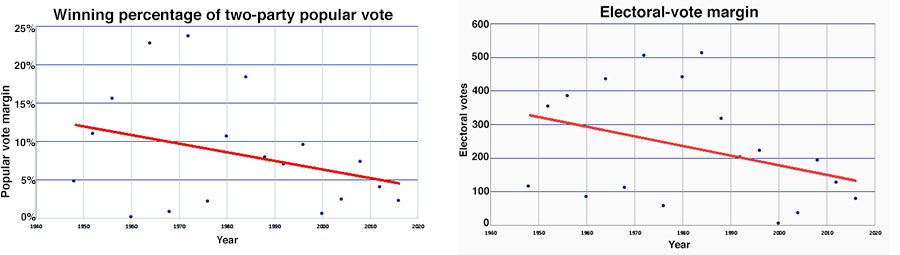
The reasons elections have tightened is that nowadays campaigns generally play it safe and aim for a modest win by targeting demographic groups and states they have a decent chance of winning. It's all about microtargeting, a concept that would have been unthinkable to candidates like Adlai Stevenson, who spoke about what he believed in and hoped for the best. Campaigns now are constantly polling, running ads, and polling again to see if anything changed. If so, the campaign is tweaked a little. If some state looks like it is lost, the campaign abandons it and moves on to another state that looks more promising. Campaigns didn't work at all like this in the old days. Republican strategist Karl Rove once said: "Republicans should run the most conservative candidate who can win." Republican campaigns now run the most conservative campaign they can and still hope to win. Democrats do the exact inverse. When a campaign deviates from this principle, as Barry Goldwater did in 1964 and George McGovern did in 1972, they get clobbered. So barring some surprises (in a year that has yielded one surprise after another), we could have another close election. (V)
Today's Presidential Polls
In case you had forgotten that Virginia, once the capital of the Confederacy, is now basically South Maryland, this poll should remind you. (V)
| State | Biden | Trump | Start | End | Pollster |
| Virginia | 53% | 39% | Aug 09 | Aug 22 | Roanoke Coll. |
Today's Senate Polls
Mark Warner gets all the Democrats but Daniel Gade doesn't get all the Republicans because nobody knows who he is. (V)
| State | Democrat | D % | Republican | R % | Start | End | Pollster |
| Virginia | Mark Warner* | 55% | Daniel Gade | 34% | Aug 09 | Aug 22 | Roanoke Coll. |
* Denotes incumbent
Previous | Next
Main page for smartphones
Main page for tablets and computers