Previous | Next | Senate page
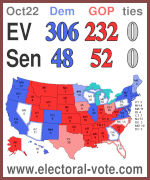
New polls: PA
Dem pickups: AZ FL GA MI NC PA TX WI
GOP pickups: (None)
And That's a Wrap
Mercifully, after two weeks, convention season is over, and the presidential race can enter the home stretch. Thursday's fourth and final evening of the RNC was as conventional as nights one and three, excepting that the two Trump speeches took place on the South Lawn of the White House as opposed to in a convention hall. Apparently, the gimmickry and surprises that the President spent last weekend sweating over were solely for the second day of the convention. In any event, here are our impressions of the finale:
- Trump "Profoundly Accepts" Renomination: It's not clear if Trump misread the teleprompter,
or just misspoke, or if that was the word he actually meant (as opposed to the more obvious "proudly"). In any case, he
officially became the Republican nominee for president, and then delivered a rambling speech that was...just lousy.
With Trump, there are two distinct speaking styles. The first is "rally Trump" style, where he's much more engaged and up-tempo, but he also tends to meander. The second is "teleprompter Trump" style, where he's more focused and more structured, but his delivery is flat and he adopts an odd cadence where he trails off after every fourth word or so. Somehow, the campaign managed to secure the worst of both worlds. The address started as a teleprompter speech, of course, which meant it was delivered in the less engaging style. But Stephen Miller (who supposedly authored the speech) also exercised little restraint, such that the address was extremely bloated. And then, on top of that, the President could not resist doing some riffing. The result was something that stretched on well over an hour, concluding well after 11:30 p.m. ET. If the goal is to reach the small number of persuadable voters who are still watching—four nights and two hours in—and to leave them with something to think about, this is not the way to do it. Last week, we criticized Joe Biden's considerably better speech for being overlong at 25 minutes. Trump's was triple that.
As to content, here is a list of the new and different things Trump said last night:
That's "nothing," in case it was not clear. You could easily have gone through videos of past Trump rallies and speeches and edited together a reasonable facsimile of what we saw last night. Remarkably, for a fellow who twice did the deer-in-the-headlights routine when asked about his plans for a second term, he offered absolutely nothing specific he might pursue if given another four years. Roughly 80% of the speech could have passed for a Trump State of the Union address, with a (grossly distorted) recitation of his accomplishments, including the SOTU-standard shoutouts to members of the audience as avatars for various initiatives. The other 20%, and the only part that would have been out of place in a SOTU, was attacks on Joe Biden. Incidentally, the tally of major lies and/or distortions was at least 20. If you want to read about them, see CNN, The New York Times, NPR, or Politifact.
There was a large crowd in attendance for the speech, at least 1,000 people. Masks were few and far between, social distancing was nonexistent. Allegedly, there was no COVID-19 screening, and no requirement that attendees be tested. If so, that's very reckless, not only from a human standpoint, but also from a political standpoint. That said, we wonder if there actually were precautions in place, so as to minimize the political risks, and yet maximize the message "See! All this caution isn't really necessary!" Incidentally, not once in the 10-plus hours of the RNC did they mention, in any way, the 180,000-plus Americans who have died in the pandemic. - Ivanka Speaks, Too: The President's introduction, and the only other live speech, was
delivered by his daughter Ivanka. Many people across the political spectrum and in the media think the Trump family is
going to be a big part of the GOP a long time after Donald Sr. has exited stage left. We're not so sure of that, but let's
go with it for now. If the Party decides that it wants to continue the policies and style of the President, largely
unaltered, then Donald Jr. is their man, because he is a clone of his father.
On the other hand, if the Party wants Trumpism wrapped in a velvet glove, then Ivanka is their woman. Last night, she said a lot of the same things that her father and brother say, also embracing their characteristic casual relationship with the truth. However, she did it in a way that was calm and reassuring, and that is much more likely to sit well with never Trump Republicans, independents, and the now notorious "suburban housewives." That said, anger is what appeals to the Donald's white, male base, and is the foundation of their cult-like devotion to him. So maybe Trumpism wrapped in a chocolate coating is not a winner. We do not know, although we're pretty sure that—due to demographic changes—unalloyed Trumpism isn't going to be a winner much longer, either. - Theme 1: Law and Order: Having addressed the two star attractions of the evening, let's
now talk about the clear points of emphasis. Hurricane Laura most certainly did not cause the evening to be canceled, or
altered in any way, and it got a brief mention from Ivanka Trump, and a briefer one from Donald Trump. Jacob Blake was
even less visible, meriting only a brief mention from HUD Secretary Ben Carson.
That said, events in Kenosha, WI, and their after-effects were a major element of Thursday's proceedings. Team Trump sees gold in running against "mobs" and "street violence" and "thuggery," not to mention uppity athletes who dare to use their platform to protest (more below), and so there was much on Thursday laying the groundwork for that "plank" in the platform.
Early in the evening, Ann Dorn spoke about the death of her husband David, who was killed during riots in St. Louis while trying to protect a friend's pawn shop. She was emphatic that if David was still alive, he'd be pulling the lever for Trump, because Trump will keep us safe. Maybe, maybe not, since David's daughter Lisa spoke to reporters on Thursday, said she disagreed with her stepmother, and declared, "We don't want his death or his legacy or any of his images to be used for political gain. That's not the purpose of my dad's life. He would not have wanted it. It's sending the wrong message."
Later in the evening, there was a "law and order" tag-team with President of the Police Benevolent Association of the City of New York Patrick Lynch, followed by former New York mayor (and current Presidential TV lawyer) Rudy Giuliani. Both of them made the same exact argument, namely that New York City has become a scary place in the last year or so, thanks to trouble-making thugs and a spineless liberal mayor. Lynch and Giuliani agree that only Donald Trump can fix it. Somewhat unclear: (1) Didn't the alleged decline happen under Donald Trump? and (2) If he can fix it, why isn't he working to do so already? Those questions might well be asked about many of the litany of things wrong with America that Republicans spent four days complaining about.
In addition to the law and order theme (which the President also raised), there was also a poke in the athletes' eyes, in the form of a montage dedicated to heroic American athletes. Outside a split-second appearance by Jackie Robinson (only identifiable if you happen to know his uniform number), all of the athletic heroes—like, say, Lou Gehrig—were white. We also learned that, to our surprise, the Wright Brothers and Amelia Earhart are apparently athletes. The athletic montage was followed by a pro-Trump speech from UFC president Dana White, who spent the entire time shouting about how wrong it is to defund the police. - Theme 2: Democrats for Trump: We would have expected this to be a big part of the RNC,
since the DNC several times showcased Republicans, both prominent and common, who have jumped ship to the S.S.
Biden. However, Thursday was the only appearance of a "Democrats for Trump" module at the RNC, with a video clip
featuring half a dozen or so folks who say they're done being Democrats, followed by Rep. Jeff Van Drew (R-NJ), who
switched parties after the impeachment trial. Van Drew's speech was meant to explain why he couldn't be a Democrat any
more, but the real question it raised, given his accounting of his background, is why he was ever a Democrat in the
first place.
- Theme 3: No Joe: Attacks on Joe Biden have been recurrent throughout the RNC, but on
Thursday they came into very clear focus. Trump & Co. realize they are running from behind and that, even worse,
there aren't that many undecided voters left. That means they have to bring the Democratic nominee back to earth, at
least a little bit. The dominant line of attack, for the last couple of months, has been that Biden is
sleepy/confused/in severe decline. It hasn't worked well, and Biden's strong showing last week really cut that line off
at the knees. Similarly, the Burisma stuff never really took hold.
So, Team Trump appears to have pivoted to two other lines of attack. The first is "Joe Biden, trojan horse for the radical left." During primary season, anyone and everyone knew that the Republicans would slur any Democratic nominee as a wild-eyed radical communist, several miles to the left of Joe Stalin and Chairman Mao. When the blue team chose one of the most centrist members of the field, that attack became more difficult to sustain, since nobody is going to confuse Biden with Leon Trotsky or Che Guevara. No problem, the idea now—and at least six speakers raised it on Thursday—is that Biden is not himself an ultra-lefty, but he will become a tool of the ultra-lefties.
The other line of attack is "Joe Biden, tool of China." It would seem that when he's not being manipulated by Sen. Bernie Sanders (I-VT) and Rep. Alexandria Ocasio-Cortiz (D-NY), Biden is going to be lent by them to Xi Jinping, who will get his own chance to manipulate the would-be president into unwise, job-killing trade deals. How these hypothetical trade deals will get past Congress, assuming they are so bad, was not explained. Remarkably, beyond this, a little braggadocio about tariffs, and many snide references to "the China virus," China was basically absent from the convention. Before the commencement of the RNC, the things Trump would do to China in his second term was expected to be a point of emphasis. - Theme 4: A Vaccine Is Coming: The RNC was full of incongruities, and one of the biggest
involved COVID-19. On one hand, the general tenor is that the pandemic is in the past due to Donald Trump's leadership,
which is ostensibly why nobody required masks or social distancing. On the other hand, there was much verbiage,
particularly on Thursday, about how the development of a COVID-19 vaccine is imminent. Some speakers, like Ivanka Trump,
were careful to qualify their words with phrases like "we're on course for..." Others, like Donald Trump, guaranteed
that a vaccine will be in place by year end. If there is no vaccine, that could come back to bite the Trumps. And if
there is a vaccine, well, it's going to be hard for many people to accept that the timeline was guided by prudence and
scientific principles, as opposed to political expediency.
- Other Speakers: A brief comment on some of the evening's other speakers:
- Franklin Graham, who gave the invocation, has completely abandoned his father's
policy of remaining above the fray.
- Ja'Ron Smith, deputy assistant to the president, was the latest in a parade
of Black speakers who made the same argument for why Donald Trump is not racist.
- Ben Carson also made that argument, and declared that Trump "does not
practice identity politics." That's true...if you don't include white identity politics.
- The
"speech"
by House Minority Leader Kevin McCarthy (R-CA) was accompanied by a soundtrack and dramatic imagery.
We are left with the strong impression that it's actually a campaign ad that was redeployed for this purpose.
- Senate Majority Leader Mitch McConnell swayed back and forth
during his address,
like maybe his shoes were too tight. He was left to make the case, all by his lonesome, that the Senate is really
important, too. Remarkably, of all the vulnerable GOP senators this cycle who could use a little publicity, only Sen.
Joni Ernst (R-IA) was given a speaking slot over the four nights.
Or more likely, none of the other half dozen or so endangered Republican senators in tight races wanted to
be seen within a country mile of Trump.
- Sen. Tom Cotton (R-AR) is supposedly a rising star, but he didn't show it on Thursday,
as his speech was bland and entirely forgettable. That said, a past rising star from Arkansas botched a convention
speech and later did ok, so this is hardly definitive.
- Alice Johnson, the one-time coke dealer who was (justly) pardoned by Trump, gave
the best speech
of the night:
The message, reiterated later in the evening by Ivanka Trump, is that the President is committed to helping people who have been over-sentenced, especially for non-violent offenses. That is a noble goal, but it does raise the question of why the President hasn't sprung any other over-sentenced folks since he helped Johnson in mid-2018. Well, unless you count Roger Stone as over-sentenced. - Carl and Marsha Mueller talked about their daughter Kayla, a human rights worker who was
kidnapped and tortured by ISIS during the Obama years and later murdered, despite multiple attempts to find and rescue
her. The Muellers asserted that if only Donald Trump had been president, Kayla would still be alive. That's very
possibly true, since Obama refused to trade convicted terrorist Aafia Siddiqui for Mueller, while the Donald would
probably have made the deal. Needless to say, we cannot imagine the heartbreak the Muellers must have gone through, and
continue to go through. We would be lying, however, if we did not note that we found it a little uncomfortable that
Kayla and her memory were used so overtly as a political prop.
- Trump social media guru Dan Scavino barely blinks. It's eerie. See for yourself.
There were fewer speakers on Thursday than on most other nights, so this is actually close to an exhaustive list. - Franklin Graham, who gave the invocation, has completely abandoned his father's
policy of remaining above the fray.
That's it for our convention commentary. We hope it was useful because, hoo boy, they are dry. And now, the race truly begins. (Z)
In Kenosha, Trump Sees Opportunity
With the presidential race now hitting full throttle, time is running short for Donald Trump. He's trailing in polls with 67 days to the election, and a little more than 20 days until early voting commences. He needs to make up some ground, and fast. If he is still down 10 nationally on, say, Oct. 1, it will probably be too late for him. And the events in Kenosha, along with their effects, seem to present a real opportunity, as Team Trump sees it.
First, let's get up to date on recent developments. The circumstances under which Jacob Blake was shot remain unclear, beyond what is shown in the widely available cell phone video. He's in the hospital, and will be for the foreseeable future. Despite being in no condition to flee, Blake is handcuffed to his hospital bed, which many see as harsh and inappropriate. Meanwhile, unrest in Kenosha and elsewhere continues, with some amount of violence and property destruction. Burning buildings make for compelling TV, so the violence is being covered extensively, whereas the peaceful protests are getting less attention. And finally, the NBA, NHL, and WNBA all suspended play on Thursday, though they will all resume this weekend.
And now, the response from Trump & Co. As we note above, Thursday's RNC was heavy on rhetoric about mobs, cities in crisis, heroic police, and the like, while concurrently very light on mentions of Blake. Donald Trump has personally embraced the latter policy, and has yet to say anything about Blake, or to speak to his family. Meanwhile, the folks who can say things that even the President can't say are already rewriting history. It is quickly becoming a matter of faith on the right that Blake was going for a knife, which is why the police had to shoot him. There is no public evidence, as yet, that this is the case. Meanwhile, the shooter who killed two protesters is being recast as...a hero. Fox News' Tucker Carlson is leading the way on that; he took to the air and wondered: "How shocked are we that 17-year-olds with rifles decided they had to maintain order when no one else would?" That would be an open endorsement of vigilantism for those keeping score at home.
At the same time, there is nothing that Trump and his base like more than a pissing contest with ungrateful athletes, especially black ones. And so, on that front, the administration put on a full-court press on Thursday. Marc Short, the chief of staff to Mike Pence, slammed the NBA protests as "absurd." White House Senior Adviser Jared Kushner observed how lucky the NBA players are to have the wealth and the privilege necessary to "take a night off." Pot, meet kettle. Trump himself declared that the NBA has "become like a political organization, and that's not a good thing." He also, as you might expect, derided the league's poor ratings. For reference, a day's worth of NBA games attracts about 12 million viewers, or about the same as the average day of the RNC.
How well this approach will work obviously remains to be seen. Since all the sports leagues are resuming play in a day or two, it's going to be hard to maintain the ungrateful athletes bit much longer. As to running against mobs/urban violence, polling broke heavily in favor of the protesters in early July (after the killing of George Floyd), but has drifted back to pre-Floyd numbers since. During those two months, the President's efforts to frighten voters, particularly suburban women, did not land. Maybe the media's greater focus on violence this time will give Trump a stronger opening. That said, the worst phase of this won't last much longer, and if the political effect of George Floyd faded in 55 days, we're not clear why the same wouldn't happen here. Trump also has the problem that this is not happening in Joe Biden's America, it's happening in Donald Trump's America. In the end, a campaign has to take the opportunities that are available, so this is a politically savvy path to pursue, but it looks like a long shot to us. (Z)
Team Biden Finally Does Some Counter-programming
At the end of the DNC, the Biden campaign promised a week of counter-programming to the RNC. If it happened Monday, Tuesday, and Wednesday, it was pretty scarce, such that many Democrats were squawking about Team Biden's apparent silence.
The Democratic ticket broke out of its bubble in a big way on Thursday. Biden was ubiquitous on TV, and in particular noted that he has already spoken to Jacob Blake's family, while also opining, apparently correctly, that Donald Trump is "rooting for violence" (see above). Running mate Kamala Harris gave a speech in which she savaged the President's performance on COVID-19: "Donald Trump froze. He was scared. And he was petty and vindictive." She knows that will get under his skin; there's nothing he hates more than to be portrayed as weak. Speaker Nancy Pelosi (D-CA) even got into the act, sharing her view that there should not be any presidential debates because Donald Trump is not presidential enough to deserve them. This was pretty clearly coordinated in order to give Biden an opportunity to emphasize how very much he wants to debate, and he certainly doesn't agree with the Speaker.
In addition, the Biden campaign paid to air a two-minute ad in many markets during the RNC:
If you don't want to watch the whole thing, we don't blame you, but consider watching the first 10 seconds for some world-class-level trolling.
And speaking of trolling, Biden also announced on Thursday that his campaign managed to grab www.keepamericagreat.com, which means that people who search for the President's 2020 slogan are greeted with a site that runs down exactly which promises he's failed to keep, and how. We continue to be mystified as to how many political campaigns, especially those with millions of dollars at their disposal, fail to lock up all possible domains that might be of value or interest. But these things keep slipping through the cracks. (Z)
This White House May Not Be Transparent, but Its Motives Are
Yesterday, The Washington Post ran their latest piece about how Donald Trump is profiting from his office. Knowing full well that the Secret Service is a captive customer, Mar-a-Lago and other presidential properties are in the habit of hitting the USSS with every fee they can come up with, including resort fees, furniture removal fees, and premium reservation fees (required to secure a room close to the President). The bill thus far totals more than $900,000.
This is hardly the first story the Post has written on this subject; the paper's David A. Fahrenthold won a Pulitzer back in 2017 for his coverage of the general issue. However, the White House has apparently decided to fight back, and has announced that a "dossier" is being compiled on Fahrenthold and other reporters, for "blatantly interfering with the business relationships of the Trump Organization." Like, for example, the "business relationship" between the Trump Organization and the USSS.
If the White House was putting together an actual dossier, presumably of information they believe adverse to Fahrenthold (and the others), they would not announce it publicly. Collecting dirt becomes much harder if your subject is aware of what you're up to. This could be an attempt at intimidation, but a vet like Fahrenthold is not going to be cowed, and the White House knows it. That leaves us with the only plausible explanation: This is a PR stunt meant to underscore the convention's (and the administration's) ongoing message that the media is the enemy of the people. The "dossier," if it ever even existed, has surely already been tossed in the garbage, having served its purpose. (Z)
U.S. Chamber of Commerce Breaks Left
The U.S. Chamber of Commerce (USCOC) is a pro-business lobby. It's right there in their name. And what that has translated to, for generations, is regular support of moderate Republican politicians. That doesn't mean that the USCOC never backs Democrats, but they lean rightward often enough that they are considered an essential part of the Republican fundraising machine, along the lines of the NRA or American Crossroads.
Maybe not anymore, though. The modern GOP has abandoned some of its longstanding economic principles, like budget austerity, and "moderate Republican" is something of a rare bird these days. Meanwhile, some of the Democrats who were first elected in the 2018 wave year—folks like Rep. Elissa Slotkin (MI), or Abigail Spanberger (VA)—actually look pretty good, as far as the USCOC is concerned. So, they are preparing to endorse (and give money to) nearly two dozen first-term House Democrats.
It's not quite a done deal yet, as some in the USCOC are pushing back due to their view that the Democratic Party on the whole is not sufficiently pro-business. That said, the leadership of the organization is on board, so it's probably going to happen. Meanwhile, the whole thing is a reminder of: (1) How far right the party of Reagan has veered recently, and (2) that many of the GOP's traditional funding sources, including the USCOC and the NRA, are drying up. Have you heard much from the Koch brother who is still alive (Charles)? We haven't either. We wonder why. If the GOP is going to make a go of it as the Trumpublican Party, they're going to have to find some new donors. (Z)
Japanese PM Is Out
Shinzō Abe is Japan's longest-serving prime minister, with just short of 8 years under his belt since taking office in Dec. 2012, plus another year from 2006-07. He's also had a rough couple years, including both national and personal health crises (COVID-19 and severe colitis, respectively). It would appear that the latter became too much to handle, because late Thursday night (U.S. time), he announced that he will step down, one year before his current term was set to expire.
Abe has generally had a warmer relationship with Donald Trump than any other leader of a major, industrialized democracy. That's a little bit because they have some common political goals, but it's mostly because Abe is a shrewd and pragmatic operator. If Trump is returned to office in November, then he'll have to try to develop a relationship with someone new, which may not be so easy for him. If Joe Biden is elected, then he and the new PM will have something of a "fresh start" to work from, with the possibility that they may try to coordinate on a new version of the Trans-Pacific Partnership (which is, of course, basically an anti-China alliance). (Z)
COVID-19 Diaries: Stasis
A forest fire that is contained is not the same as a forest fire that is out. In the U.S., we seem to have found a balance where the number of COVID-19 cases is kept from exploding, but we are not willing to do enough to really stop the virus. The number of new U.S. cases in June and July seemed to be increasing dramatically (though it never did go back to the exponential growth rate of March). This growth was led by the new hotspots of Texas, Florida, and California. In all three states (after a renewed effort to manage the pandemic), new cases and deaths are no longer on the increase and Texas and Florida are both showing dramatic decreases.
My fear that school openings might provide COVID-19 with a compelling "October surprise" may not materialize. One month ago, the reopening of most schools and universities seemed to be inevitable. If 56 million schoolchildren and 20 million college students were stuffed into classrooms, lecture halls, and other gatherings, it would have destroyed our modest progress and probably placed us back on an exponential growth curve rivaling our experience in March. Some schools did try to reopen and then immediately closed when new cases were discovered.
In a rare example of not ignoring reality, schools and colleges throughout the country are rethinking their reopening plans and most now seem to be proceeding much more cautiously. Trump has declared teachers "essential workers," and his non-binding edict says that teachers should still teach even after potential exposure. It remains to be seen how many schools and universities will volunteer to test how wise such advice might be. My child's local school in New Jersey has elected to start fully online with no face-to-face classes. However, the football team is still out practicing together on the field every morning. I find some priorities hard to explain.
The glass-half-full perspective is that, with fewer people thinking it is all a hoax and more people employing social distancing rules, COVID-19 can be prevented from moving through the population like a raging wildfire. The glass-half-empty perspective is that we are still living in the middle of a wildfire with no end in sight. We are just keeping the flames from getting too high.
In New Jersey, we are still taking COVID-19 very seriously. But it is not enough. The number of new cases/day has been basically flat for the past two months. Hospitalizations are still decreasing but are no longer decreasing dramatically.
Unless Americans agree to increase our level of effort to stop the spread of the disease, the country will find some sort of equilibrium where we only do enough to keep things from getting really bad but never stop it.
It may be possible to stop COVID-19. Both Australia (which I wrote about last week) and New Zealand are taking their recent outbreaks very seriously (though it is hard for me to call New Zealand's total of less than 100 new cases much of an outbreak). The daily new cases in Australia look like things are well on their way to being controlled. Daily new cases in New Zealand look like they never really took off in the first place and are now looking like they are approaching zero once again. If Australia continues its progress and both countries go back to no new cases, then we will have strong evidence that COVID-19 can be defeated. It simply must be decided if it is worth the cost.
It is hard to see any "bright side" when 1000 people/day are dying, millions are out of work and there are whole sectors of the economy that will take years to recover, if they ever do. However, there are some positive things that COVID-19 is doing for us:
- No flu season. I have been suspecting this for a while and now there is some nice data. South Africa is
having
a very mild flu season. The flu has a raw R0 (infectiousness) of only a little over 1. The same behaviors that reduce
the experienced R0 of SARS-COV-2 (the virus that causes COVID-19) will also reduce the transmission of the flu. However,
it is still important to get a flu shot, as flu and COVID-19 symptoms are similar. Anyhow, expect to see a reduction in
all respiratory infectious diseases.
- Expanded remote delivery of health care services. You don't really need to be face-to-face with a doctor for many
medical issues. However, until COVID-19 arose, payers (insurance companies, Medicare) were unwilling to pay for many
remote services. It was required for patients to see their doctors face to face in order for the practice to get paid.
Things will be more convenient going forward. However, expect to see a charge on your bill the next time you speak to a
doctor after hours.
- A happier planet. A reduction in driving, flying and all sorts of other activities are
improving
our air and water quality.
- Telecommuting is here to stay. We are
finding out
that not all jobs require you to be sitting in an office every day. Both employers and employees can realize significant savings.
However, telecommuting is mainly available for higher paying jobs, so this benefit is not realized by most low-wage earners.
- Remote education is going to transform higher education (and maybe high school as well). Many classes can be taught on a computer terminal rather than in a classroom. Not all classes lend themselves to online delivery (such as hands-on labs) but others may actually work better on a computer. Online classes are still in their infancy, but they will be getting lots of attention this year. The lower cost of online delivery should help to put downward pressure on the cost of higher education.
It would seem that almost everything has at least one or two silver linings. (PD)
Dr. Paul Dorsey, Ph.D., works in medical software, providing software to support medical practices and hospitals nationwide.
Today's Presidential Polls
Pennsylvania is both a linchpin and a bellwether; if Joe Biden wins it by 7, he'll be hard to beat nationwide. (Z)
| State | Biden | Trump | Start | End | Pollster |
| Pennsylvania | 49% | 42% | Aug 17 | Aug 23 | Franklin+Marshall Coll. |
Previous | Next
Main page for smartphones
Main page for tablets and computers