Previous | Next
Senate Approves Relief Bill as the Stock Market Tanks Again
When two related things happen at the same time, it is not necessarily the case that one caused the other. That said, the Senate passed a trillion-dollar relief bill yesterday, which Donald Trump promptly signed. But as that was happening, the Dow Jones dropped another 1,338 points. That used to be considered a big deal. Now it is just part of a day's work. Could it be that investors thought the bill was too little, too late?
The bill, which originated in the House and was passed by the Senate with no changes, provides for paid sick leave for many people, unemployment benefits for others, and free COVID-19 testing. Work is still ongoing on another relief bill (the third), which would dump vastly more money into the economy, providing bailouts for many industries and direct payments to most or all Americans. While many Republicans don't like bailouts (see below), Treasury Secretary Steven Mnuchin has said that absent one, unemployment could go to 20%. What he didn't mention, but all members of Congress tacitly understood, is that with 20% unemployment, next January the only Republicans left in Congress could be the 28 Republican senators not up for reelection this year. Nevertheless, eight Republican senators voted against Wednesday's bill, namely Sens. Marsha Blackburn (TN), Jim Inhofe (OK), James Lankford (OK), Mike Lee (UT), Rand Paul (KY), Ben Sasse (NE), Tim Scott (SC), and Ron Johnson (WI). Of these, only Inhofe and Sasse are up for reelection in 2020 and both are from deep red states with essentially no Democratic bench, so they are safe no matter what they support or oppose.
The Dow closed at 19,899 on Wednesday. That is perilously close to the 19,727 close on Jan. 19, 2017, the day before Trump took office. If it drops another 172 points tomorrow, all of the gains during the Trump presidency will be erased. Given that interest rates are already at zero and Congress just passed a trilion-dollar bill to stimulate the economy that looks like it hasn't impressed anyone, the government doesn't have a lot of bullets left in its gun. (V)
Republicans Have Come to Love Bailouts
In 2008 and 2009, many Republicans in Congress were violently opposed to the government picking winners and losers and bailing out preferred industries. They were particularly incensed at Barack Obama bailing out the auto industry in 2009, saying it was up to the free market to pick winners and losers, not the government. Many howled that the (smaller Obama) bailout would bury the country in debt To some extent, the bailouts led to the tea party movement, which many Republicans in Congress strongly supported.
Now that it is a Republican administration that is picking the winners and losers, however, bailouts are fine. All that is needed is to change the rhetoric a bit. Yesterday, Sen. Marco Rubio (R-FL), who rode the tea party wave to a Senate seat in 2010, said: "This is not like the financial meltdown, where you had banks that made bad decisions and asked the government to bail them out." It's true that banks made bad decisions, but the auto industry was just collateral damage. It wasn't the cause of the 2008 meltdown. Nevertheless, the administration is planning to bail out the airlines and hotels, even though they are also just collateral damage. Senate Majority Leader Mitch McConnell (R-KY), who was a vocal opponent of Obama's bailout of the auto industry, said: "This is not an ordinary situation, and so it requires extraordinary measures." Of course, the 2008 meltdown was also anything but ordinary. Desmond Lachman, an economist at the conservative American Enterprise Institute, warned in 2009 that with Obama's stimulus, America "would become like Greece." He's fine with the current bill. How do you say "hypocrite" in Greek? Maybe like this: υποκριτής.
It seems that when a Democrat bails out a key sector that is in trouble through no fault of its own, it is bad, but when a Republican does that, it is good. Maybe what is needed is for the Republicans to come to grips with the unpleasant truth that sometimes the free market doesn't work so well, and the big bad government has to come to the rescue. But don't expect "It is the job of the government to rescue failing industries in times of crisis" to make it into the 2020 Republican platform.
Some Republicans are at least consistent in their views. Sen. Rand Paul (R-KY) is no fan of bailouts, no matter who the president is. He proposed an amendment to the coronavirus relief bill to cut $1 from other spending for every $1 in relief, so as not to increase the federal deficit. All he had to do was line up another 50 senators to get his amendment approved. In the end, his amendment didn't make it and only seven other Republican senators opposed the bill. Anyhow, with such a dramatic shift in public positions, there is little question that the nearly $1 trillion bailout bill that's been discussed will pass Congress once it's ready. (V)
What Is an Essential Business?
The U.S. is not on complete lockdown (yet), with all but essential business and stores closed and people told to remain home except to go to doctors, pharmacies, and food stores. But things are heading in that direction. Much of Europe is already locked down, though what is considered an "essential business" and thus allowed to remain open varies from country to country. Here are some examples of businesses that are allowed to remain open in various countries:
- France: small bakeries, butcher shops, wine shops, tobacco shops, and delicatessens
- Belgium: Stalls selling French fries (called "frites")
- Germany: Bike shops are considered essential because people are being told to avoid public transit
- Italy: Newsstands, bakeries and bread shops; at least one gelateria is open and doing deliveries
- The Netherlands: Marijuana cafes. The red light district is closed, though, because while dope is essential, sex is not
What would be considered essential if the U.S. were forced to go to lockdown? In addition to food stores and drug stores, probably everything related to cars would be essential, including gas stations, auto parts stores, car repair places, and maybe even dealerships and used car lots. Possibly gun shops could stay open, so people could arm themselves in case their neighbors tried to break in to loot their 6-month supply of toilet paper. If schools are shut down, people would need a way to keep the kids quiet at home, so stores selling iPads and other brands of tablets might be deemed essential. Also, given Americans' eating patterns, drive-thru fast food restaurants would probably be exempt. Every country has its own priorities. (V)
Trump Attacks "Chinese Virus"
Yesterday, Donald Trump began calling the coronavirus the "Chinese virus," as if to lay the blame for the sickness and economic toll on China:
I will be having a news conference today to discuss very important news from the FDA concerning the Chinese Virus!
— Donald J. Trump (@realDonaldTrump) March 18, 2020
It as though he would have preferred a good old domestic American virus. If it had been a domestic virus, he would have been able to blame Hillary Clinton or Barack Obama for it. Wait a minute...how close is China to Kenya?
There is a tiny bit of truth (indirectly) in the President's tweet, though. The virus probably was transmitted from exotic animals to humans. In China, people sell, buy, and eat pangolins (even though that is illegal there). There is some DNA evidence the coronavirus originated with pangolins. Maybe if Chinese people would stop eating pangolins and other exotic species and just stick to cows, the worst they would get is mad cow disease.
When a reporter asked Trump if labeling the virus as Chinese was wrong and harmful to Asian Americans, he replied: "No, not at all. Not at all." Nevertheless, an unnamed White House official has been calling COVID-19 the "kung flu."
Trump also criticized China for not telling him abut the virus earlier. This fits Trump's well-established pattern of deflecting all criticism of himself by blaming someone else. (V)
Washing Your Hands Affects the Election
From a strictly political point of view, if everyone stops washing their hands and goes out and parties, a lot of people will get sick and many will die. If, on the other hand, everybody washes their hands until the top layer of skin comes off, the same number of people will get sick but fewer will die. The reason if that if nothing is done to contain the coronavirus, there will be a huge peak of sick people very soon, most will (probably) develop immunity as a result, and the pandemic will (probably) be over before the election.
So why do health authorities tell people to wash their hands often and stay home? Because they want to "flatten the curve;" that is, reduce the height of the peak to avoid overwhelming the health care system. For example, if 1,000 people show up at a hospital this week, each in need of a ventilator for 7 days to stay alive, that is the same number of ventilator-days as 100 people showing up each week for the next 10 weeks. The difference is that if the hospital has only 100 beds and 100 ventilators, then in the first case it picks 100 lucky people to admit and sends 900 home to die. In the latter case, it can handle everyone. Here is a graphic from CBS News that shows this.
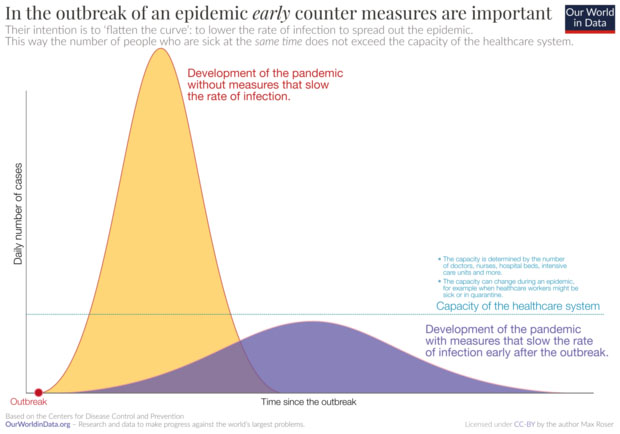
The area under the curve really should be the same in both cases but the peak is lower so the health-care system isn't overwhelmed.
The "obvious" solution—having the federal government tell General Electric, Medtronic, and the handful of other American companies that produce ventilators to run their plants 24/7 at maximum capacity with a government guarantee to buy every unsold ventilator if need be—won't work. The reason is that the machines, which sell for about $50,000 each, are very complicated to make and require parts acquired from a complex (and partly overseas) supply chain. And U.S. companies aren't the only ones frantically trying to buy the essential parts.
If the "wash-your-hands-and stay-home-" campaigns succeed, many lives will be saved, which is obviously top priority. But a side effect is that the measures needed to contain the pandemic may have to stay in place for many months, potentially well into the general election campaign and even up to Election Day. Whether the campaigns will adapt is far from clear. In particular, the thing Donald Trump loves best in the world is holding rallies where 10,000 people cheer him. Will he give that up? Don't count on it. On the other hand, Joe Biden is not a very good speaker and might actually prefer to wage his campaign largely online and on television (with the help of Michael Bloomberg's money). That way what people see is very carefully professionally crafted ads, not goofy Joe. It could be a fairly asymmetric campaign, something we not seen in a very long time (more on this tomorrow).
The other impact the hand-washing campaign could have is on the election itself. If the curve is flattened enough to last to Election Day, many people will be afraid to go vote for fear of getting infected, which could reduce turnout. Generally, low turnout is good for Republicans and bad for Democrats, but if it is mostly old people (Trump's base) who stay home, that might not be true this time. On Tuesday, we had an item about the problems with nationwide mail-in voting, so we won't repeat that here. Suffice it to say, it is possible, but requires a lot of advance preparation that has to start very soon. (V)
Campaigns Are Already Adapting to COVID-19
Candidates for the House and Senate are already reacting to the spread of the coronavirus and are changing their campaigns. There are three immediate problems. First, the basic staple of any campaign is talking to the voters at rallies and town halls. But with people afraid to assemble in large groups, that is almost impossible. Second, campaigns need money, but with the stock market in free fall and most economists predicting a recession this year, people are hesitant to give campaigns dollars they may badly need themselves shortly. Third, door-to-door campaigning and meeting lots of voters personally definitely won't fly now.
Many candidates are tackling the first problem with virtual town halls and other uses of digital media. This is tough, though, with COVID-19, Congress, and the stock market sucking up so much attention. It's hard for a House member to be heard and even harder for a state legislator.
The money problem is even worse. The NRCC warned Republican House members not to fundraise off the disease, as that would be in poor taste and might annoy people. It also noted that asking people who have just seen their 401(k) statements to give them $10, $50, or $100 might not work so well. It could easily generate a backlash, with people thinking "these politicians have no idea of what life is like in the real world." The only solution is to find sugar daddies who will cut large checks to the campaign. However, big donations tend to come with strings attached.
Finally, few candidates want to go knocking on doors to talk to lots of voters, some of whom may already be infected. Neither do their staffs and volunteers. And the voters are not likely to want to shoot the bull at length with them if they were to show up. All of this suggests that this may be the year that digital campaigning takes over and replaces traditional campaigning—at least for those campaigns that can raise the necessary funds.
On a related note, Wednesday saw the first sitting members of Congress to be diagnosed with COVID-19: Reps. Mario Diaz-Balart (R-FL) and Ben McAdams (D-UT). They are going to be quarantined, obviously, but given the large numbers of people that members of Congress (and their staffs) interact with, there will be many more members stricken. So, not only might the politicians be reluctant to press the flesh with large numbers of voters, but large numbers of voters might be reluctant to press the flesh with the politicians. (V)
Census Bureau Suspends Operations
Since 2020 is a census year, enumerators need to be out in the field counting noses. However, those noses may be sniffling and sneezing and doing other things not good for the health of the enumerators. For that reason, the Census Bureau has suspended field operations for 2 weeks. After that, it will reevaluate the situation.
The census is needed, of course, to apportion seats in the House of Representatives (and, consequently, votes in the Electoral College). If the coronavirus interferes with the count or causes it to be less accurate, that has obvious implications for the allocation of political power in the United States. As of the end of February, there were 23,610 temporary workers employed by the Census Bureau. At the same point in 2010, there were 145,000 of them. To some extent, the smaller number of workers may reflect improvements in technology, allowing people to respond to the census questionnaire online using a computer, tablet, or smartphone.
Nevertheless, there are many people who are hard to reach and who need to be prodded to answer the questions and be counted. This is what the field workers do. But if the Bureau can't hire enough workers or doesn't want to expose the workers to potential health threats, this could reduce the number of people who are counted. The diificult-to-count people tend to live in cities in blue states, thus potentially reducing those states' representation in the House. (V)
Weld Calls It Quits
Former Massachusetts governor Bill Weld ended his quixotic campaign for the Republican nomination yesterday after Donald Trump amassed more than half the delegates to the Republican National Convention. That meant that even if Weld got all the remaining delegates, Trump would still get the nomination. Under those conditions, Weld didn't see a lot of point in continuing, even though he once said that if Trump were reelected, he would "fear for the Republic."
Weld has been a fierce Trump critic for years. Last year, he published an op-ed in which he wrote: "Trump's rampant dishonesty and paranoia render him incapable of serving as president. For once, he should put the good of the United States ahead of his own ego and resign." As you may have noticed, Trump didn't take Weld's advice, but the former governor will no doubt continue to provide it. (V)
Back to the main page