Previous | Next | Senate page
New polls: CA IA KS NH OR SC
Dem pickups: AZ GA MI OH PA WI
GOP pickups: (None)
Some Takeaways from the Debate
Various media outlets had lists of takeaways. Here are some of them:
NPR:The New York Times:
- Even for Trump, he went too far
- Trump likely did nothing to expand beyond his base
- Biden missed opportunities
- Trump tried to tie Biden to the far left, but it didn't work
- Trump's response on his handling of COVID-19 was more of the same
- Good luck to the next moderator
The Washington Post :
- Trump trampled over everything
- Biden, at his strongest, pivoted to the camera—and away from Trump
- Trump still wants to wear the outsider mantle
- Trump would not condemn white supremacy or urge his supporters to stay calm
- Trump did little to address the gender gap
- Biden rebuffed the leftist label
CNN:
- Biden resisted Trump's goading—mostly
- Trump's coronavirus answers got no better
- It was an awful debate
- Biden distanced himself from the left
- Trump declined to condemn white supremacists
The Los Angeles Times:
- Trump doesn't condemn white supremacists
- Disputing the election
- Anything but coronavirus
- Taking over—and talking over—the Supreme Court
- Will you shut up, man
- Family Matters (about Hunter Biden)
The Hill:
- Trump untethered
- Not-so-sleepy Joe
- An ominous warning
- The pandemic debate
- Schoolyard taunts
- Supreme [Court] skirmish
The Chicago Tribune:
- Trump missed a chance
- Biden kept his cool
- Biden's to-camera strategy
- The debate is unlikely to change many minds
- Will there be another debate?
Yahoo News:
- Trump's serial interruptions
- Trump's can't escape the virus
- Racial reckoning
- Question about court, answer about health care
- "Invisible" Wallace struggles to contain Trump
- Family business (about Hunter Biden)
The Houston Chronicle:
- Trump tried to rattle Biden—but it probably wasn't enough to shake up the race
- Biden attempted to keep his focus on ordinary Americans
- Trump again refused to condemn white supremacists
- Trump repeated his baseless claim that the election will be rigged
Fox News:
- President Trump refused to denounce white supremacy
- Things got personal
- Family came up—but only Biden's family
- Climate change did come up, despite worries it wouldn't
- Trump again refused to commit to a peaceful transition of power
- Biden and Trump clashed on who controls the Democratic Party
- Wallace reminded the candidates who the moderator is
- [Biden] just lost the left
- Biden addressed voters personally on coronavirus
- Clash over masks and shutdowns
And now a couple of views from the other side of the pond, where they had to stay up until 3 a.m. to watch it:
The Guardian:Euronews:
- The debate was a mess, largely of Trump's making
- Trump refused to condemn white supremacists
- It got very personal
- Non-answers on policy questions
- Biden wanted to talk to the American people, Trump wanted to talk to his base
- Trump on the offensive
- Race a hot issue
- Heated personal attacks
- Trump couldn't hide from the coronavirus pandemic
- Side-stepping policy questions
If we had to summarize the top takeaways above and some others we read but aren't listed above, it would be:
- Trump refused to reject white supremacy
- Trump is a bully but Biden could handle it
- Trump addressed only his base while Biden addressed America
- Trump kept evading any responsibility for 200,000 Americans who have died of COVID-19 on his watch
Poor Biden. He spent weeks preparing, including doing mock debates, for a debate that never happened. He undoubtedly can name the leader of every country with a population over 20 million, knows which treaties the U.S. is a party to, and can defend every XO Barack Obama signed. That might have been useful in an actual debate, but is useless in a shouting match that would have embarrassed any third-grade class.
What Trump was trying to do is show his base that he is a powerful man and he dominates everyone and you better do what he says or else. He was probably hoping to motivate the millions of blue-collar men in the "Midwest" who didn't vote in 2016 to register and vote now. What he may end up doing, however, is scaring the daylights out of those much coveted "suburban housewives," and not on account of alleged marauding Black hordes. Maybe those women who are trying to teach their kids how to be a successful bully will be impressed by his performance, but our guess is that they are outnumbered by women who are trying to teach their kids to be nice and kind to people and obey the rules. They are not going to like what they saw Tuesday.
Will the debate move the needle? We'll know in a week when some post-debate polls come in, but with all the current polls showing that 90+% of the voters have already made up their minds, there is not a lot of room for movement. We seriously doubt that any Biden supporters will jump ship due to Trump's attempt to dominate him. However, for some traditional Republicans, Trump's complete disregard for the debate rules might be a bridge too far and they will grudgingly pull the lever or mark the oval for Biden. (V)
Results of a Debate Focus Group
Republican pollster Frank Luntz ran a virtual focus group of 17 voters from eight swing states during the debate. Of these, 15—nine men and six women—were undecided before the debate. After the debate, four had decided to vote for Biden, two had decided to vote for Trump, and the rest still couldn't decide. Luntz was incredulous at the people who were still undecided. He said: "You just saw 90 minutes. How can you still be undecided?" One wanted better answers from Biden but excused Trump for just being Trump.
When Luntz asked all of them to describe Trump in one word, they came up with words like "bully," "unhinged," "arrogant," "forceful," "chaotic," and "un-American." When he asked them to describe Biden in one word, he got terms like "surprised," "better than expected," "more professional," "more a people person," "confident," "leader," "humanity," and "integrity." But also "politician," "predictable," "nice guy but lacking vision," and "somewhat evasive."
Ruthie from Pennsylvania described the debate as "trying to win an argument with a crackhead." Joe from Arizona, who leaned toward Biden before the debate and will now definitely vote for him, said: "[Trump] inflames a lot of anger in this country." Joe from North Carolina said that the constant attacks on Biden as senile had gotten to him, but there was no significant gaffe, so he will probably vote for Biden now.
On the other hand, Luke from Wisconsin said that Trump is annoying and unpresidential, but he likes him on the economy and law and order. Travis from Arizona said that every time Biden tried to land a jab on Trump "he whiffed." We are skeptical that folks like Travis are really "undecided."
Kimberly from Ohio, the only Black person in the group, wanted to hear more about race relations. She was also upset that little was said about Congress' failure to come to agreement on another stimulus deal. She said: "You still have millions of Americans out there who can't even feed their families." Jeremy from Arizona liked Biden's declaration that he was the one running the party. He was afraid that Rep. Alexandria Ocasio-Cortez (D-NY) was in charge and was glad to hear that Biden is not taking orders from her. Still, he is not entirely convinced and is still undecided. Mike from Iowa said that Biden's best moment was when he talked about unity. He would like Biden's cabinet list before deciding, though. He is worried about it being stocked with progressives.
When asked about Trump's refusal to condemn white supremacy, five of the undecideds said that moment stood out in an otherwise difficult-to-follow debate. Nick of Arizona said: "I don't really think he's some big racist, but I guess I don't really know." Kimberly wasn't sure either. It is beyond our comprehension that a Black woman who definitely watched the entire debate 10 minutes later wasn't sure whether Trump is a racist, but here we are. Focus groups are hardly a scientific random sample of anything, but they are still useful to get some insight into how some voters feel. (V)
Republicans Fear Trump Blew It
A number of Republicans feel that Donald Trump missed a golden opportunity to reset the election because his debate style is not going to appeal to the independents and women he needs to win. Trump campaigned in Minnesota yesterday, but he didn't impress local Republicans with his debate performance. Amy Koch (R), former majority leader of the Minnesota state Senate, said: "Trump just overwhelmed and it was too much. It was over the top and rude and it felt desperate and bullying. He blew it. He did nothing to improve his standing with independents, women, or suburban voters."
Republicans in Congress (quietly) fumed that Trump refused to answer a question about white supremacy. Sen. Tim Scott (R-SC), the only black Republican in the Senate weakly said that Trump should "correct" his answer.
Bryan Lanza, a former Trump campaign official, opined that Trump was the "dominant force" of the debate. But he said that he would have been better served by having a policy debate on the Supreme Court, energy, the environment, and the economy. An unnamed former White House official said: "I don't see how he helped his case among women or college-educated voters who are put off by his style." Other GOP strategists say that Trump has to learn that a debate is not like a rally, where the goal is to eviscerate his rivals. The problem is that at a rally, he is speaking only to the faithful. At a debate, the whole country is watching and there is the potential to lose votes as well as gain them.
CNN talked with people who advise Trump. All of them said that Trump was too aggressive, touted few of his accomplishments, and turned off the moderate voters he needs to win. Some of them even went as far as to say he was obnoxious, unprepared, and lacking a cogent line of attack. One called it a disaster.
Talk is already beginning among Trump's aides how to break the news to him before the town hall on Oct. 15 in Miami. However, Trump apparently believes his performance was stellar, so he is unlikely to be receptive to suggestions for changing his style. He insists that his supporters are thrilled by watching him spar with reporters and rivals. That might well be true, but it is also true that his supporters are about 40-45% of the electorate, at best, and in the absence of strong third-party candidates, you don't win elections with those numbers.
Incidentally, those supporters (and non-supporters) who subscribe to Trump's e-mail list were hit with sixteen messages in the 24 hours after the debate spinning the President's performance and pleading for money (the match bonus is up to 800%—you'd be a fool not to give!). We suppose that could be seen as striking while the iron is hot, but from where we sit it reeks of desperation. (V)
Senate Republicans Locate Missing Spines and Other Body Parts
In an unprecedented development, top Senate Republicans—scared to death of people voting a straight Democratic ticket—criticized Donald Trump's refusal to denounce any form of white supremacy. Majority Leader Mitch McConnell (R-KY) sharply rebuked the President for not categorically denouncing white supremacists. Sen. John Thune (R-SD), the majority whip, said Trump should "clear it up." Sen. Bill Cassidy (R-LA) told reporters Trump should "unequivocally condemn white supremacy." Sen. Susan Collins (R-ME) expressed her concern. Ok, not really. Actually, she said: "it was the least educational debate of any presidential debate I've ever seen." Strong words. Mainers are gentle people.
Stung by these comments, yesterday Trump claimed that he doesn't know who the (far-right) Proud Boys are, even though on Tuesday he told them to "stand by." But he couldn't leave it at that. He went on to say that left-wing violence was the real problem. The careful reader will notice that he, once again, neglected to condemn white supremacists. (V)
Biden Urged to Demand New Debate Rules--but He May Not Have to
Joe Biden has already said that he will take part in the next two debates. To do otherwise would make it look like he was afraid of Trump and he knows the weak get eaten. But many Democrats are calling on him to demand rule changes, so the so-called debate can actually be a debate on the issues. First and foremost among the demands are giving the moderator buttons to turn the mics on and off so that nobody can speak when it is not his turn. A second demand is to end the split screen shots and just focus the camera on whoever is speaking at the moment.
Sen. Chris Coons (D-DE) thinks it would be better for Biden not to commit to more debates right now. Keep Trump guessing. He added: "It was very hard to follow what was being said, and President Trump showed not just disrespect to the moderator, but to the American people who tuned in trying to figure out what his plans are."
On the other hand, some Trump supporters love what they call his "freewheeling style." Scott Jennings, a former top political aide in the George W. Bush White House, said: "Trump is the biggest dog in the junkyard. He's proved that. He's louder, ruder, and appears tougher. The job for Biden tonight was to seem strong enough to do the job and Trump took direct aim at that." Another Republican strategist said: "He's a bully, but after he kicked sand in Biden's face, Biden needed to be stronger and he just wasn't." But that same strategist added: "If the president was looking for ways to lose more women voters, he accomplished that tonight." Other Republican strategists are worried about the effect it has on suburbanites and undecided voters who are tired of his chaotic approach to governing.
In any case, Biden may not have to make a decision. Apparently the folks at the Commission on Presidential Debates watched their baby on Tuesday and were not pleased. They announced that there will be more structure at the next two presidential debates.
NEW statement from @debates: "Last night's debate made clear that additional structure should be added to the format of the remaining debates to ensure a more orderly discussion of the issues." pic.twitter.com/9llABAJMbo
— Zeke Miller (@ZekeJMiller) September 30, 2020
The commission can make whatever rules it wants, but if Trump ignores them because he knows there are no consequences, what good does it do? The tools that make the most sense, of course, would be to give the moderator control over the mics and cameras and instruct him or her to use those tools to keep control. If that happens and Trump's mic is turned off and the camera is focused only on Biden when he is speaking, Trump will be sorely tempted to go over to Biden's podium to insult him. Then the consequences could come in. One possibility could be that a violation costs you a few minutes of speaking time. Another possible option would be to take a cue from the world of soccer (football to our European readers). While the use of actual yellow and red cards would be a little cheesy (although yellow and red together do make orange), the moderator could be empowered to issue warnings to candidates, and to dismiss them from the debate after the second or third case of non-compliance, although the sight of four armed guards pushing the President of the United States off stage might excite his base more than anything.
Of course, if new restrictions are announced, Trump could say he won't show up. The commission could fight back by saying that the debate will go on without him and will consist of the audience or moderator just questioning Biden for 90 minutes. In that case, we can imagine that the Democratic nominee might observe once or twice that his opponent is "too weak" and "too scared" to show up when he knows he has to play by the rules. (V)
Money Is Pouring in for the Democrats
While some people were sitting back and calmly watching the debate on Tuesday, a lot of Democrats gave up and ran to their computers to log into their ActBlue accounts and send money Joe Biden's way. The group raised $3.8 million during one hour of the debate (10-11 p.m.), an all-time record. In the 16 hours after the debate commenced, the group raised $36 million. Since Sep. 19, when Ruth Ginsburg's death was announced, ActBlue raised over $420 million. That is an incredible amount of money. To give you an idea, Trump spent $531 million on his entire 2016 race (and probably wrote it all off on his taxes as a business loss). One Democratic group raised 80% of that in 10 days. And that doesn't include what Biden's campaign or the DNC raised. WinRed has not announced its haul during the debate or during the past 10 days. If it were more than what ActBlue pulled in, we would surely have heard of it.
It now appears that Biden will have plenty of money for running ads, get-out-the-vote drives, and more during October. Most likely he will swamp Trump in all the key markets. However, it is important to remember that Hillary Clinton raised and spent twice as much as Trump in 2016 and she still lost. (V)
Both Parties Worry about Absentee Ballots
Huge numbers of voters are requesting absentee ballots, and both parties are worried. In Florida, 2.3 million Democrats and 1.6 million Republicans have requested absentee ballots so far. In Pennsylvania, 1.5 million Democrats have requested ballots, three times as many as Republicans. In North Carolina the numbers are 524,000 to 195,000 in favor of the Democrats. In Iowa the 319,000 Democratic requests is double the number of Republican requests.
Republican strategists are worried silly. Glen Bolger, a top Republican pollster, said: "One rule of campaigns is to get as many of your voters to vote as early as possible." That is doubly true this year, when an outbreak of COVID-19 or bad weather in key states could derail turnout. Republican lawmakers and operatives have quietly told Donald Trump to shut up and stop discouraging mail-in voting, but to no avail. House Minority Leader Kevin McCarthy (R-CA) acknowledged this when he said: "We've got our work cut out for us."
But Democrats are also worried. In 2016, 318,000 mail-in ballots were rejected. This year that could reach 1 million, due to either a signature mismatch, the ballot arriving after Election Day, or some other reason. Republican lawyers in every swing state are poised to challenge almost every ballot for any reason they can think of. Democrats are worried about putting all their eggs in one basket and are starting to encourage voters to vote early in person.
Stanford and M.I.T. have a project tracking over 320 lawsuits in 44 states over the election. The suits cover a wide variety of issues. In Nevada, Republicans want to throw out ballots that don't have a stamp. In Texas, Republicans want to prevent the state from automatically sending a ballot to every senior. Other cases involve the date by which ballots must arrive to be counted. Some of these cases will make it to the Supreme Court and Democrats are worried that they may lose on 5-3 or 6-3 decisions, in which case the idea of encouraging so much mail-in voting could end up handing Republicans victories up and down the ballot. None of these issues come up with in-person voting, although voter-ID laws play a role there.
Democrats are not lying around waiting to lose all the lawsuits, though. The DSCC has hired a voter protection director. It also partnered with the DCCC to invest $10 million in voting rights litigation. (V)
Barrett Won't Pledge to Recuse Herself from 2020 Election Cases
Democrats have called on Supreme Court Nominee Amy Coney Barrett to promise to recuse herself from voting on any cases relating to the 2020 election. She has refused to do so. She did say that she would recuse herself from cases involving her husband and her sister, both of whom are lawyers. She also said she would recuse herself from cases involving Notre Dame University, where she studied and was a law professor. She also said she would not take part in cases in which she was involved when she was on the U.S. Court of Appeals for the 7th Circuit. But as to election cases, no, she would not recuse herself.
Senate Judiciary Chairman Lindsey Graham (R-SC), who is in the fight of his life for reelection against Jaime Harrison (D), called the Democrats' demands "absurd." "She doesn't have a legal conflict," he said. Mitch McConnell refused to answer reporters' questions about whether Barrett should recuse herself from election cases. (V)
Appeals Court Lets Extended Deadline for Ballot Receipt in Wisconsin Stand
In a potentially crucial decision, the U.S. Court of Appeals for the 7th Circuit shot down an attempt by Republicans to have ballots received after Election Day be rejected. Last month, a district court judge ruled that on account of COVID-19 and delays in the mail system, absentee ballots postmarked by Election Day but arriving a few days later should be counted. Republicans immediately appealed to the 7th Circuit. Yesterday, their appeal was rejected because none of the appellants have standing to appeal. The appellants were the RNC, the Wisconsin legislature, and the Wisconsin Republican Party. The court did not rule on the merits of the case.
To appeal, someone has to convince the appeals court that they would be damaged by the lower-court ruling. It would be hard for the RNC to claim: "We have an inside track on the vote and expect more Democrats to mail their ballots just before Election Day because we know they are dumb and lazy." Absent an argument like that, it could well be that more Republican ballots would be thrown out by rejecting ballots arriving late. If that were the case, the three groups filing the appeal would not be damaged at all. All three judges on the case agreed and all three were appointed by Republican presidents.
It is likely that the Republicans will appeal to the U.S. Supreme Court. The Supreme Court could accept the case and rule on the merits if it so chose. State law requires ballots to arrive by Election Day, so the Supreme Court could easily say that judges cannot overrule the legislature. If the legislature is concerned about the effects of COVID-19, it could change the deadline, but in any event, it gets to make the call, not a judge. (V)
The Six Races That May Determine Whether Future Elections Are Honest
Quick. Who's your secretary of state? Not Mike Pompeo. Your own state's secretary of state? You know, the person who runs the elections in your state (with a few exceptions). Don't know? You're not alone. A lot of people don't pay a lot of attention to their state secretary of state, or at least didn't until now. But with election procedures becoming so contentious, these elected officials are often at the center of the storm. It's up to them to make sure that elections are honest and the true winner is certified.
Actually, the situation is not uniform. Three states (Alaska, Hawaii, and Utah) don't even have a secretary of state. In those states, the lieutenant governor does the job of secretary of state, since they have nothing else to do while waiting for the governor to die or resign. In the other 47 states, the secretary is either elected, appointed, or chosen by the state legislature. While in most states, the secretary of state runs the elections, in 10 of them, an elections board runs them. In other democracies, election officials are generally nonpartisan civil servants, so as to prevent election monkey business, but that is not how it works in the U.S. Here is the lay of the land:
| State | Secretary | Party | How chosen? | Who runs elections? |
| Alabama | John Merrill | Republican | Elected | Secretary |
| Alaska | Lt. Gov. Kevin Meyer | Republican | Elected | Secretary |
| Arizona | Katie Hobbs | Democratic | Elected | Secretary |
| Arkansas | John Thurston | Republican | Elected | Secretary |
| California | Alex Padilla | Democratic | Elected | Secretary |
| Colorado | Jena Griswold | Democratic | Elected | Secretary |
| Connecticut | Denise Merrill | Democratic | Elected | Secretary |
| Delaware | Jeffrey Bullock | Democratic | Appointed | Elections board |
| Florida | Laurel Lee | Republican | Appointed | Secretary |
| Georgia | Brad Raffensperger | Republican | Elected | Secretary |
| Hawaii | Lt. Gov. Josh Green | Democratic | Elected | Elections board |
| Idaho | Lawerence Denney | Republican | Elected | Secretary |
| Illinois | Jesse White | Democratic | Elected | Elections board |
| Indiana | Connie Lawson | Republican | Elected | Secretary |
| Iowa | Paul Pate | Republican | Elected | Secretary |
| Kansas | Scott Schwab | Republican | Elected | Secretary |
| Kentucky | Michael Adams | Republican | Elected | Secretary |
| Louisiana | Kyle Ardoin | Republican | Elected | Secretary |
| Maine | Matt Dunlap | Democratic | Legislature chooses | Secretary |
| Maryland | John Wobensmith | Republican | Appointed | Elections board |
| Massachusetts | William Galvin | Democratic | Elected | Secretary |
| Michigan | Jocelyn Bensen | Democratic | Elected | Secretary |
| Minnesota | Steve Simon | Democratic | Elected | Secretary |
| Mississippi | Michael Watson | Republican | Elected | Secretary |
| Missouri | Jay Ashcroft | Republican | Elected | Secretary |
| Montana | Corey Stapleton | Republican | Elected | Secretary |
| Nebraska | Robert Evnen | Republican | Elected | Secretary |
| Nevada | Barbara Cegavske | Republican | Elected | Secretary |
| New Hampshire | Bill Gardner | Democratic | Legislature chooses | Secretary |
| New Jersey | Tahesha Way | Democratic | Appointed | Secretary |
| New Mexico | Maggie Oliver | Democratic | Elected | Secretary |
| New York | Rossana Rosado | Democratic | Appointed | Elections board |
| North Carolina | Elaine Marshall | Democratic | Elected | Elections board |
| North Dakota | Alvin Jaeger | Republican | Elected | Secretary |
| Ohio | Frank LaRose | Republican | Elected | Secretary |
| Oklahoma | Michael Rogers | Republican | Appointed | Elections board |
| Oregon | Bev Clarno | Republican | Elected | Secretary |
| Pennsylvania | Kathy Broockvar | Democratic | Appointed | Secretary |
| Rhode Island | Nellie Gorbea | Democratic | Elected | Secretary |
| South Carolina | Mark Hammond | Republican | Elected | Elections board |
| South Dakota | Steve Barnett | Republican | Elected | Secretary |
| Tennessee | Tre Hargett | Republican | Legislature chooses | Secretary |
| Texas | Ruth Hughs | Republican | Appointed | Secretary |
| Utah | Lt. Gov. Spencer Cox | Republican | Elected | Secretary |
| Vermont | Jim Condos | Democratic | Elected | Secretary |
| Virginia | Kelly Thomasson | Democratic | Appointed | Elections board |
| Washington | Kim Wyman | Republican | Elected | Secretary |
| West Virginia | Mac Warner | Republican | Elected | Secretary |
| Wisconsin | Doug La Follette | Democratic | Elected | Elections board |
| Wyoming | Edward Buchanan | Republican | Elected | Secretary |
Six states are having an election for secretary of state in November, and that could affect future elections in those states. These states are Missouri, Montana, Oregon, Vermont, Washington, and West Virginia. Those elections could be important, as some past secretaries of state have definitely put their thumbs on the scale to help their party. Think about Katherine Harris (R) in Florida in 2000 refusing to extend the recount and Brian Kemp (R) in Georgia in 2018 changing polling sites and purging voter rolls to ensure his own election as governor.
Given all the concern about election security and accuracy this year, these races are very contentious. In West Virginia, Democrat Natalie Tennant has accused incumbent Mac Warner (R) of making the state a laughingstock for embracing Internet voting (Pro tip: She's right). In Missouri, Democrat Yinka Faleti thinks that incumbent Jay Ashcroft's mail-in voting policies are "derelict and dangerous to our democracy." In Montana, the seat is open, but that didn't stop Democrat Bryce Bennett from criticizing the retiring Republican. In Washington, Democrat Gael Tarleton accused incumbent Kim Wyman (R) of standing by while Donald Trump undermined the state's voting system.
Challengers can complain all they want to, but in today's partisan environment, it is very likely that whichever party wins the state's electoral votes will also win most of the downballot races, especially secretary of state, where the candidates are generally not well known. (V)
Voters Don't Expect to Know the Winner Nov. 3
We noted this in passing already, but it is important enough to bring it up regularly. A new Politico/Morning Consult poll shows that 66% of voters do not expect to learn the winner of the election on Election Night. Just 20% expect the result on Nov. 3. This is very good news for the Democrats. It means that if Donald Trump claims victory or otherwise calls for counting to be stopped, people are not going to take him seriously, especially if Joe Biden gives a speech Election Night asking people to please be patient and wait for all the votes to be counted, even if it takes a week. Most voters expect the count to be completed within a week, although 21% think it could take longer than a week.
Much of the problem lies with Michigan, Wisconsin, and Pennsylvania, which don't allow ballots to be processed or tallied before Election Day. Michigan Secretary of State Jocelyn Benson has repeatedly asked the (Republican-controlled) state legislature to allow her to verify, open, and count absentee ballots as they arrive, as Florida and North Carolina do, but the legislature is not really interested. However, the Michigan legislature did pass a bill to allow some local clerks to start processing ballots on Nov. 2. That could help a little bit, but not much.
A majority (53%) of respondents said they were worried that Trump would declare victory before the ballots were counted. About a third said the same thing about Biden. Everyone was worried about vote tampering and technical glitches. (V)
Seniors Are Up for Grabs in Florida
For years, 65+ voters in Florida have voted consistently for Republicans. This year, that might not hold. An AARP poll of seniors earlier this month had Joe Biden +1 over Donald Trump. A Monmouth poll had Biden +2 over Trump. Other Florida polls also had Biden slightly ahead. In 2016, 30% of all Florida votes came from people 65 and older, so losing the iron grip the GOP had on this demographic matters.
The 2016 exit polls had Trump beating Hillary Clinton by 17 points among seniors. In 2012, Mitt Romney beat Barack Obama, also by 17 points. In 2008, John McCain beat Obama among the seniors by 8 points. In 2004, George W. Bush, no senior himself at that time, also won that demographic. So having it be a statistical tie is a major shift toward the Democrats.
Ryan Tyson, a Florida Republican pollster, says that no Democrat can win more than 38% of the white vote in Florida. To win the state they need nonwhite votes. Biden is trying to prove Tyson wrong. He is running $700,000 worth of ads saying that Trump will cut Social Security if reelected. It is his seventh ad aimed at seniors. In another one, he pointed out that Trump's executive order to suspend payroll taxes could destroy Social Security. Other ads pointed out that Trump's botched handling of COVID-19 meant that grandparents couldn't see their grandchildren. He made that personal by pointing out that he and Jill also could not see their grandchildren, just when they needed them. That's probably worth 10 speeches on economic policy and 50 on foreign policy.
Trump is also running ads aimed at seniors. His say that seniors won't be safe in Biden's America. That one was running for $400,000 in The Villages and $1.1 million statewide. The Villages has been heavily Republican for years, but Democrats are showing signs of life there now, including a recent golf cart parade. If Biden can reduce his expected losses in The Villages by a couple of points, that could help in a state that is often decided by 1%. (V)
Today's Presidential Polls
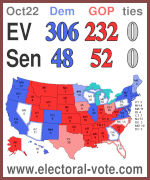
It looks like Iowa and even South Carolina may be swing states. If 8-10 states are swing states, with the results being largely determined by factors like the local weather on Nov. 3, that helps Joe Biden since he has more electoral votes nailed down solid (279 currently) than Donald Trump (120). If you look at the map above, any state with a white center is de facto a swing state. Right now there are eight of them. (V)
| State | Biden | Trump | Start | End | Pollster |
| California | 59% | 32% | Sep 26 | Sep 28 | SurveyUSA |
| Iowa | 48% | 46% | Sep 23 | Sep 26 | RABA Research |
| Kansas | 42% | 52% | Sep 26 | Sep 29 | Civiqs |
| New Hampshire | 53% | 44% | Sep 24 | Sep 28 | U. of New Hampshire |
| Oregon | 56% | 39% | Sep 26 | Sep 29 | Civiqs |
| South Carolina | 47% | 48% | Sep 23 | Sep 27 | Quinnipiac U. |
Today's Senate Polls
Sen. Lindsey Graham (R-SC) is in the fight of his life. Jaime Harrison (who is Black) is no doubt going to get > 95% of the Black vote plus a decent number of suburban white women who are fed up with Donald Trump. Could that be a majority? It would be surprising, but the Graham-Harrison polls have been close for months. If South Carolina were to end up with two Black senators, we would be tempted to say that finally the Civil War is really over. (V)
| State | Democrat | D % | Republican | R % | Start | End | Pollster |
| Kansas | Barbara Bollier | 43% | Roger Marshall | 50% | Sep 26 | Sep 29 | Civiqs |
| Oregon | Jeff Merkley* | 55% | Jo Rae Perkins | 35% | Sep 26 | Sep 29 | Civiqs |
| South Carolina | Jaime Harrison | 48% | Lindsey Graham* | 48% | Sep 23 | Sep 27 | Quinnipiac U. |
* Denotes incumbent
Previous | Next
Main page for smartphones
Main page for tablets and computers