Previous | Next | Senate page
New polls: NH
Dem pickups: AZ GA MI OH PA WI
GOP pickups: (None)
Note: The graphs of all the polls have been expanded. The y-axis no longer starts at 0 to make it easier to understand close races. The x-axis begins at July 1 (except when there is no data). To see all the presidential polls, click here. To see all the Senate polls, click here. Links to these pages are on the menus to the left of the maps on the main page and Senate page. Clicking on a state on either the main map or the Senate map also gives the new expanded graph.
The Trumps Have COVID-19
This weekend, we were planning to answer a question from W.R.S. in Tucson, AZ, that pointed out that Anonymous may soon unmask himself or herself (although unmasking during a pandemic could be foolish), and asking us to list other "known unknown" potential October surprises. We had "maybe someone leaks Trump's taxes" and "maybe Trump gets COVID-19" and then we decided to hold off for a week so we could think about it a bit more. Now we kinda wish we'd run that answer, because we'd look like geniuses.
In case you haven't already heard, the White House announced late Thursday/early Friday that Donald and Melania Trump have both tested positive for COVID-19. The news actually broke in stages; first a positive test for presidential advisor and frequent traveling companion Hope Hicks was announced, then a 14-day presidential quarantine was announced, then the President's and First Lady's positive results were announced. Maybe the quarantine was planned as a cover story to hide the diagnosis, and the cat got out of the bag. Maybe not. Either way, after a September with about half a dozen "October" surprises, it took about 22 hours for us to get our first actual October surprise. This also means that within the span of less than a week, we've got the tax story, the debate story, and now the Presidential diagnosis. The nation's news editors better be stocking up on black coffee.
There are so many moving parts, and so many "known unknowns" and "unknown unknowns" here that we're just going to work through a list of the 10 biggest questions that occur to us. Keep in mind this news broke very late in the day, and properly processing it will take far more than an hour or two. But an hour or two is what we've got to work with, so here goes:
- Advantage Trump?: We can think of four ways this could plausibly work to Trump's
advantage. The first is that it might engender some sympathy for him, the way that Ronald Reagan's approval
rating jumped 7 points (from 60% to 67%) in the weeks immediately following the March 30, 1981 attempt on his life. We
actually doubt this will happen big time, though. First, Trump has done so much stuff unworthy of sympathy, it's hard to imagine
that this will somehow balance the scales. Second, it's not like Reagan spent nine months downplaying the significance
of assassination attempts, and blaming assassination attempts on the Chinese, and doing little to nothing as 200,000+ of
his fellow Americans fell victim to assassination attempts. Third, Trump will surely take advantage of this downtime to
really light things up on Twitter. Hard to feel too much sympathy for someone who says dozens of nasty things each day
about anyone and everyone.
A second way this could plausibly work for Trump is if he makes a rapid and relatively painless recovery with no lingering aftereffects. Then, he might be able to spin that into case study #1 that COVID-19 isn't a big deal, and those silly libs with their silly shutdowns and their silly masks were wrong all along. Of course, this would work only if Trump actually does make a rapid and relatively painless recovery. Further, even if he does have a relatively mild case, there is still the matter of the 200,000+ dead.
Third, this is going to be a massive story today and tomorrow and is going to dominate many news cycles. We've already heard from a reader who wondered if it might not be the most consequential news story since 9/11. Maybe it is. The debate debacle is probably pushed aside for good. The tax story is at least temporarily sidelined. Can The New York Times run more follow-ups while he's still sick? Who knows? In short, whether it was intended that way or not, the COVID-19 diagnosis looks like another successful case of redirecting people's attention away from particularly adverse news.
Fourth, and finally, the diagnosis will give Trump cover to change the rules for the last month of the campaign with near-impunity. If he wants to skip the remaining debates, he can. If he wants to never face unfriendly reporters again, he can make that happen. If he wants to relocate to Bedminster and spend his days watching Fox News, tweeting, and chatting with Sean Hannity on the phone, he can.
Because of these potential advantages, there will be plenty of folks wondering how much truth we're actually getting here. Is Trump sick, but only mildly? Is he completely healthy, and only feigning illness? Anything is possible with him. However, the downsides to the diagnosis (coming up in a moment) are big, so just making this up would be a huge gamble. Much of the remainder of this piece will be written with the assumption that he actually is sick, but we certainly recognize this could be a scam. After 30,000 lies, what's one more? - Disadvantage Trump?: We talked about four ways this could plausibly work to the
President's advantage; now let's move on to four ways it could work to his disadvantage. To start, the President's
casual attitude about masking, his mockery of Joe Biden for same, his insistence on holding rallies (even after Herman
Cain lost his life as the price of attending the Tulsa rally), and his pooh-poohing of the pandemic all look a whole lot worse today than they did yesterday. Thus
far, much of the base (though not all of it) has been willing to buy into the notion that COVID-19 is mostly or entirely
fake news. Can their capacity for cognitive dissonance accommodate a situation when the Dear Leader himself is diagnosed?
Second, falling ill is going to make Trump look "weak" in the eyes of the base, and also in his own eyes (even if he, or they, won't admit it consciously). It should not be that way, any more than Hunter Biden's drug use should be the basis for judging him to be a loser. However, Trump has spent years turning health and wellness issues into deep and abiding personal failings, whether it's reporter Serge Kovaleski's arthrogryposis, or Hillary Clinton falling ill during the 2016 9/11 memorial service, or an occasional stutter from Joe Biden. Meanwhile, the President has made much hay of his own haleness and his heartiness, regularly celebrating himself as the healthiest/fittest president who ever served. That just went out the window. Or maybe not. Trump is old enough to remember how the former Soviet Union treated the leaders' illnesses. After the leader had been dead for a week, there might be a press release saying the leader had a mild cold. Trump could play the same game. All official announcements should be taken with a heaping tablespoon of salt.
Third, Trump now has cover to eliminate just about anything about campaigning that he doesn't like. But the tradeoff is that his very favorite thing about campaigning, namely rallying, surely has to go. After all, he's going to be in quarantine for nearly half of the remaining campaign days, or possibly longer if his case turns serious. And after that, can he justify the risk to his own health of rolling the dice again? Even if he feels he can, would anyone actually show up?
And finally, Trump is down in the polls, and everyone knows it. It was around 7.5 points but, after the debate, it may be more. It's possible that a "sympathy bounce" could be just what he's looking for to re-set the race. But if that doesn't happen, then his opportunities to move the needle may just have vanished into thin air. - Trump's Treatment?: There are a couple of distinct issues here. The first, obviously, is
exactly what the impact of the disease on the President's health will be. On one hand, he has access to first-rate
healthcare with none of the waiting that we of the hoi polloi have to endure. Put another way, if he needs a ventilator,
it's safe to bet he'll get one. On the other hand, he is a 74-year-old man who is obese and who may have other, unknown
comorbidities. As we know, the similarly husky (but nearly 20 years younger) Boris Johnson ended up in intensive care,
and was ultimately out of commission for exactly one month (March 27 to April 26).
The other question in this area, one that we may never get a straight answer to, is exactly what course of treatment the President will pursue. Will he stick with nonscientific treatments, like hydroxychloroquine? Will he tell the doctors to inject him with every vaccine that is currently under review? Will he quaff a few Diet Cokes and Cloroxes? Or will he defer to the experts and heed their advice? Our guess is that when it comes to his health, he won't do anything stupid. On the other hand, he already claims to have taken hydroxychloroquine, so you never know. - Mike Pence?: Mike Pence claims to have just been tested and is negative.
Maybe the claim is true. Maybe it is not. It takes a few days for an infected person to test positive. If he really is negative, it is a demonstration of how unimportant he is:
Trump probably never wants him around.
His only function is to get evangelicals to vote for the ticket.
Of much greater consequence are questions of the transfer of power. When BoJo fell seriously ill, he very responsibly handed off power to Dominic Raab. The same happened a couple of times during the George W. Bush presidency, when Bush very responsibly handed off power to Dick Cheney (ok, you can debate whether it is ever responsible to give Dick Cheney power). Anyhow, would Trump hand off power if he was incapacitated? That would be a further admission of weakness (see above), so we wouldn't bet on it. If it became necessary, would Pence and the Cabinet invoke the 25th Amendment?
And what if Pence does become president for some period of time. Might he do something crazy, like issue pardons for everyone, so as to curry favor with the boss and the base? A wild thought, but not impossible. On the other hand, what if the presidency devolves upon Pence and then he becomes seriously ill? Would he (and, probably more importantly, the people around him) move heaven and earth to keep the Oval Office from passing into the hands of Speaker Nancy Pelosi (D-CA)? If she does somehow claim the presidency, we can guess what her first item of business will be (Hint: "I formally withdraw the nomination of..."). If Trump should die of COVID-19, as 200,000+ Americans already have, Pence would become president and would be expected to nominate a new vice president. That person would have to be confirmed by both chambers of Congress. This puts Pelosi in an, er, interesting position. Approving a new veep would mean she is no longer a heartbeat away from the presidency. She might be willing to do that, but she might just have a couple of conditions she wants met first.
- Foreign Shenanigans?: This is where things get dark. If Vladimir Putin decides that he'd
like to own more of Ukraine, or if Kim Jong-Un has been getting an itchy trigger finger, or if Xi Jinping decides he'd
like to add a North China Sea and a West China Sea to his portfolio to complete the set, or if Iran wants to poke the
U.S. and/or Israel in the eyes, now would appear to be primetime. That's especially true if it is unclear exactly who
in the U.S. is exercising executive authority.
Furthermore, don't sleep on Canada. They've had their hearts set on owning Maine and Michigan for a long while, and after patiently biding their time for 208 years, PM Justin Trudeau might just decide that the time has come to put things right. The Honourable Susan Collins, MP? It certainly could happen. Ok, no it couldn't, but we thought that a little comic relief might be useful here. - Business in Washington?: There is, as of Thursday night, very little information about who
might have had contact with the Trumps, Hicks, and any others in their orbit who may have been exposed to the disease.
Certainly, Steven Mnuchin did, and he's been meeting with Pelosi daily. She, in turn, has met with her leadership team,
and with many members of her caucus. The same is true of Senate Majority Leader Mitch McConnell (R-KY), who had direct
contact with Trump. And then, of course, there is the woman of the hour, Amy Coney Barrett. She has definitely
interacted with Trump—several times. And she's already had interviews with a number of Republican senators.
Add it all up, and it's not clear how much business the Congress will be doing in the next couple of weeks. Maybe they will be able to keep on keepin' on, or maybe they'll have to shut down for some period of time, with the budget, COVID relief (see below), and the Barrett confirmation up in the air. If Barrett is herself diagnosed with COVID-19, then the confirmation process might have to wait until she gets better. Further, any senator who was exposed cannot plausibly hit the campaign trail, which means a Sen. Lindsey Graham (R-SC) or a Sen. Cory Gardner (R-CO) or a Sen. Thom Tillis (R-NC) would be grounded, while their opponents would be free to keep on truckin'. - WWJD?: There has been
no information about Joe Biden. He was socially distanced from Donald Trump on Tuesday night, yes, but they shared a lot of air,
much of it hot. So, what will Joe do? Do medical science or political reality (or both) dictate that he will now have to
quarantine, as well? And even if a quarantine is not indicated (though it probably is), does Biden suspend his campaign
until Trump recovers? That's what John F. Kennedy did in 1960 when Richard Nixon fell ill; anything else might look
sleazy and opportunistic. But giving up 2 weeks of crucial campaign time when it may not be needed would be painful.
Meanwhile, if Biden has actually contracted the disease, it's an additional kettle of fish. He's no spring chicken, either. And since we get this question every single week, we will just answer it now: The ballots are already set across the country, and cannot be changed (especially since millions of votes have already been cast), even if a candidate dies. Since a vote for Biden/Harris is really just a vote for Biden/Harris electors, and since a vote for Trump/Pence is really just a vote for Trump/Pence electors, then the election would legally be in the electors' hands. This is true today, and will remain so through Election Day and up until the electors meet in December. But there is an interesting twist here. In July the Supreme Court ruled that electors must vote for the state's winner (except in ME and NE). There was no footnote saying: * except when the candidate is in the intensive care unit at death's door.
That said, even with the election technically in the electors' hands, the parties would certainly make their feelings known. Since electors are party loyalists, they would probably heed the parties' wishes, particularly if they feared that even a couple of defections might lead to the election of the opposing candidate. The DNC would likely ask the electors to elevate Kamala Harris to the #1 slot, and then would have to identify a new VP candidate. Their choice would depend a fair bit on whether it's before the election or after, but this could be the one scenario where everyone involved takes a shot at VP Barack Obama, and dares the Republicans to sue. The RNC would keep Pence on the ticket, probably elevating him to #1, but maybe not. For his hypothetical running mate, all signs point to Nikki Haley; it's hard to imagine they would seriously consider anyone else. - What about the Debates?: The next presidential debate was already in some doubt, with the
Commission on Presidential Debates (CPD) having announced that changes to the format are coming, and the Trump
campaign
responding
on Thursday that changes are unacceptable. Now, with the next matchup just 13 days away, the CPD, Trump, and Biden
all have plausible excuses for canceling, and any or all may seize the opportunity. At the same time, the CPD is now in
an excellent position to decree that Trump and Biden have to be in separate places for the debate.
In a Zoom debate, it would be easy for the moderator to maintain complete control by pushing buttons to turn the various
audio and video feeds on and off, depending on whose speaking time it is.
- How Will Trump's Base React?: Here's the kumbayah possibility: Trump's base awakens to the
fact that his pooh-poohing of masks, social distancing, the pandemic, etc. was politically motivated, unsupported by science,
and entirely unwise. Then, everyone agrees to a real shutdown and, just maybe, the U.S. gets this thing under control,
Aussie-style. Oh, and as
long as we are fantasizing, let's also have the Angels winning the next five World Series.
Meanwhile, the grim, but more realistic possibility: Possibly egged on by Q, the violent elements of the President's base, energized by his remarks on Tuesday, take to the streets, maybe because they think the "deep state" has finally gotten him, or maybe because they fear that the diagnosis is the final nail in the election coffin. - How Will the Economy React?: "I am certainly not going to predict what general business or the stock market are going to do in the next year or two since I don't have the faintest idea," Warren Buffet once said. If he, a fellow who has built an $80.5 billion fortune on the basis of his stock market investments, can't do it, then we certainly can't either. That said, Dow Futures fell 450 points after Trump announced his diagnosis. Since there isn't a lot of other news at that time of night, it's probably fair to connect the two events. And if some of the possibilities we've listed above (or some we've overlooked) come to pass, it presumably won't be good news for the markets or the general economy, especially since another 837,000 Americans filed for unemployment in the last week.
So, there's our immediate response. How many "known unknowns" and "unknown unknowns" did we miss? Who knows? But we may just be talking about this a bit more in the next week or two. (Z)
House Approves COVID-19 Relief Measure
Democrats have increased the pressure on Republicans to pass a bill to help people deal with the economic fallout from COVID-19. Yesterday, the House passed a $2.2 trillion relief bill without a single Republican vote. The vote was 214 to 207, with some Democrats also voting against it. The bill is unlikely to even get a vote in the Senate because the actual negotiators, Nancy Pelosi and Steven Mnuchin, are far apart on many issues. But Pelosi is hoping that in the absence of a real bill, at least her vulnerable members will be able to tell their constituents: "We tried but the Republicans blocked it." Whether this will help with the "Why can't they just work together?" crowd remains to be seen.
Not all of the vulnerable members are happy with that strategy. Rep. Abigail Spanberger (D-VA) said: "The American people are exhausted by empty promises and government dysfunction." But Pelosi's options were basically to give in and sign onto the Republicans' bill or pass her own bill, even though it has zero chance of passing the Senate. One of her big objections to the Republicans' bill—other than it being much more miserly—is that it grants legal immunity to employers whose employees get COVID-19 on the job. Pelosi feels that this is basically an announcement to employers saying: "You don't have to protect your employees because they can't sue you if they get sick."
Nevertheless, she and Mnuchin are still talking sporadically. Part of the problem is that it is not clear if Donald Trump really wants a bill. If he did, he could just order Mnuchin to get the deal done today, no matter what it takes. Then Mnuchin could say to Pelosi: "I'll give you all the money you want if you will accept the immunity provision." She would probably accept that to help her vulnerable members. Mnuchin could then tell Trump that he got a big "win" and Trump would be happy.
Another problem is the Senate, which is badly divided. Mitch McConnell sees no need for a new bill, but his vulnerable members desperately want one. If the bill—any relief bill—actually came to the floor of the Senate for a vote, it would pass with 47 Democratic votes and the votes of Sens. Martha McSally (AZ), Cory Gardner (CO), Joni Ernst (IA), Thom Tillis (NC), David Perdue (GA), Kelly Loeffler (GA), and Susan Collins (ME), all of whom are in tough races. McConnell knows this, of course, but members who are not up for reelection don't want to spend government money to help people. This puts him in a bind. He is waiting for marching orders from Trump, but until he gets them, he is unlikely to bring any bill up for a vote. (V)
Trump Finally Condemns White Supremacists
It took him nearly 48 hours, but Donald Trump finally said (to Sean Hannity): "I condemn the KKK, I condemn all white supremacists, I condemn the Proud Boys. I don't know much about the Proud Boys, almost nothing, but I condemn that." That will give Trump supporters something to post to Facebook, and Republican members of Congress something to point to when facing tough questions from reporters. Well, assuming the story doesn't get lost in the tidal wave of COVID-19 diagnosis coverage.
Of course, other than those who are looking for cover in order to vote/support Trump, nobody can take this denunciation seriously. First, because when it comes to condemning white supremacy, anything less than a batting average of 1.000 is a real problem, and the President's batting average is well below .500. Second, if you do swing and miss, and you regret it, it should take you seconds (or maybe minutes) to clean up the error, and not 48 hours. Especially when that 48 hours is chock-full of teeth pulling and arm twisting from your allies and your staffers. Third, and as always, Trump's "denunciation" was accompanied by an even longer postscript about how truly awful Antifa, Black Lives Matter, the Democrats, the radical left, etc., are. In the end, everyone should be very clear where Trump really stands. Certainly the Proud Boys are; they continue to celebrate on social media, and they're now selling "stand back and stand by" merchandise. Well, they're trying, though nearly every online merchant has removed the products. Maybe the Proud Boys can sell it here. (Z)
New York City Botches the Absentee Ballots
For months, Donald Trump has been yelling that absentee ballots are rigged. Now New York has conveniently given him some evidence. The bipartisan but notoriously dysfunctional New York City Board of Elections, which is stacked with political hacks, has mailed out 100,000 ballots with incorrect return envelopes to Brooklyn voters. The names printed on them appear to be chosen not entirely at random, but not correctly, either. When the envelopes arrive at the election office, workers will look at the printed names, look up the signatures for those names, and discover they don't match. Now what? Think Hanlon's razor: "Never attribute to malice that which is adequately explained by stupidity."
Mayor Bill de Blasio said: "It's appalling." Melissa DeRosa, an aide to Gov. Andrew Cuomo (D-NY), said: "To say that we're troubled by this is the understatement of the year."
Trump is surely going to use this mess to argue that absentee ballots are a bad idea and can't be trusted. The reality is that this particular screw-up helps him, since New York City is very heavily Democratic and this is going to result in thousands of votes for Joe Biden being invalidated. What Trump will not note is that the printing error was the work of a private company under contract to the city, not by the city itself. Don't expect to hear: "The private sector can't do anything right. The city should have handled this itself."
The city is planning to send out a second batch of ballots to voters. These will be marked with a red dot, so if a voter votes twice, only the second one will count. But needless to say, Trump will spend the next month saying that some voters voted twice—even though he, himself, called for that last month. This is assuming that he is not intubated the whole month, which makes talking a bit difficult. (V)
The Pope Is No Dope
Secretary of State Mike Pompeo is in Rome this week for meetings with Italian officials. And while he was in town anyhow, the Secretary thought he might as well request an audience with Pope Francis. Pompeo need not have wasted his time; the Vicar of Christ said, in so many words, "gratias ago sed nulla" ("thanks, but no thanks").
The Pope cited a Vatican policy against meeting with officials of foreign governments close to elections. Of course, he is free to ignore that policy as he sees fit because he is, you know, the Pope. The truth is that the meeting was never, ever going to happen even if an election wasn't close. Francis knows that Joe Biden is an actual Catholic and Christian, Donald Trump is neither, and that pictures of a meeting with Pompeo would be used to imply papal endorsement of the Republican ticket. Further, though he would not say so directly, the Pope loathes both Trump and Pompeo. The former because of his personal behavior, the latter because he just published an article that was highly critical of Francis in a journal that is always highly critical of Francis.
On a somewhat related note, we pass along an essay from Jeannie Gaffigan that is making the rounds. She is best known for her work as part of the comedy duo that also includes her husband Jim; both are outspoken Catholics. In the essay, Jeannie explains what while Trump might be "right" on abortion, he is "wrong" on many other issues that cost (or degrade) lives, like "racism, unjust social and economic structures, providing inadequate access to health care, wantonly harming the environment, abusing or neglecting anyone." She concludes that Biden is the only candidate she can vote for in good conscience, even if he is pro-choice. Anyhow, we know that some readers are interested in the religious or the Catholic "case" for Biden, so that is why we mention it. (Z)
Could McCain Bring in Arizona for Biden?
Not John. He's dead. But his widow, Cindy McCain, endorsed Joe Biden last week, and the McCain name still carries weight with many Arizonans, especially moderate Republicans. Most recent polls (except for the very most recent one, which was by an unknown pollster), have Biden ahead in the Grand Canyon state, as follows:
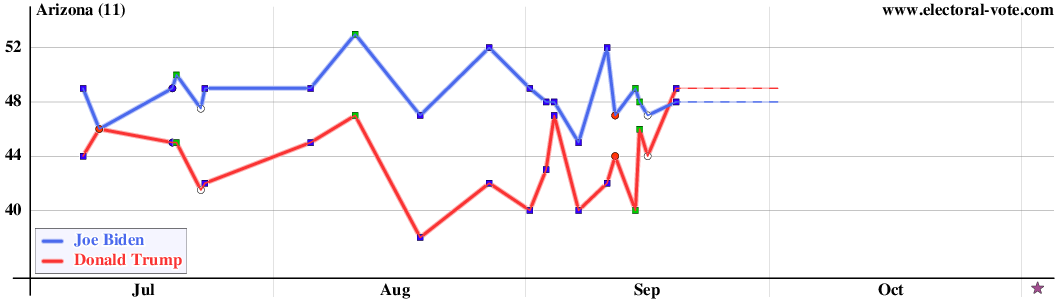
McCain's endorsement could be the cherry on top of the sundae that finishes the job. Her influence could bring in moderate independents—especially suburban women—who liked the late senator for his courage, guts, and general maverickyness. Mavericity? Maverickality? Paul Bentz, an Arizona Republican pollster, said that those women are "definitely an audience that Cindy McCain appeals to." He added that there are 300,000 swing voters in the state and having the widow of an enormously popular senator side with Biden could pull in a fair number of them.
The place were McCain could have a big influence is Mesa, AZ, a city of half a million people in Maricopa County, the state's most populous. Legislative district 25 in Mesa is representative. It has 35,000 Democrats, 62,000 Republicans, and 48,000 independents. Looks good for the Republicans, no? Maybe not. Democratic primary turnout doubled compared to 2016 and they are aggressively courting independents. What McCain can do is give the independents and some of the moderate Republicans "permission" to vote for Biden. In a tight race, that could be enough to help Biden over the finish line first. That holds not only for Mesa, but for suburbs all over the state. (V)
Money, Money, Money
Political spending this year is going to smash all records. It is projected to hit $11 billion, crushing the previous record of $6.5 billion, which was the tally for 2016. Small donors (defined as individuals giving $200 or less) will account for 22% of the donations, up from 14% in 2016. While this is well and good, it means that the big donors still rule the roost. In fact, the top 100 donors have chipped in 8% of all giving ($750 million), and this excludes the $1 billion Michael Bloomberg spent on his own short-lived campaign. Women have opened their wallets like never before, spending $1.7 billion (compared to $1.3 billion in 2016). The pandemic has affected how the money has been spent, with advertising up and travel down.
A substantial chunk of that money—at least $250 million and counting—is going to be spent on television ads in Florida between now and Election Day. If you live in Florida, this would be a good time to turn off your television until election night because all programming is going to be preempted to make room for the ads. The October ad buys for $250 million are $100 million more than in 2016. And this total doesn't reflect all of the $100 million Bloomberg has promised to spend there, since he has reserved only $30 million in time so far.
All this spending raises the question of whether this makes any sense, given that 90+% of the voters have made up their minds already. But the campaigns have more money than could fit in Scrooge McDuck's swimming pool and Florida is the mother of all swing states, so here we go.
Many of the Florida ads, both in English and Spanish, are running statewide, but some are running only in the 18-county so-called I-4 corridor that runs from Tampa to Orlando. Many of the state's swing voters live there. But neither campaign has forgotten South Florida. The two campaigns combined have already spent $33 million in the Miami media market. (V)
Today's Presidential Polls
Emerson has been pretty Trump friendly this cycle, and even they are telling him not to bother in New Hampshire. (Z)
| State | Biden | Trump | Start | End | Pollster |
| New Hampshire | 53% | 45% | Sep 30 | Oct 01 | Emerson Coll. |
Today's Senate Polls
Theresa Greenfield up by 12 points over Joni Ernst? Hard to believe. Theresa Greenfield's lead now statistically significant? Very plausible. Meanwhile, the U.S. Senate hopes of West Point graduate Corky Messner are going south. Which makes this our second directional joke of the day. (Z)
| State | Democrat | D % | Republican | R % | Start | End | Pollster |
| Iowa | Theresa Greenfield | 51% | Joni Ernst* | 39% | Sep 23 | Sep 26 | RABA Research |
| New Hampshire | Jeanne Shaheen* | 54% | Corky Messner | 41% | Sep 24 | Sep 28 | U. of New Hampshire |
| New Hampshire | Jeanne Shaheen* | 55% | Corky Messner | 40% | Sep 30 | Oct 01 | Emerson Coll. |
* Denotes incumbent
Previous | Next
Main page for smartphones
Main page for tablets and computers