
Dem
47

GOP
53

As long as we are on the subject of taking big risks, the state of Texas has officially laid its cards on the table. When talk began to circulate, a couple of weeks ago, that the Lone Star State might try to re-gerrymander its maps, we pointed out that it's a very big roll of the dice, since: (1) the Texas maps are already gerrymandered six ways to Sunday; (2) nobody really knows if the Latino break towards Republicans in 2024 was actually toward the Republican Party, or was only toward Trump; (3) it's hard to know exactly how the population has changed since the 2020 census was conducted.
Still, Gov. Greg Abbott (R-TX) & Co. are moving forward. On Wednesday, Texas Republicans released a new map designed to allow the GOP to flip five House seats from blue to red. Here it is:
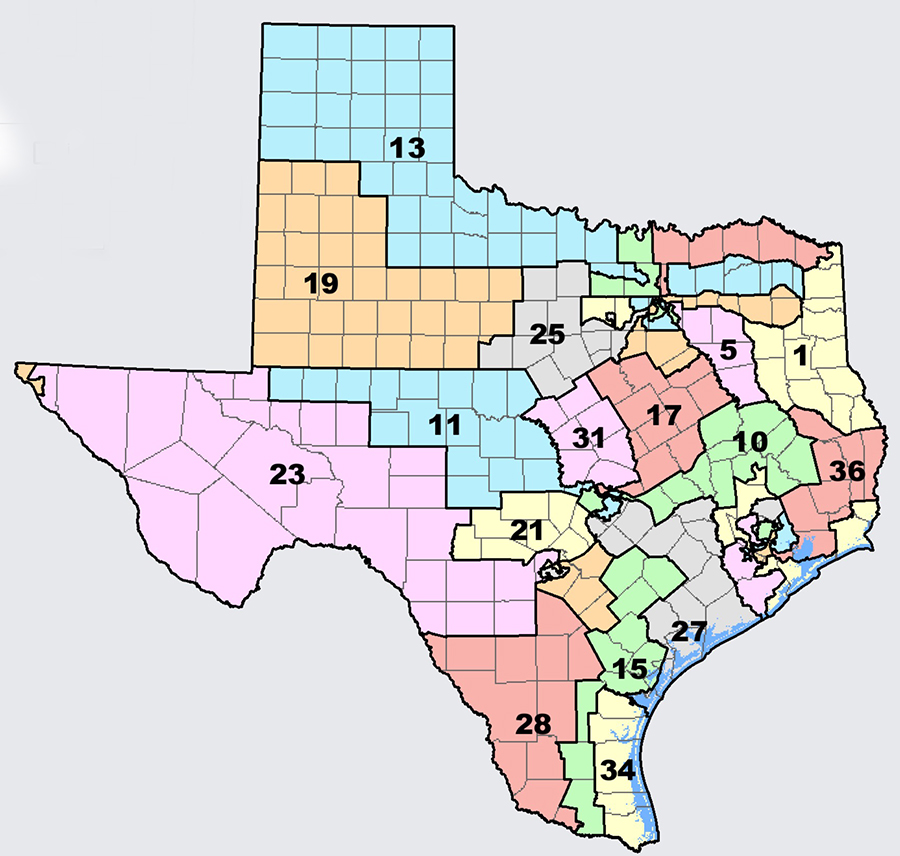
If you follow the link above, you can get a zoomable version of the map so you can see all the details if you want. Needless to say, when you get down to the street level, the new maps have very strange boundaries in some places as the mapmakers drew their maps to specifically include some precincts and exclude others. Here is a close-up of some of the mapmakers' handiwork:
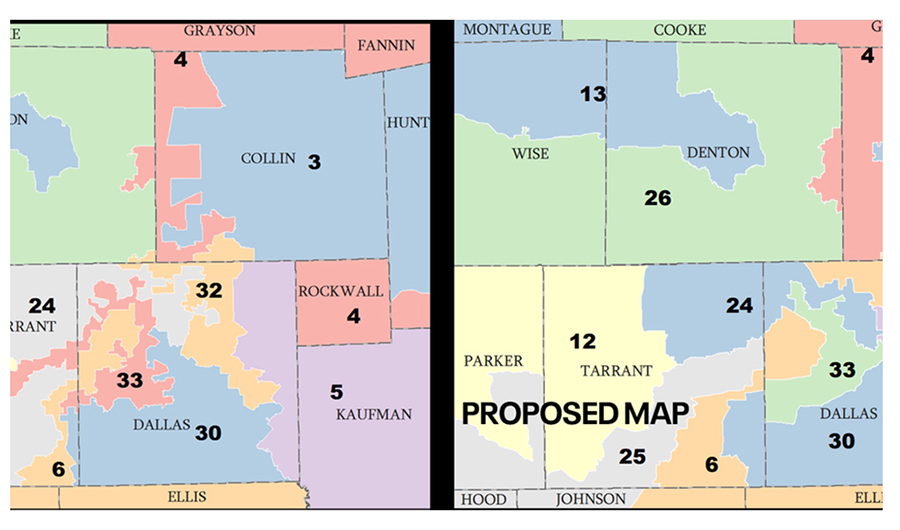
Here are the major changes:
| District | Old PVI | Incumbent | Changes |
| TX-09 | D+24 | Al Green (D) | Moves the district from South Houston to East Houston |
| TX-28 | R+2 | Henry Cuellar (D) | Removes San Antonio from the district |
| TX-32 | D+13 | Julie Johnson (D) | This Dallas area seat would include many new rural areas |
| TX-34 | EVEN | Vicente Gonzalez (D) | More Republicans packed into this Latino district |
| TX-35 | D+19 | Greg Casar (D) | It will now exclude Austin and include more of Bexar County |
Donald Trump carried all the new districts by double digits. The new map, if adopted, will set up a hotly contested primary between Democratic Reps. Lloyd Doggett and Greg Casar. Casar said: "Merging the 35th and 37th districts is an illegal voter suppression of Black and Latino Texans." The Supreme Court has ruled that while racial gerrymanders are illegal, partisan ones are hunky-dory. The map is built on the belief that Latinos have become more Republican, so it increases the number of Latino-majority districts. The Supreme Court is very unlikely to say giving Latinos more districts is an illegal racial gerrymander. The new map does not pit any Republican against another Republican.
Democratic voters who were removed from the five districts were stuffed in districts that were already very blue, on the theory that changing a D+30 district into a D+40 district won't hurt the Republicans at all. The current Texas congressional delegation is 25R, 13D.The new one could be 30R, 8D, if everything goes right.
But everything might not go right. As we have noted, when Democrats are removed from targeted districts they have to go somewhere. If they are stuffed into already blue districts, those districts will have to lose voters and they have to go somewhere, too. The net result is that some Republican districts will have to be watered down and, in a blue wave, Republican incumbents could lose their seats. Larry Sabato's Crystal Ball has already analyzed the new map. If every precinct votes in 2026 as it did in 2024, the Republicans would indeed win 30 seats. However, if every precinct voted as it did in the 2018 midterms—which was not a good year for Republicans—Republicans would win only 26 seats. Sabato also concluded that even in a blue wave, there is no practical way for Republicans to come out with fewer than the 25 seats they have now, and they have a very good shot at 26. There are also eight safe Democratic districts. This means that only four districts are at all competitive. These are mostly Latino-majority districts and how they go depends on whether Trump's gains with Latinos in 2024 stick.
There will be a committee meeting today to mark up the new map. If all the Democrats on the committee flee the state, they could hold up the process. They will be fined $500/day for not showing up for work, but they can't stay out of state indefinitely. The map could be changed a bit, but the Republicans feel that they have managed to keep their incumbents pretty safe. But again, the map presumes that each precinct will vote in 2026 as it did in 2024. If turnout is much less in 2026, especially among marginal voters who came out to vote specifically for Trump, there could be surprises.
Incidentally, Larry Sabato's Crystal Ball is not the only analysis out there. Sam Wang, of the Princeton Gerrymandering Project, produced an analysis before the new map was unveiled. He says that, under the right circumstances, as much as a dozen Republican-held seats could be put at risk. And a new poll from the DCCC finds that Texans overwhelmingly dislike the gerrymander plans, and that this could make Democrats more motivated to get out and vote. The point here is that there are many X-factors that are hard to predict, and that small changes in assumptions result in big differences in outcomes.
The Ohio legislature is also working on redrawing its map. The current delegation is 10R, 5D. There are two Democratic districts that are R+3 and D+3, respectively, that the Republicans could try to grab. Together these two gerrymanders could give the Republicans 7 new seats, although with the same footnote that, in a blue wave, some Republicans in formerly safe districts could drown.
There are a couple of other Republican-led states that are making some early noise about gerrymandering. Gov. Ron DeSantis (R-FL), who still sees a future for himself in national politics, has suggested he might try to squeeze another GOP seat or two out of his state. Florida, with its 20R, 8D delegation, is already more gerrymandered than Texas, and so would be assuming an even greater risk. Meanwhile, under pressure from the White House, there is also some discussion in Missouri about redrawing that state's maps. The problem is that the state's House delegation is already 6R, 2D, and very blue St. Louis (which is mostly located in MO-01) and very blue Kansas City (which is mostly located in MO-05) are on opposite sides of the state. So, it would not be easy to create just one Democratic district.
From the standpoint of a healthy democracy, the Republicans' maneuvering is very bad. As a country, the U.S. already does too much to quiet the voices of both the minority and minorities. Gerrymandering makes those problems even worse, and enables a situation where a state's House delegation is 20% or 30% or 40% more partisan than its electorate. From a tactical standpoint, however, the Republicans' thinking is fairly sound (certainly, more sound than Trump's tariff policy; see above). If the 2026 electorate is very similar to the 2024 electorate, then the Republicans would probably end up keeping the House, anyhow. If 2026 sees a mild blue wave, then securing a few extra seats could be just enough for Mike Johnson (R-LA) to keep his speaker's gavel. And if it's a big blue wave, up to and including a blue tsunami, then the Republicans will lose the House, gerrymander or no. And, as the last few years have shown, there isn't a whole lot of difference between being in the minority by a couple of seats, and being in the minority by 20 or 30 seats. So, there's something to be said, from a tactical standpoint, for squeezing the maps for all they're worth. (V & Z)