
Previous | Next | Senate races | Menu
New polls:
Dem pickups: (None)
GOP pickups: (None)
We're back. You are free to criticize anything we write, but keep it civil, give your arguments why we are wrong, and no name-calling.
Also we thank the many readers—and the number is well into the thousands—who took the time to send messages of encouragement and support. They were much appreciated!
Are We at War or Not at War?
In case you swore off news until we were back on the air, Donald Trump demonstrated that his bomb is bigger than everyone else's bomb by ordering the destruction of Iran's two uranium enrichment sites, Fordo (sometimes spelled Fordow) and Natanz (and a third site, Isfahan). Here they are on the map:
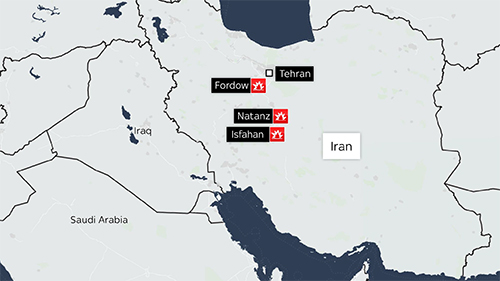
The bombings occurred at 2:30 a.m. Iran time Sunday morning. If Trump followed the chain of command, he would have given the order to Secretary of Defense Pete Hegseth, who probably said he was too busy rooting out trans people in the military to deal with things like wars. Besides, what the hell is a GBU-57 and what do they cost on Amazon? The GBU-57 bomb is nicknamed the MOP (Massive Ordnance Penetrator). If Hegseth was indeed indisposed, for whatever reason, then Trump would have bypassed him and given the order to the Chairman of the Joint Chiefs, Dan Caine. If you are interested in how the bomb works, here is a description in six easy steps.
In news stories, you will read all about centrifuges. What is a centrifuge? Here is the story in brief. Atomic bombs (the easiest nuclear weapons to build) use uranium-235 as the main explosive. U-235 is fissile—that is, it can cause a chain reaction when the nucleus is split and the neutrons emitted hit other nuclei and cause them to split, and so on. Each time a uranium atom splits, it gives off energy. It adds up. Fortunately, over 99% of natural uranium is uranium-238, which has 92 protons, just like uranium-235, but three more neutrons. Uranium-238 is not fissile and can't be used in bombs, so the uranium-235 has to be separated out. This is done by converting the uranium to a gas, uranium hexafluoride, and pumping it into a gas centrifuge, which uses centrifugal force to separate the isotopes based on the microscopic weight difference. The output, a gas with a slightly higher percentage of U-235, is pumped into another centrifuge and then another and another and another until the gas is 90% U-235. The details are classified because the Pentagon doesn't want high school kids building them as science fair projects. The bombed site at Isfahan converts yellowcake uranium ore to uranium hexafluoride gas by mixing the ore with hydrofluoric acid. The resulting uranium hexafluoride gas is then transported to Natanz and Fordo for enrichment using the centrifuges. The Natanz facility also builds the centrifuges. Depending on how good they are, the cascade of centrifuges might have hundreds or even thousands of centrifuges, like these at Oak Ridge National Laboratory:

Iran knew (or, at least, highly suspected) this was coming and may have taken preventive action to minimize the damage. Personnel could have been evacuated and fissile material may have been squirreled away under Ayatollah Ali Khamenei's bed for safekeeping. Moving the centrifuges to a safe location might have been doable if the moving project started early enough. They are individually not that large. We don't know if they were destroyed and neither side is likely to begin telling what they actually know. But even if they were all destroyed, there is a shortcut the Iranians could use to get up to speed (no pun intended): Buy enriched uranium from North Korea.
After the attacks had been completed, Trump gave a brief speech announcing that they were completely successful and Iran's nuclear facilities were obliterated. It was a very unusual speech. Half the speech was devoted to thanking other people! He specifically mentioned Israeli Prime Minister Benjamin Netanyahu, the Israeli military, the U.S. pilots who flew the B2 bombers that delivered the GBU-57s right on target, other U.S. military personnel involved in the mission, Dan "Raisin'" Caine, and God. Hegseth was not mentioned. He probably wasn't even in the loop because Caine really didn't want this one broadcast to the world in advance on Signal.
Trump also warned Iran that it had better make peace now or there would be more bombings, and the remaining ones are much softer targets than Fordo and Natanz, which are buried hundreds of feet under mountains. He didn't mention Joe Biden or the 2020 elections. The speech was the kind any president could have given—short, direct, and to the point. It was probably written by a professional speechwriter and edited by J.D. Vance or Secretary of State Marco Rubio and read off a teleprompter. Here it is. It is only 3½ minutes and worth watching simply because it is so out of character for Trump:
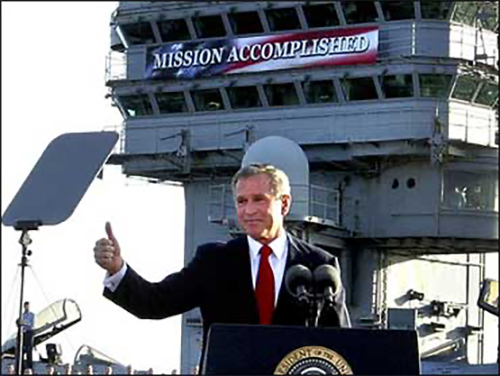
What Trump forgot to do was give George W. Bush a call to ask if he could borrow George's "Mission Accomplished" banner. He might also have asked how well that worked, especially the part about U.S. troops remaining in Iraq for 8 years after the speech and the 4,400 American deaths that resulted from the occupation:
While some countries have condemned Trump, it is also true that last week the International Atomic Energy Agency passed a resolution stating that Iran had breached its nonproliferation agreement and was stockpiling enriched uranium. The director, Rafael Grossi, said: "I've been there, it's half a mile underground."
Yesterday morning, Hegseth and Caine gave a joint press conference at the Pentagon. They tried to issue two contradictory messages at the same time. To Iran, the message was: We have nearly unlimited military power and if you don't do what President Trump orders you to do, we will continue the bombings until you submit to his power. To the MAGA base (which hates foreign wars), the message was: This was a one-shot deal. One and done. War over. We won. They have to hope that each recipient receives the correct message.
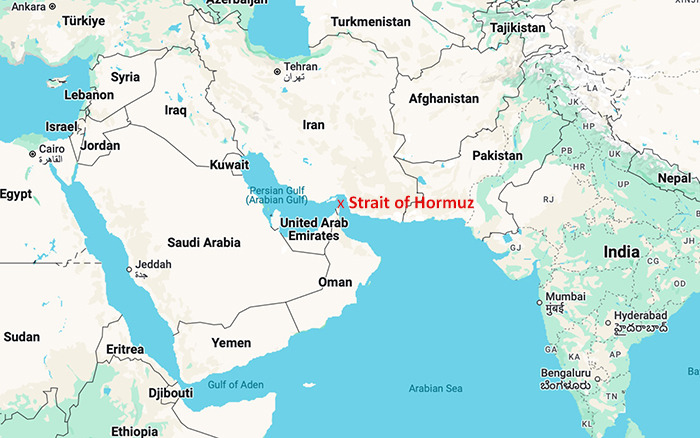
One action Iran has already taken is starting to close the Strait of Hormuz, through which much of the world's oil flows. The Parliament voted to close it, but the Supreme National Security Council must approve the decision. If it does, that could cause the price of oil to skyrocket, especially in Asia. It could also lead to worldwide inflation. On the other hand, it would also wreck the Iranian economy, so the Council might reject the law. To save you the trouble of cranking up Google maps to see where the strait of Hormuz is, here it is. It is 62 miles wide. We are a full-service website:
What else Iran will do is unknown. Probably also applies to the Iranian government. Agreeing to full denuclearization with armed inspectors would be humiliating. But not agreeing could lead to more attacks and destabilize the country. One factor it has to consider is that none of Iran's nominal allies, especially Russia and China, have done anything other than issue routine condemnations of the U.S. Whether they would come to Iran's aid in the event of a real war is far from certain. On the other hand, Saudi Arabia simply expressed "concern" about the situation. Maybe the Kingdom hired Sen. Susan Collins (R-ME) as an emergency consultant.
Here is a brief summary of the reactions from the leaders of several other countries/groups:
- China: The parties concerned should implement a cease fire.
- E.U.: Iran must not be allowed to develop nuclear weapons.
- Egypt: It would be better to return to negotiations.
- Hamas: Muslim nations should join a jihad against the Zionist-American arrogance.
- Iraq: The escalation created a grave threat to peace.
- Ireland: We are now entering a moment of particular danger and the international community could lose control.
- Italy: Iran's nuclear facilities represented a danger to the entire area.
- Japan: Iranian nuclear weapons must be prevented.
- Lebanon: The bombing could lead to a regional conflict.
- Mexico: We need an urgent call for peace.
- Pakistan: The government called the strikes "deeply disturbing"—just days after nominating Trump for the Nobel Peace Prize.
- Qatar: It regrets the increased tensions in the region.
- Russia: The airstrikes are a gross violation of international law.
- U.K.: Iran's nuclear program posed a grave threat and the U.S. has helped alleviate that threat.
- Vatican: The situation in Iran is alarming and the tragedy of war must be stopped.
- Venezuela: The attacks are illegal and unjustified.
Chinese leaders are probably struggling to interpret the attack. They have always wondered what Trump would do if China attempted to take over Taiwan by military force. Would they be treated to some TACO? There are surely voices in Beijing now saying there is also a chance he would take action to defend Taiwan.
It is much too early to judge what the political impact will be. Will there be more bombings? Will Iran retaliate by killing Americans or taking them hostage and if so, how will Trump react? By now he is probably cursing himself for not having nominated an actual Secretary of Defense rather than someone attempting to play one on television and not even being a good actor.
A huge factor is whether the strikes actually destroyed the centrifuges. If they did, it was a military victory and Trump will get credit. If the centrifuges were either hidden off site or too deep to be affected, Trump will look like a fool for appointing clowns as DNI and Secretary of Defense. The CIA may not know what really happened for a long time and the public may never know—unless Iran manages to test a nuclear device.
Another big factor is how Iran tries to retaliate and whether the retaliation can be repelled. If some Americans are taken hostage and then tortured to death on camera, many Americans will be asking: "Was it worth it?" If the U.S. now becomes embroiled in a war in the Middle East, those people who voted for Trump because he promised to avoid foreign wars aren't going to be pleased, especially if American soldiers come home in coffins. Although recent polling showed that Americans did not want Trump to bomb Iran—45% against bombing, 25% for bombing, 30% unsure—after a military victory, there is always a rally-round-the-flag effect. But this show has just started. We know how Act I ended, but we have no idea what will be in Act II. Will Iran now negotiate in good faith to avoid more bombings or will it focus on retaliation, and if so, how, and how will that drive public opinion?
Some Democrats are already complaining. Sen. Mark Warner (D-VA), the ranking member of the Senate Intelligence Committee, said Trump acted "without consulting Congress, without a clear strategy, without regard to the consistent conclusions of the intelligence community" that Iran had made no decision to take the final steps to a bomb. If Trump started a war without congressional authorization, that would surely be grounds for impeachment. Congress, not the president, has the exclusive power to declare war. The commander-in-chief gets to run the war, but only after Congress has declared it.
On the other hand, Republican leaders in Congress were quick to praise Trump for his decisiveness. Speaker Mike Johnson (R-LA) said Trump's decision to attack Iran should serve as a reminder that Trump "means what he says" (except for the hundreds of times when he doesn't). In fact, not even this time, since he said he would give Iran 2 weeks to come to the negotiating table and then attacked the next day. Senate Majority Leader John Thune (R-SD) blamed the attacks on Iran. He said: "The regime in Iran, which has committed itself to bringing death to America and wiping Israel off the map, has rejected all diplomatic pathways to peace."
Nevertheless, not all Republicans were on board the S.S. Midnight Hammer. Rep. Marjorie Taylor Greene (R-GA) tweeted: "Israel is a nuclear armed nation. This is not our fight." Rep. Thomas Massie (R-KY) tweeted: "This is not constitutional."
It is probably not lost on Trump that some of the domestic actions he has taken are based on laws that give the president emergency powers during times of war. If the action he took in Iran leads to an actual (possibly after-the-fact) declared war, his domestic actions will have a more solid legal basis. Of course using a war in Iran to deport Mexicans to El Salvador is not exactly what Congress had in mind when writing laws giving the president special emergency powers during wartime. Congress undoubtedly was expecting the president to use the emergency powers to help win the war. Having soldiers tied up occupying American cities is not going to help win a war with Iran. (V)
Trump Will Get Big Win from Europe, But the U.S. May Be the Loser
Leaders of the 32 countries in NATO will meet in The Hague Tuesday and Wednesday to address the challenges facing the organization. The biggest challenge is preventing Donald Trump from destroying an entity that has kept the peace in Europe for three-quarters of a century. It was formed in 1949 to make it more difficult for Russia to invade any member country, knowing that the other members would come to its rescue. Trump has no interest in rescuing any other countries and has no problem with Russia conquering any countries Vladimir Putin chooses to conquer.
NATO Secretary General Mark Rutte, who was prime minister of the Netherlands for an unprecedented 14 years, knows a thing or two about politics, including American politics. In particular, he knows that while Trump cares nothing at all about other countries (and almost nothing about the United States), he cares very much about getting wins. So Rutte has quietly lobbied all the members to arrange a big win for Trump so he can come home and brag about it and dream of getting the Nobel Peace Prize.
What Trump wants is for other members to pay their fair share, however that might be understood, of the costs of preparing to defend each other. He has a legitimate point there. After World War II, no European country was in any shape to have a large defense budget, so the U.S. shouldered most of the cost. Of course, the U.S. had a huge strategic interest in doing so. There was a real risk that Russia might conquer all of Europe and a whole series of presidents, from Harry Truman, Dwight Eisenhower, and Jack Kennedy onward, wanted to prevent an increase in Russian power at all costs. Now European economies can tolerate much larger defense budgets and what Trump wants is that they do that. What Rutte is doing behind the scenes is to get all the non-US members to pledge to spend 3.5% of their GDP on direct military expenditures and another 1.5% on indirect military expenditures, like infrastructure that is useful to the military (e.g., upgraded airports and harbors). A sticking point is when this goal needs to be achieved. Among other things, Rutte's plan calls for a 400% increase in air and missile defense, thousands more tanks, millions more artillery shells, and much more. Rutte's goal is to present this plan to Trump and tell him that it was achieved on account of Trump's military and political brilliance. It could work. Baseless flattery is more important with Trump than a dozen F-35 fighter jets.
What Trump doesn't realize, but all the European leaders do, is that if Europe rearms itself in a major way, the E.U. will have much more sway in NATO and the U.S. won't be able to call the shots so easily. In the long run, it may make Europe into a major world military power, independent of the U.S. That is not necessarily in the best interests of the U.S.
But there is more. Ramping up defense spending without imposing new taxes will require cutting social spending. That will be very unpopular. One way to soothe the pain will be to spend all or most of the new defense budget in Europe, which will create good-paying jobs. Many working-class Europeans would be quite happy to have a good unionized job in a defense plant building jet fighters or tanks. German Leopard tanks are top-notch. BAE, a British company, is good at shipbuilding, submarine construction, and electronic warfare. Major parts for the Eurofighter Typhoon fighter jet are made in the U.K., Germany, Italy, and Spain. Giving fat contracts to these and other defense companies means many fewer contracts for Lockheed Martin, RTX (formerly Raytheon), General Dynamics, Northrup Grumman, Boeing, and other U.S. defense contractors. That will cost jobs in the U.S. Trump is probably not even aware of this and, in any event, the effects will not be felt until well after the midterm elections. (V)
Trump Doesn't Trust Gabbard
Donald Trump picked Tulsi Gabbard (whose views on U.S. foreign policies mirror Vladimir Putin's so much that some people, including Hillary Clinton, believe she is at best a "useful idiot" and at worst a Russian asset) as DNI. Now his decision is coming back to bite him in the rear end.
He desperately needed to know how far along Iran is in building a nuclear bomb since that could determine whether to take out Iran's nuclear facility buried deep in a mountain in Fordo, Iran, 100 miles south of Tehran. But Trump actually knows that he can't trust her. His nomination was undoubtedly intended as a show of dominance to force all the Republican senators to vote for a nominee they all very well knew was completely unfit for the job. Now he is stuck with a DNI who is incompetent and possibly not even loyal to the United States and who he can't trust with a possible war on the horizon.
What must be especially galling for Gabbard is that he has now dismissed her assessments of Iran's nuclear capability in public—twice. First, he said: "She's wrong." Then he said: "I don't care what she says." He is especially upset with her for posting a video blaming the "political elite and warmongers" for the conflict in Iran. This is a straightforward Russian talking point. Here is an excerpt from her video. The "warmongers" comment is at the 0:25 mark:
In effect, Gabbard is blaming Trump for the war between Israel and Iran. He has to hope the Nobel Peace Prize Committee doesn't see the video. He was not amused.
Trump spoke to Gabbard and told her to her face that he believed that she was using her position to set herself up for higher office and that if she wanted to be president, she should not be in his administration. Did he follow up with the phase he used on his reality TV show: "You're fired!"? Nope. TACO time in the Oval Office. However, Trump is spending more time talking to CIA Director John Ratcliffe, who is an intelligence professional and was DNI in Trump v1.0. If Trump had any guts, he would have already dumped Gabbard and replaced her with Ratcliffe. Or, failing that, Bozo the Clown. Either would be an upgrade, at this point. (V)
It's Almost July 4th
Speaker Mike Johnson said he was going to pass Donald Trump's One Big Beautiful Bill by July 4th. That now seems increasingly unlikely. What's the next holiday that could be the deadline? Labor Day celebrates workers and the law making it a federal holiday was signed by a Democrat, Grover Cleveland, so that's no good (although, in Cleveland's favor, he was the only other president to serve two nonconsecutive terms). Given all the scary things the administration is doing, how about Halloween? Plan B could be Veterans Day, although the evangelicals might prefer Christmas.
The latest hangup is an obscure, but crucial, provision in the bill that deals with Medicaid reimbursement rates. It limits what health insurance companies pay states who contract with them to provide Medicaid coverage. The CBO says the bill will take $1 trillion out of government payments for health care. Some of the cuts are to Medicaid while others are to the Affordable Care Act. In all, $1 trillion less money coming into hospitals is serious money. The projection is that the bill will cause 11 million people to lose health care coverage. It will also raise out-of-pocket costs for millions of others. If these people discover this before Nov. 2026, they might make their feelings known at the polls.
Rural hospitals get much of their revenue from Medicaid. These cuts will force some of them to shut down nonemergency services, like pregnancy care. Other rural hospitals may simply no longer be able to make a go of it and will close altogether. This also affects rich people: If you have a heart attack and the nearest hospital is 100 miles away, and it is snowing, well, good luck. Estimates show that as many Republicans as Democrats will be hurt by the cuts. Donald Trump's pollster told him that the bill will hurt his supporters and he has opposed the cuts, but the bill seems to have a life of its own, and the cuts are needed to make the tax cuts for millionaires and billionaires possible.
An additional problem is that Senate Parliamentarian Elizabeth MacDonough has ruled that multiple provisions in the bill drowned in the Byrd bath and have to be buried. In particular, the proposals for killing the CFPB, slashing Fed employees' salaries, eliminating the Treasury Department's Office of Financial Research, and killing off the Public Company Accounting Oversight Board are not primarily budget related and can't be put in a reconciliation bill. They need to be put in a normal bill, which can be filibustered. This will require Sen. Tim Scott (R-SC), who is chairman of the Senate Banking Committee, to go back to the drawing board. Unless he can find $1 billion to cut quick like a bunny, this could delay passage.
Oh, MacDonough has also ruled that a provision that limits the way judges deal with people who thumb their noses at court orders has nothing to do with the budget and must go.
Another thing MacDonough ruled ineligible to be in a reconciliation bill is the Republicans' plan to shift some of the cost of SNAP (food stamps) to the states. She said that is a policy decision, not a budget decision, and has to be done via the regular order.
Another problem for the bill is Sen. Josh Hawley (R-MO). He is a strong opponent of the massive cuts to Medicaid, probably because someone has told him that it threatens constituents in his largely rural state. He wants to reduce the cuts, but then the math doesn't work. In short, the bill is still in limbo. (V)
New York City Primary Is Tomorrow
The Democratic Party primary for the nomination for mayor of New York City is tomorrow. Many people are lamenting that the field of candidates is weak and the ranked-choice voting will be about finding the five least-bad candidates. The second- and third-choice of losing candidates could end up deciding who wins.
The Democrats nominated moderate suburban women to run for governor in New Jersey and Virginia, but no Mikie Sherrill or Abigail Spanberger is on the ballot tomorrow.
The weather could also play a role, since it is expected to be very hot tomorrow. And, as usual, turnout is always a big issue in June elections, with Andrew Cuomo's union supporters facing off against Zohran Mamdani's volunteers. It's a complicated, unpredictable race.
First, who are the main candidates? Here is the list:
- Andrew Cuomo (67): The former governor of New York State who resigned in disgrace after
more than a dozen women credibly accused him of sexual harassment is trying for a comeback. On the plus side, he can
claim (sometimes deservedly, sometimes not) many accomplishments as governor, from laws legalizing same-sex marriage and
marijuana, to building the Second Avenue subway and rebuilding LaGuardia Airport. His pitch is that he is a mean S.O.B.
and will stand up to Donald Trump like no one else. In fact, he wants Trump's job. He is also calling Mamdani an
antisemite for his repeated attacks on the Israeli government. Many people in the City hate Cuomo for various reasons,
but he is nominally the favorite. His final pitch is that like him or hate him, he is the only candidate actually capable of
running a city as big, complicated, and fractious as NYC. After all, he once ran the entire state.
- Zohran Mamdani (33): A 33-year-old left-wing state assemblyman and Palestinian activist
with no executive experience wants to run the most fractious and complicated city on earth and manage a $112 billion
budget. He wants to raise taxes on the rich and build affordable housing. On Oct. 8, 2023, the day after the Hamas
attack on Israel, Mamdani
blamed
the Israeli government for it and said nothing about Hamas. Most Jewish groups in the city strongly oppose Mamdani. His
final pitch is that Cuomo is an a**hole.
- Brad Lander (55): A competent, friendly, but not exciting progressive technocrat who is
the city comptroller and wants a promotion. His daughter calls him "Dad Lander." It fits. He calls himself a pragmatic
progressive. He wants to end homelessness for people with mental illness. At least he is good with nine-digit numbers.
- Adrienne Adams (64): She is a Black woman and speaker of the city council. She would be
the first female mayor, but not the first Black one. She has emphasized her experience, knowledge of the budget, and
ability to work with the council she now leads.
- Scott Stringer (65): He was formerly city comptroller, so he also understands the budget
well. He ran for mayor in 2021 but his campaign was derailed by allegations of sexual misconduct.
- Michael Blake (42): As a former state assemblyman from the Bronx with no real base, he
is not going to win, but his voters' second choices could matter. His focus is on affordability. He is Black.
- Zellnor Myrie (38): Another pointless candidate here. He is a state senator from
Brooklyn with no real executive experience. He is also Black. He has proposed creating a million homes.
- Whitney Tilson (58): A former hedge fund executive. On the face of it, he is a terrible fit for the city, but Michael Bloomberg was also a rich, older white guy and was an effective and popular mayor. Tilson's thing is building more charter schools, probably not concern #1 for most people.
As if ranked-choice voting weren't complicated enough, New York law makes it possible for Cuomo or Mamdani to get on the November ballot as the candidate of some third parties or even as independents, as Mayor Eric Adams is doing.
According to recent polling, it's between Cuomo, the mean a**hole, and Mamdani, the Palestinian activist who has no executive experience. It reminds some Democrats of the situation last July where the nominee was going to be either a kindly old man well beyond his best-by date or a Black woman few people knew much about. Is this the best the Democratic Party can do? Part of the problem is that the top elected officials in New York State, Gov. Kathy Hochul (D-NY), Sen. Chuck Schumer (D-NY), and Sen. Kirsten Gillibrand (D-NY), all despise Cuomo and probably are secretly praying that it isn't Mamdani, but didn't rally around an alternative (with Lander, the friendly, competent technocrat the obvious choice). Organized labor is partly for Cuomo (because he created a lot of jobs with all his infrastructure projects as governor) but partly also on the sidelines. The New York Times editorial page imitated a TACO. Some people are wishing that New York AG Letitia James had run, but she decided to stay in state politics and will undoubtedly run for governor eventually.
The dynamic of a youthful insurgent powered by young voters against a grizzled veteran, possibly with some baggage, is likely to play out many times within the Democratic Party in the years ahead. However, there is a difference between executive positions and legislative positions. Rep. Alexandria Ocasio-Cortez (D-NY) is great at giving speeches and wowing crowds, but as a member of Congress she knows which way to vote and the rest is icing on the cake. For mayor or governor, you actually have to make difficult decisions every day, especially about where to spend scarce funds. How much to spend on education and how much on housing is definitely not a no-brainer. In the best of all possible worlds, the Democrats will pick grizzled veterans for executive positions and inspirational young people for legislative ones. In the worst of all possible worlds, it will be the reverse. (V)
Trump Administration ICE Continues Campaign of Dirty Tricks
The arrest of New York Comptroller and mayoral candidate Brad Lander made headlines last Tuesday, as Donald Trump's ICE makes attacks on more public officials. But even more importantly, it has shone a light on a reprehensible practice coordinated between the ICE Office of the Principal Legal Advisor and ICE Enforcement and Removal Operations to cancel INA (Immigration and Nationality Act) proceedings in order to snatch up unsuspecting noncitizens appearing in court.
The individuals being targeted are people who entered the United States the "right" way. They presented themselves to border patrol officers at a port of entry, filled out the form requesting asylum, and were allowed into the country to await a hearing to determine whether they can remain in the U.S. Most often they are seeking asylum to escape persecution in their home country. They are given a Notice to Appear with the date and location of the hearing before an immigration judge. When they arrive for their hearing, however, they find that ICE's Office of the Principal Legal Advisor has moved to dismiss their case, which seemingly means that they are free to go and remain in the country. But, in fact, it's a trick. Dismissal of the regular proceeding means that ICE can now put that person in expedited removal (ER), which is a fast-track to deportation. (Although the expansion of ER is also legally dubious.) Unless the person knows to oppose the motion to dismiss or appeal the dismissal if it's granted, they can be detained pending the ER process. And unless they know how to navigate the ER process by requesting what's called a "credible fear interview," they will find themselves quickly deported, as ER affords few rights to noncitizens.
In other words, ICE is now showing up to immigration court to lie in wait for people whose cases the government is dismissing for the sole purpose of eliminating their rights, so ICE can immediately pick them up. Again, these are folks who followed all the rules and who Trump and his MAGA acolytes promised they weren't targeting. But it's all about the numbers. Trump has ordered ICE to make 3,000 arrests/day. ICE officers have quotas and don't care who they are arresting and often don't know who they are arresting, as they've already swept up a number of U.S. citizens. Morale at ICE and CBP is at an all-time low and the agencies are having difficulty filling vacant positions—go figure.
This new bait-and-switch tactic was engineered by Benjamin Huffman, who was acting DHS secretary at the time. His memo guides this new behavior and is being challenged in court by several nonprofit organizations. "Our nation has watched in horror as immigrants—all of whom are doing exactly what the government has asked of them—are being placed in a legal Catch-22 where they must appear in court, but when they do, ICE is waiting outside the door. This is morally reprehensible and, for our clients' members, unlawful," said Hillary Li, counsel for Justice Action Center, which represents the nonprofits. "We filed an amended complaint and motion today to ensure that the court has a full understanding of the urgency of the situation at hand."
This behavior will only serve to drive people who had been following the law underground and will force them to fail to appear. This will further destabilize an already-broken system. Further, polls show that these tactics are very unpopular with the American public, including people who voted for Trump. Once again, he chooses a chainsaw when a scalpel would be much more effective.
There is some good news on this front, however. It turns out there is a work-around. A group of students out of USC, working with the Agents of Change Civil Rights Advocacy Initiative, have set up a hotline to help people fill out requests to move their immigration hearing online. The hotline has been live for about a week and they've already received thousands of calls. The volunteers staffing the hotline, who provide services in English and Spanish, are doing their best to keep up with the demand. These requests are routinely granted thus saving the immigrants a trip to the courthouse and possibly detention by ICE. (L)
Previous | Next
Main page for smartphones