
Previous | Next | Senate races | Menu
New polls:
Dem pickups: (None)
GOP pickups: (None)
Megabill May Come up for a Vote in the Senate Today
Late Saturday evening, the Senate voted to advance the giant MAGAbill to a floor vote, which will probably take place today. It was an almost-party-line vote of 51-49. The vote had to be kept open for 3 hours to allow for last-minute sausage making. For example, Sen. Ron Johnson (R-WI) threatened to vote "no" unless the bill was changed to make it harder for able-bodied adults to get Medicaid. Senate Majority Leader John Thune (R-SD) gave Johnson what he wanted and Johnson flipped his vote.
All Democrats voted "no" and so did Sens. Rand Paul (R-KY) and Thom Tillis (R-NC). Paul is against everything and Tillis is worried that his state will lose $38 billion in funding and many rural hospitals will close. Trump threatened Tillis with his support for a primary opponent next year, but Tillis surprised him and everyone else by announcing that he will retire at the end of his term (see below). Consequently, Tillis is now free to vote what his constituents want when the actual bill comes up for a floor vote.
If Paul and Tillis stick to their guns, then two female senators will suddenly have an immense amount of power. These are Sens. Susan Collins (R-ME) and Lisa Murkowski (R-AK). Collins is up next year and is polling badly (see below). Murkowski is not up next year, but is making noises about becoming an independent and caucusing with the Democrats. At the very least, if the two of them get together and threaten "no" votes, they could arrange for their states to get more pork than Iowa produces in a decade.
Another potential problem is Elon Musk, who is shooting from the sidelines. He is all over eX-Twitter tweeting how the bill will cost millions of jobs and cause immense harm to the country. He has millions of followers, but do they actually believe him anymore? We don't know.
Another stalling tactic is that in principle, all bills must be read aloud in the Senate chamber unless there is unanimous consent to skip the reading. Usually there is, but Minority Leader Chuck Schumer (D-NY) withheld his consent, forcing the Senate clerks to read the 940-page bill out loud. That took 16 hours, and wrapped up late last night. Schumer said that Americans are entitled to know what is in the bill: tax breaks for billionaires, while ordinary families lose health care and food assistance.
Now that the bill has been read, each party will get 10 hours to talk about it on the floor. The Republicans might just decide not to use their time since nobody will be paying attention anyway. Then comes the vote-a-rama. Democrats will introduce a barrage of amendments. None of them will pass, but it will waste a lot of time during which they can try to get public opinion to back them and have people contact their senators.
Once the bill passes, possibly with amendments to placate recalcitrant Republican senators, the Republicans have another problem. Either the House must swallow the bill whole, which seems unlikely to us, or there will have to be a conference committee formed and they will have to thrash out a single compromise bill. It matters a lot who is on the committee. For example, if one Freedom Caucus member is on it, he could gum up the works. But if no FCer is on it, the resulting bill could go down to defeat in the House. Similarly if the SALT cap is greatly reduced by the Senate, House moderates from New York and California could vote no in the end to force changes they want.
Bad as the bill may be, it could have been worse. The Senate Parliamentarian has gone through the bill and said that many provisions failed the Byrd bath and have to be removed. Among her cuts are these:
- Many changes to Medicaid that are not budget related
- A plan to give a tax credit to parents sending their children to private schools
- A proposal to reduce federal matching for states that expanded Medicaid
- A provision to remove certain immigrants who utilize Medicaid
- A provision to ban gender-affirming care
- A provision to limit increasing the provider tax, which could decimate rural hospitals
- A provision to reduce judges' power to enforce contempt citations
- A provision selling off millions of acres of federal lands
- A provision to pass food aid costs on to states
- A proposed limitation on food aid benefits to certain citizens or lawful permanent residents
- Proposed restrictions on the ability of federal courts to issue nationwide injunctions
- A proposal for a funding cap for the Consumer Financial Protection Bureau
- A proposal to slash pay of employees at the Federal Reserve
- A proposal to slash $293 million from the Treasury Department's Office of Financial Research
- A plan to dissolve the Public Company Accounting Oversight Board
- An effort to repeal an EPA rule limiting air pollution emissions of passenger vehicles
- An item allowing project developers to bypass judicial environmental reviews if they pay a fee
- A measure deeming offshore oil projects automatically compliant with the National Environmental Policy Act
- A modified version of the REINS Act, which would increase congressional power to overturn major regulations
- A scheme to punish so-called sanctuary cities by withholding federal grants
- An increase on Federal Employees Retirement System contribution rate for certain new civil servants
- A measure seeking to extend the suspension of permanent price support authority for farmers
- A requirement forcing sale of all the electric vehicles used by the Post Office
- A change to annual geothermal lease sales and to geothermal royalties
- A proposal for a mining road in Alaska
- Authorization for the executive branch to reorganize federal agencies
- New fee for federal worker unions' use of agency resources
- Transfer of space shuttle to a nonprofit in Houston from the Smithsonian's National Air and Space Museum
In short, the sausage grinder is working at full speed now, grinding up everything in its path, and pigs are flying (well, pork is flying, anyway). We may not know for days, maybe even weeks, what is in the final bill and what compromises had to be made to get there. (V)
Thom Tillis Will Retire
Donald Trump has been pummeling Thom Tillis for weeks now about his opposition to the big MAGAbill. He has threatened Tillis with a primary over and over. Tillis decided it wasn't worth it anymore and yesterday announced that he will not run for reelection in 2026. Trump is probably happy that he cowed Tillis into submission. Makes him feel good.
There are only a couple of minor problems for Trump, though. First, since Tillis can't be primaried, he is free to vote based on what his constituents want. There is not much Trump can do to punish him. Second, holding the Senate seat next year has gotten an order of magnitude tougher. So far, former governor Roy Cooper (D) has been coy about jumping in. After all, beating a sitting senator is never easy. But now... well, winning an open seat in a swing state is much more doable. Cooper is a veteran politician. He understands that. He also understands that the amount of money that will pour into a potential campaign from out of state will be in the hundreds of millions of dollars. Finance will not be a problem.
Of course, the Republican side is completely open now. It will take a while to see who jumps in. No one was expecting this. The field could be very large and the Trumpiest candidate could win the GOP primary, possibly leading to a "candidate quality" problem for the Republicans. Obviously, we will be paying lots of attention to this race now. Also to the one in Maine. (V)
Collins Is Deeply Unpopular in Maine
New polling shows that Susan Collins has a problem. A new University of New Hampshire poll shows that only 14% of Mainers view Collins favorably, while 57% view her unfavorably. With numbers like these, she ought to be concerned. In contrast, term-limited Gov. Janet Mills (D-ME) has an approval rating of 51% while 41% of Mainers don't approve of her. Mills has not said if she plans to challenge Collins, but with numbers like these, the Democrats will move heaven and earth to get Mills to jump in and take on Collins. After all, while Collins has won statewide, so has Mills. Collins is no doubt praying that Mills stays out of it. (V)
Trump Isn't Exactly Doing a Power Grab
While it might seem that Donald Trump is doing a power grab, that isn't exactly true. The other two branches of government are handing him unlimited power on a golden platter and he is merely taking what is being graciously offered. What is actually happening is that he tries something audacious and then the other branches promptly approve what he did instead of vigorously pushing back. To wit:
- Tariffs: The Constitution specifically enumerates the powers of Congress. Art. I, Sec. 8
begins with: "The Congress shall have Power To lay and collect Taxes, Duties, Imposts and Excises, to pay the Debts and
provide for the common Defence and general Welfare of the United States..." "Imposts" is an archaic word for "tariff,"
that is, a tax on imports (and possibly exports). When Trump tried this, Congress could have immediately responded by
repealing any old laws giving the president some special powers during an emergency and passing a new law (over his
veto) saying that the president may not levy any tariffs at all and that customs inspectors are forbidden from collecting
any tariffs except in accordance with specific statutes passed by Congress. CACO here.
- War: Another power specifically granted to Congress is the power to declare war. In the
run-up to the Iran bombing, Congress could have passed a resolution reminding this president and future ones that they
have no power to attack other countries (which is an act of war) without the express permission from Congress and that doing
so is an impeachable offense. In a pinch, secret sessions of each chamber could have been called to give authorization
and have the bombing start immediately thereafter, followed by Congress making its secret action known. At the very
least, Congress could have passed a resolution condemning Trump for usurping its constitutional power, but not a peep.
- Emergency Powers: There is a very old law specifying that the president has special
powers when the country is being invaded. Congress could have clarified this by modifying the law to specify that an
"invasion" means that a hostile foreign power has sent its armed forces to U.S. territory without the
explicit permission of the president or secretary of defense. Again, the legislature just ceded the power to let the president
declare anything he wants to as an invasion in order to get emergency powers. Congress didn't have to allow this.
- National Guard: A state's national guard is normally under the control of the
governor. Again, Congress could have changed the law to make it completely explicit that the national guard is strictly
under the control of the governors and that overriding the wishes of the governor requires Congress to vote for a
national emergency. This time Congress is giving away the states' powers, rather than its own. Whatever happened to
federalism?
- Birthright Citizenship: The wording of the Fourteenth Amendment couldn't have been more clear. Sec 1. starts with: "All persons born or naturalized in the United States, and subject to the jurisdiction thereof, are citizens of the United States and of the State wherein they reside." Last week, the Supreme Court caved and instead of simply stating that Trump's citizenship XO was blatantly unconstitutional and thus invalid, it said the courts can't enforce the Constitution. It could have struck down the XO 9-0 with a biting opinion saying that the Supreme Court, not the president, gets to decide what the Constitution means. It didn't. It ceded its power to the Executive Branch. Voluntarily. Maybe in a couple of years it will decide this case on the merits. Also, maybe the next Democratic president will use this precedent to sign an XO stating that the Second Amendment applies only to the smooth-bore muzzle-loading muskets available in 1789 and Congress may regulate or ban any weapons not available in 1789 and the courts have no power to overrule this.
A paucity of profiles in courage here, all around. An imperial presidency didn't just happen. The other branches simply voluntarily gave up their powers instead of coming down hard on the Executive Branch. Clearly, the Republicans are expecting a 1000-year reich and not even thinking about what the other team might do with these expanded powers should it ever get full control of the government. (V)
Newsom Sues Fox News for $787 Million
Yup, Gov. Gavin Newsom (D-CA) is definitely running for president. He clearly believes that many of his previous lefty stances will not sit well with moderate Democrats in the 2028 primaries, so he is doing everything he can to get people to forget them and focus on other things. His most recent PR stunt is suing Fox News for $787 million, claiming that host Jesse Watters defamed him when he [Watters] said Newsom lied about a phone call between Newsom and Donald Trump. Newsom has severe dyslexia and dyscalculia (which caused him endless trouble in school), so he can be forgiven for not suing Fox for $787.5 million, the exact amount Dominion Voting Systems got Fox to fork over after Fox personnel made false and damaging claims about their voting machines.
To his credit, though, Newsom has decided to use a technique Donald Trump has used with great success: suing the media. Sometimes media outlets are willing to settle for a smaller amount rather than have the story be in the news for months or years. Newsom has even admitted the Dominion connection, despite getting the amount wrong. He said: "If Fox News wants to lie to the American people on Donald Trump's behalf, it should face consequences—just like it did in the Dominion case." Fair enough.
If Fox fights back, Newsom will probably lose. The courts have ruled that public figures like Newsom have to expect a fair amount of incoming fire. They can win a defamation case only if the defamer knew that he or she was lying and lied anyway. That is a tough thing to prove in court. In the Dominion case, it was different. Dominion is a private company that makes voting equipment. It is not a public figure. It is an ordinary business trying to make money by selling a product. It doesn't have to meet the much-higher standard that a public figure like Newsom does.
But Newsom isn't trying to win this in actual court, only in the court of public opinion. Democrats are so desperate for someone who will stand up to Trump, the Republicans, and the right-wing media ecosystem that many blue teamers are sure to applaud him for at least trying. Winning their sympathies (and votes) in 2028 is clearly what he is aiming for. Besides, there is an off chance that Fox might offer to settle for a much smaller amount, as ABC did. Expect more stunts from Newsom between now and 2028. (V)
Another Test of Youth vs. the Establishment
People are reading a lot into Zohran Mamdani's win in the Democratic NYC mayoral primary. But a young socialist beating a widely hated sleazebag is not, by itself, a national trend. Another test case will take place in Arizona on July 15. This time the establishment candidate doesn't have a lot of baggage that turns off many voters.
This test case is in AZ-07, a roughly triangular district that runs from the outskirts of Phoenix to the point where California, Arizona, and Mexico meet on the west and down to Tucson and on to the Mexican border on the east, plus almost the entire Mexican border on the south. Not surprisingly, the district is heavily Latino (60%) and it is also somewhat poor (median household income of $61,000). It is also home to seven sovereign Native American nations.
The House seat became vacant when Raúl Grijalva died in March and Gov. Katie Hobbs (D-AZ) called a special election to fill the seat. After first hesitating, Grijalva's daughter, Adelita Grijalva (54), jumped in. She has a bit of a political background, having served on the Tucson school board for 20 years and then 4 years on the Pima County Board of Supervisors. She resigned in April because Arizona has a resign-to-run law, which states that you can't run for one public office while holding a different one. The idea is that if you are a public servant, you are supposed to spend all your time serving the public, not going for a promotion. She is reasonably qualified for the House, having served in a lower office recently and she has no known baggage. Of course, as the daughter of a long-time congressman, she could be seen as a nepo baby, although county supervisors run for Congress all the time. Naturally, given her father's job, she is seen as highly establishment and is backed by the Democratic establishment.
Enter 25-year-old Deja Foxx, a Filipina-American who grew up in public housing and was fed by food stamps. She was the first in her family to go to college, and it was Columbia University, where she made the dean's list for academic performance. She is also a political activist and spoke at the 2024 Democratic National Convention about abortion rights. Foxx is a Gen-Z'er, 7 years younger than millennial Zohran Mamdani, who got the Democratic nomination for NYC mayor, not so much because he was younger than the other main candidate, but because the other guy was an unpopular scumbag. Foxx can't count on that factor, because although Grijalva is much older, she hasn't done anything wrong or offended anyone. Foxx's hope is that enough voters want generational change and she is in the right place at the right time, with no incumbent. Working for her is that Arizona is a relatively young state. In 33 states, the median age is older than Arizona's and in 16 it is younger. Will generational change do the job when the older candidate is a fairly standard politician with no obvious flaws? We will see in 2 weeks. The district is D+13, so the winner of the Democratic primary will be the heavy favorite in the special general election.
Also, a Democratic firehouse primary in Northern Virginia's VA-11 district concluded this weekend and a youngish candidate, James Walkinshaw (42), won. The special election was called when Gerry Connolly died in May. The primary wasn't old vs. young. There were nine candidates, most of them total unknowns hoping lightning would strike. Walkinshaw was Connolly's chief of staff and made the case that he understands how Congress works very well and doesn't need any on-the-job training. It worked. The district is D+18, so he is a shoo-in for the Sept. 9 special general election. (V)
Reading the Tea Leaves
Special elections are, well, special. Nevertheless, people often try to read more significance into them than they are worth at face value. But are they actually worth anything? Fortunately, there are years of data in which special elections can be compared to subsequent congressional elections. A couple of young reporters gave it a shot.
To start with, history does tell us that the president's party very often gets whacked hard in the midterms. The conventional wisdom is that the opposition is ginned up and eager to take on the president's party while supporters of the president are despondent that he didn't do most of the things he promised. For example, presidents always promise to reduce the cost of living and they never do.
So far, since Jan. 20, 2025, there have been 31 special elections at various levels. In 27 of them, there has been movement toward the Democrats compared to the 2024 elections. This could be due to who turns out for wonky special elections, but even that could be an indicator of energy and enthusiasm. It could also be an indicator that 2024 was abnormal, with marginal voters who turned out specifically for Donald Trump, but didn't bother turning up in state Senate races and probably won't show up for House elections in 2026 either, since Trump won't be on the ballot.
Let's start with state legislative races, in three batches: very red states, closer states, then very blue states. Here are the results for special state legislative elections in red states that Donald Trump won by more than 10 points. A blue arrow going to the left indicates that the Democrat in the special election did better than Kamala Harris did in 2024. A red arrow to the right indicates that the Democrat in the special election did worse than Harris.
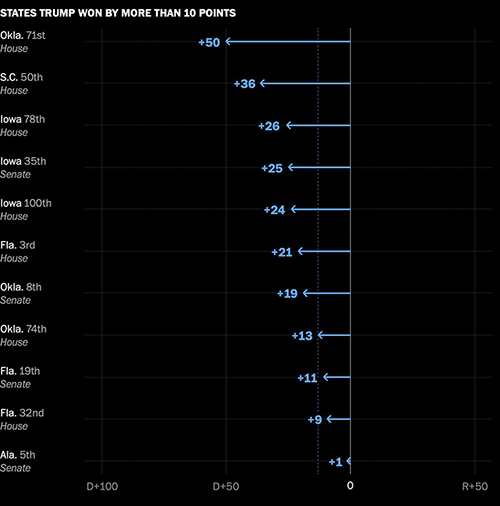
In the Trumpy states, every Democrat running in a special election for the state legislature did better than Harris. This could be a sign that the marginal Trump voters who showed up for him in 2024 have lost their interest in voting, but who knows?
Now on to closer states. These special elections for state legislative seats that took place in states where the presidential winner's margin was 10 points or fewer. They are swingier than the ones above and below, but not all are truly swingy:
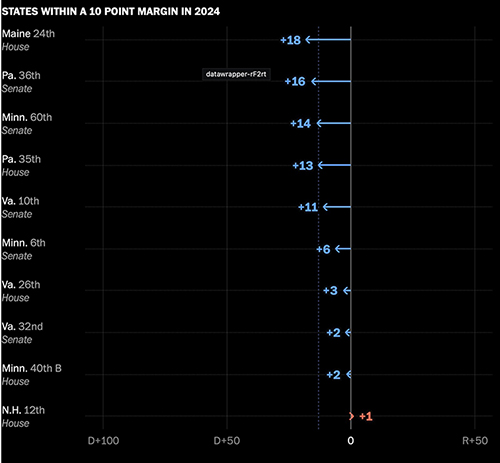
Same pattern as in the very red states except in one New Hampshire state House race, the Democrat did 1 point worse than Harris in 2024. Basically, the same conclusion.
Now we have the results for special elections for the state legislature in states that Kamala Harris won by more than 10 points.
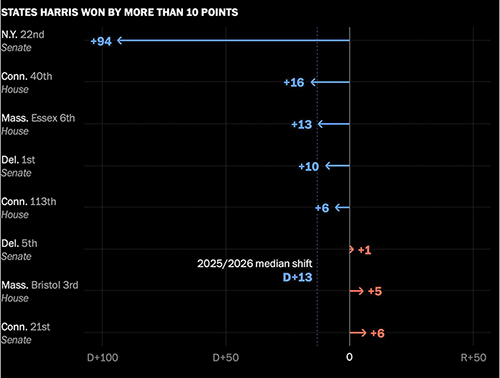
As you can see, the 22nd state Senate district in New York moved 94 points toward the Democrats in the special election. Huh? This district has a very large number of Orthodox Jews who vote as a bloc based on what their rabbis tell them. This gives them more power than if everyone voted his or her personal preference. They voted in large numbers for Trump because their rabbis didn't trust Harris on Israel. In state elections, they normally vote for Democrats, and that shows up here.
Finally we have two special elections for the U.S. House. Both races were in Florida and both races went for the Republicans. Nevertheless, the Democrats in the special congressional elections did much better than Harris did in 2024.
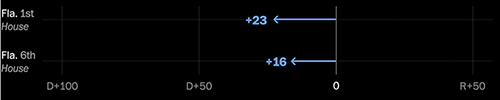
Now the $64,000 question is: Does any of this have predictive value for the 2026 midterms? Answer, based on historical data: yes. With some homework, one can look at special elections in 2017-2018 and compare them to the 2018 House popular vote. Likewise, the 2019-2020 special elections can be compared to the 2020 House popular vote, and so on. Here are the data:
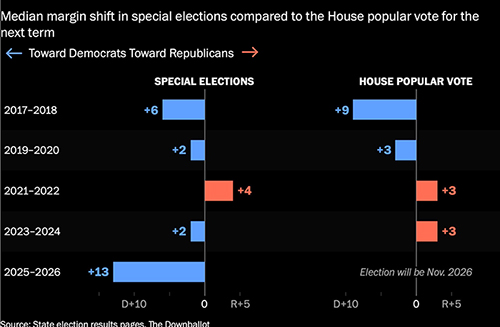
So, what can we learn? In 2018, 2020, and 2022, the special elections were a good predictor of the popular vote in the next House election. In 2024, they were not. Of course, the 2024 elections were unusual with Joe Biden dropping out in July and Donald Trump bringing large numbers of marginal voters and minorities who are normally Democratic. Still, given the immense swing toward the Democrats in this year's special elections (D+13, on average) and the increasing unpopularity of the Republicans, the Democrats have reason for optimism in 2026.
There is another indicator that has a decent (70%) prediction rate but it is too early to know: the Virginia gubernatorial election. When a Democrat is elected as governor of Virginia, the Democrats usually do well in the House the next year. We'll get that indicator in November. Nevertheless, we do have polls of the Virginia gubernatorial race. A May 12-19 poll from Roanoke College has Rep. Abigail Spanberger (D-VA) ahead of Lt. Gov. Winsome Earle-Sears 43% to 26% with the rest undecided. That is a 17-point margin. Another poll, by an unknown Republican pollster, has Spanberger ahead by only 4 points, 52% to 48%. We are automatically suspicious of a poll where 100% of the voters have an opinion already, especially since the Roanoke poll says 31% haven't made up their minds yet.
Also, Spanberger's approval/disapproval is at 41%/40% while Earle-Sears' is at 32%/48%. These data points suggest that Spanberger is ahead and, assuming she doesn't blow it somehow in the next 5 months, she is the favorite. That will be another hint about 2026. (V)
Previous | Next
Main page for smartphones