Previous | Next | Senate races | Menu
New polls: FL NE OH
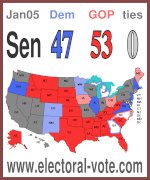
Dem pickups: AK KS ME NC OH TX
GOP pickups: (None)
It was VERY late, for various reasons, but there WAS a posting yesterday, and a substantive one.
This posting is the sequel, in a manner of speaking, as we explained yesterday.
Also, we have put together a survey, so that readers can predict which candidate they think will win the 18 Senate races
that are plausibly in doubt, how many House seats the Democrats will win, and which candidate they think will win the 17
gubernatorial races that are plausibly in doubt. There is also a space to make one other prediction, of any type, for
Tuesday, for those readers who have thoughts. The survey will be available until 10:00 p.m. PT Monday night; we will
have the results in Tuesday's posting. Click
here
to record your responses. We thank reader S.A.K. in Karnataka, India, for reminding us to do this.
And finally, a (belated) congratulations to the Milwaukee Brewers on their first World Series win, and congratulations to the
Golden State Valkyries on their first WNBA title.
The Line Must Hold, Part I: The Judiciary
As expected, U.S. District Judge for California's Central District David Carter denied Donald Trump's demand for a temporary restraining order requiring Los Angeles County elections officials to review a list of names provided by DHS that allegedly contain some non-citizens and set aside ballots already cast by anyone on the list until their voter eligibility could be confirmed. Besides the practical impossibility of that demand a week before voting ends, the judge found that the federal government has no legal basis to make such a demand and that the allegations were "not credible." At the same time, the federal government's interference would violate other federal laws like the Voting Rights Act, the National Voter Registration Act and the Constitution. The feds can't require a state to disenfranchise thousands of voters based on a mere suspicion that some people may be ineligible to vote.
Carter did not mince words, writing that never before "has the federal government, on the eve of an election, sought to coerce a state and local government to abandon their own Constitutional elections procedures and bend to the will of the Executive Branch."
The judge also pointed out that the DoJ acknowledged that none of this would affect the election's outcome. This admission means that there is no reason to prevent anyone from voting and that any legitimate concerns, if there actually are any, can be addressed in the normal course, after the election. Unfortunately, this is setting the stage for Trump's likely goal all along: challenging election results. And like clockwork, when the lawsuit didn't produce immediate results, the DoJ announced that they have opened a criminal investigation into California election procedures.
Election law expert and director of the Safeguarding Democracy Project at UCLA School of Law Rick Hasen said, "The federal government lost in every way it could possibly lose. It lost on the law, and it lost on the facts, and it lost on the equities—[or] weighing the harms to the various parties." But those small details won't stop this DoJ.
The DoJ appealed and, on Friday, the same panel on the Ninth Circuit Court of Appeals again rejected their request to disrupt California's election. It was the same makeup as before, with Judges Mark Bennett and Gabriel Sanchez in the majority. They repeated their earlier ruling that it's too close to the election and that the "United States has not made the required showing that such extraordinary relief, during an ongoing election, is clearly required by law."
Now that they have ruled, Trump will undoubtedly run to the Supreme Court on its shadow docket in one last ditch attempt to mess with California's election. At that point, we'll see just how much chaos the Republican majority wants to throw into the midterms. Judge Carter, anticipating such an emergency appeal, noted that if this kind of partisan interference is allowed this close to an election, that would open the door for a future administration to engage in similar tactics. "If [the Trump administration's] last-minute request for relief were granted, either party could create chaos for their own political purposes to disrupt the election process." In other words, in case you're listening SCOTUS, you wouldn't want President Newsom to feel he has carte blanche to rummage in Texas' elections, right?
Meanwhile, at the same time the Ninth Circuit was denying Donald Trump's request to order Los Angeles election officials to set aside certain ballots so the DoJ could confirm certain voters' eligibility, a different court issued a sweeping ruling prohibiting Trump and the federal government from engaging in any of these types of shenanigans anywhere in the country.
U.S. District Judge for the Northern District of California Trina Thompson ruled that "when state and local government employees perform the work of distributing, processing, or counting ballots or otherwise administering the 2026 midterm election" in accordance with the law, "they do not violate federal criminal law even if a particular ballot belongs to a registered voter alleged by Defendants to be ineligible to vote." As a result, there is no basis for the feds' threats to election officials of criminal prosecution for actions that are not illegal.
The case was brought by civil rights groups and labor unions, including the NAACP, SEIU, AFL-CIO and League of United Latin American Citizens (LULAC). It alleges that the feds' actions violate the Voting Rights Act and the Constitution. Judge Thompson agreed, finding that "although Defendants claim that their actions are designed to halt unlawful voting by noncitizens, their actions are likely to have the effect of interfering with election administration and disenfranchising lawful voters."
Her order is broad and prohibits the administration from demanding that officials segregate ballots, purge voters from voter rolls or discontinue ballot processing. She also ordered the government to stop any action to "threaten, intimidate or coerce" election officials into changing ballot processing procedures. She also required the feds to inform her of any subpoenas or search warrants demanding access to election materials or ballots. The order expires on November 16 and applies to all state and local election officials, not just California.
The court's reasoning matches the rulings from Carter in Los Angeles and from the Ninth Circuit. And it also aligns with the skepticism from the Alaska district court over the feds' attempts to halt the certification of the Senate race if their favored candidate loses. Democratic groups have filed a similar lawsuit in D.C. that is presided over by Judge James Boasberg. He held a hearing on Thursday on the groups' request for a temporary restraining order blocking Trump from threatening elections officials and pressuring states to set aside or reject ballots cast by certain voters. Boasberg said he would rule in that case tomorrow.
There is a notable consistency across district courts and appellate courts, from judges appointed by presidents of both parties, in the way they view the unprecedented effort by the Trump administration to interfere in the states' administration of elections. Hopefully, this pattern will continue when one of these cases reaches the Supreme Court. (L)
The Line Must Hold, Part II: Election Protection
Recall that when Donald Trump tried desperately to steal the presidential election of 2020, the best and most effective line of defense was the court system, where he lost over and over again. As (L) demonstrates in the item above, the courts are holding firm so far in 2026.
That said, other entities are gearing up to defend democracy, as needed. Much remains unclear, since those who are playing defense can keep their cards close to the vest until the last moment. Still, here's a rundown of some of the things that ARE known:
- Senate Democrats: This is the embodiment of close-to-the-vest. Senate Minority Leader
Chuck Schumer (D-NY)
has put together
an election-protection task force that includes nine of his Democratic colleagues. They meet regularly to discuss
various election-interference scenarios, coming from both within the U.S. and without, and to plan out how to deal with
them. They are reportedly locked and loaded for a wide variety of scenarios, including federal agents at polling
locations, ballot seizures in key battleground states, and foreign interference operations. Somewhere, Will Rogers is
smiling.
- The Blue States: Democratic states are clearly loaded for bear. A bunch of them, led by
California,
passed laws this year
meant to protect polling places from outside intrusion. They also have state AGs who are champing at the bit to go after
the Trump administration, and who have already been hard at work making sure that voters and poll workers know exactly
how the law works, and exactly what to do if the law is broken. See, for example,
this press release
from California AG Rob Bonta. It is further clear, even if they are not saying so openly, that blue-state governors
are ready to call upon National Guard troops, if necessary.
- The Red States: We've noted this a couple of times, but while red states might be friendly to
Trump on policy, they are largely not friendly to him when it comes to mucking around in elections. Some of the GOP-run states
have cooperated in terms of handing over lists of voters, some haven't, but nearly all of them are leery of federal interference
in the actual voting process. After all, conservatives are supposed to believe in limited government. There have already been
plenty of indications that the red states are ready to fight back, perhaps just as hard as the blue states. To take one red,
red state example, Gov. Mark Gordon (R-WY) has
instructed
state AG Keith G. Kautz to be ready to push back against "aggressive" behavior from the feds.
- Civil Rights Groups: The Trump administration has announced plans to send 1,000
election observers to polls. The White House has not explained why, but it's obvious the point is to intimidate
some voters and keep them from voting. Civil rights activists hate these kinds of stunts, so they
already have
multiple thousands of observers who will be on-site at key polling locations, to make sure the laws are observed.
Those observers will be backed by an army of lawyers, who will be ready to head to court and ask for an injunction
at the drop of a hat. Or a jackboot.
It is also worth noting that there are something like 100,000 polling places in the U.S., such that the administration's shock troops are going to be spread mighty thin. And, of course, the 50 million+ ballots that have already been cast are beyond their reach. - Other Groups: There are literally hundreds of other groups working to safeguard elections,
either on a local or national level. Reader K.M. Williamsburg, VA did us the favor of compiling
a list of the most important election-monitoring groups:
The Carter Center: Perhaps the foremost election-monitoring organization in the world, having kept an eye on over 125 elections in over 40 countries since its founding in 1989.
These are the famous ones, but they are also the tip of the iceberg.
OSCE/ODIHR (Organization for Security and Co-operation in Europe, Office for Democratic Institutions and Human Rights): Another organization with international reach, one that has been keeping an eye on U.S. elections for much of the Trump era.
Election Protection: This is the largest U.S.-centered election-monitoring and voter-assistance group. If a voter has a problem, their first call should probably be to Election Projection at 866-OUR-VOTE.
Campaign Legal Center: Also U.S.-centered, and focused on election administration, voting rights, and election integrity issues.
National Conference of State Legislatures: They don't monitor elections, but they do provide lots of good nonpartisan information about election laws, including the specifics of observer rules and election administration.
The bottom line is that the Trump administration has so clumsily telegraphed its intentions, for so long, that there is an enormous resistance, for lack of a better word, that has had plenty of time to plan and is ready to go. And the resistance is run by much smarter people. (Z)
Sunday Q&A
We selected 20 questions that cover stuff related to this week's elections. As noted yesterday, we'll do non-politics questions either next weekend, or the weekend thereafter, as circumstances dictate.
M.M. in Spotsylvania, VA, asks: Being a constant worrier, I have a new worry should Democrats win both (or even one) chambers of Congress in the upcoming midterm election. With high prices for gas and groceries, rising inflation, and an endless conflict in Iran as concerns to the average American voter, what can Democrats do to reverse any of these items and take credit for doing so? My worry is that slowing the administration's agenda by having control of Congress will not result in any meaningful way to lower prices, stop the Iranian conflict or give aid to Ukraine. Republicans will then point to the ineffectiveness of a Democrat controlled Congress as evidence that they should regain control of both Congress and the White House in 2028.
(Z) answers: There are three possibilities. First, they can conduct investigations, and try to demonstrate that they are the party that likes law and order and dislikes corruption. Second, they can pass legislation that Donald Trump kills off, and then say, "See? We need a Democratic president to get things done." Third, they can try to work with Trump. He's not really a Republican, and might plausibly play ball on some issues. It's not likely, but it's not impossible.
Whether this will be enough to impress voters is unknown. But I tend to think if it's very clear that, say, restored funding for Medicare/Medicaid WILL happen if a Democrats is elected president and the Democrats hold Congress, many voters will find that compelling.
H.B. in Portland, OR, asks: It looks likely that: (1) There will be at least one more independent in the Senate soon and (2) There will soon be at least one, if not more, Democratic senators representing parts of the country and flavors of folk that haven't had much Democratic Senate representation in some time. (Midwesterners, Texans, farmers, rural folks, loggers, fisherfolk, white mainline Christians, etc.)
How do you think these dynamics will affect the Senate? Beyond "getting to 51 votes," I mean the conversations and negotiations between members, the priorities, the alliances, the bills proposed and passed, and so forth.(Z) answers: It is going to be tricky for (potential) Senate Majority Leader Chuck Schumer (D-NY), and there are going to be some things on which some (hypothetical) Democratic members are going to have to go against their party. That said, and we will certainly write about this after the election dust has settled, there are numerous Democratic policy positions that have pretty broad support, even among moderates and (some) Republicans. Supreme Court reform is one, and single-payer healthcare is emerging as another. So, the Democratic caucus should be able to find some issues where they have common ground.
S.T. in Worcestershire, England, UK, asks: As the potential number of Democrat gains continues to increase, I am left wondering about the likely composition of the Republican senators post election.
Obviously they will vary from hardcore MAGA (Mike Lee, UT) to staunchly independent (Lisa Murkowski, AK) but if there is a Blue Tsunami, the number of non-MAGA Republican senators could be vital in terms of impeachment, or overriding the filibuster.
Have you any thoughts on how many "moderate" Republican senators there could be in the new Senate, who might be willing to join Democrats in thwarting the Trump agenda?(Z) answers: The way a candidate behaves on the campaign trail often runs contrary to how they behave once they are in office. So, I would not want to guess how many GOP-held seats will go from MAGA-to-moderate, or vice-versa.
Further, what is considerably more important is whether the non-MAGA Republicans already in the Senate (say, John Curtis of Utah, or Dave McCormick of Pennsylvania) decide they've had enough of pretending to be MAGA to keep Donald Trump happy. There are signs that his armor is cracking, but it's hard to be sure until it happens.
D.R. in Seattle, WA, asks: Is anyone tracking dummymandering? Or will they, after the election?
(Z) answers: Polls do not offer the kind of certainty that would be needed to draw conclusions. However, it is a near-certainty that, sometime after the election, we will write something about how well the various gerrymanders worked out.
R.D. in Austin, TX, asks: One thing I have been pondering is which Republican-led states might want to feed Donald Trump's ego and play another round of the "big lie" and which ones will say "enough!" I don't know how you could answer this, but which states would appear to have a GOP state party that will still believe in the rule of state laws and which ones won't?
(Z) answers: The number of states where this is a risk is fairly small. Not zero, necessarily, but fairly small, for two reasons. First, it is risky (and possibly illegal), as well as politically unpopular with most voters. Many Republican officeholders, like Brad Raffensperger (R-GA), have a sense of integrity. Others will not want to assume the risk, especially since Donald Trump does not reciprocate such "favors."
The other issue is that the states with the most MAGA voters, and thus the most MAGA elected officials, are not likely to have close elections.
That said, the profile of a state where you might expect shenanigans is: Solid Republican control, but relatively evenly divided voter base. That is a pretty good description of North Carolina, where state Republicans already have a well-deserved reputation for shenanigans. It could also describe some of the red/reddish states where a GOP-held Senate seat is in play, like Texas or Kansas.
G.S. in Palm Springs, CA, asks: What are your thoughts on early vote counts that encompass in-person and mail-in voting? If we look at the Florida Election Lab, for example, we see about 53 million votes cast, but about 25% of those are unaffiliated by either Democrat or Republican.
(Z) answers: It is hard to draw any firm conclusions about early voting, particularly this year, because: (1) some states have recently expanded early voting, and (2) Donald Trump's threats against polling places have driven some people to get their ballots in early.
That said, the number of early votes this year is already nearly 10 million more than cast in 2022. It is reasonable to interpret that as a sign of higher enthusiasm. And since history suggests that Democrats are more likely to vote early than Republicans, you can probably infer that the early voting favors Democrats by a non-trivial margin. That comports with polls suggest that Democrats are more enthusiastic this cycle than Republicans.
T.K. in Columbia, MD, asks: Is there data on how bad weather affects turnout on Election Day? Does it break down along partisan, gender or ethnic lines? I saw a prediction of bad weather on Election Day coming from east Texas, Louisiana and Mississippi up through the midwest to Michigan. That's a lot of states with... interesting elections.
Bonus question: How does election polling compare to weather forecasting?(Z) answers: There have been many studies, and the conclusion is that rain reduces Election Day turnout by about 1%. These days, that disproportionately affects Republican candidates, since Democrats are more likely to vote early and Republicans are more likely to vote on Election Day.
P.C. in Stony Brook, NY, asks: Have there ever been instances where a natural disaster or severe weather event demonstrably affected the outcome of a significant election in the U.S.?
I'm not referring to the fallout of public opinion following such an occurrence, such as when the public seemed to sour on Bush's handling of Hurricane Katrina. Rather, whether any election results can be directly traced to the displacement of populations, the destruction of ballots, the loss of voting venues, etc.(Z) answers: The famous example actually involves weather that did not turn inclement. In 1960, John F. Kennedy's campaign was worried about forecasts of rain, since the rain was expected to fall in places with a lot of Democrats. It did not, and JFK won, of course. There have been several studies of this, and they conclude that the Kennedy campaign was right, and that if there had been rainfall, Richard Nixon probably would have won.
J.E. in Gilbertsville, PA, asks: Do you know why we are seeing so many ads about Amendment 3 in Florida (paid for by A Better Florida)? Do they think there are that many Florida voters in the Philly airwave area?
C.S. in Waynesboro, PA, asks: I live in south central Pennsylvania. On the cable channels I watch, I'm seeing political ads for Pennsylvania governor, both sides, pro and con. I'm seeing ads, both pro and con, for Scott Perry and his challenger Janelle Stelson. I'm not in their U.S. House district but I'm in the advertising area covering their district. I'm seeing ads for a PA state house election closer to Harrisburg, which again, I'm not in the district but I understand why I'm seeing it.
However, just today, I've started seeing anti-Troy Jackson ads paid for by Sen. Susan Collins' (R-ME) campaign in the Maine Senate race. What the hell? I can understand the stupidity of showing Maine ads in Portland, OR, instead of Portland, ME. But how could they possibly be spending money in south central Pennsylvania for a Maine Senate race? Is her campaign personnel truly this incompetent?(Z) answers: We have gotten many variants of this question. The answer is that broadcasts that reach a narrow audience usually charge more per viewer, because they can. If you are Al's Sofa Emporium in Daytona Beach, then it is more efficient for you to pay to advertise to the 20,000 people WESH Channel 2 than it is to pay to advertise to everyone in Florida, since anyone outside of Daytona Beach is wasted money. Similarly, a niche show like Property Brothers can charge more per viewer, because a huge proportion of that show's audience is interested in home improvement products.
By contrast, for a regional broadcast of a football game, the cost per viewer is lower because the targeting is much less efficient. Maybe 70% of the audience of Property Brothers might be interested in paint, but maybe 20% of the audience of Sunday Night Football is. And Behr or Sherwin-Williams won't pay the 70% hit rate for an audience where they will only have a 20% hit rate.
What it boils down to, in so many words, is that paying for one commercial slot with a broadcaster that reaches 40 media markets, even if some of those markets are not useful, can be cheaper than paying for 20 commercial slots in smaller, more targeted media markets. That is particularly true as we approach November and December, and local ad inventory gets scarce (and thus, more expensive).
R.L. in Alameda, CA, asks: Every time we have the TV on, either YouTube or sports (on multiple platforms), we have been fed "No on 40" paired with "Yes on 42" ads during every single ad break. Every. Single. Time. It's maddening, particularly since our algorithm clearly does not know that we already voted.
For the uninitiated, these are California propositions. Prop 40 is the billionaire tax. Prop 42 (and 41) are competing propositions that are supposed to counter Prop 40. I don't fully understand them. Apparently Prop 40 is the only item on the California ballot that is contentious (at least here in the Bay Area) because it is literally the only political ad we have seen. (FWIW, Xavier Becerra, D, finally ran an ad for governor, pretending that he needs to. I actually appreciate that he is finally trying to earn my vote).
Deciding how to vote on Prop 40 was challenging. Endorsements are all over the map. Some unions are in favor. Some are opposed. (My union local, IBEW 595 based in Alameda County, did not take a stance). Some Democrats are in favor (Bernie Sanders, Ro Khanna). Others are opposed (including current governor and 2028 presidential candidate Gavin Newsom, D, and a host of other state officials). Republicans are opposed. My wife and I decided to vote yes on 40 and no on 41/42. We have read that it may not stand up to the inevitable court challenge. It may not work as hoped. Ultimately, we decided that we want to send a message to the billionaires that we are pissed and that no one should be allowed to have that much wealth.
I don't know how it got on the ballot, but clearly the 'Yes on 40' campaign (if there is one) has no money because I haven't seen a single ad promoting it. Although I'm sending this as a comment, I'm interested in your take.(Z) answers: Prop 40 is tough. Billionaires are paying something less than their fair share, by nearly any measure. And the price of the federal tax break, which benefited that class enormously, is that a lot of poor people will go without healthcare. Peter (the feds) robbed Paul (the poor people) to pay off the billionaires. California is trying to steal the money right back. Correcting this and/or sending a message, are good reasons to vote for Prop 40.
However, the money will be tied up in court for years before California gets it, if it ever does. Further, a one-time assessment is, by definition, a one-time fix. An ongoing assessment, at a much smaller number, would be less likely to trigger fighting-tooth-and-nail resistance, and would be a long-term fix rather than a short-term one. These are good reasons to vote against Prop 40.
Prop 42 is 100% scam. It not only has a backdoor meant to kill Prop 40, but it also layers other anti-tax goodies on top of that. Same for Prop 41.
The main Yes on 40 group is Service Employees International Union, which is also involved in three or four other propositions, so their resources are spread thin. That said, I have seen plenty of commercials for some of the other props, particularly the ones about immunology research (38), voter ID (39) and relaxing environmental regulations (45).
E.W. in San Anselmo, CA, asks: So, maybe I'm missing something here, but I'm having a hard time understanding the point of having the second Dan Sullivan on the ballot in Alaska, and how that could help Mary Peltola (D). With Alaska's ranked-choice system, wouldn't anyone voting for one of the Dans put the other one second?
(Z) answers: The Peltola campaign's hope was that both Sullivans would be listed in a near-identical format, and that some Republicans would vote for the wrong Dan Sullivan and then not bother to make a second choice, either because they are lazy, or they oppose ranked choice voting, or they don't understand how the ballot works. The odds of this working out as planned were very small. It was a stupid gamble.
P.Y. in Boca Raton, FL, asks: How much of the Alaska vote has already taken place?
(Z) answers: By the time the news about the ratfu**ing by the Mary Peltola campaign broke, about 50,000 early votes had been cast. The last time there was a midterm U.S. Senate election in Alaska (2022), a total of about 250,000 votes were cast. So, a pretty good chunk of the final tally was banked before the news broke. That said, there are still more than enough ballots out there that Peltola could be hurt by this.
S.C. in Mountain View, CA, asks: Yesterday's posting reported new polls for Alaska, Illinois, Kansas, Minnesota, and South Dakota. Sometimes a new poll changes a state's prediction (as it did that day for Kansas, Minnesota, and South Dakota), sometimes it doesn't (as it did that day for Alaska and Illinois).
But the October 31st map also showed changes from the October 30th map for Georgia (went from Likely Dem to Strongly Dem), Montana (went from Barely GOP to Barely Independent), Nebraska (went from Likely Independent to Barely GOP), Ohio (went from Barely Dem to Likely Dem), and South Carolina (went from Barely GOP to Strong GOP). There were no new polls reported for those changes, so I am confused.
Can you explain the reason for those changes?(Z) answers: Our preparations for Election Day damaged the polling database. It has been restored.
T.T. in Portland, OR, asks: What's up with the big map regarding South Carolina? Some polling has been done since Lindsey Graham's sister took over the reins. This story from USA Today details results from the South Carolina Policy Council's (SCPC) recent poll.
I've been reading about your skepticism regarding certain polling operations. Is the SCPC suspect or phony? Or is it bona fide and reliable? And if it's OK... how come it hasn't been folded into the map, turning South Carolina into a barely-Republican property?(Z) answers: SCPC claims to be "independent," but is clearly a libertarian think tank. That makes them a partisan pollster, and we don't include partisan pollsters. There have now been a couple of recent, non-partisan polls of the race, and those are in our database.
A.M. in New York City, NY, asks: You have Montana as toss up/leans blue because of one outlier poll; while all your other predictions seem solid and in line with the general consensus, I don't understand why you're representing Montana this way and would be grateful for an explanation.
(Z) answers: The tone of this question is rather accusatory. We have an approach, which we do not keep secret, and we apply that approach. The only judgment involved is which pollsters are, or are not, partisan.
Nearly all of the polls of that race were very clearly partisan, and so don't clear the bar for us. If any reader thinks we've missed a poll that seems to meet our criteria, then we welcome a heads-up at comments@electoral-vote.com.
M.L. in West Hartford, CT, asks: Forget Kansas. How bout the poll that has the Democrat ahead in SOUTH DAKOTA?!
Probably an outlier, right? A little research shows that the firm is a Democratic firm, so maybe a little wishful thinking/thumb on the scale?
I'd be curious to hear your thoughts.(Z) answers: The Democratic houses have consistently shown a close race. The Republican houses and the non-partisan houses have consistently shown a not-close race (Rounds +10%, or so). Maybe the Democratic houses know something, but if we were betting, we would bet on the underlying redness of the state and on the nonpartisan polls.
J.L. in Madison, WI, asks: You wrote, of the Cenk Uygur ad:\0x2028 "This is the other antisemitic ad we promised was coming; the ad has been roundly derided as such. The campaign of Abdul El-Sayed (D), running for the open U.S. Senate seat in Michigan, has disavowed the spot."
I don't especially know much about Uygur and from the sound of it he does sound like an annoying attention chaser, but watching the ad I can't see anything particularly antisemitic about it.
Quite frankly, one could point to the fact that its point about U.S. support for Israel causing inflation is correct in that our support for Israel led to us beginning the war in Iran which increased energy prices which causes inflation. That feels like a logical conclusion to make. Reiterating what I said before, what's antisemitic about this line of logic (unless I am missing something?), this kind of feels like conflating support for Israel with antisemitism, which I don't think is a reasonable connection.
Again, I could be missing something here and I mean no ill will, just wanted to share my thoughts.(Z) answers: We are extremely weary of this particular argument, inasmuch as everyone has made their mind up. So we very carefully wrote that passage to take no position on the matter. We wrote: "the ad has been roundly derided as [antisemitic]." That is objectively true; it has. We took no position on whether WE thought it was antisemitic.
To answer your question, we will pass along a note from reader L.B. in Savannah, GA. I do not identify as Jewish, but I have good reason to believe that L.B. does. And in an e-mail about the El-Sayed commercial, L.B. wrote: "How is this different from Der Sturmer in the 1930s saying 'Without the Jew, the German school would thrive; German children would not go hungry; our hospitals would have room again.'?"
In short, it's not just what the ad says, it's how the ad says it. Another question worth pondering: If the goal is to criticize the policy of the current administration, why not focus on "the unjust Iran War" as opposed to "Israel is manipulating Americas"? Is there a good reason for that choice, other than to cater to some pretty unsavory sentiments?
T.M.M. in Odessa, MO, asks: Looking at the results from recent non-partisan polls in red states, are there are any unpolled states that might be potential pickups for Democrats? (I'm looking at you, Kentucky.)
(Z) answers: There aren't too many unpolled states left, since these days it seems almost every state in play. Louisiana is probably getting a bit less attention than it should, although we did include it in our survey above.
J.L. in Los Angeles, CA, asks: I've researched the origins of the term ratfu**ing, and I see it being traced back to the Great Rose Bowl Hoax of 1961 and CalTech's student newspaper reporting on the prank as "RF" (sanitized to "Royal Flush"). The meaning of the term "ratfu**ing" evolved from college prank to political sabotage, getting a boost from Bob Woodward and Carl Bernstein's 1974 book All the President's Men documenting the Watergate scandal. Wikipedia has a fascinating history of the word to read, but it leaves out one critical detail...
Why "ratfu**ing"? I mean, I understand the origins of terms like "screwing the pooch" and "putting lipstick on a pig." Those seem fairly obvious to suss out. But why would a college prank have any connection to fornication, either between rodents or—and I'm not sure how this could work—with a rodent? So please 'splain it to me, Lucy, how this particular and peculiar term came to be?(Z) answers: The problem with word/phrase origins is that they are usually poorly documented, such that there are many possibilities, more than one of which might be correct. One theory is that the term started during World War I, when rats in the trenches would commit all sorts of mischief. There is no question that soldiers of that war used the term ratfu**ing to describe this behavior, but it's not clear how the term might have made the jump to college students... multiple decades later.
Another theory is that the term began life as "rat finking" in the mid-1950s, and then took a vulgar (and probably easier-to-say) turn. That works, timeline-wise, and one can see how rat (sleazy person) and fu**ing (screwing someone) worked quite well together.
However the term emerged and evolved, it is certain that the preppy college boys of the late 1950s and early 1960s became the Nixon staffers of the 1970s, and brought the term into politics.
D.A. in Orangetown, NY, asks: What are some of the more unusual venues that are used, or have been used, as official polling places?
(Z) answers: Here is a list of 10:
- Su Nueva Lavanderia in Chicago
- Neptune Society Columbarium in San Francisco
- The International Space Station in... well, outer space
- Venice Beach lifeguard headquarters in Los Angeles
- La Boulangerie Café in San Francisco
- The Mummers Museum of Folk Culture in Philadelphia
- Krishna Temple in Salt Lake City
- Perfect Games Arcade and Amusement Park in Ames, IA
- The Municipal Water Department Laboratory in Philadelphia
- Rotary Nature Center in Oakland
- Pierce Brothers-Moeller Murphy Funeral Home in Santa Monica, CA
- (Z)'s grandmother's garage, for many, many years
If you want more, photographer Ryan O'Donnell has created The Polling Place Project.
Normal order should resume next week, once the election is over. (Z)
Today's Senate Polls
Florida is lost for the Democrats. If Abdul El-Sayed wins big, progressives will loudly note: Progressives can win! See Michigan. Moderates will come back with: What about Florida? In the Nebraska poll, Osborn is at 43% this time. In Ohio, this is the first poll in ages that is a tie or Husted ahead. We expect it to be close, but mostly Brown has been ahead.
| State | Democrat | D % | Republican | R % | Start | End | Pollster |
| Florida | Angie Nixon | 45% | Ashley Moody* | 49% | Oct 26 | Oct 30 | Stetson U. |
| Nebraska | No Democrat | 0% | Pete Ricketts* | 49% | Oct 23 | Oct 29 | Siena U. |
| Ohio | Sherrod Brown | 50% | Jon Husted* | 50% | Oct 18 | Oct 31 | Activote |
* Denotes incumbent
Previous | Next
Main page for smartphones