
Dem
47

GOP
53

It's just that kind of week.
B.S. in Huntington Beach, CA, writes: I am a faithful reader and supporter of Electoral-vote.com, and I rarely disagree with the analysis or commentary provided by (V) and/or (Z). This is not so much a disagreement as an omission that I believe needs to be pointed out.
As you speculate on The Convicted Felon's (TCF's) motivations as his last years in office slowly play out, you included grift, ego, and revenge. I take no exception to this observation, except that you did not include cruelty as one of his principal, and maybe primary, motivating factors.
As I look back on his terms in office, yes, he always wants to line his pockets. Yes, he has an insatiable need to feed his ego. And yes, political revenge is apparent with this administration on a daily basis. But I believe, even as he pursues these motivations, the rope that ties it all together is cruelty.
Why blow up fishing boats in the Caribbean? Why develop a policy of child separation in pursuit of deportations? Why deprive American families of food, housing and health care? Why mock people with disabilities or insult female journalists? The list goes on and on.
I suspect that the reason TCF's mother spent large swaths of time away from her little Donny as a child is that his innate cruelty was on display at an early age and she found him intolerable to be around. His father, not so much, but his mother could not bear to watch him in action pulling wings off of flies and terrorizing his siblings. And this trait has followed him even into the White House. I believe it is his most significant character trait and motivates most of what he wishes to accomplish. Just be cruel.
P.R. in Saco, ME, writes: You wrote, in your item "Merry Christmas, America?: Trump Loses His Mind on Social Media": "'Enjoy what may be your last Merry Christmas!' Um, what? What does that mean?"
My conjecture: TCF is dying, knows it, and believes he won't make it 'til next Christmas, because everything he ever writes is about himself—there is no other reality outside of him. He is the world unto himself.
E.F. in Baltimore, MD, writes: Donald Trump's entire career has been about turning his own name into a brand. Why did he write his name as "TRUMP" (including the quotations)? He's lost the ability to distinguish between himself and the brand he's come to represent. Like walking into a McDonald's and demanding to speak to Ronald about the food.
As for his latest crazy Truth post, every accusation he makes is another confession. But deep down, he's just a salesman. He has to convince himself that the product he's selling is desirable, before he can persuade his customers to buy it. By repeating these self-serving lies, he's convincing himself that they're true. And he's demanding that you believe them too.
N.E. in San Mateo, CA, writes: You wrote: "Later, Trump also posted a picture of a model showing the (apparent) new livery for Air Force One."
The really odd part is that's a twin-engine jetliner, and both the current VC-25A executive transports (which become Air Force One when the President is on it) and the upcoming VC-25Bs are based on slightly different versions of a 747 hull.
The distinctive 747 proportions mean the livery for a twin-engine is going to need substantial adaptation to look good. Given that it should have been equally easy to get a model of a 747 to put the new livery on, it's an odd choice.
(V) & (Z) respond: For the record, Qatar Force One is not a twin-engine jetliner, either.
C.K. in Jacksonville, FL, writes: This commercial was filmed near Donald Trump's golf course in Scotland by the company who built the nearby wind farm. Apparently, you need binoculars to see them:
F.L. in Allen, TX, writes: trump. verb [NO OBJ.]
informal
break wind audibly.
Little wonder TCF is afraid of wind power.
J.S. in Houston, TX, writes: I have always cringed at "The Convicted Felon (TCF)" reference and decided to write up the reasons and share. First, the conviction is merely for falsifying business records to hide a sexual encounter before becoming president, highlighting the failure to convict for anything like "high crimes and misdemeanors." More importantly, referring to anybody as a felon dehumanizes all felons; it reinforces the stereotype that convicts are inherently evil. For context, there are community efforts like the The Prison Show (broadcast from my Houston neighborhood) that strives to make the time spent incarcerated more humane and assist inmates in their return to society.
S.G. in Morgantown, WV, writes: I was gifted a copy of Senator Robert Byrd's autobiography Robert C. Byrd: Child of the Appalachian Coalfields for Christmas 2024, and I've recently finished it up (I hope the Electoral-Vote.com staff and readership will forgive me for taking a year to make it through 800+ pages that are more than a little self-serving).
Of particular interest to me was Byrd's staunch opposition to the presidential line-item veto, which was ultimately ruled unconstitutional in Clinton v. City of New York (1998).
One passage of the book warned of the potential dire consequences of the act. It likely came across as just another politician blowing hot air in the mid-1990s, but the warnings seem salient under the present administration:
"The control over the purse is the foundation of our constitutional system of checks and balances. The control over the purse is the ultimate power to be exercised by the legislative branch as a check against a dictatorial executive," I said. I warned Senators that the bill would give the president great leverage to bully Congress with threats of canceling funding for congressional priorities, while demanding that Congress support the president's spending initiatives...
The Senate, you mark my words, is on the verge of making a colossal mistake, a mistake we will come to regret but with which we will have to live until January 1 of the year 2005, at the very least. The Senate is about to adopt a conference report which Madison and the other constitutional framers and early leaders would have absolutely abhorred, and in adopting the report we will be bartering away our children's birthright for a mess of political pottage. It is a malformed monstrosity. This so-called line-item veto act should more appropriately be labeled, 'The President Always Wins Bill.'Can you imagine how the current administration would abuse the power afforded by a line-item veto? It's honestly terrifying to consider.
E.V. in Derry, NH, writes: Your analysis of the vulnerability of the new battleship design did not specifically address one weapon that is now a big threat—sea drones. In just a couple of years, Ukraine had developed both surface and submarine drones (Sea Bay and Sub Sea Baby) that have proven very successful in damaging ships.
Denys Davydov, on his YouTube channel, presented a detailed look at how this new design will be vulnerable to various weapons already successfully in use: "Trump's New Golden Fleet Is a Joke."
Denys provides a Ukrainian view of the war and, increasingly, of the related politics, both domestic and international. Many YouTube channels are overly sensational and unrealistic about what is happening on the battlefield. In contrast, Denys cheers the Ukrainian successes, but is critical of errors and realistic about the realities on the ground.
Regarding Donald Trump, Volodymyr Zelenskyy, of course, has to praise him as the best of the best of the best. Denys presents what probably more Ukrainians are now really thinking about Trump's policies and decisions.
S.C-M. in Scottsdale, AZ, writes: My father was a World War II vet and he was on the Northampton when it was sunk in the Battle of Tassafaronga. The Northampton was no match for the Japanese Long Lance torpedoes. Keep in mind it was a night engagement. My father said, the ship was on fire and the surviving crew jumped off the sinking cruisers and were picked up by the waiting destroyers.
As for the "Trump" class specs, the tonnage is in line with the Washington Naval Treaty limits for new battleships at the time. For example, the displacement tonnage of the South Dakota was just over 35kt. The armor was "balanced" in the sense its own weaponry (16-inch guns using armor piercing shells) could not penetrate the armor. I am curious why the displacement of the "Trump" class gets up to over 30kt. What is all that weight being used for, if it is indeed accurate? The more I look, this whole venture seems like a way to stroke Trump's ego and is mostly vaporware.
BTW, the Northampton class was also under the Washington Naval Treaty limits and was only 9kt in displacement. It was originally classified as a light cruiser, but ended up designated as a heavy cruiser because of its 8" main battery.
Also, naval tonnage is normally the weight of the water displaced by the ship and not the actual weight of the ship.
K.W. in Colorado Springs, CO, writes: Retired US Navy Chief Petty Officer here.
The reason the Navy doesn't have battleships anymore is because they are obsolete, and have been since World War II. The money would be much better spent on drones, aircraft carriers, aircraft, destroyers and frigates.
A more appropriate name for a class of battleships would Yamato class. The Yamato was destroyed on a suicide mission trying to protect Okinawa. The plan was to beach her and use her guns as beach guns.
E.B. in Seattle, WA, writes: I've worked designing (mostly commercial) boats for almost 25 years, so I have some... thoughts about the Trump-class ships.
First of all, you made a minor error. Newport News is not the only shipyard capable of building the new ships. Ingalls Shipbuilding in Pascagoula, MS, is building the America-class amphibious assault ships, which are roughly the same size and weight. That's the good news. The bad news is that the yard is fully occupied building those ships (plus destroyers), which the Navy actually needs/wants. In a pinch, either NASSCO in San Diego or Aker Philadelphia also have the capacity to build ships that size. The bad news is that neither of those yards has built combatant ships in a generation or four, so they will have significant learning curves if they get on this particular gravy train.
That is the full extent of the good news. It all goes downhill from there. First of all, the timeline. The America-class ships are an instructive example. The first in class was ordered by the Navy in June 2007, keel laid in 2009, and finally delivered in April 2014. Roughly 7 years would be a pretty normal timeline for this size ship, especially a first in class. The more new stuff they have on board (ahem, lasers and railguns), the longer the development time will be. There is no chance whatsoever that the USS Defiant will be floating by the time Trump leaves office. It's probably even odds whether the keel is laid.
As you note, staffing is an issue. It was brought up to Donald Trump too, and he said that robots would do the work. The problem is that robotic welding in shipyards is best at large, flat panels like bulkheads and the decks, sides and bottom in the middle of the boat. But on fast combatant ships, there isn't much flat shell plate. Oh, and these yards are already mechanized pretty much as far as they can go. Robots aren't going to solve the problem.
Finally, there are some tells for when a project is going to go bad. The owner wants to be really involved in the design even though they don't really know the job. The owner changes their mind a lot. The owner is more invested in appearance than function of the boat. Any of that sound familiar?
P.P. in Lincoln, VT, writes: I actually was amused by the "Trump Class" battleship concept, as it clearly comes from a mind that plays with boats in the tub or the pool. Setting aside all of the practicalities of designing, building, manning and equipping such a ship, never mind the doctrinal changes to use it, another leader in the past thought he "knew" better than the experts—Adolf Hitler.
Rather than a ship, he wanted a land battleship. First, the Maus, 207 tons with a 128mm main gun and a 75mm coaxial secondary gun, a crew of six, and absolutely no chance of ever seeing action as it couldn't fit through tunnels, cross rail bridges or otherwise make it across a river. Granted, it did have "fording" capability, but who'd trust going across a river, underwater, with this monster? Hitler had a hand in the design. Two prototypes built.
Then, the ultimate land battleship, the Landkreuzer P. 1000 Ratte. Some historians consider it to be a joke, but apparently Hitler was interested enough for a moment that some design work was done. 11-inch guns in a leftover turret from a battlecruiser, 1,100 tons, its own anti-aircraft battery and numerous other weapons to protect it. Albert Speer canceled it before it got any further.
There are parallels here of course—grandiose weapons designed to be bigger and better than any other before. One hopes that Trump, like Hitler, simply loses interest as soon as the actual work begins and he gets distracted by something else.
E.W. in Skaneateles, NY, writes: I can't believe you called lil' Petey Hegseth the Secretary of Playing Battleship. Everyone knows he's actually the Secretary of LOSING at Battleship Because He Group Texted a Reporter the Battleships' Locations.
J.N. Freeland, WA, writes: I saw this online:

J.L. in Richmond, VA, writes: Luckily for Trump there's precedent for a non-expert to design a vehicle, and I don't recall any flaws with it:

R.L. in Alameda, CA, writes: If the Department of Justice thinks that they are achieving something by releasing a few Epstein files at a time during the slow-news, people-aren't-paying-attention Christmas week, they'll have another thing coming after New Year's Day. By releasing tens of thousands of unindexed files now, intrepid journalists who otherwise aren't busy chasing stories have plenty of time between their family Christmas parties to comb through the docs, find the most salacious material, and index them to make it that much easier for folks like me to search through them and find even more good stuff.
I recall the Epstein files returning to the news during the summer, when I was in Europe (which is why it stuck in my memory). Then we had a bit of a delay from late summer into the fall while "Speaker" Mike Johnson (R-LA) kept the House closed so they couldn't vote on it. But the story didn't go away. All he succeeded in doing was to increase interest and, when the government shutdown ended and he no longer had a pretense to keep the House closed, the story raged back into the spotlight. This is going to happen again in 2 weeks. People will go back home and back to work. They'll start paying attention to the news again. And this story will not only be more in our faces, the docs will be out in the world and organized for all to see.
Democrats may have their issues with communicating (both on the listening and receiving end—although, in my view, some are improving at this). But their communications issues pale in comparison to Republicans' inability to understand the Streisand Effect.
D.W. in Arden, NC, writes: When reviewing some of the released photos, I thought it was odd that a photo with Michael Jackson, Bill Clinton and Diana Ross was there with redacted faces of what I presume they wanted us to believe were victims. My son later sent me the same image that someone posted that was public long ago and shows those redacted images as Michael Jackson's and Diana Ross' own children. The clip doesn't show what paper or article it's from, but the caption is: "Singer/songwriter Michael Jackson, his children Michael Joseph Jackson, Jr. and Paris Michael Katherine Jackson are photographed with President Bill Clinton, Diane Ross, and her son Evan Ross in Washington, DC on December 19, 2003." It appears to me that the DoJ is trying to imply that this is some kind of proof of their involvement with Epstein, who isn't even in the photo.
K.P. in Brooklyn, NY, writes: This made me chuckle:
Speaking of initials, numerous documents refer to a "member of the British royal family" whose name begins with "A." Undoubtedly, this is Queen Anne, who reigned from 1702-14, and whose activities during the War of the Spanish Succession have always left us with lots of questions and few answers.
A.B. in Lichfield, England, UK, writes: You mentioned that the royal 'A' referred to in the Epstein Files might just possibly be the Andrew formerly known as Prince.
What you don't seem to have considered is that this is a quite deliberate attempt by the Trump Department of Justice to undermine the reputation of Prince Albert. Clearly there are many in the southern United States who have never forgiven Albert for his personal role in defusing the Trent Affair in 1861—much to Abraham Lincoln's relief—thereby avoiding war between the United Kingdom and the United States. Never one to overlook an opportunity to seek petty revenge in order to appease his base, Trump must have personally ordered the attempt to smear Queen Victoria's husband 164 years after his untimely death.
I think.
It at least has the benefit of being more credible than most MAGA conspiracy theories.
M.H. in Salt Lake City, UT, writes: Hi, EV-ers. Please allow me to add to the chorus of voices wishing you well. And as much as I enjoy/rely on your daily postings, I value your service too much to risk seeing any of you burn out. I, for one, encourage you to take weekends (yes, entire weekends) off if you feel this will protect your productivity.
As an end-of-year holiday gift, I offer an image that I, for one, find amusing. I hope you do as well:

D.W. in Fremont, CA, writes: In the upcoming budget battle, the Democrats could try to pass a health insurance premium relief bill by holding their noses and naming the bill The Donald J. Trump Health Care Relief Bill, or something similar. It would be harder for Trump to fight a bill, if his name is on it, and then he could claim credit for its passing.
D.S. in Davis, CA, writes: I think Gov. Gavin Newsom (D-CA) can safely be considered the presidential front runner of the Democratic Party... which has somehow lost two of the last three elections to Donald Trump. He's perhaps started to try to move beyond this, but mostly what he seems to have done so far is launch an assault on Trump's media capture without moving politics forward in a productive way. I think we need to keep in mind that as a photogenic challenger from California, he has a built in media exposure bias that ultimately has little to do with his ability to win elections, or fix anything. The value proposition for media outlets to cover Newsom is much greater than for other candidates, but that doesn't make him the best candidate. It just means he's appearing the most in the feeds of the Democratic political class, just like Hillary Clinton and Kamala Harris before him.
I think any Democratic frontrunner has two problems that need to be overcome before they can be crowned:
- They need to articulate a populist theory of governance that breaks with the party elites and "trust us, government can work" status quo of the past. They need a vision for what they will do, and they need to take it directly to the people, not just people online, or through party approved channels.
- They need to recognize their "big tent" has become a very unsafe place for many people within it and establish new rules and then model/live by them. It is possible to have productive discussions and find common ground with people you profoundly disagree with. But this basic level of respect for political opponents is sadly lacking in the current environment of finger pointing and score settling. This country desperately needs engagement, not debate with the other side, and neither party even considers engagement these days, instead opting to focus on just getting back into power to undo the past.
Newsom is not nearly strong enough and secure enough in what he is trying to do, and why he's trying to do it, to hold such discussions with people from across the country. When he starts getting sound bites where he engages with people in non-coastal states and really listens to them without getting defensive, then I will take him seriously.
H.M. in Tallahassee, FL, writes: In reference to: "Lessons, Part I: DNC Doesn't Want to Wade Back into the Intra-Party Battles of 2024, Spikes Autopsy":
The Trump campaign and associated entities spent $300,000,000 on ads on televised pro and college football games in all seven swing states in October 2024.
The topic of all the ads? Then-California AG Kamala Harris' 2019 response to a question about providing transgender care for federal inmates in response to a Trump 1.0 Department of Prisons dictate. The intended impression was, of course, that Harris was a captive of the transgender community, not that she was simply stating the appropriate legal response to a Trump/DoP dictate.
And how much money did the Harris campaign and its associated entities spend in response to that $300,000,000 investment, to correct the incorrect impression left by those ads? Zero dollars. No response to $300,000,000 in advertising, to a captive audience of mainly men, all watching televised sports in the month leading up to the election, in the swing states, and on a so-called "dreaded topic," almost guaranteed to depress Democratic turnout.
The result was obvious in the death-by-1,000-cuts coverage on election night, when Steve Kornacki, reporting on Pennsylvania, kept talking about how Harris wasn't turning out the voters the way Joe Biden did 4 years earlier, in county after county after county.
B.R in Berwyn, PA, writes: I agree with much of what you wrote about the DNC's handling of the autopsy, but with one crucial difference. Yes, commissioning an autopsy was reasonable. Yes, loudly promising a public release before thinking through responsible use was a mistake. And yes, publishing a raw report would almost certainly be political malpractice, both because it would hand ammunition to Republicans and because it would reignite factional warfare inside the party. On those points, I'm largely aligned.
Where I think your analysis falls short is in what it implicitly assumes the autopsy is for. The piece frames the danger as the report landing on one of two destabilizing conclusions: that the activist left is damaging the brand, or that a cautious establishment is blocking needed change. Even if those are real internal tensions, treating them as the central lesson misses the more actionable question Democrats actually need to answer.
The most important learning from 2024 is not which faction is morally or ideologically at fault. It's how campaigns perform under real-world conditions. How candidates message. Which issues they lead with. How they sequence priorities. What builds trust with persuadable voters, and what causes voters to tune out even when they agree in principle. Those are operational questions, not ideological ones, and they can be studied without turning the exercise into an activist-versus-establishment trial.
This is also where Democrats could learn something from Republicans. Republicans fight endlessly over ideology, personalities, and power. But when it comes to campaigning, they tend to strip things down to a few core messages, repeat them relentlessly, and avoid unnecessary internal signaling that confuses or alienates swing voters. Notably, the progressive left's own darling, Sen. Bernie Sanders (I-VT), has always been ruthlessly disciplined about his messaging. Many of his fans adopt his moral conclusions, but without adopting his strategic restraint.
The DNC, by contrast, too often treats campaign strategy as a moral referendum rather than a practical exercise in persuasion. That makes it harder to learn the right lessons, because every tactical adjustment gets read as ideological betrayal.
In other words, the risk isn't that Democrats will learn too much from 2024. It's that they'll learn the wrong lesson again by framing the autopsy around blame instead of around what actually works. The party doesn't need a public confession or a private show trial. It needs disciplined internal learning and visible changes in how candidates campaign, communicate, and build trust going forward.
A.J. in Baltimore, MD, writes: Your item "Why Did Young White Men Vote for Trump?" linked to an article called "The Lost Generation" by Jacob Savage which lists statistics suggesting that, in certain settings, the percentage of employees who were young white males decreased significantly in the ten or so years leading up to 2024.
Here is an article which re-examines those statistics in a broader, more holistic sense, rather than just focusing on the employment data of, say, NPR. You can see that the percentage of thirtysomething white men who were employed, or who were employed in the arts/media industries, has barely changed between 2013 to 2024. There was a very small decrease in the percentage of thirtysomething white men who were in the top 10%, 20%, or 50% of the earning distribution for their age group, but they are still overrepresented in each of those categories.
The rebuttal's conclusion is that all the diversity initiatives of that 11-year period barely produced any tangible difference for employment when you look at society as a whole, yet still produced such a massive backlash that it allowed politicians like Donald Trump to ride the anti-DEI rhetoric to victory. Bleak!
D.A.Y. in Troy, MI, writes: In your piece "Why did Young Men Vote for Trump?", you linked to and referenced an article by Megan McArdle basically suggesting white men are being subjected to reverse discrimination in hiring and cite how certain areas have seen a noticeable drop in white men as their percentages of employment.
I wish to counter her. It is clear this was just another hit piece on DEI, and it ignores how the present state of affairs was set up decades ago.
Growing up in the late 80's and 90's, there was a general measure in school, as well as media, meant to communicate to young children that girls were just as good as boys and could do things traditionally considered the exclusive arena of men. Girls were encouraged to hit the books, work their butts off, and they could succeed in breaking into the kinds of careers men had a stranglehold on.
We are now seeing the result of this. Women are now more educated than men, and more likely to enroll in and graduate from college than men are. What DEI does is not force companies to hire anyone but straight white men, but to consider anyone who is not a straight white men. And companies are seeing people other than straight white men are increasingly more qualified than straight white men.
My father worked for GM from around 1970 to 2008, and he told me how there were many white men who were marginally qualified for their jobs and probably would not have been hired if the playing field had been truly level. Well, that is the world we live in now. It used to be a white man with the minimum qualifications would get in over more qualified women and minorities because the hiring manager was usually a white man who had spent their career working alongside white men. That is not the case anymore, and marginally qualified white men are being left behind, not because of evil DEI or reverse discrimination, but because they cannot skate by into a job like their fathers and grandfathers could.
This is a bitter pill to swallow. This means that white boys need to do what girls did 30 years ago. They need to hit the books and work their butts off. They need to not just meet the minimum qualifications but try to be the most qualified candidate. That is a lot of work.
Then in comes Trump, selling his snake oil. If we put women back in the kitchen, minorities back in the ghetto (or the sh**hole countries they or their ancestors came from), and the LGBTQ+ community back in the closet, then companies will have no choice but to consider white men first like God intended. When given the choice of hard work just to compete or eliminating the competition, the inclination is towards the latter. Of course, like actual snake oil, this is not a solution. It's just a way to separate the rubes from what the grifting charlatan wants.
We're going to pay for this. I fear Gen-Z and early Gen-Alpha will represent a massive hole in capability for America as we allow Trump and his goons to destroy our education system in an attempt to devalue women and minorities. But, they were the ones who voted for the right to be stupid. Now they'll live with the consequences (unfortunately, so will the rest of us).
C.J. in Boulder, CO, writes: I see (V) has approached a third rail of academia: diversity hiring. Your summary is pretty much on target but there is an aspect for academia that is not getting much attention. The desire to bring the faculty's ethnic makeup quickly up to the community composition means we'll see the exact opposite problem in roughly 20 years. As the old white guys retire, the diversity of the faculty will be skewed the other way. Now, the fact there is greater leakage in the pipeline for minorities and women in academia (meaning they are more apt to leave academia as their careers advance) will help to mitigate this, but for an organization that should have a long-term mentality, it sure seems like universities are acting rashly (they typically want to hire at the assistant professor level for financial reasons, while a better evening out would occur if they could lure some senior people into their schools). And if anybody doubts that there is a sense among young white male academics that they are screwed, I've seen specific examples associated with some hires (one I think has filed a lawsuit claiming discrimination). There is a lot more that could be written.
As for how Black voters respond, what I've seen is that remains a fairly common sense of oppression and micro aggressions that some (most?) minority faculty experience. Adding in imposter syndrome and often higher than average service loads, they don't feel specially privileged either, so a similar shift from Black men seems plausible.
It is sad that programs put in place to try and capture the talent across ALL racial, ethnic and gender groups are feeding this kind of anger, anger that could do (and maybe has done) a lot of damage. I think all of us would like race and gender to be irrelevant in hiring and promotion, but that history of slavery and Jim Crow in particular continues to echo through our lives.
A.M.S. in Silverdale, WA, writes: I am going to preface this with the full expectation that some of your readers will rip me a new one for even suggesting that being a white male isn't a golden ticket of opportunity and privilege, but I don't care because this needs to be said. With regard to your item "Why Young White Men Voted for Trump," I think you hit the nail on the head. That reverse discrimination is not perceived, it's real. And it isn't just young men. Let me give you two personal examples.
I worked for 12 years as an environmental consultant before starting my own business in 2002. As a small business owner for over 10 years, I was never able to win municipal or government contracts unless I had a proprietary process or some other sole-source justification. Meanwhile, any company that was Women's Business Enterprise (WBE), or was put in his wife's name by the white husband, had more government business than they could handle. Even better if she was a minority or Native American. It's just true. While I never did it myself, everyone knows those are the rules and so they use them to their advantage. And yes, I can assure you it causes resentment, even among the men who put their companies in their wives' names. Nothing has changed since then, and all large-business government contract holders are required to give special preference to disadvantaged small businesses whenever possible in order to hit those contract quotas. As an aside, Veteran-owned SBs get similar preferential treatment in all government contracting, but that is gender- and color-blind and I think is the least we can do given their service.
I also got to experience modern hiring practices in 2011-2013, after the 2008 recession ate my company (and every other small business that did not get a bailout). Apparently we should have seen it coming and known better, unlike certain too-big-to-fail helpless financial institutions. I had the experience again after a layoff in 2020 (pandemic). I will stick with the latter for illustration.
From 2020 through 2022, I got exactly ONE interview despite hunting and applying for jobs full-time, and that job went to a minority applicant. Every interviewer was a woman or a minority, and I could not shake the feeling that I was the token middle-aged white guy applicant/interviewee. Eventually, I was able to get a job in 2022 at half the pay at a local government through specific applicable experience that got me an interview on the other side of the algorithm. From there, I was able to pick up a better job commensurate with over 35 years of environmental consulting and small business experience, but only because I had highly valuable contract- and project-specific experience and the need was immediate.
That whole set of experiences did not feel like white privilege to me, I can assure you. While it might get you out of a traffic ticket if the cop is feeling benevolent and happens to be white male, too, it is a serious impediment in the DEI hiring environment. As a proud member of Gen-X Year 1, I have pretty much always known life isn't fair, so I have just dealt with it and it has not affected my voting preferences. However, it has got to be absolutely impossible for many white men not to feel resentment when they get passed up over and over again because well-intentioned DEI hiring practices put them last in line every time. Why even go to college, right? A mountain of debt and no job prospects.
I am too old to care if your readers want to disagree with me. But my experience is that it is a real thing and it does not feel fair at all. Both my brothers have observed the same thing in different industries. One of them went to the Dark Side because of it, and we have been estranged because of it. I am not here to say that previous hiring discrimination wasn't real too, but it's definitely holding the sins of the father against the son and grandson. Further, I am not suggesting that we go back to the old days that got us here in the first place, but I think it would go a long way if hiring practices reflected the end percentages instead of trying to catch up all at once for every single non-entry-level position that opens up as they have been doing for the last 20 years or so. I agree with you that if you look up the management teams at any business with more than 100 people, odds are the only white guys will be the ones who have been there for more than 20 years. HR is ALL women, all the time. Younger males will almost always be minorities. So it is no surprise that young white men feel locked out of working opportunities, because they are. We need to fix this or we will lose two or more entire generations of white men to resentment, bigotry and hate, because at least they feel welcome there.
Incidentally, the above illustrates why I encouraged my son to go into the trades as an electrician. He already has job security as a journeyman, and will shortly sit for his master exam, at which point he will always have job security and can even open up his own business when he is ready. And if he is smart he will put it in his wife's name and have her be president, so he can win municipal contracts that pay union wages. Because that's just how it works in America.
M.G. in Piscataway, NJ, writes: In the past I would occasionally watch a segment or two on Fox because I was curious about how they would cover a given topic in the news. I don't do that anymore because I eventually realized Fox wasn't conservative journalism. Fox is a 24-hour-a-day infomercial for the Republican Party, and the purpose of the Republican Party is to say or do whatever it takes to make life better for their mega-donors. The Republican Party will gaslight workers and say they just aren't working hard enough, they will trick their voters into thinking Democrats hate America, and they use their voter's religion against them to trick them into voting Republican.
I read an article recently and I realized I completely fell for one of Fox's scams. On multiple occasions I heard someone on Fox say that the top 1% are paying half of the income taxes in the U.S. and the bottom 40% aren't paying any income tax at all. I assumed guys like Elon, Mark, Jeff and Larry were the ones paying the 50% of income tax collected each year. They aren't. Elon has a salary of $0. Mark has a salary of $1 a year. Jeff has a salary of $81,840. His salary was low enough that in 2021 he was able to get a child tax credit. It's people like doctors, lawyers, successful entertainers, small business owners, middle managers, plumbers, and IT professionals that are paying most of the income tax collected each year. Elon, Mark and the most of the other people in the super-rich category are in the 40% that don't pay any income tax at all.
The super-rich have other ways of avoiding taxes too. If Elon wants a billion dollars of fun money, he must sell stock and he pays taxes then, right? Nope. If Elon wants a billion dollars of fun money he takes out a billion-dollar loan, for which he often pays less than less than 1% interest. When that money runs out, he just takes out another loan.
The super-rich must pay inheritance tax, right? Nope. There are lots of loopholes there, too. Let's say stock was originally worth $1 billion, but now it is worth $1 trillion dollars. When the super-rich person passes on, his estate should pay tax on the $999 billion but it doesn't. The inheritors don't pay the tax on the $999 billion either. They use something called stepped-up basis and the tax owed on the $999 billion is forgiven.
Elon is not 10,000 times smarter than the average Electoral-Vote.com reader. Elon doesn't work 10,000 times harder than the average Electoral-Vote.com reader. The game is rigged so that labor is vastly over-taxed so that owners can be vastly under-taxed.
Since the majority of people in the super-rich category made a huge percentage of "their" money by paying very little or no tax for many decades, I would like to propose a new annual 2% tax on people with over $100 million in the stock market. This tax will use the FICA model. The military will be funded exclusively by this new tax, which will be known as MICA: Military Insurance Contributions Act. If somebody asks how we are going to pay for the next-gen fighter jet or next-gen warship, or the next war, the answer is MICA. If the military wants more money than is in the MICA bucket, then the MICA rate needs to be increased or the military will have to do without. Since China is the country with the second--largest military budget and their military budget is only a third of the U.S. military budget, there is plenty of room to decrease the 2% MICA tax by getting rid of waste, fraud and abuse in the U.S. military budget.
B.H. in Sherman Oaks, CA, writes: In your response to P.K. in Arlington Heights, you provided some historical and cultural background to explain our country's resistance to affordable universal health care. I would add that this resistance has been institutionalized by money in politics and the legal machinations that undergird all this. Most people are aware of the corrupting effect of campaign contributions. Fewer people are aware of the corrupting effect of corporate lobbyists. Measured in dollars, three out of the top five lobbying sectors are Insurance, Hospitals, and Pharmaceuticals. Organizations like ALEC are positively brazen about promoting industry interests, up to and including the astonishing practice of having corporate lobbyists literally draft legislation.
In short, there are mountains of money to be made by keeping our subpar-yet-somehow-best-in-the-world "health care" system for-profit. Not so much health care, but lots and lots of profit.
S.C. in Mountain View, CA, writes: You discussed the December 23 special elections in South Carolina. Well, Santa Clara County is going South Carolina one better, by having an election today (December 30). I expect you to report the results in your New Year's Eve edition, lest you lose your claim to being a full-service election-focused site.
As background, on June 23, Santa Clara County Assessor Larry Stone announced that, not only was he not going to run for re-election in 2026, he was resigning effective July 6, forcing the Board of Supervisors to call a special election to fill the vacancy.
Santa Clara County uses a two-round runoff system for County offices, both for regular elections and special elections. All the candidates compete in the first election (for regular elections, consolidated with the statewide primary, which is in March in presidential election years and June in gubernatorial election years), and if someone gets a majority of the votes in that election they win. Otherwise the top two vote-getters in the first election face each other in a runoff election (for regular runoffs, consolidated with the November statewide general election).
The timing of Stone's resignation meant that the first election of the special had to be November 4, with the special runoff, if necessary, December 30. Four candidates ultimately ran. The top vote-getter, Neysa Fligor (this is a non-partisan election, so I am not attaching letter labels, but she is a Democrat) only received 37.67% of the vote, so she will face second-place finisher Rishi Kumar (also a Democrat) today. He received 24.01% of the vote.
Each of these elections was estimated to cost the County $13.1 million. Since the County has been considering for several years changing from two-round runoff to ranked choice voting (RCV), and laying the legal and administrative groundwork for that, the Board of Supervisors asked administration if they could use RCV for the special election and thus save the potential cost of a runoff. The administration said no, that they would need more than 4 months to prepare for the County's very first RCV election, so the timing would not work. (County law requires that the first election, which with RCV would be the only election, be held within 4 months of the creation of the vacancy.)
Fortunately for the County, after the November 4 special election was scheduled, the State of California called for a statewide special election for November 4 to vote on Prop 50, the Election Rigging Response Act. While normally the state does not reimburse counties for conducting statewide elections, neither regular nor special, they made an exception in this case and would reimburse the counties. Santa Clara County's share of that reimbursement was $17.5 million, with a "keep the change" provision that counties could keep any excess and apply it to their cost of the next statewide election (presumably the June 2026 gubernatorial primary).
But the December 30 runoff will still cost Santa Clara County $13.1 million, a cost that could have been avoided had the first election been conducted using RCV. The Board of Supervisors is considering asking the Registrar of Voters to do whatever is necessary to get the County ready to do RCV so that whenever the next special election happens it can be done with RCV.
One bit of irony here is that the now-resigned Stone is a vociferous opponent of RCV, and has encouraged people to lobby the Board of Supervisors against it. While switching to a single November RCV election for regular elections won't save the County money (as it will still have to run the statewide primary), and the extra cost of the first RCV election is estimated to be $4 million to do the necessary voter education, the next time a special election is necessary spending $4 million to save $13.1 million becomes attractive. So Stone's premature resignation may be the cause of the Board of Supervisors approving the use of RCV, at least for special elections, despite his opposition to it.
P.S.: Election results should be findable after the polls close tonight at 8:00 p.m. PT by going to this page and looking for a results link. If that doesn't work check the Elections drop-down menu.
R.L.D. in Sundance, WY, writes: First of all, let me just say Merry Happy to all my fellow Electoral-Vote.com peeps!
Second, here's what I know about Wyoming billionaire Reid Rasner (rhymes with "haze her"). He's a Trump Republican, and his biggest promise is to rubber stamp anything Donald Trump says or does. That's it for policy statements. I mean, to the extent he ever gets specific, like on immigration, there is no daylight visible between him and Trump's official position. He did go so far as to state that there is "nothing to suggest" any totalitarianism and, when presented with examples, the only response has been that a totalitarian regime would not allow any dissent and therefore, as long as people are still allowed to complain on Facebook, everything must be fine.
I can't get any local TV stations here, and if I could they'd probably be South Dakota stations, so I can't speak to TV ads, but Rasner's Facebook and flyer ads were pathetic. The only trick he missed was investing in Trump's own shade of bronzer to wear in the headshots. As they never say in Wyoming, he's all hat and no cattle. He did think he had a chance to be the U.S. buyer of TikTok and was promoting his bid for a while. Big promises to bring their operations to Wyoming and a bunch of "good tech jobs" along with it. Apparently the state government wasn't willing to play along with him, so he ended up making a deal with the new governor ("Mad Dog" Noem's successor). Of course we all know now how that worked out, but I was not at all surprised (and I doubt anyone else was either).
And then there's the election results in his primary battle against Sen. John Barrasso (R-WY). Dismal. Despite being a billionaire, Rasner only spent $181,000 statewide and raised $262,000 vs. Barrasso's millions, garnering him only 25% of the vote to Barrasso's 68%. He only broke 30% (barely) in Crook, Weston, and Niobrara counties. My gut feeling is that Rep. Harriet Hageman (R-WY) is a weaker primary candidate than Barrasso, but if this is all the effort Rasner's willing to put in, I don't see him doing much better.
B.S. in Palo Alto, CA, writes: Thank you for your item "Gruesome Stories about Health Care Costs Are Starting to Appear."
It is sad when Republican voters touch the stove. The folks you cited in the Wyoming post are comparatively (versus those in most other states) disadvantaged by their Republican government. Wyoming is in the minority of states that have limited their Medicaid Program to only that which is required. Wyoming does not have a Medically Needy feature to its Medicaid Program, and it has not opted into the Medicaid Expansion. In combination, these programs provide a safety net for families, such as those referenced in your post.
If Wyoming had the Medicaid Expansion, intact families with fathers would be eligible. If Wyoming had a Medically Needy feature in its Medicaid program, families with fathers would be able to "spend down" into eligibility. Because Wyoming has neither, these families get no Medicaid help unless the family breaks up to a mother and children and has very low income.
Some of these now-uninsured folks will present at Emergency Rooms with serious conditions and the hospitals will be required to take them (per Reagan-era law), even though the hospitals have been stressed by losing insured patients who could not afford insurance. The stress on hospitals will be larger on rural hospitals (due to less large-employer insurance and poor economies of scale).
The affected Wyomingites, of course, can move to states that actually care to provide a safety net. The states that border Wyoming and have both the Medicaid Expansion and a Medically Needy Program are Montana, Utah, and North Dakota.
Alternatively, they can stay and vote for intelligent state governance.
W.W. in Aspen, CO, writes: While I spend a lot of my professional time working on the energy transition away from fossil fuels, I also spend a lot of my personal time thinking about it. What upsets me most, to the point that I can be worked into a frenzy in mere seconds, is the absolutely gobsmacking way in which solar is touted by virtuous organizations as the world's solution to the energy transition. Ignoring the rather magical accounting that almost always fails to include the levelized cost of energy for all the systems required to make an intermittent source like solar functionally useful, I am blown away by either the open or willful ignorance, or the deliberate turning a blind eye to, the human rights cost of solar. A few advanced economies, including the U.S., have laws addressing forced labor or genocide issues associated with mining minerals for polysilicon production materials and energy. This energy is almost entirely provided by coal, and takes about 10x as much electricity as that needed to manufacture aluminum!. The intelligence apparatus of the U.S., Canada and the U.N. have issued reports that conclude slavery and genocide are part and parcel of the solar supply chain. I'm not concocting the word "genocide" to sound hyperbolic, that's the term used in official State and U.N. reports.
None of the developing regions have anti-slavery laws for the solar supply chain, but it is the advanced economies from which the funds for solar projects in the developing regions are received. In particular, it is the philanthropies and foundations that wear their environmental reputation with pride and tout themselves as striving for a socially just world by funding solar projects in developing regions. The solar panels in those projects are almost certainly tainted by slavery and genocide because the lowest-cost hardware in all developing regions comes from western China due to its abundant coal resources and hence, cheap energy (and free labor). Philanthropies and foundations could simply require that any of their funding that is for solar project hardware abroad meet the same standards that the United States Uyghur Forced Labor Prevention Act requires of projects in the U.S. They'd have to grant more money though... ah, perhaps we now know the reason for willful ignorance.
I guess if it is in your mission statement, it must be true?
D.P.W. in Walpole, NH, writes: Wrapping up 12,156 days as an Assistant Public Works Director and Solid Waste Manager for a small city in southwest New Hampshire and author of the book Everyone's Trash: One Man vs. 1.6 Billion Pounds (how much waste is generated EVERY day in the United States), your answer that there is tolerance in the recycling systems to handle contaminants (tape, plastic windows on envelopes, staples, etc), is right on the mark. The letter writer is what I categorize as the overeager recycler who gets analysis paralysis when it comes to deciding what is and is not acceptable in recycling. That said, our existing infrastructure to deal with our waste means that overwhelmingly the things you throw out will end up in a landfill or burned for energy (80+%), while a mere pittance is recycled. Bonus points to the person who used a paper bag over gift wrap, as that act in the hierarchy of waste management—reuse—is right at the top.
Technology exists today to treat and process the waste stream for a much higher and better use, but we actually rely on technology that was good 30+ years ago, and is now hopelessly outdated to meet modern waste management needs. I think of it this way: In July 1969, we saw the remarkable technological achievement of landing on the moon, but if you happened to go to the airport in July 1969, you would have dragged your suitcase through the airport because wheels on suitcases were not patented until 1970. In 2025, as far as recycling goes, we are proverbially dragging our suitcases around the airport because the 800-pound gorillas that control the market are making obscene amounts of money maintaining the status quo of burying or burning waste while window dressing their "commitment" to recycling.
S.R. Paradise, CA, writes: As a retired Recycling Coordinator for my county, I'll lend this perspective.
Virtually everything in a modern recycling stream has impurities. The cleanest cardboard has ink on it; the load of crushed aluminum cans will have some steel contamination. There are means in modern recycling systems to address these things. Burning is the least good option for reducing waste. For one, that carbon that is in that paper bag is released when burned. Cutting trees doesn't release the carbon, burning them does. The carbon in the trees that built that 200-year-old house is still sequestered. Repurposing is the best way to keep carbon sequestered and to reduce waste.
Of course, the best way to reduce waste is to not produce it. Colored wrapping paper is a sure way to have your waste bin overflowing this week. But using decorative cloth bags or sturdy reusable paper bags will make gift-giving more planet friendly.
A.M. in Madison, WI, writes: I'm an eco- and recycling-freak like the daughters of R.S. in Ticonderoga.
I've been using painter's tape instead of cellophane tape. It's paper, not plastic, though I'm sure it too has lots of chemicals. In addition to the original blue, it comes in green, which is quite festive and especially appropriate for Christmas.
For paper that's been spoiled—food wrappers and the like—I run it through a paper shredder and compost it. This would work for wrapping paper if it isn't in good shape to recycle.
D.E. in Baltimore, MD, writes: For me, I find the following to be the most ecologically friendly way to give gifts: (1) gift bags or boxes; you can easily ask for the bag back and reuse it for another occasion. My husband has some dating back to the 1980s; (2) furoshiki; same idea as a gift bag, only you use fabric (a lot more durable than paper) to wrap gifts, or the fabric could be part of the gift (a "movie night gift set" wrapped up in a throw blanket); (3) Be lazy and don't wrap it. Granted, my friends and family know I don't like (and I'm not good at) wrapping gifts, so this tip may not quite work for you. This year, I gifted my nieces backpacks with other gifts inside.
R.S. in Milwaukee, WI, writes: Regarding the question from R.S. in Ticonderoga about wrapping presents: As I have gotten older, I have turned away from wrapping paper. Besides, my wife and I have what we need and generally stay away of accumulation more stuff. We tend to buy each other more experience-based gifts (live theater, movie, etc.).
I am reminded of a year when my family had a visitor from Japan. My sister was teaching, and her family sponsored a foreign exchange student. He presented to our parents a gift wrapped in a print scarf, which itself became a gift to my mother.
A.B. in Wendell, NC, writes: The question about AI really got me. I am a Criminal Justice Technology major, due to get my A.A.S. this Spring. I thought I'd weigh in on this subject from a student's perspective.
Of course, it is made very clear to us with each new class and each new semester, that the use of AI is not permitted. I always write my professors back, telling them that it is called AI (Artificial Intelligence) for a reason—it sure as heck isn't the real thing!
I would never even consider using AI. For one thing, it is often wrong. Plus, it's just unethical. Worse, as you correctly point out, you cheat yourself when you use AI—you go to college to LEARN... not to just get a sheepskin. A sheepskin that will then be no good to you as you go out into the real world, and find you can't do what your degree suggests that you can.
As an aside, I am old enough to remember the original Terminator movie, and AI has always scared the hell out of me, anyway. What happens when we lose control of it, or someone malevolent gains control of it? I think AI is something that should NOT be encouraged, or further developed, either. It is an energy-waster, and possibly a freedom and democracy eraser!
On the other hand, I understand the temptation to use AI. We have all had the professor who believes his/her class IS THE ONLY ONE YOU ARE TAKING, and makes huge work demands on you. That was how I got my first and only B so far... last semester, my writing class. I had to read way too many research papers for the class, and ended up in danger of falling behind in other classes. I literally had to drop back to part-time work instead of full-time work, because of the demands of that class!
P.S.: I got an 85 grade in the class, and no use of AI. The others, of course, I got my A.
(V) & (Z) respond: We're pretty sure someone malevolent ALREADY has control of AI. Well, several someones.
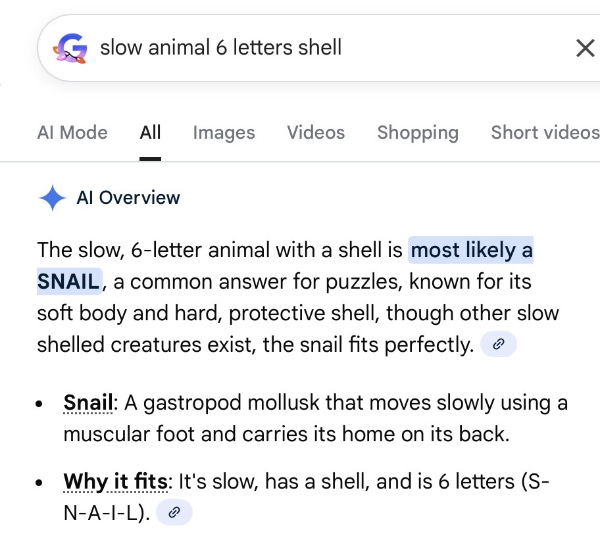
G.W. in Avon, CT, writes: You wrote:
The second is to observe that AI has serious weaknesses, and makes a lot of mistakes, and a student who violates the rules of my course and uses AI to answer their quiz questions for them, or to write their essay for them, is almost certainly going to get caught, and then will pay the penalty (zero on the assignment the first time; F in the course and referral to the university for discipline the second time).Presented for your amusement; this is Google being "helpful":
R.E.M. in Brooklyn, NY, writes: I recently read of a great AI assignment: Give the students a topic and have them generate a paper on ChatGPT. Then they have to review the paper closely and find and correct all the errors. I wish I could remember where I saw it; it was brilliant.
M.S. in Canton, NY, writes: I'd like to offer a dissenting opinion on the question of Stephen Sondheim vs. Andrew Lloyd Webber (with full acknowledgment that de gustibus non disputandum est). For me, this question is not about Lloyd Webber: He is what he appears to be, a master of widely accessible and memorable tunes; I agree with (L) that his best work was with Tim Rice (although I would not dismiss Phantom quite so quickly).
The issue is Sondheim. I admire his work, but mostly I just don't like it. In interviews I heard over the years, Sondheim always came across as thoughtful, insightful, and dedicated. There's no denying the impact he had on American musical theater for half a century. Some might argue that West Side Story is the best musical ever (although Sondheim pretty much hated the lyrics Bernstein forced him to write), and A Funny Thing Happened on the Way to the Forum is a delight. Beyond that, though, I find I only like about one song per show, at most: "Send In the Clowns," "Ladies Who Lunch," and just a few others. His music is undeniably clever, but it rarely moves me.
R.C. in Des Moines, IA, writes: I was pleased to find out (Z) and (A) enjoyed RRR. I loved that movie. I've recommended it to many friends and only one watched and they were lukewarm to it. Sigh.
J.T. in Philadelphia, PA, writes: This week's Q&A was well worth waiting for. I was especially fascinated by the Dutch cultural list, and I found lots to agree with in some of the opinion answers (notably the Sondheim musicals) and disagree with in some others (TV series finales).
But as a septuagenarian, I thought I'd address the finale to The Fugitive. It's a show that I mostly followed during its initial run and have only watched a few episodes since. I remember that, back in the day, it was often compared to Les Miserables—the book, not the musical which had not yet been written—because of the way Lt. Gerard relentlessly pursued Richard Kimble, just as Javert pursued Jean Valjean.
But I kinda see it as a modern version of The Lone Ranger, where Kimble helped out a different family each week and then rode off into the sunset, or slinked away into the darkened alleyways. Of course, he did so for different reasons and without a trusty companion like Tonto, so the comparison wasn't perfect, but then neither is the Les Mis comparison.
In any case, I recall watching the finale and loving it, but the next day my friend Maryann informed me that she was disappointed in it because they had brought in a ringer for Kimble to have a happy ending with, in this case Diane Baker, who was guest starring on practically every TV series in those days. After all the people he had helped and all the women he had nearly fallen into relationships with over the years, they didn't bring any of them back. So Maryann didn't think it was a satisfactory conclusion, and after thinking it over, I had to agree with her. They brought in a woman out of left field so to speak. It would have been better if they had brought back one of the women with whom he had already developed a relationship in a previous episode. Maryann had a candidate in mind, but I no longer recall who it was.
D.S. in Layton, UT, writes: Let me begin by thanking you all as well as my fellow E-Vers for all of your collective contributions, which made it possible for me to survive the fifth year of a Trump presidency. Between keeping me informed, laughing and curious, your page joins Wordle as part of my morning routine prior to waking up Lady D.S. with coffee and the tragic news that HE is still President.
I will accept you not including Breaking Bad in your list of best final episodes as you have not seen the show, but now that you have some time off you can use it to fill that cultural hole. It is one of the greatest dramas in television history and the final episode was one of the best along with: (1) The Shield, which was possibly the most raw cop show ever and ended with the central character's life an absolute mess, while his last action indicates that he is about to take it even further off the rails and (2) Monk, which wrapped everything up and, I am not ashamed to admit, jerked a few tears from our collective ducts.
Also, I do not remember whether St. Elsewhere or Newhart ended first, but both of them predated Dallas with the whole show being a dream, and both were far better.
(V) & (Z) respond: We feel duty-bound to point out your timeline isn't right. The revelation that Season 9 of Dallas was a dream came in the first episode of Season 10, which aired on September 26, 1986. The final episode of St. Elsewhere, with its big twist, aired on May 25, 1988. The final episode of Newhart, with ITS big twist, aired on May 21, 1990.
D.G. in Irvine, CA, writes: While it might not be the best final episode, my favorite ending for a finale episode has to go to the finale of Newhart. It helped that I had watched a lot of The Bob Newhart Show reruns in the '80s, I suspect.
N.S. in Los Angeles, CA, writes: I just wanted to share a politics-related fun fact about The Wonder Years' series finale. In the second-to-last line of the series, we hear adult Kevin's son say, "Hey Dad, wanna play catch?" to which Kevin responds, "I'll be right there." Adult Kevin was voiced by Daniel Stern (the other bad guy from Home Alone, along with Joe Pesci). Kevin's son was voiced by Daniel Stern's real life son Henry, who in 2016 was elected to the California State Senate, becoming the first millennial to do so. He's still there, having won reelection in 2020 and 2024.
J.R. in St. Petersburg, FL, writes: Most of fandom—Star Trek: Enterprise fandom, at least—considers "Demons"/"Terra Prime," the two-parter which was the penultimate Enterprise story, to be the actual series finale. It was created by Judith and Garfield Reeves-Stevens, and written by Andre Bormanis and the excellent fourth season EP Manny Coto, who could easily have saved the series, given a fifth season.
"These Are The Voyages...," written by Rick Berman and Brannon Braga, is generally viewed as just a coda—and Rick Berman even admitted, in a magazine interview years later, that kidnapping Enterprise with the Next Generation> framing device was "a mistake... that made a lot of viewers really mad." (Or words to that effect; I keep losing the bookmark...)
Ya think, Rick?
Anyway, ya'll have a great week off, and we look forward to your continuing excellent commentary and analysis in the new year. I predict that, since you're off, the regime will pull at least one fast one a day...
(V) & (Z) respond: So, since we're going to be off, the administration is going to slow down?
B.K. in Plymouth, MN, writes: I had to comment on the finale to Star Trek: Enterprise, as it was intended to be just a season finale instead of a series finale. I doubt that it would have helped "These Are The Voyages...", as 17 seasons of Star Trek was likely the absolute limit fans could take. Even the Star Wars shows of today seem to be having the effect of wearing on the casual fans. Plus, "The Pegasus" is an OK episode from The Next Generation season 7, but I don't believe it needed to be revisited.
W.D. In Mattawan, MI, writes: (Z) Wrote: "Quantum Leap: So, Sam never gets to go home, after all. And thus, the tension at the heart of the entire series was meaningless, and none of it was building to... anything. Great job, producers."
Over the years, I have come to appreciate the ending to Quantum Leap. Particularly given the final episode indicates that Sam had unconscious control of his leaps and could have returned home anytime. That he did not return home means he was still willing, on some level, to prioritize putting right what once went wrong over his personal desires. Nevertheless, the ending that aired was admittedly unsatisfactory, even if there are elements of it that I can appreciate.
However, I would not put the blame for the lack of resolution on the producers. When the final episode was filmed, the network had not yet determined whether the series would be renewed for a sixth season, so the writers created a cliffhanger. The script for the episode firmly establishes that Sam has leaped into the future and Al will continue to search for him, possibly even becoming a leaper. It was long thought that this ending was changed prior to filming the episode, but it turns out they actually did film the scene where Al and Beth talk about continuing the search to find Sam (albeit without confirming he's in the future). You can find this "lost ending" on YouTube. Instead of using this cliffhanger ending, the network canceled the show and the decision was made to re-edit the episode into a more closed ending. With neither funding nor time to reshoot, there was no way to actually return Sam home. I suppose they could have put text on the screen saying he went home, but that feels a little too pat to me. This may have been the best they could do with the footage they had and under a mandate to not end on a cliffhanger.
(Note: I wrote this response ignoring the recent, two-season revival. Different writers, different producers, and they retconned some of the mechanics. Not a bad show, but I don't consider it canon regarding Sam's story arc.)
R.R. in Pasadena, CA, writes: I think you're being unfair to say that the Quantum Leap ending is one of the worst, as there's the real world explanation for what happened to consider. They had finished production when the cancellation order came down, so there was not a chance to film anything else. They had filmed a tag for the show already, where Al talks to his wife (whose marriage Sam saved just before) about how Sam was lost and he's going after him, setting up a season six where Al was to become a leaper. The producers couldn't really leave that in, it would have been worse to tease the fans that way, and they couldn't film anything else, so adding some text following Sam's leap after saving Al's marriage was the best they could do.
The text itself isn't really a disappointment either. Sam had just done a leap where he did a good thing, not to save history but because it made Al's life better. He was free to leap through history doing the same, not limited to keeping history in check... the entire last episode is about Sam's character and teaching him that he can do whatever good he wants. And since Bruce McGill's character was implied to be some kind of supreme being, that basically means Sam was a guardian angel, stepping in to help people's lives be better. That Sam gave the rest of his existence to doing that isn't a disappointment, it's a noble ending for the character, and it doesn't make the series meaningless because there was never a guarantee that he would leap home, only a hope. Sam chose not to go home, and presumably in exchange improved countless lives.
As for Bakula's other entry on your list... Star Trek: Enterprise is such a missed opportunity, and the fact that they finally got everything humming along in season 4 only to end on the worst episode possible is emblematic of that. It felt like such a betrayal watching that, which makes sense because it was really Rick Berman trying to put a coda to that run of Star Trek series instead of serving Enterprise. And it's really a double middle finger, because if they hadn't wasted so much on meaningless retreads and the temporal cold war, we could have had the Romulan War and the process of the foundation of the Federation, which we only glimpsed. Enterprise had a lot of really good stuff going on and some great episodes, and all that ended up wasted because of an infuriating final episode.
Scott Bakula was generally great in both shows, though, so it's just a coincidence that he's on your list twice (especially since one of those really isn't justified, IMO). If you want a bad series finale then look at Gene Roddenberry's Andromeda, a really cool concept with 1½ great seasons followed by 3½ seasons completely sabotaged by Kevin Sorbo's ego, with a conclusion that's basically Sorbo doing the wrestler victory dance after five seasons of trying to save the galaxy... it was actually even worse than the Enterprise conclusion, which is hard to do.
L.H. in Chicago, IL, writes: Thank you for your eloquent and insightful response to what I thought of as a frivolous question of mine concerning non-Christmas winter songs not being played after Christmas. I agree with your observation, and will not complain again.
The only thing I can add to your comment is that I WISH my local LITE-FM station would go to all Christmas music as soon as THANKSGIVING ends. They seem to think that the listeners want that as soon as HALLOWEEN ends. I will actually not listen to that station in November before Thanksgiving Day, because I like Christmas music, but I don't want to be sick of it before December even begins. And Thanksgiving is my favorite holiday of the year, so I hate it getting the bum's rush.
Enjoy your well-deserved break. As far as I'm concerned, 2025 can't go away fast enough.
B.G. in Strafford, VT, writes: L.H, in Chicago wrote that "Baby, It's Cold Outside" was originally meant to be about consensual flirting and not sexual harassment. I agree!
I first heard this take in 2010, when Slay Belle argued that the song was a feminist anthem when written in 1936.
About 6 years ago, I recorded the song with new lyrics to reclaim its original perspective:
S.K. in Sunnyvale, CA, writes: A follow-up to you answer yesterday to L.H, in Chicago. Case in point: "Let it Snow" was written in July, during a heat wave, as the author fantasized about cooler weather. It was, of course, released shortly after the following Thanksgiving.
J.M. in Arvada, CO, writes: I'll die on the hill that "Linus and Lucy," by the Vince Guaraldi Trio, is a Christmas song despite just being a jazz number.
(V) & (Z) respond: Of course it's a Christmas song. That whole album is one of (Z)'s preferred choices for Christmas parties, because it's obviously Christmas, but it's also instrumental, so you don't have lyrics competing with people's conversations.
P.C. in Yandina Creek, QLD, Australia, writes: Best Christmas song ever: "Fairytale of New York," by The Pogues and Kirsty McColl.
No contest...
B.J.L. in Ann Arbor, MI, writes: Interested in your response about the impact of Moneyball. I have a kid who is now a collegiate baseball player, and can attest that baseball is just the most sophisticated data-collection exercise of analytics in sports. Football is a close second and field-video capture results in immense data mining in other sports including soccer, tennis, rugby and field hockey, with increasingly meaningless stats being collected.
There have been tactile changes in scouting we've seen. The analytics are so pervasive that one might find that scouts never leave their offices for pre-scouting. It's imperfect, as fields are all variable size and small fields might result in kids with outsized power stats. Today it's all about power hitting or hitting with authority. Having access to training staff who can help raise someone's profile. It's a much less egalitarian game. It's expensive.
I've also seen that scouting is lazy. Someone gets buzz for being hot as a strong hitter or pitcher and suddenly they awaken MLB scouts' interest. The scouts will be physically present at a collegiate game to watch the game and the player of interest. Watching the scouts, they don't seem aware or interested in the rest of the players also playing that day. It's distressing to see that the blinders of analytics can't account for someone who is a diamond in the rough; those are the ones they should be looking for.
J.A. in Monterey, CA, writes: Let me add further to the answer to the question on momentum (aka, the Hot Hand), posed by A.S. in Black Mountain, as I have written extensively on this, particularly with respect to basketball.
Daniel Stone of Bowdoin College, in a 2012 article, made the point that it is impossible for a researcher to correctly classify shots that players take into the hot-hand vs. normal state. And so, if shooting percentages are 45% in the normal state and 65% in the hot-hand state, then the incorrect classification by the researcher means he/she will understate the 20-percentage-point hot-hand effect. So the difficulty of identifying whether a given shot is in the hot-hand state, along with the relative infrequency of the hot hand, makes it impossible to quantify the hot-hand effect and very difficult to detect it in data. (I'd guess about 3% of all shots are taken in some hot-hand state; note that the hot-hand is a continuum, not a discrete state.) Daniel Stone's obvious point was missed by Steven Levitt (Freakonomics), a few economics Nobel laureates, Larry Summers, and myself in my first article on this topic (even though I found evidence for the hot hand).
The hot-hand research gives us one of my favorite ironies: Economists claim that the hot-hand fallacy is that people mistakenly see patterns (the hot hand) in data that are random (i.e., no hot hand), but it is the economists who are mistakenly perceiving randomness in data that is patterned (failing to recognize the hot hand). This is another case, in my view, in which the public is often more correct than what economists can tell us with their research... and this is coming from an economist!
K.R. in Austin, TX, writes: Your answer to A.S. in Black Mountain reminded me of a long-ago time when Jack Morris, a great pitcher for the Detroit Tigers (and other teams) in the 80s and 90s had a bad streak. ' It turned out that he was doing something that tipped off his pitches to the other team. In baseball, it's apparently common for teams to share information like that with all the teams except the team that the player is on.
A.G. in Scranton, PA, writes: My fellow readers will have to forgive me for being so emotionally invested in this story of blind people being able to play the game of football. As an autistic person, I was told—even at home—that there were going to be things in life I just had to accept that I would never be capable of doing. I proved those people wrong, and the story resonates with me because I bet they were told many of the same things.
Like the football equivalent of Mystery, Alaska, I think the blind football players should scrimmage against the New York Jets.
Sure, some people would say that it would be cruel, an unfair competition, that it would just end up in a horrible blowout victory over a bunch really nice of guys who are just trying their best to play a game they love despite all of the barriers, physical handicaps, and limitations that G-d put in their path to playing football at any level, and that there's no way a bunch of truly earnest men—even men with their hearts in the right place—could ever stand a chance out there against real football players.
I think that if they want to prove to every schoolyard bully who taunted them about never being able to play football that they were wrong that they can do so in that scrimmage and be heroes to those who others—"normal" people—might believe to be less capable than others. It would mean a lot to a guy like me to watch them do that and I know it would mean something to millions of others in similar situations.
And, by gum, if they can turn around, battered, muddy, bloodied, and bruised at the end of that game and say they left everything they had out there on the field of battle then I don't care what anybody says, none of them will ever have to hear the word "loser" from me... and they can tell anyone else who says it to go to hell.
Still, we should probably ask the blind players to take it a little easy on the Jets, though. There is such a thing as good taste.
Rim shot.
K.F.K. in Cle Elum WA, writes: Such good news about Flash's and Otto's lifespans and successful surgeries. It can be hard to watch our pups age. The week before my daughter got married in Ensenada, our family dog ruptured a disc. We bundled him up and took him to an emergency vet in St Paul, MN. The prognosis was grim and they were not equipped to do surgery. A kind vet there called a friend at a Blue Pearl clinic and he was seen at the crack of dawn the next morning and admitted for surgery. I never believed I would pay what it cost to have that surgery for a 10-year-old dog—but also, I could not imagine having him put down days before a wedding, and the prognosis for a good life post surgery was good. So we proceeded. The staff there could not have been more caring. When we needed to board him while in Mexico, they reduced the fee because he no longer needed medical care but couldn't board at a regular place. They sent pictures and updates to me in Mexico on a regular basis and we were so happy to bring him home post wedding.
He lived another year and half or so. I was in Pullman, WA, restoring a wooden racing shell (whole other story) and he'd been showing odd behavior in the week prior—stopping on walks, etc. He also had idiopathic seizures so it was hard to know what was going on. I came home from my long weekend and got a pretty normal greeting. When I woke up the next morning he had passed quietly in the night, laying at the foot of our bed. I truly believe he waited for me to be home in order to die. I hope he is catching squirrels in some alternate realm.
Two photos, post surgery and one year later:

D.J.M. in Salmon Arm, BC, Canada, writes: All the best to the staff dachshunds in the new year! Perhaps they would like a Canadian approach to dog walking:
(V) & (Z) respond: We will see if the dog walker is up for that. The dog owner definitely is not.
B.C. of Walpole, ME, from aboard my Uncle Charlie's boat, writes: With my fellow readers I have enjoyed the hobbies feature, but I offer a word of caution: Hobbies can be dangerous. My Uncle Charlie, a serial hobbyist, took up photography, wood carving, copper enameling, casting silver jewelry by the lost wax process, radio-control boats, radio-control submarines, home winemaking, etc., etc., etc. His serious dependence on hobbies coupled with the need for a more powerful "fix" (in the unique argot of the hobby underworld) led to the crack cocaine/black heroin/crystal meth of hobbies: model railroading.
One of Uncle Charlie's O-gauge boxcar buddies built a new model railroad—not in the garage or the basement or the attic, but in the backyard, with cars large enough for an adult to straddle and ride. Another of his HO-caboosehead junkies—I'm not making this up—bought an airplane so the guys could fly to model railroading conventions together.
That's when we did the intervention. Family and friends sat him down and said, "Uncle Charlie, you have hobbies." He denied it, of course. We pointed to the sailboat in his garage: "Where did you get the boat, Charlie?" (He'd bought the plans and built it himself in the time between copper enameling and home winemaking, before he fell in with the model railroading crowd.) Eventually all hobbyists end up with this terrifying realization: If I stop working, I'll have more time for hobbies, but I won't have as much money for hobbies.
As I read about readers' avocations, I could see some of them sliding down the slippery slope to total hobby addiction. I don't want to see any of them end up like Uncle Charlie. If you can't avoid hobbies, please, forsake the utter degradation of model railroading.
J.E.S. in Sedona, AZ, writes: I appreciated the report from J.G.P. in Glendale about his Uncle Ross' crypt being located adjacent to Charles Laughton. These sorts of accidental/inadvertent/unexpected side-by-side (or above-and-below, in Uncle Ross' case) are fascinating to me, to the point that I researched and wrote a book (co-authored by Rear Admiral James McNeal) on the subject: Side By Side in Eternity: The Lives Behind Adjacent American Military Graves.
The origin story for this book stemmed from my own father's grave. He was a highly-decorated Marine Corps officer, tragically killed in an automobile accident soon after his retirement. He is buried at Beaufort (South Carolina) National Cemetery, at the end of a row beneath a magnificent live oak. His side-by-side in eternity neighbor is "_ Harris, USCT," (U.S. Colored Troops), a fallen Black soldier whose death date is recorded as 11/11/1865, shortly after the end of the Civil War. (Beaufort National Cemetery is also the final resting place of many members of the 54th Massachusetts Infantry, the revered unit whose story was immortalized in the film Glory, and is also explored in my book):

I was struck by this random happenstance of burial plot assignments, and have spent a lot of time researching Harris, trying to learn more about him and his life, with limited results; there were three possible soldiers in the record who could be buried next to my father, and due to shabby historical documentation of the USCT veterans, I can't positively confirm which one is him. (It doesn't help that his grave lists but one name, so "Harris" could actually be a surname or a given name.) But that doesn't really matter in the big scheme of things, as my family have adopted Harris as one of us, regularly visiting the cemetery to tend to both my father's grave and Harris' grave. It's a small gesture of gratitude for a big sacrifice by someone otherwise forgotten by history. We remember, with respect.
If you have suggestions for this feature, please send them along.