
Previous | Next | Senate races | Menu
New polls:
Dem pickups: (None)
GOP pickups: (None)
Trump's Trade Deals Don't Stand up to Scrutiny
The whole point of Donald Trump's blitzkrieg PR strategy is to flood the zone with "the good news" so as to win the next news cycle or two. By the time the pleasant glow starts to dissipate, he's generally moved on to the next blitz. This is true of most of his policy initiatives, but particularly his "trade deals."
When the White House announced the latest trade deal, the one with the E.U., it certainly looked like a "win" for the administration, since E.U. president Ursula von der Leyen effectively agreed to accept a 15% tariff without any retaliatory countermeasures. On top of that, she committed to $600 billion in investment in the United States, plus $750 billion in E.U. purchases of American gas and oil.
We gave Trump credit, both yesterday, and the day before, for his success (albeit with reservations in both cases). After all, we are trained academics, and we do what we can to evaluate the evidence on its own merits. In this case, that means trying to put aside our general sense that Trump is not really a very good negotiator, and that his approach to trade is haphazard and not well thought out.
However, the more we read about the deal, and the more we think about it, the more we feel like we might have been snowed by the initial PR blitz. To start with, it's now come out that the trade deal—which, again, isn't actually a trade deal, it's just a framework—was negotiated in under an hour, basically in between rounds of golf in Scotland. Does that really sound like any sort of serious process, as opposed to "let's get something on paper before the deadline, so Trump can declare a victory"? The alternative for the E.U. was to call Trump's bluff, and see if he did, or did not, chicken out again.
Beyond that, it's now clear that both of the multi-hundred-billion-dollar promises were nothing more than meaningless vaporware. We wrote yesterday that the $600 billion in investment is effectively just a helpful suggestion. The E.U. nations have no intention of putting up that money themselves, and no ability to compel private companies to do so. That means that the only way any of that money gets invested is if the private companies decide it's in their best interests. Since those companies would pursue such investments with or without a trade deal, that means that "the E.U. will invest $600 billion in the U.S." actually works out to "probably some E.U. companies will invest in the U.S., which they would have done anyhow."
When we wrote the item yesterday, we suspected that the $750 billion in energy purchases was similarly vapory, but we couldn't find anything to confirm that. Apparently, that's just because it takes a little time to gather the evidence. In the 6-8 hours after we went live, there were a whole bunch of pieces poking holes in that part of the deal. For example, this one from Politico describes the concession as a "fantasy." Readers can click through the link for the nitty-gritty, but for the pledge to become reality, the E.U. would have to triple its energy purchases from the U.S., while the U.S. would have to double its energy exports (not its European exports, ALL its exports). Neither of these things is plausible. On top of that, much of the $750 billion would be in the form of liquified natural gas (LNG). Well, even if the U.S. could produce that much LNG, and even if Europe could purchase that much, E.U. nations don't have the necessary infrastructure to store or distribute LNG at that scale.
So, it would appear that all that Trump got was an agreement from the E.U. to accept 15% tariffs without retaliating. Except, he doesn't actually have that, either. At least, not yet. Thus far, by waving his saber around, the President has secured six trade "deals." Do you know how many of those have actually been signed, however? Only one. That would be the one with the U.K., and that one was also a framework. Apparently, a more formal framework than the others, but a framework nonetheless. As we have written many times, actual trade deals are hard. The serious ones, whether they were actually adopted (NAFTA, USMCA) or were abandoned (Trans-Pacific Partnership), took years to hammer out. Last we checked, "years" is rather more time than "an hour in between golf games."
Inasmuch as there are no details yet, there is plenty of room for the E.U. (and for other trade partners) to haggle over dozens, or hundreds, or thousands, or tens of thousands, of different imports. If you want some really dry reading, take a look at this pdf of goods potentially subject to tariffs when imported into the United States. It's almost 200 pages, at a rate of roughly 40 items per page, and covers things like "parts and accessories of taximeters," "air compressors mounted on a wheeled chassis for towing," "pearl onions not over 16 mm in diameter," "aromatic esters of formic acid" and, of course, "nonaromatic esters of formic acid." After all, you don't want any esters-of-formic-acid shenanigans. Anyhow, E.U. officials have already been making noises about the details, and suggesting that there may be some significant disagreement over exactly what products are, and are not, covered by the trade framework.
At this point, let us point out a few things:
- The leaders of the various U.S. trade partners know that Trump's main concern is "wins." The quicker he can declare
a win, and the larger the number of impressive bullet points he can include in the official White House fact sheet, the
better, as far as he is concerned.
- Once he gets a "win" out of one trade partner, he tends to move on to some other trade partner. Again, he has not
completed a trade deal with any nation, as yet. Even the signed one, with the U.K., is nowhere near complete. And none
of them appears to be particularly close to being completed.
- There is plenty of opportunity for trade partners to stretch out the time between "trade framework" and "actual
trade deal." First, if the Trump administration is haggling with 10 or 20 or 50 or 100 trade partners at once, it may be
a while before it finds time to focus closely on any one trade partner. Second, if the E.U. or Japan or the U.K. or
anyone else can add a day to the negotiating process by making a ruckus about duties on pearl onions, and then another
day by making a ruckus about esters of formic acid, and so forth, they can delay the process quite a bit.
- The leaders of the various U.S. trade partners know that Trump will never want to admit that a previously announced
"win" has turned into a "loss." That potentially gives them leverage, in the form of: "Well, if you don't budge on
[TARIFF X], we'll have to walk away and abandon our tentative agreement."
- The leaders of the various U.S. trade partners also know that even if they have to eat some tariffs for a while, there is a very possible expiry of Jan. 20, 2029. One can absolutely imagine the tariffs having negative effects, and the next president campaigning on a promise to rescind them on Day 1. On top of that, there is also a lawsuit challenging the legality of the tariffs in the first place, on the basis that there is no "national emergency" as called for by the law under which he is operating. So, if the various leaders can chew up a bunch of the time, they can potentially reduce the hit, or maybe avoid it entirely.
Add it up, and we wonder if Von der Leyen, although she's coming under withering fire from her colleagues, hasn't just shown the world the template for dealing with Trump: Give him some giant concessions he can brag about, even if those concessions aren't realistic or meaningful, and then go into a prevent defense, as much as is possible. The efficacy of such an approach depends, to a large extent, on whether some tariffs kick in even during the "we only have a template" phase. Nobody seems to know whether this will be the case or not, perhaps because nothing has been written down on paper, much less signed (except, again, in the case of the U.K.). And note that it's not impossible that Trump will conveniently forget to circle back and actually finish off these trade deals. While he clearly believes tariffs are magic, he can't ignore the clear economic turmoil that they've engendered, particularly at the over-the-top levels he's demanded. It could be that he decides that standing pat with tentative "wins," and avoiding the fallout of the actual tariffs, is the best of both worlds for him.
Meanwhile, Trump's announced deadline of August 1 is just days away, and there's no deal with Brazil, Canada, China, India, Mexico, South Korea, Taiwan, or Thailand, among many others. Will Trump stick to his guns? Will he chicken out? Will he announce more "frameworks" have been hammered out? We have no idea. However, note that a couple of times, he has allowed tariffs to kick in, only to lose his nerve when the stock market plummeted and, in particular, when the bond market took a turn adverse to U.S. interests. So, even if he brings the hammer on Friday, it will be at least a week or two until you can be sure it's for real, and not another KFC special.
We will also make one other observation, when it comes to Trump's dealmaking. Even if the tariffs come to fruition, and even if the trade partners do not retaliate or find other ways to undermine the deals, that still doesn't mean he's truly won. There's the possibility of economic turmoil, including inflation, which could hit the Republicans in the teeth in 2026, 2028 or both. Further, trade is supposed to be a long-term game. If the other nations of the world conclude that the U.S. is an unreliable and/or abusive trade partner, they can and will start to redirect their business elsewhere. That probably won't happen while Trump is still in office, and it might even not happen while he's alive, but the potential long-term consequences have to be at least part of the assessment.
The bottom line is that, with an additional 48 hours' worth of information and consideration, we are considerably less impressed with Trump's E.U. deal than when it was announced.
Finally, one last bit of trade-war-related news. Sen. Josh Hawley (R-MO) is about to introduce a piece of legislation, supported by Trump, that would lead to $600 "tariff rebates" being issued to all Americans. It's a clear example of trying to buy people's votes with... their own money. It's also a tacit admission that, despite Trump's claims to the contrary, the costs of tariffs are mostly borne by American consumers, not by foreign producers. If the bill actually gets to the floor of the Senate and the House, it could be very interesting, as support might not break down along party lines. (Z)
The Epstein Files: Maxwell Thinks She Has Leverage... and She Might Be Right
Ghislaine Maxwell is many things, but she is not stupid. And the lawyers working for her are not stupid, either. She and her lawyers know that everyone wants to talk to her. She and her lawyers also know that she can take a cue from her former friend/client/enabler Jeffrey Epstein, and plead the Fifth if she does not see the value in spilling her guts.
To that end, Maxwell sent a letter to the House Oversight and Government Reform Subcommittee yesterday advising that if they would like to have a non-Fifth-Amendment chat, there are going to be some conditions: (1) immunity from further criminal proceedings, (2) questions in advance, (3) no deposition until her appeals are over, and (4) holding the deposition somewhere other than the prison where she is incarcerated.
We can think of many possible games of 3-D chess that Maxwell might be playing here. The most obvious is that she is buying time, so that some sort of pardon arrangement can be worked out with the White House. After all, once she's told her tale, she's got no more leverage. She cannot seriously be worried about additional prosecutions; she's already got a de facto life sentence. She's currently set to be released at age 83, and not too many people make it to that age when the last 20 years are hard years.
Meanwhile, the attempts to distract or otherwise defuse the issue are getting more inventive... or more desperate. Donald Trump, for his part, claimed that The Wall Street Journal has been begging with him to settle the defamation lawsuit he filed. Uh, huh, we will believe that when we hear it from, well, anyone besides Donald Trump.
Meanwhile, the hottest right-wing meme yesterday was... photos from Brooke Shields' Calvin Klein ad campaign in 1980. The claim is that "the liberals" were OK with that campaign, and Shields as "basically the same age" as the teenagers that Epstein and Maxwell trafficked. We will note that: (1) There is no reason to think the campaign was by, or for, liberals; (2) Whether it was or was not, the liberals of today are not the same people as the liberals of 45 years ago; (3) Shields, born in 1965, had been acting professionally for more than 10 years at that point and her mother was an actress. She certainly had an agent and took the role voluntarily and (4) there is a rather large difference between "tight jeans" and "rape."
And finally, we will share this whackadoodle tweet from Deputy FBI Director Dan Bongino:
During my tenure here as the Deputy Director of the FBI, I have repeatedly relayed to you that things are happening that might not be immediately visible, but they are happening.
The Director and I are committed to stamping out public corruption and the political weaponization of both law enforcement and intelligence operations. It is a priority for us. But what I have learned in the course of our properly predicated and necessary investigations into these aforementioned matters, has shocked me down to my core. We cannot run a Republic like this. I'll never be the same after learning what I've learned.
We are going to conduct these righteous and proper investigations by the book and in accordance with the law. We are going to get the answers WE ALL DESERVE. As with any investigation, I cannot predict where it will land, but I can promise you an honest and dignified effort at truth. Not "my truth," or "your truth," but THE TRUTH.
God bless America, and all those who defend Her.
Respectfully,
Dan
Bongino is himself a conspiracist, and he thinks he can redirect the other conspiracists by implying the existence of bigger and scarier conspiracies than the piddling Epstein matter. The problem—and (Z) actually used to have this as a class assignment—is that it's pretty hard to cook up a compelling conspiracy theory out of thin air. And Bongino does a terrible job of it here; a proper conspiracy theory has to have at least SOME details, and this one has none. So, back to the drawing board. Presumably with a Sharpie. (Z)
Legal News, Part I: It's Now JUDGE Bove
There have been a number of judicial nominees put forward by Donald Trump (and a few by the Georges Bush) who were in the running for "most godawful judicial nominee in the last century." This is not just our subjective judgment; these nominees' godawfulness is affirmed by their fellow legal professionals, who have undertaken a number of campaigns, backed by letters signed by some high number of distinguished people, to encourage the Senate to give the thumbs down. While Democratic presidents are plenty good at coming up with partisan nominees, those presidents do make sure that their nominees are still well-qualified and are not ethically compromised.
The latest competitor for the title of "most godawful judicial nominee in the last century," who has a real argument as rightful claimant to the crown, is Emil Bove, who was tapped by Trump for a seat on the Third Circuit Court of Appeals. By all indications, Bove is qualified, with a J.D. from Georgetown and 20 years in the legal profession (though no service as a judge). However, he is as ethically compromised as any judicial nominee since, perhaps, Abe Fortas. It is bad enough that Bove has worked, for many years, for Donald Trump, since Bove could end up hearing cases in which the President is either a plaintiff or a defendant. It is far worse that, before and during his service in the Trump v2.0 White House, Bove has engaged in all sorts of behavior that, at best, should get him disbarred and, at worst, should land him in prison.
Since Trump sent Bove's nomination to the Senate, there has been no shortage of people trying to warn the senators that he's a very bad candidate. For example, 80 former federal and state judges signed a letter warning about "Mr. Bove's egregious record of mistreating law enforcement officers, abusing power, and disregarding the law." This was seconded (81sted?) in a letter signed by 900 former Justice Department attorneys. There are also at least three whistleblowers who came forward with specific information about misconduct by the nominee.
In a development that should be a surprise to absolutely nobody, the Senate confirmed Bove yesterday. The vote was 50-49, with Sens. Susan Collins (R-ME) and Lisa Murkowski (R-AK) crossing the aisle to vote with the Democrats. Once again, by amazing coincidence, Collins managed to rebel against her party without her vote actually mattering. Sen. Bill Hagerty (R-TN) is the one member who did not cast a vote; if he had, it presumably would have been to confirm. So, President of the Senate J.D. Vance was never in danger of having to cancel his golf plans.
And so, a godawful judge will receive his commission and will take his seat. We know we will get this question, so we'll just answer it now: There is no precedent for impeaching and removing a judge, except for crimes committed while on the bench. It's not impossible, mind you, just that there's no history of it. It is also improbable that, even if the Democrats regain the Senate, 15 or so Republicans would cross the aisle to support such an effort. The good news is that appeals court decisions are handled by a panel of three judges, except when they are heard by the entire circuit en banc. So, there's actually somewhat less room for one rogue judge to make mischief, in contrast to district court judges like Trevor McFadden, Reed O'Connor and Matthew Kacsmaryk. Silver linings!
The downside is that Bove might be Trump's nominee to replace Justice Samuel Alito if he retires next June, which seems very likely. Otherwise he would be taking a risk that the Democrats could capture the Senate in Nov. 2026 and no more Trump judicial nominees would be confirmed. (Z)
Legal News, Part II: CECOT
And now, the latest developments in the Kilmar Abrego Garcia case, the case concerning the U.S. deportees sent to CECOT in El Salvador, and the Los Angeles case against ICE.
Abrego (as he prefers to be known) remains in federal custody for the next 30 days, but only at the request of his attorneys. Waverly Crenshaw Jr., the Tennessee judge who is overseeing the criminal case against Abrego for allegedly facilitating the movement of undocumented people in the U.S., upheld a magistrate judge's order that he be released pending trial. The magistrate judge who set the conditions of his release granted the defense motion to delay the release for 30 days. This request was to allow the judge in the immigration case, U.S. District Judge Paula Xinis in Maryland, to issue an order regarding Abrego's rights, should ICE attempt to detain him again upon his release. And her order, which came down soon after the criminal court's order, says that Abrego must be brought back to Maryland upon his release and that ICE must give Abrego and his attorneys at least 72 hours' notice before initiating any deportation proceedings.
What this means is that 30 days from July 23, the date of the order, Abrego should finally be able to return to his home in Maryland to see his wife and son. But given the Trump regime's vendetta against him after he had the temerity to hire an attorney to fight his deportation, which they admitted was a mistake and a violation of the 2019 stay of removal order, he is likely to remain a target of this government. It should be noted that in prioritizing his deportation, Trump is admitting they have no case against him in criminal court. If he was actually guilty of these crimes, then he should be put on trial and, if convicted, serve his sentence in the United States. After serving time, then he can be deported. But clearly, Trump has no confidence that the charges against him will stand up.
Meanwhile, as readers know by now, despite repeatedly declaring in court that they had no control over the prisoners held at CECOT and so could not even facilitate their return to the U.S., the government managed to use them as political pawns to secure the release of 10 Americans held in Venezuela. So, all 252 men have finally been released from the hellhole where they were tortured and are currently in Venezuela. Since then, a few more details have come to light. One of the "Americans" released and returned to the U.S. is a green card holder who was convicted of a triple murder in Spain and was serving time in Venezuela. So, apparently, if you're a hairdresser, you're a threat to the country's safety and should be deported, but if you're a convicted murderer, Donald Trump will cause untold suffering on the part of hundreds of others just to get you back and set you free. It would seem that when Trump said "they're" sending murderers and rapists, he was talking about himself and his employees.
In a court filing in the case involving Daniel Lozano Camargo, aka "Cristian," who was wrongfully deported in violation of a settlement agreement protecting young people with pending asylum claims, the government admitted that all 252 men can be returned to the U.S. if ordered by a court. It stated that Lozano can return to the U.S. to continue his immigration proceedings "should he wish to return." Other detainees have lawyered up and are seeking contempt orders for their unlawful removal and detention in violation of U.S. District Judge Boasberg's order enjoining the deportation flights to El Salvador.
Finally, oral arguments in the Ninth Circuit were held yesterday on Trump's emergency application for a stay pending appeal of the temporary restraining order enjoining ICE from indiscriminately snatching people off the street in Los Angeles and surrounding areas. To say that the government got a chilly reception from the panel is an understatement. They were skeptical of the government's claims of an "emergency" requiring a stay when, according to the government, none of this is actually happening. If they're not doing what the plaintiff claims they're doing, then how can they be harmed by an order telling them to stop doing what they're not doing?
The government's best argument was that a "follow-the-law" injunction is too broad and vague to adequately apprise agents of what is prohibited. But the response was that the order was more than just "follow the law"—it listed four categories that could not be the sole basis for reasonable suspicion: race, accent/language spoken, location, type of work. And as Judge Jennifer Sung pointed out, Los Angeles is the most diverse city in the country with more than 40% identifying as Hispanic or Latino, so using those factors alone is just as likely to result in the arrest of a law-abiding citizen as someone who is out of status. And the record supports that, with the evidence of the arrest of a U.S. citizen who is Latino and happens to work at a tow yard. The other issue that came up is whether ICE has a policy of these indiscriminate arrests. Judge Ronald Gould repeatedly questioned the DOJ attorney whether agents were told to arrest 3,000 people per day. In the end, the panel seemed somewhat inclined to clarify the lower court's TRO but otherwise uphold it. They should rule soon. (L)
Election News: U.S. Senate
Note that when we do these "round-up" items, we only cover those races where there has been some meaningful bit of news. We got a number of e-mails last week along the lines of "What about the governor's race in [STATE X]?" That is because there was no news, or at least no news we were aware of, related to the governor's race in [STATE X]. Of course, we can't keep our ears to the ground in all 50 states, so we are always grateful for heads-up about interesting gubernatorial/U.S. Senate/U.S. House news at items@electoral-vote.com. Also note that we have capsules at the Senate candidates and Governor's races links above.
And now, the latest Senate-race news:
- Georiga: We are not sure where Georiga is, but as of this week, Rep. Mike Collins (R-GA)
is running for the U.S. Senate there. He announced his campaign
with an ad
that ends with this thought:
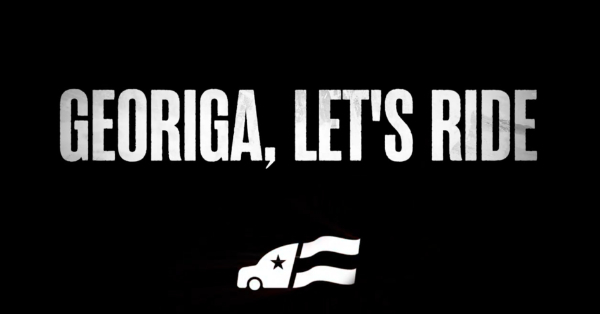
Fun fact: "Sweet Georiga Brown" is the theme song of the Harelm Globetrotters.
It is our guess that Collins actually intends to run in the state of Georgia. If so, it's not a great start to make such a big mistake in your launch ad. We suspect there will be more than a few jokes at his expense during the campaign. Our helpful advice: If the jokes give you heartburn, Rep. Collins, a few bites of a plain baked potatoe can help.
Collins is probably the best candidate the GOP could have hoped for, once Gov. Brian Kemp (R-GA) took a pass. Certainly, he's better than Rep. Marjorie Taylor Greene (R-GA). That said, Collins will now face a bruising primary against Rep. Buddy Carter (R-GA). They will probably compete to show which of them is the Trumpiest of them all, and then will have to turn around and run in the general election in a state where Trump is not especially well liked. Meanwhile, Sen. Jon Ossoff (D-GA) can sit back, relax, and enjoy looking at his campaign bank account statements and his polling numbers. At the moment, he has more than $15 million on hand, and he's up between 3 and 10 points in hypothetical matchups against both Collins and Carter. - Kentucky: The mud is already flying on the Republican side of the contest. Prominent local
businessman Nate Morris
got in
last week and, just to make clear where he stands, he made the announcement on Donald Trump Jr.'s podcast. The other
three Republicans in the race immediately slammed Morris as a closet liberal and a faux Trumper. Should be lots of fun.
Meanwhile, Sen. Mitch McConnell (R-KY) favors former state AG (and former McConnell aide) Daniel Cameron as his successor. It's not going so well; after raising a relatively paltry $508,000 in Q1, Cameron raised just $365,000 in Q2. That's called "headed in the wrong direction," and it's not gonna cut the mustard when the other leading candidate, Rep. Andy Barr (R), has more than $6 million in the bank. - Maine: Pollster Morning Consult gave Susan Collins something to be "concerned" about this
week. In the last 3 months, her net approval among Maine voters
had dropped
12 points. She was at 47% approve, 44% disapprove back in April, and now she's at 42% approve, 51% disapprove.
That's a move from net of +3 to a net of -9. No other senator dropped so much.
While one would not want to read too much into this, with so many lifetimes left until the actual election, Collins' net approval at this point in 2019 was +12. She ended up winning that election by 9 points. So, tentatively, she has some work to do. - North Carolina: The biggest news of the last week is from the Tar Heel State,
as the Democrats bagged their man when former governor Roy Cooper agreed to
take the plunge.
If you would like to see his announcement ad,
it is here.
Readers will be happy to hear that he spelled both "North" and "Carolina" correctly. In his first 24 hours
after declaring, Cooper
raised
$3.4 million. That is very impressive for a single day, and one this far out, but it's also just a start. The last
Democrat to run for the U.S. Senate in North Carolina (Cheri Beasley) ultimately raised over $38 million.
And she wasn't a popular former two-term governor in an absolutely critical race.
Cooper's entry into the race promptly caused former representative Wiley Nickel (D) to drop out. Rep. Don Davis (D) has hinted at a run, but up against the Cooper buzz saw, he's presumably having second thoughts. Meanwhile, Donald Trump's latest preferred candidate (after two or three others took a pass) is RNC Chair Michael Whatley. There's been no Cooper vs. Whatley polling, as yet, but in all the Cooper matchups that HAVE been polled, the former governor has been on top by 1-4 points. - Ohio: Now that the Democrats have their preferred candidate in North Carolina, it's time
for the pooh-bahs to turn their attention to other winnable states. And so it is that Senate Majority Leader Chuck
Schumer (D-NY)
was in Ohio last weekend,
to persuade former senator Sherrod Brown (D) to try to get his old job back. Brown has made no comments, thus
far, but he would be far and away the Democrats' best hope to flip the seat currently occupied by Sen. Jon Husted (R).
It's tough to unseat an incumbent, but not impossible, as Brown himself learned last year. Further, Husted isn't a
full-fledged incumbent, as he was appointed to the job, and did not win it himself. Appointed senators' track record is
about 50/50.
- South Carolina: It is hard to imagine a sequence of events that would end with this
seat in Democratic hands. So, the best that members of the blue team can hope for is that the much-disliked Sen.
Lindsey Graham (R-SC) gets booted out on his rear by another Republican. It might happen, as Paul Dans,
one of the key figures behind Project 2025,
announced a primary challenge
this week.
Graham rates poorly in the "spine" department, but very highly in the "getting reelected" department. That said, he's dared to challenge Donald Trump on a few occasions, and MAGA voters are very unforgiving types. Dans, by contrast, is all-in on the President. It is possible that this race could be decided by Trump's endorsement. However, these days, Trump's main goal is to keep his batting average as high as is possible. It would not surprise us at all if he makes no endorsement, or if he uses a trick he's used in several other races, and endorsed both of the Trumpy candidates. It is our guess, based on no data whatsoever, that Dans' best and only hope is if he is the ONLY Trump-backed candidate. Otherwise, Graham's incumbency and $15-million-and-counting war chest will be too much to overcome. - Texas: You might have noticed that Sen. John Cornyn (R-TX), who is not all that Trumpy,
has nonetheless veered in a very Trumpy direction in the last month or two. For example, as we noted last week,
Cornyn is leading the charge (along with Lindsey Graham) to appoint a special prosecutor to investigate
Barack Obama.
This may have something to do with the fact that Trumpy challenger Ken Paxton, the wildly corrupt Texas AG, is absolutely crushing Cornyn in primary polls. There have been four polls of the race released in the last two months, and they had Paxton up by 22, 16, 10 and 19 points. It is hard to imagine how Cornyn might meaningfully change the trajectory of the race; he's already doing what he can in the Senate to shore up his support. Meanwhile, Paxton is apparently bulletproof, and cannot be harmed by scandal. The most recent poll was taken after Paxton's wife left him for being a philandering lech, and yet it had Paxton at 57% and Cornyn at 38%. Maybe Cornyn should find someone who is very good at Photoshop, and can create some photos of Paxton with Jeffrey Epstein.
Democrats are praying, chanting, burning incense, rubbing their good luck stones, and otherwise appealing to the higher power of their choice that Paxton knocks Cornyn off. The majority of Texas Republicans are clearly fine with a Trumpy sleazeball, but the majority of Texas voters might not be.
We'll cover the House shortly. (Z)
Never Forget: Scout's Honor
Today, a memory from J.G.P. in Glendale, AZ:
In the early 1970s, I was a Boy Scout in Southern California—part of a generation raised on reverence, khaki uniforms, and a sense of civic and spiritual duty that sometimes outpaced our own understanding. I earned my Eagle Scout rank in 1971 and, like many Catholic Scouts, I worked toward the Ad Altare Dei religious emblem. The requirements were challenging but meaningful: attending Mass regularly, demonstrating knowledge of Church teachings, performing acts of service.
But one requirement stood out: We had to attend five rosary services for the deceased.
At 12 years old, this was a logistical challenge more than anything. My peers were still very much alive, and death was not something that yet shadowed my world. So, my father and I took to the obituary section of the local newspaper like some sort of somber treasure hunt, scanning for the names of recently deceased Catholics. When we found one, we'd put on our Sunday clothes—or in my case, my neatly pressed Scout uniform—and drive off to attend the rosary.
Most services blurred together: dim chapels, murmured prayers, faces I didn't recognize. But one stuck.
The man in the coffin had been a soldier—young, recently returned home from Vietnam in the most tragic way. He had been a member of our parish, and I might've served on the altar at the very same church where his casket now rested. My father, a World War II veteran who liked to say he "kissed the sand in Normandy," sat beside me in the last pew as we recited the prayers for the dead.
As we were quietly leaving, a woman approached me. The soldier's mother. Her eyes were red but kind. She thanked me for coming, told me her son had been a Scout once too, and that he would've been proud to know a young boy in uniform came to honor him. She hugged me.
That hug—gentle, grief-soaked, and utterly undeserved—stayed with me long after the medal was earned and tucked away into a drawer.
I remember walking out into the parking lot and telling my father that I felt ashamed. I had come in pursuit of a badge. She had come to bury her son. And somehow, she ended up comforting me.
Years later, in one of those moments that sneaks up while reminiscing with your parents, I told my dad that I couldn't remember the soldier's name. "I wish I did," I said. "I'd look for him on the Vietnam Memorial one day. But I just don't recall it."
My dad was quiet for a moment, then simply said: "That's because he wasn't just one name. He was all of them."
I've never forgotten that moment. The humility of a grieving mother. The quiet wisdom of a father who'd seen war firsthand. And the realization that sometimes, when we set out to earn something for ourselves, we're actually being given something far greater—a lesson in grace, sacrifice, and remembrance.
The Ad Altare Dei medal sits in a drawer somewhere, its ribbon a bit faded. But the memory—the soldier without a name, the hug that still lingers—remains sharp.
He represented them all. And I was lucky enough to stand in prayerful silence, wearing a Boy Scout uniform, on behalf of every one of them.
Thank you, J.G.P. (Z)
Previous | Next
Main page for smartphones