Previous | Next | Senate races | Menu
New polls:
Dem pickups: (None)
GOP pickups: (None)
Denise Powell Is Your Winner
When we wrote up the Nebraska election results yesterday, the outcome of the Democratic primary in the D+3 NE-02—the district being vacated by Rep. Don Bacon (R-NE)—was unknown. With 89% of the vote in, businesswoman and activist Denise Powell had 38.9% of the vote to 36.8% for state Sen. John Cavanaugh. We guessed that Powell would hold on to win, as there was no plausible theory for why the final 10% might break 4-to-1 for Cavanaugh, but that was just a guess.
It would seem we were on to something, though. Now that 95%+ of the ballots have been counted, the total is... 38.9% of the vote for Powell, as compared to 36.8% for Cavanaugh. So, things did not budge one bit. There's no way to make up a 2-point gap with less than 5% of the vote still out, and so Powell will indeed be the nominee.
Powell will now face off against Brinker Harding (R). He sounds like a character in a Charles Dickens novel, but he's actually an Omaha city councilman and 4th-generation Nebraskan. He is running on a platform of slashing the federal budget and owning the libs. If he gets sent to Washington, one of those two things will go right out the window. The only poll of the race, which is very old, had Powell leading Harding by 5 points. That's not a great data point, but the blue lean of the district, the national climate, and our sense that Harding is not a great fit lead us to conclude that Powell is the favorite here. This is the kind of seat the Democrats simply must flip to retake the House, so both parties will certainly spend big on this one. (Z)
Will Trump Give Away the Farm to Xi?
Donald Trump is in China now and President Xi Jinping is going to play him like a fiddle. Just look at Trump at the arrival ceremony, grinning from ear to ear, with him as the center of attention and hundreds of Chinese students waving American and Chinese flags at him. He just eats this up:

Of course, the real buttering up (fattening up for the kill?) will come today when Trump meets the exceedingly savvy and well prepared Xi.
Trump just loves loves loves all the pomp and ceremony with himself at center stage. There will be more, with Trump
feted with a no-holds-barred state banquet today. For the sake of the U.S., one can only hope his staff keeps reminding
him that he is there to defend the interests of the United States, not to see the trip as an early 80th birthday party. After
he came down the steps from the plane, he was followed by Elon Musk, Secretary of State Marco Rubio, Secretary of
Defense War Pete Hegseth, and Nvidia CEO Jensen Huang and
other CEOs.
Huang might have been useful if he spoke fluent Mandarin, but he doesn't (he speaks Taiwanese Hokkien). Rubio is the
only one of the bunch who might try to look out for the best interests of the U.S., but how much influence Rubio
really has remains to be seen.
Reuters' headline sums up the trip well: "Trump lands in China for Xi summit with Nvidia CEO in tow." Trump sees the trip as making deals for the handful of cronies and other CEOs, like Huang, he took with him. Huang is exactly the wrong person to take along. Nvidia makes the chips China needs so its AI can beat America's AI. Congress is wildly against the sale. Here is Sen. Dick Durbin (D-IL) quoting Karl Marx on this:
Trump will gladly sell China Marx' proverbial rope with which to hang America. All he cares about is getting a good price for it, which China will happily pay since it needs the chips badly. This is one point of leverage the U.S. has over China. A Democratic president could take a different view, something like: "We don't want to sell you Nvidia's chips, but we will barter them with you. One chip = [X] kg of rare earths," for some appropriately large [X]. Then the haggling would be over the value of X. In this deal, the U.S. government would buy the chips from Nvidia and then barter them for rare earths. With Trump, don't count on that, let alone a discussion of Taiwan, the Chinese expansion into the South China Sea, Iran, tariffs, and other issues that actually matter.
The Independent's headline is even worse than Reuters': "A humiliated Trump will be played by China." U.S. media are afraid to show what foreign media like Reuters (Canadian) and The Independent (British) clearly see. This is the best The New York Times can muster:
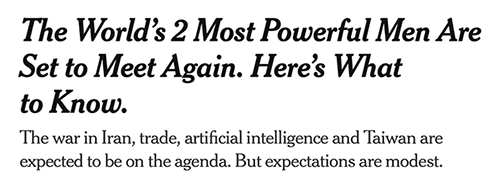
Yes, expectations are modest. Got it. Trump is negotiating from a position of weakness, and Xi knows that in great detail. Trump doesn't know how to get out of Iran, inflation hit a new 3-year high yesterday, and gas is averaging $4.53/gal., up from $2.87/gal. when the Iran War started. The Donald feels he needs something to crow about, and he thinks Americans will love it if at the end of the summit he announces a few billion-dollar deals. But even here, the deals have to involve China buying products manufactured or grown in America. Getting permission from China to allow Apple to sell a bazillion iPhones there made in India won't cut it. Nor will China agreeing to buy 100 tankers full of Texas oil. To have any effect on voters, the deals have to result in jobs being created in America or farmers selling more agricultural products to China.
The key to understanding Trump is that he is vain, peevish, grossly uninformed and completely unaware of actual reality. Xi probably thanks whatever higher power he thanks that he is facing Trump, not Kamala Harris, who is far better informed than Trump. China is the main supplier of weapons to Iran and Russia (for use in Ukraine). Is Trump going to demand that Xi stop the flow? He is probably not even aware of it. And speaking of weapons, one thing Xi wants is for the U.S. to stop supplying them to Taiwan. Will Trump agree? Hold on to your hat. And what about China building artificial islands in the South China Sea, complete with airstrips and military bases and then claiming the sea around them as Chinese territorial waters to create a choke point for trade? Does Trump even know how to read a map (other than to use a sharpie to move a hurricane)?
Although Trump doesn't understand the details, what he does understand is his vision of the world. It is Russia gets to dominate Europe, China gets to dominate Asia and Africa (for its resources), and the U.S. retreats from being a world power and becomes a regional bully to boss around North and South America. Rubio understands this and so do Senate Republicans, but Trump listens only to his gut. May 14, 2026, may go down in history as the day the U.S. surrendered being the world's preeminent power to China for a mess of soybeans. (V)
Courts Have Overruled Trump 10,000 Times on Detention
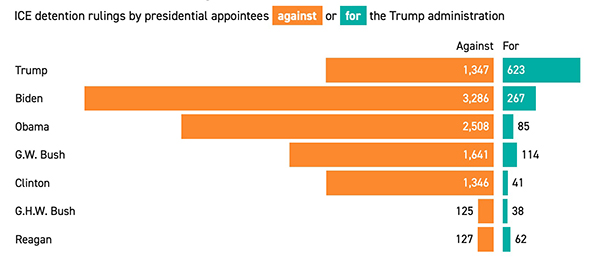
Yesterday, we had an item on bodies. That was about one case. Politico went to the trouble of tracking down other immigration cases. It found over 11,000 of them. In 90% of them, the judge ruled against the Trump administration. Turns out the Constitution says that everyone in the U.S., legally or not, including immigrants, has the right to due process. Specifically, that means that law enforcement may not arrest and deport someone without a judge first saying that the arrestee broke some law and is subject to deportation. In other words, just grabbing people off the street and deporting them violates the Constitution and judges will not stand for it.
If you are an immigration nerd and want to see all 11,610 cases, here is the list. Be prepared to scroll through 581 pages, though. It would have been nice if Politico had made an Excel spreadsheet you could download, but apparently it didn't.
What is interesting is who appointed the judges who made these rulings. The majority were Democratic appointees, in part because many Bush and Reagan appointees have long since retired, so the courts have more Democratic appointees than Republican appointees. Still, even among Trump appointees, Trump has lost over two-thirds of the cases. Among Biden appointees, Trump has lost 92% of the cases. That does suggest a difference in philosophy (or something) between Democratic and Republican appointees. Here is the distribution:
Politico has said it will keep the database up to date as new cases are decided. (V)
What Is the Twenty-Fifth Amendment Really For?
Many Democrats are calling for the Twenty-Fifth Amendment to be invoked to get rid of a president they hate. That is not what it was intended for. John Feerick, the law professor who thought of it and who helped write the text, finally got around to explaining what it was for.
It was adopted after John F. Kennedy was assassinated and was intended to provide continuity of government in times of crisis. It was never intended as a tool for the opposition to undo an election it doesn't like. The Constitution says: "in case of the removal of the president from office, or of his death, resignation or inability to discharge the powers and duties of the presidency, those powers 'shall devolve on the vice president.'" The problem is that this raises some questions that did not have clear answers. What does "inability to discharge the powers and duties" mean? Who gets to make the call? And if the president is dead, does the vice president actually become president or just a kind of acting president? The general idea is clear: The vice president is like a spare tire that can be rolled out if needed, but the mechanism isn't clear, especially if the president is alive and claims there is no "inability." Also, if the vice president becomes or acts as president, how do we get a new spare tire?
The Amendment was meant to provide clarity. It has four sections. The first three are not controversial, and are as follows:
- If the president dies or resigns, the vice president becomes president.
- If the vice presidency becomes vacant, the president nominates a new veep for Congress to approve.
- A president can declare his own "inability"—for example, when undergoing planned surgery.
The fourth section is the tough one. It says the veep and a majority of the Cabinet (or some other body Congress may choose) can declare the president unable to discharge the duties of the office. The authors were thinking of a situation like the one that occurred in 1919, when Woodrow Wilson had a stroke and his wife, Edith Wilson, didn't tell anyone and ran the country herself for 17 months. Sec. 4 says if the veep and half the cabinet see that the president is not up to the job, the veep can take over. However, if the president contests this, Congress gets to decide who is right, with a two-thirds majority in each chamber required to actually remove the president. This is intentionally a steeper hill than an impeachment and conviction (which requires a majority of the House and two-thirds of the Senate), to reduce the chances of the opposition using this section for partisan reasons. The framers of the Amendment were really focused on a medical situation, not a political one.
Could this come into play before Jan. 20, 2029? It could. If Trump goes the way of an earlier guy who ruled the place, King George III, and becomes stark raving mad and that is clear for two-thirds of the House and two-thirds of the Senate, then J.D. Vance could invoke the Amendment and there would be votes in both chambers. That would be consistent with the intention of the framers of the Amendment. It was never intended to remove a president who was sane but making decisions the opposition didn't like. The intended cure for that situation was for the voters to replace the entire House and one-third of the Senate within 2 years. Or, alternatively, impeachment and conviction. (V)
Poll: Michigan Senate Seat Could Flip
A great deal of attention had been paid to the possibility, maybe even the likelihood, of the Democrats flipping Senate seats in Maine and North Carolina. There has also been a lot of attention to possible longshot Democratic wins in Senate races in Ohio, Alaska, Texas, and Iowa. Also on the agenda are the independents running for the Senate in Montana and Nebraska.
There has been much less attention to the races where Democrats are defending open seats or vulnerable Democratic incumbents. Initially, the most vulnerable seemed to be Sen. Jon Ossoff (D-GA). But he has a couple of things going for him. First, he is a fundraising powerhouse, raising $78 million this cycle and spending $51 million of it, leaving him with $27 million in the bank. Second, the Republicans are having a brutal three-way primary and are bleeding cash. All the general election polls have Ossoff ahead by 2-9 points, probably because the Republicans are bludgeoning each other to death. All in all, Ossoff is in surprisingly good shape.
Much further under the radar is Michigan, where Sen. Gary Peters (D-MI) is retiring and where it is the Democrats who are having a brutal three-way primary. The Democrats are Rep. Haley Stevens, state Sen. Mallory McMorrow, and former Wayne County health director Abdul El-Sayed. There the Republicans have their candidate in former Rep. Mike Rogers. A new Glengariff poll shows how close it is. Rogers beats Stevens 43.8% to 41.5%. He beats McMorrow 42.8% to 40.7%. Against El-Sayed, Rogers beats him 44.7% to 39.8%, which is (barely) outside the 4-point margin of error. In other words, Democrats need to worry about defense as well as offense.
The only other Democratic seat that might be in danger is the open seat Sen. Jeanne Shaheen (D-NH) is leaving behind. There it is the Democrats who have their candidate, Rep. Chris Pappas (D-NH), while the Republicans have two plausible candidates, both former senators: John Sununu and Scott Brown. The most recent poll has Sununu ahead of Brown by 37 points. The second most recent one has Sununu up to 29 points, so it looks like Sununu vs. Pappas. The last 10 general election polls have Pappas ahead of Sununu by between 2 and 14 points, averaging a 7-point lead.
So on the defense side for the Democrats, Georgia is not the biggest worry, nor is New Hampshire. The trouble spot appears to be Michigan. Unfortunately for the Democrats, the Michigan primary is Aug. 4, so the blood will continue flowing for almost 3 more months. The one potential saving grace here is that this is not an ideological war. All three are fairly progressive and probably all of them are acceptable to the supporters of the losers, so it is unlikely that there will be a long period of sulking starting Aug. 5, with supporters of the losing candidates threatening to sit this one out. (V)
Republican Super PACs Are Engaging in Rodent Reproduction in Democratic Primaries
Both sides do it, but at the moment, the Republicans are at bat. A mysterious super PAC called Lead Left has been meddling in three Democratic congressional primaries in hopes of getting the weakest candidate nominated. It is registered to the address of a Staples office supply store in Tallahassee and has been funneling money through LLCs with no disclosure of who is behind it. However, its website has links to WinRed and the messaging in its ads closely parallels those in a Nevada group linked to the House Republican leadership. A second super PAC is active in a California race.
One race where the first super PAC is active is in the new TX-35 district, where the DCCC is backing Johnny Garcia, who has worked for the local sheriff and is a moderate. The Republicans are backing Maureen Galindo (D), who raised under $10,000 in Q1, in the upcoming runoff with Garcia. The GOP is sending out bilingual mailers saying she is a progressive Democrat who would dismantle ICE and impeach Donald Trump. Galindo has said the money came from a billionaire Zionist. Sens. Jacky Rosen (D-NV) and Ted Cruz (R-TX) have both called her openly bigoted. It is not every day that Rosen and Cruz agree on anything. We're not sure they could even agree that today is a Thursday.
Another race the red team is meddling in is PA-07. This is an R+1 district in the Lehigh Valley represented by Rep. Ryan McKenzie (R-PA). There, Lead Left is supporting Lamont McClure, a former Northampton County Executive. In the PAC's ad, it says: "Lamont McClure kicked ICE out of Northhampton. He takes on Trump and wins." McClure raised only $20,000 in Q1. The stronger candidates are Bob Brooks, a firefighters' union leader, and Ryan Crosswell, a former DoJ attorney. The Democrats are not interfering in that battle, but they see McClure as a much weaker candidate.
The third race doesn't seem to make any sense. Here Lead Left has opposed John Cavanaugh in the blue dot. But the Democrats also oppose Cavanaugh—because they want him to stay in the Nebraska legislature to block Nebraska from going to winner-take-all in presidential elections. It seems odd a Republican-aligned super PAC is doing what the Democrats want. Maybe the people behind it don't actually understand what they are doing. In any event, both Lead Left and the Democrats got what they wanted (see above).
The fourth race is CA-22, a district around Bakersfield where Rep. David Valadao (R-CA) is trying to hang on. The official Republican House super PAC is supporting the progressive Randy Villegas against the DCCC favorite, Jasmeet Bains, a moderate, in this conservative district.
Republicans are enjoying themselves. Mike Marinella, a spokesman for the NRCC, said: "Between the DCCC picking favorites, progressives revolting, dark money groups pouring millions into messy intraparty fights, and candidates publicly torching each other and party bosses, Democrat primaries have become a circular firing squad and must-see reality TV all rolled into one." What he conveniently forgot to mention is that the dark money is from Republicans stirring up trouble in Democratic primaries. (V)
Do Democrats Still Value Experience?
Probably the most interesting House race in the country that doesn't really matter is in NY-12, a D+33 district that covers Midtown Manhattan and the Upper West Side and Upper East Side. Kamala Harris carried the district by a margin of 64 points. This is the district from which Rep. Jerry Nadler (D-NY) is retiring. Whoever is the Democratic nominee will win in a landslide, so all that matters is who that nominee is.
It is interesting because there are four main candidates (and a bunch of minor ones). Here they are alphabetically:
- Alex Bores, a young assemblyman since 2022 with an interest in technology
- George Conway, a lifelong conservative Republican who hates Donald Trump with the heat of a million suns
- Micah Lasher, a 44-year-old assemblyman with 25 years of experience in politics, in many roles
- Jack Schlossberg, a complete political newbie who just happens to be Jack Kennedy's grandson
Bores isn't well known and Conway is a one-trick pony. Just hating Trump won't do the trick because the other three also hate Trump. This makes it Lasher, the highly experienced and very qualified candidate, against the guy who is carrying the Kennedy mantle forward. Politico has an interesting story about the race and whether experience matters anymore. If it does, Lasher should win because he has over two decades of it, working for Nadler, Gov. Kathy Hochul (D-NY), former NYC mayor Mike Bloomberg, and former NY AG Eric Schneiderman. He knows how all the nuts and bolts of politics work in great detail. He has helped draft legislation to aid consumers, toughen gun laws, protect access to abortion, and raise the minimum wage. Schlossberg has done none of this and isn't pretending he has. He is running on the vision of restoring the Kennedy dynasty.
Because Lasher has been around so long in politics, he has also made some enemies in Democratland. He spent a year as executive director of StudentsFirstNY, which advocated for charter schools, something the teachers' union despises. In this role, he also sent $50,000 to the NY state Senate Republican Campaign Committee. He also worked with former governor Andrew Cuomo on a pension reform plan that the unions hated. Since then, he has become more union friendly. Nevertheless, Bores has been the one racking up union endorsements. Here are Bores, Conway, Lasher, and Schlossberg (L to R) at a candidate forum in April:
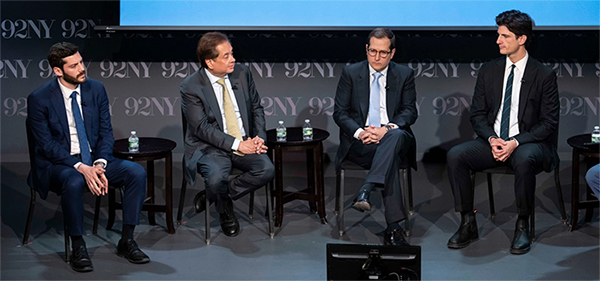
At the forum pictured above, Lasher argued that impeaching Trump is unlikely, which gave Schlossberg the chance to pounce. He said: "Maybe if you have a super PAC funded by a billionaire [Ed. note: Bloomberg], you don't understand how people feel around this district about President Trump." In practice, experience doesn't really matter that much for most first-term representatives, as they have no power and they normally get no attention. A very few have star power on their own—Alexandria Ocasio-Cortez (D-NY) comes to mind here—and use that to have far more influence than their background would justify. Lasher is highly competent but has no star power. Schlossberg has zero experience in politics but has tons of star power, inherited from his beloved grandfather. Many people would instantly see him as a future senator (maybe even in 2028) and a future president beyond that. Maybe that is not fair, but since when is politics fair?
There have been five polls so far, none of them recent. Schlossberg has led in four of them, by margins of 3-10 points. Bores led in one February poll by 1 point.
A study by the AARP sheds a different light on the race. It shows that voters 50 and older will likely make up 65-75% of the primary electorate in NY-12. The district is one of the wealthiest in the country, with a median household income of $153,000. Only 10% of active Democratic voters 18-29 have ever voted in a Democratic congressional primary, vs. 64% of voters 65 and older. NYC Mayor Zohran Mamdani's youth-based coalition isn't going to play much of a role here because they don't live in the district. It is too expensive. A voter who is 70 is probably going to have some memory of how traumatized his parents were by the assassination of President Kennedy and a voter who is 75 will remember it personally. The people who look back fondly on JFK could well be inclined to want a Kennedy restoration. That could play a role here.
The prediction markets are telling a very different story. Kalshi has Bores at 51% chance, Lasher at 37%, Schlossberg at 17%. This adds up to 105%, but that is due to the vig. The primary is June 23 and is first past the post. (V)
There Are Green Shoots in the Media World
The media landscape is very grim. Thomas Jefferson once famously said he would prefer newspapers without a government over a government without newspapers. A modern version of that would replace "newspapers" with "media outlets," since recycling trees isn't really the essence of journalism in the 21st century. It is about investigative journalists looking for and publicizing things the government would rather not publicize. They are not going the way of the dodo, but times are tough and courage is scarce in legacy media outlets.
There is a lot of bad news on the news front, what with mergers, retrenchments, and billionaires buying and silencing publications. As more and more legacy media companies are bought by billionaires or silenced by their owners, is there any hope for investigative reporting?
Here are some of the problems. The billionaire owners of The Washington Post and The Los Angeles Times killed endorsements of Kamala Harris carefully prepared by their respective editorial boards. Donald Trump has sued the Post, the Times, The Des Moines Register and even the Rupert-Murdoch-owned Wall Street Journal. He hasn't won all of them, but he has put them on notice to behave or else.
Now on to television. When Trump threatened ABC News, it paid him $16 million in tribute. Paramount, which owns CBS, also paid Trump $16 million to make him leave them alone (for the moment). If you think this will not interfere with their editorial policy going forward, good luck with that. And Bari Weiss, who now runs CBS News, is not likely to be compared to Edward R. Murrow or even Walter Cronkite. Trump has also sued NBC. As soon as Paramount completes the deal to buy Warner Bros. Discovery, the Ellisons, who run CBS, will also run CNN.
The Times is often critical of Trump, but still pulls its punches a lot now. Other than that, the legacy media, both print and broadcast, has been completely cowed. And if they published something critical and got sued, they know that finding a law firm would be difficult because most of the big ones have been neutered by Trump as well.
Is journalism and its buddy, Truth, now dead? Maybe not. Let's take a look.
- Wire Services: First, some legacy media companies are still alive and well. The
Associated Press is a nonprofit and has been going strong for 180 years, although it did take a hit last year when
Gannett (the biggest newspaper chain in the country by readership) and McClatchy (#6) dropped the AP simply for business
reasons (they want to use the money to hire their own reporters). Reuters, which is headquartered in London and is owned
by a Canadian company, has 2,500 journalists and 600 photojournalists. Over 1,000 newspapers and 750 broadcast TV
stations subscribe to it. Reuters produces 2 million stories a year and reaches a billion people every day. The AP is
slightly left of center and Reuters is smack in the middle. As a nonprofit, the AP encourages people to read its
website
and support it by making a donation.
- ProPublica: What got us thinking about this subject is
this story
in ProPublica. It turns out that there are a few green shoots out there in medialand—small media companies that do
real journalism and could one day become bigger companies. When the late Ted Turner started a network broadcasting news
on cable 24 hours a day, everyone thought he had lost his mind. It did pretty well, although the Ellisons may finish it
off.
ProPublica is a small investigative journalism company that has been around for 18 years and is growing quickly. It just opened a new office in California, staffed by four reporters and a fellow, to cover West Coast news. It expects to hit 250 employees this year. Revenue, partly from donations from foundations and individuals, hit $70 million last year and is growing rapidly. It has partnered with 90 news organizations and has won several Pulitzer Prizes. Here are a few of its recent stories:
- He Was Fired for Sexually Harassing Students. California Allowed Him to Keep Teaching Anyway.
- Babies Are Bleeding to Death as Parents Reject a Vitamin Shot Given at Birth
- Trump Exempted Some of the Nation's Biggest Polluters From Air Quality Rules. All It Took Was an Email.
- The Trump Administration Aims to Penalize Disabled Adults Who Live With Their Families
- Despite Court Order, NYPD Failed to Properly Monitor Stop-and-Frisks by Aggressive Unit
- Puerto Rico Lawmakers Call for Investigation Into Alleged Drugs-for-Votes Scheme After ProPublica Report
- Prosecutors Had a Drugs-for-Votes Scheme "Locked Up." Under Trump, They Were Told Not to Pursue Charges.
- A Noncitizen Says She Was Told She Could Vote. Then Customs Detained Her at the Airport and Threatened to Deport Her.
- A U.S. Senate Candidate Says Foreign Truckers Are Making America's Roads Unsafe. His Own Truckers Have Caused Harm.
- Politico:
Another outlet that does investigative journalism is
Politico,
which has been around for 19 years. It was founded by media executive Robert Allbritton in 2007. It is online, but is
also a physical, paper newspaper (which is why we italicize the name). When Mike Allen was at Politico, he
started Politico Playbook, an early morning e-mail newsletter. By 2016, it had 100,000 subscribers in D.C. alone,
including insiders, outsiders, journalists, lobbyists, senators, presidents, and would-be presidents. Politico
was recently purchased by German media company Axel Springer for over $1 billion. As the name suggests, its focus is on
politics. It has versions for the U.S. and Europe. It has over 700 employees in the U.S. and 375 in Europe. It does lots
of investigative journalism and has broken a number of scandals. It has won one Pulitzer Prize and various other awards.
One thing it does that no other organization does is cover congressional committee meetings. If a company is in, say, the agriculture business and the House Agriculture Committee has a hearing or meeting, the company will pay big bucks to know exactly what happened there. That is also true of nonprofits and local governments that have a keen interest in what some part of the federal government is up to. Highly tailored (and very expensive) subscriptions are available for folks with very specific interests. Half of Politico's revenue comes from this part of the company.
- Axios:
In 2016, veteran journalist Mike Allen left Politico and, along with Jim VandeHei and Roy Schwartz, founded
Axios.
Its goal was to do investigative journalism and report the results as concisely as possible, for busy readers. Most
articles are under 300 words. It now has 500 employees. In addition to the website, which is free, there are multiple
paid newsletters. It also runs ads, some of which double as content. It has gotten into some trouble for not always
adequately distinguishing between editorial content and paid ads. In 2022, Cox Enterprises bought the company for $525
million.
- NOTUS: Another news source with Politico roots is NOTUS, a digital news outlet
owned by the Allbritton Journalism Institute. NOTUS stands for News Of The US. It was founded by Politico founder
Robert Allbritton in 2023. It has a website but also distributes content to other nonprofit news outlets. Notable about
NOTUS is its focus on training the next generation of investigative reporters. Recent college graduates who want to
become investigative journalists can apply to become a (paid) "fellow" for 24 months. Those accepted get a month-long
immersion course in the ways of D.C. and then watch how the professional staff journalists work. After a while, they can
start doing their own investigations and writing their own stories. After the 24 months, the good ones have a nice
résumé and list of articles they have published, making it easier to find jobs as journalists elsewhere.
When Jeff Bezos decided to strangle The Washington Post in the hopes it would die a slow death and then, out of gratitude, Donald Trump would give Bezos' space company, Blue Origin, more NASA contracts, one of the things he did was drop local news coverage and sports coverage. Allbritton saw possibilities here. He hired a number of the Post reporters Bezos had fired and decided that NOTUS would now cover D.C. local news and local sports. The goal would be to ultimately replace the Post as the capital's leading newspaper, albeit only in digital form. It will start next month and be renamed The Star, which sounds more newspaperly than NOTUS. Also, The Star was the name of a now-defunct D.C. paper once owned by Allbritton's father, Joe Allbritton. The more Bezos degrades the Post to please Trump, the faster The Star will pick up the slack and become D.C.'s paper of record. Given his own background, Allbritton clearly has the smarts, the money, and the history to pull this off.
- Bolts:
Yet another nonprofit digital newsmagazine is Bolts, which covers the nuts and bolts of the (political) news. It was
founded by Daniel Nichanian in 2022, and is somewhat focused on local political news that other outlets miss. It lives
on philanthropic grants and individual donations. It does some investigative journalism and often covers stories that
are down in the weeds but actually important. It leans to the left. It has a focus on voting rights, what's on the
ballot, and criminal justice, among other things. It also has a Q & A section called
Ask Bolts,
somewhat analogous to what we do on Saturdays. It is small, but growing.
- Talking Points Memo:
Another small outlet that has a few investigative reporters is
Talking Points Memo.
It started as Josh Marshall's blog in 2000. It decided to offer paid subscriptions in 2012 and now has over 35,000 paid
subscribers. It also runs a fundraising drive every year and runs ads for nonsubscribers. This has allowed it to hire 18
staffers, mostly reporters. It gets 400,000 page views every day now and has become a (much) smaller version of
Politico, except it clearly leans left.
Coverage includes more things on the fringe than other outlets. Still, it has had some scoops. It also has a section with reader discussions and other features including TPM Cafe (opinion), Muckraker (think: Upton Sinclair), podcasts and more. - Media Matters:
Formally,
Media Matters for America
is a left-leaning website that focuses on investigating and calling out hypocrisy and outright lies in conservative media,
including radio, television, and online.
Sometimes calling out misinformation or lies becomes a story in itself. Among other right-wing media figures that MMfA
has written up for lying include Don Imus, Rush Limbaugh, Laura Schlessinger and Tucker Carlson.
- Slate:
This is an online magazine that covers current affairs, politics, and culture from a liberal point of view. It does some
investigative journalism and in-depth analysis, especially on the Supreme Court. It also has many (audio) podcasts.
- Vox:
Ezra Klein, Matt Yglesias and Melissa Bell founded Vox in 2014 to explain current events in depth but in simple ways
that people can easily understand. It provides more context around news stories than most other publications. It leans left. In addition to news articles, it has podcasts and a YouTube channel
that has 12.5 million subscribers. In Oct. 2021, it had 20 million visitors to the website.
- The Bulwark: When The Weekly Standard went under in 2018, founder Bill Kristol
and editor-in-chief Charlie Sykes decided to set up a website to continue their mission. That mission has morphed into
saving democracy. Although many of the staffers have a center-right background, virtually all of them savage Donald
Trump on a daily basis. Part of the site is free and part is by subscription. There are 76,000 paid subscribers at $100
each, meaning it is taking in over $7 million in revenue a year and is growing rapidly. It has many newsletters,
(video) podcasts and more. The YouTube channel has 1.25 million subscribers, about half as many subscribers as The
Washington Post, but a huge number for a publication that has only been out there for 8 years, and it is growing
rapidly.
Unlike the others in this list, it doesn't do much investigative journalism. Its specialty is no-holds-barred political analysis. It is very rough on Trump and the corruptness of his administration. It has about a dozen podcasts and 10 newsletters, some daily and some weekly. One unusual podcast is Sarah Longwell's focus group podcast. She is constantly running focus groups talking to all kinds of voters—for example, 3x Trump voters, Trump-Biden-Trump voters, and many other combinations to see what makes them tick. That podcast features actual audio of voters saying what they think about the topic du jour. For highly educated and well-informed political junkies, hearing how ignorant and bigoted many voters are is quite a shock. Longwell keeps pointing out that the Democrats have to go with the voters that are out there, not the voters they would like to be out there. Some of the other podcasts are both informative and fun. Jonathan V. Last (JVL) and Longwell do a podcast together every Friday. JVL says Longwell is his best friend, and that comes through, even though he is a devout practicing Catholic and she is a nonreligious lesbian married to another woman.
Of late, they have added a new feature. They do live shows in major cities around the country and then put them on the site as podcasts. Longwell also wrote a book entitled How to Eat an Elephant: One Voter at a Time describing how the voters (and the Democrats) can take the country back from MAGA.
The conclusion is that while legacy mass media outlets are mostly caving to Trump, there are some small to medium outlets that are springing up, mostly digital (which saves the enormous expenses of printing a paper newspaper or having television broadcasting equipment). A number of them do serious original reporting. Some of them have quite a bit of starting capital and large ambitions (like The Star aiming to supplant The Washington Post).
The media landscape is changing. For decades, newspapers and broadcast television were dominant. Newspapers are dying (or going digital) and increasingly many people, especially young people, are "cord cutters" and no longer subscribe to cable television. They get their news from online sites like the ones above and others that straddle advocacy and reporting (like MMfA) and social media, which is an open sewer of misinformation. When new industries are born, initially there are many players. In 1910, there were an estimated 400 companies manufacturing cars in the U.S. Eventually some go under and others merge. It is likely that the many online news sites will eventually merge into a smaller number with larger staffs and more coverage. They will come to rival and probably surpass current newspapers and linear television, especially since younger audiences are not interested in newspapers or television. (V)
Previous | Next
Main page for smartphones