


 Welcome & FAQs
  Table of Senate polls
 Senate graphs
 Tipping-point-state
 Congress: retirements
 Governor's races
 Icons for bloggers
 Data galore

|
Inside Putins Secret Plan to Hack Moldovas Election Injustice Kim Says He Has ‘Fond’ Memories of Trump |
Trump to Urge Limited Tylenol Use Trump and Musk Reunited Quote of the Day |

• Reader Question of the Week: Teaching Assistance, Part III
Sunday Q&A
Here is the missing posting from yesterday. Thanks to those who expressed concern; the issue was that we temporarly lost our broadcast license for the joke we made about the size of Trump's... toolkit, if you will.
Don't forget that next weekend is "no politics questions" weekend. If you have questions about film, art, food, music, books, history, education, etc., please send them to questions@electoral-vote.com.
If you are still working on the headline theme, we will say that those who solve it probably say "Yay!" Which actually does fit, though to make it more doable, we avoided words that qualify in that particular way.
Current Events
E.S. in Providence, RI, asks: On the September 15th episode of his Countdown podcast, Keith Olbermann reported that among a large swath of the right wing, Charlie Kirk was seen as the true heir to the MAGA throne and would have been the 2032 GOP Presidential candidate. Given that he was young, charismatic, and articulate (despite what you think of his opinions), while a lot of the GOP bench is fairly old and unlikable, do you think this theory explains the explosive outrage of the MAGA base? Would the death of some other MAGA influencer have touched off the same kind of venom we are now seeing?
(Z) answers: I think it was mostly that he was young and his passing was so sudden and so shocking. If "we lost our likely 2032 frontrunner" was part of the dynamic, it was only a small part.
Not many MAGA influencers combine Kirk's charisma and his youth. If Joe Rogan had been gunned down, he might have triggered a similar response, we suppose. We don't think any of the Fox entertainers would trigger this kind of grief, nor Ben Shapiro, who is pretty close to Kirk in terms of age and style, but does not seem to inspire the same kind of loyalty.
S.P. in Harrisburg, PA, asks: To what extent do you think the Charlie Kirk assassination could result in helping Republicans in the midterms next year, possibly considering the combination of a sympathy vote and more attention to Kirk's work?
(Z) answers: I think it is more likely to hurt them than help them.
Anyone who is motivated to vote Republican/MAGA due to fandom for Charlie Kirk is ALREADY voting Republican/MAGA. Meanwhile, the response to Charlie Kirk's death is causing all sorts of anti-democratic overreaches by the administration, such as what happened to Jimmy Kimmel. It is well within the realm of reason that those overreaches will inspire some people to get to the polls who might not otherwise have done so, so they can use their vote to push back against the administration.
D.P. in Oakland, CA, asks: It looks like eight home teams held some kind of pregame memorial moment for Charlie Kirk. What Democratic figure might have received the same from NFL teams?
Also, how is Roseanne Barr's removal different from Jimmy Kimmel's?(Z) answers: Generally speaking, such an honor is reserved for three types of people: (1) those of enormous stature, (2) those who were/are seen as heroic figures to a large number of people, and (3) those who were cut down unexpectedly, and in the prime of life.
If Barack Obama were to die this week, we suspect he'd get a moment of silence at next weekend's NFL games. Probably the other two Democratic ex-presidents, too. Very possibly any Democratic member of Congress, if they were shot and killed. And if not EVERY Democratic member of Congress, then at least Sen. Bernie Sanders (I-VT) or Rep. Alexandria Ocasio-Cortez (D-NY).
Roseanne Barr was removed from her show because, after her comments about Valerie Jarrett looking like an ape, the company that produced and broadcast her show—Disney—decided it was better for business to get rid of her than to keep her. Jimmy Kimmel, by contrast, was (temporarily?) removed from his show because, after his comments about MAGA rushing to turn Tyler Robinson into a left-winger, the Trump administration used its power over the broadcast spectrum to strongarm the company that produces and broadcasts his show—Disney—to get rid of him. The former is the free market in action, and is entirely compatible with the First Amendment. The second is government coercion of speech, and is not.
Anonymous in Illinois, asks: This week, I've seen every single person or group I respect openly proclaim that political violence is NEVER acceptable. I have what could be considered a somewhat provocative question concerning that claim: What would George Washington have thought of that statement?
The United States of America did not win its freedom by nonviolent protest. We fought a war and won. Nonviolence is, of course, to be vastly preferred. But when is the line crossed? When does fighting become not only acceptable, but necessary to preserve our freedoms? The Founding Fathers told us the Tree of Liberty sometimes needs to be watered with the blood of patriots. They didn't add that the Tree was also watered by the blood of the opponents of Liberty. When is it time to fight?(Z) answers: This is conflating apples and oranges (something that happens a lot when it comes to political violence in the context of the founding of the republic).
Washington regarded himself, with some reason, as a man of honor. And, in his time, that meant honoring the rules of war. Right at the top of that list is that noncombatant civilians are off-limits, regardless of what they might say, or how loudly they might say it. So, he would not approve of the murder of Charlie Kirk.
However, violence against a hostile military force was entirely acceptable to Washington, as it must be to any professional soldier. When it comes to the British, he would have taken the position, with considerable justification, that they were an invading army who brought violence upon themselves through repressive policies AND through acts of violence, like the Boston Massacre.
D.E. in Lancaster, PA, asks: Gov. Spencer Cox (R-UT) said: "Friends have confirmed that there was kind of that deep, dark Internet, the Reddit culture, and these other dark places of the internet where (Robinson) was going deep" to be indoctrinated in radical leftist ideology.
I visit Reddit, mainly about geeky things like comic books, Star Trek and Lord of the Rings, and I wasn't aware that it was the deep, dark web or that it was in anyway radicalized. I enjoy it because it's one of a few places on the web where you don't have MAGA trolls barging into every conversation, flinging their manure everywhere. Is Reddit the deep, dark web and a site breeding radical leftist violence? Is there a deep, dark area of the web that caters to "leftists?" My experience is that the majority of the web is right-wing, authoritarian MAGA through and through, with very few spaces for liberals and progressives to go without being harassed. I've seen some questionable comments from those on the left but nothing like the vitriol and abusiveness from the right. Am I in my own political bubble?(Z) answers: Cox's remarks are a reminder that a lot of people, particularly those who are right-wing and/or above the age of 50 or so, don't really understand the Internet, and have fallen victim to a bunch of scary-sounding buzzwords.
The "deep web" refers to any part of the Internet that is not indexed by Google, usually because is it not publicly accessible. If you log in to your bank account online, you're accessing the deep web. Same with your medical test results, or your Amazon account. Scary stuff!
The "dark web" is indeed a place of criminality, sometimes, though most people you will encounter there are just poking around because it's "dangerous" and nominally transgressive. The great majority of people have never been on the dark web, and would not have the faintest idea how to get there (it requires, among other things, a special browser—you don't just push the "dark web" button in Chrome or Firefox).
There are a few places on the Internet that have some pretty radical, sometimes violent, speech taking place. That said, those places are not predominantly left-wing or right-wing as much as they are libertarian or anarchic. And, with very rare exceptions, they are not subreddits (which tend to be pretty tame). They are places like 4chan and 8kun.
If you did go looking for online expressions of radical political belief that fit on the right-left spectrum, you will indeed find much more radical-right-wing stuff than you will radical-left-wing stuff. There are far more white supremacists, neo-Nazis, militia members, sovereign citizen-types, and QAnon-ers lurking in the shadiest corners of the Internet than there are revolutionary communists, or Black Power extremists, or latter-day Weather Undergrounders.
S.B. in Winslow, ME, asks: What will it take to stop the growing mischaracterization, verbal and physical violence against transgender people? Shortly after the Charlie Kirk murder, Electoral-Vote.com had items expressing the moral outrage of the radical right, and maybe most/all the political right (who knows these days?). That made me angry.
Daily, I am exposed to opinion after opinion about how trans women are not "real women," how our experience is a mental illness... or worse, a side effect of liberal ideology. Really? REALLY??!!! Liberal ideology? Did I run into some liberal ideologist as a child that infected my mind with a female discord such that I would WANT to be less than a privileged white male, I would WANT to have things thrown at me, to be spat upon, to have my trans-kin murdered (and maybe me, one day) simply for existing, to endure vile commentary on who I am, how I am a danger to women and children, and that my mental illness will make me buy guns to kill people who espouse the idea that everyone should have a gun so everyone is "safe" while also saying "some collateral damage is acceptable," and STILL being OUTRAGED that a gun would kill one of their own. And then, especially galling, trying every which way possible to create a transgender/gay link to the gun murder of Charlie Kirk, while WILLFULLY ignoring mass murders of children in schools, domestic murders, and on and on.
I am exceptionally proud of who I am as a woman, even though my path here was not from birth. My identity documents (thank God) align with that as do my appearance and manner (thank God). I am a productive member of society, do not own any weapons, and am an active part of my faith community, and on the whole well-liked by people who know me.
What will it take to stop the angry political and religious right from making me a target of hate?(Z) answers: I wish I had a more uplifiting answer for you. A few years ago, I thought—and wrote on this site—that targeting trans people would soon lose its political salience. My reasoning, which was clearly in error, was that broad acceptance of gay and lesbian people had arrived, and that the general trendline would quickly extend to trans people, as well. It is clear now that trans bothers a lot of people on some sort of visceral level, upsetting their sense of right and wrong, and of how the world works, in a way that gay/lesbian does not.
It is clear that at least part of this dynamic has to do with age; the older a person is, the more likely they are to be bothered (often to the point of fury) by people being trans. We suspect (though this is just a guess) that people were partly primed for gay/lesbian acceptance by the presence of a handful of notable gay and lesbian historical figures (Oscar Wilde, Walt Whitman, etc.), and by the existence of a fairly sizable number of barely closeted gay and lesbian celebrities in the latter half of the 20th century (Liberace, Paul Lynde, Billie Jean King, Charles Nelson Reilly, Rock Hudson, etc.). There wasn't an equivalent list of trans historical figures, nor were there many (or any) barely closeted trans celebrities. So, accepting trans represents a much bigger change in people's (especially older people's) frame of reference.
That leads us to one answer to your question: Things will change, to be blunt, when the generations that grew up without trans people start to die off.
The other answer we've got, the "historical trends" answer, is arguably even grimmer. Whatever group gets scapegoated in American (or any) society tends to be the one that is most different. And the thing that gets that group off the hot seat is... an even more different group (i.e., a better scapegoat) comes along. So, for example, in the northeastern U.S., it was Irish people, and then it was Eastern Europeans, and then it was Puerto Ricans and other Latinos, etc.
We get letters, on a somewhat regular basis, from a handful of readers who seem to be moderate-to-liberal on most issues, but who are anti-trans, and respond to nearly every letter/news item we run with some sort of screed condemning trans people. To these folks, we'll take this opportunity to communicate two things. First: Get over yourselves. There are plenty of ways that people live their lives that we don't understand, or that maybe we don't approve of, but it's a free country. And skip the spurious, non-evidence-based claims about the "harm" that trans people are doing. Those arguments exist just to convey legitimacy to those who wish to be anti-trans, just like voter ID arguments convey legitimacy to those who want to stop Black and brown people from voting. And not only are these arguments about trans people intellectually dishonest, they are literally getting people killed.
The other thing we'll point out is this: People who send in such messages are wasting their time. We are happy to print letters that reflect viewpoints different from ours, to print criticism of us, etc. But in the last 5+ years, we have not gotten a single anti-trans letter where we hadn't heard what the writer had to say a hundred times before (which means actual trans people have heard it a thousand times before). Such letters offer nothing to the broader discussion, and we don't need to grant the use of our platform to spread propaganda. It's the same reason we would never run an antisemitic, white supremacist, or Charlie-Kirk-style women-should-go-back-to-the-1950s letter.
Any reader who is offended by this, well, the door's on the right. We're not the right site for you, anyhow.
B.C. in Manhattan Beach, CA, asks: In your discussion of the letter purportedly from Donald Trump to Jeffrey Epstein, you did not repeat the assertion made by so many sites to the effect that Trump's signature "looked like" or "took the place of" pubic hair in the drawing.
I realize that the original Wall Street Journal article made that claim; is everyone else just repeating what the WSJ said, or does everyone see it the same way?
To my eye, the signature is about where one would expect it to be—centered at the bottom. There's nothing unusual about the way that the signature appears that leads me to think it was intentionally placed (or drawn) in such a way as to be suggestive of pubic hair.
Am I the only person in the world who does not make that connection?(Z) answers: There are plenty of people like you, who don't "see it."
We will point out two things that might change your mind. First, and we have probably written this before, Trump (and whoever might have been helping him with letter-writing) lived in New York City, and everyone in New York City knew the work of Al Hirschfeld, whose barebones caricatures often featured New Yorkers (especially Broadway stars) and were often published in New York-based publications. For example, here's his Liza Minnelli:
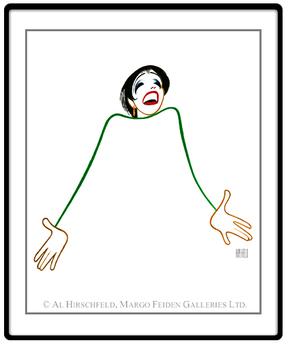
Hirschfeld was a talented artist and Trump is not, but one can still see how Trump's "style" echoes Hirschfeld's.
Second, as a thought exercise, reverse engineer the drawing. That is to say, imagine a person planned to do a Hirschfeld-style caricature, built around the "clever" joke that their signature will be the pubic hair. If you start with Trump's signature, and work from there, we think you end up with... something that looks an awful lot like the Epstein card.
P.L. in Denver, CO, asks: If at some point we have enough information that shows that Donald Trump and other high-powered people were involved in the Epstein sex trafficking, what will Attorney General Pam Bondi do? It seems like she will want to shove it under the rug. If that occurs, is there anything that can be done with the current makeup of the House and Senate, or will we need to wait until the Democrats get control?
(Z) answers: Pam Bondi will never, ever take action against Trump. The sun is more likely to rise in the west than Pam Bondi is to try to prosecute Trump. It is not impossible that some other Republicans will eventually turn against the President, maybe even enough to convict him in an impeachment trial. Not likely, mind you, but not impossible.
Bondi, by contrast, not only appears to be a True Believer, but her power is entirely tied to Trump. While he's in power, she's in power. Once he's out of power, she's cooked. So, she will do anything and everything possible to protect him, whether it's dismissing or denigrating any evidence that emerges, or simply burying her head in the sand. She is Trump's G. Gordon Liddy, or his other Roger Stone.
There is nothing Democrats in D.C. can do unless there is a massive revolt of Republicans in D.C. However, if strong evidence of sexual crimes on the part of Trump was to come to light, a state (Letitia James?) or municipal (Alvin Bragg) prosecutor might pursue it. Those things are not just a violation of federal law.
B.B. in Dothan, AL, asks: Why can't The Convicted Felon (TCF) do his hair right anymore? It's always a mess. I saw one picture of him this week in England, and his hair was square. Today's picture looks like he combed it with a garden rake. I mean, even Tricky Dick had his hair cut twice a month and Barack Obama weekly. I thought TFG was all about outdoing Obama?
(Z) answers: You're right, he's been looking pretty ragged recently. It may be that when he travels 3+ time zones, it interferes with his (already spotty) sleeping schedule, and he's not able to rise early enough for the full 1-2 hour (reportedly) combover. However, our guess is that, at his age, his hair has now thinned to the point that it doesn't have the volume necessary to make the combover work the way it once did.
D.K. in Iowa City, IA, asks: It is obvious that RFK Jr. is seriously mentally ill. Why don't Democrats pursue that line of attack? He would not pass any psych exam.
(Z) answers: Kennedy is never going to sit for a psych exam, unless it's conducted by someone from the same pool of medical "professionals" where he gets his vaccine "experts." So, it's just an unproven attack upon him, and one that's already been visited upon Donald Trump, Joe Biden, and many others. That means that it's lost a lot of its salience.
Politics
R.H.D. in Webster, NY, asks: I was intrigued by the response you gave to a question from K.E. in Newport about the next president(s) needing to show empathy in this current political climate.
Assuming the next president is a Democrat, which I'm praying will be the case, who do you think among the prospective 2028 Democratic field can best be both empathetic but also push back on the Trumpists and Republicans for all the damage they have done? I know the base will demand it after what they've had to endure under 45 and 47.(Z) answers: There are a number of candidates, or sorta candidates, that we don't really know too well yet. That said, Sen. Cory Booker (D-NJ), Govs. Gretchen Whitmer (D-MI) and Andy Beshear (D-KY), and Pete Buttigieg can all do empathy when they need to, and strength when they need to. So can Bernie Sanders and AOC, but they are not running.
N.W. in Marietta, GA, asks: I know there is no chance of Congress moving to restrict Presidential powers while Trump is still in office, but do you see a post-Trump Congress moving to do so, regardless of who the next president is?
(Z) answers: It is certainly possible. Most flaws in the American political system are only fixed once the horses have gotten out of the barn at least once (and usually multiple times).
There are two ways this can happen. The first is if the party in power is generous enough to allow new rules to be adopted that limit their power. The second is if rules are adopted with the specific proviso that they do not kick in until the NEXT presidential administration and/or Congress.
R.H. in San Antonio, TX, asks: As far as MAGA goes: What is it? Other than Führerprinzip for the 21st Century, are there any consistent, articulable principles that can be classed as a MAGA philosophy, or is it just whatever idea happens to pop into Donald Trump's head?
(Z) answers: We believe that MAGA philosophy is three things. First, it is indeed whatever pops into Trump's head. Today, acquiring Canada might be MAGA. Tomorrow, shutting down Jimmy Kimmel. Next week, it could be—Who knows? Maybe demanding an apology from the U.K. for burning the White House during the War of 1812.
Second, MAGA philosophy is crony capitalism on steroids. Favored people, business concerns, media outlets, nation-states, etc. are showered with generous concessions in exchange for fealty and/or treasure (with treasure being preferable). Disfavored people, business concerns, media oulets, nation-states, etc. are punished and/or undermined.
Third, and this was never a secret, MAGA philosophy is turning back the clock. MAGA wants to make America more white, more hetero, more fundamentalist Christian, and wants much more differentiated gender roles, the way it was back in the 1950s. We would not have thought polio would be one of the things from the 1950s they would want to bring back, but apparently that, too.
C.F. in Waltham, MA, asks: When do you think Donald Trump will sign an executive order banning recycling? It's the only environmentally positive thing I haven't heard him rail against.
(Z) answers: To start, note that XOs only apply to the executive branch. So, Trump can order federal facilities to stop recycling, but he can't bring an end to recycling efforts in, say, the state of California.
Beyond that, we don't see a reason he might go after recycling. There is no entity that benefits from ending recycling, and that is donating generously to Trump's PAC or is buying his crypto (by contrast, Big Oil benefits enormously from anything that slows the growth of renewables). Similarly, there is no known instance of Trump having done battle in the past with recyclers; none of his golf courses, for example, was harmed by a recycling plant next door.
Finally, Trump's cultural references, and his worldview, are largely stuck in the 1970s. And even back then, recycling was a good thing, with the first Earth Day having been celebrated in 1970. So, he might well have internalized a fondness for recycling that he doesn't have for, say, electric vehicles.
G.W. in Oxnard, CA, asks: As has been pointed out many times on this site, TCF has a long memory for slights, real or imagined, and a desire to extract revenge or get back at whoever he feels slighted him. Back in 1981, Trump led a group that tried to buy the Baltimore Colts NFL team. The effort failed. TCF did buy the New Jersey Generals in the ill-fated United States Football League (USFL), which later folded. Is there an NFL team that TCF could pressure the owners to transfer majority ownership using the power of his office? Are the owners above his reach? Would pressuring the sale of an NFL team at a bargain-basement price be a bridge too far for TCF's base?
(Z) answers: When it comes to their teams, NFL owners largely adopt the mantra that Charlton Heston applied to guns: "You can take it from my cold, dead hands." So, if Trump were to call NFL Commissioner Roger Goodell and demand that a team be sold to him at a below-market price, Goodell would not likely be able to find an owner willing to fall on his sword for the good of the league.
On the other hand, if an owner decided of their own volition to sell (and that happens about once every 3 years), Trump might be able to lean on the NFL to steer the team in his direction. Maybe not, though. NFL owners are not the type to accept nine-figure haircuts. Further, every owner is business partners with every other NFL owner. They did not want to be business partners with Trump 40 years ago, and they may not want to be now.
Civics
D.E. in Lancaster, PA, asks: I know you guys aren't experts on Germany, but this question has long bothered me: Germany is a democratic and federal parliamentary republic. Its Constitution, in Article 5, gives it citizens a right to freedom of expression, yet there are carve-outs prohibiting hate speech, Holocaust denials and displays of Nazi symbols. The Nazi Party is also banned in Germany, except in some circumstances in arts and education. So how did they thread this needle?
(Z) answers: We don't think this is all that incongruous. Every nation that has "free speech" nonetheless has limits on that free speech where the public good outweighs the individual's free speech rights. In the U.S., you may not infringe copyrights, or defame someone, or tell someone you're going to go get a knife and kill them; all of those are limitations with substantial justifications behind them. In Germany, which had one of history's worst bouts of dangerous right-wing radicalism, you can't say or do very specific things that helped foment that dangerous right-wing radicalism in the first place.
M.T. in St. Paul, MN, asks: Can all the crazy "settlements" Donald Trump is making with universities, law firms, news stations, etc. be overturned if and when we get a sane administration back?
(Z) answers: Yes. It is possible to go into court and argue that you would not have signed [X] contract, or granted [Y] concession, or made [Z] agreement, but for having been coerced into doing so.
It's not easy to win such cases in court, as judges and juries are loath to encourage the thinking that courts can allow people and businesses to escape from the obligations they agreed to. However, if a coercion case were ever a slam dunk, it would surely be a coercion case involving some of the things the Trump administration has done—to the universities, to the law firms, to the various media outlets, etc.
P.L. in Denver, CO, asks: It has become clear that the six conservative justices are carrying Trump's water, support the unitary executive theory, and feel they owe the American people no explanation for their decisions.
I notice that the three liberal ladies on the Supreme Court are getting more vocal. Is there anything stopping them from stepping up their comments from becoming more revealing? For example, could they reveal some of the discussions that are occurring in the shadow docket? In the past, have justices lived by an unofficial code or are there some sort of binding rules? Seems like they could do a service to America by speaking out more frequently and clearly.(Z) answers: They could do it once or twice, but if they get in the habit of sharing things that were supposed to be kept private, then they will aggravate their colleagues and lose any ability to influence the occasional close decision. Also, the conservatives just won't speak in front of them anymore.
J.R. in College Station, PA, asks: Is there any constitutional reason Congress could not pass a law creating a Superior Court of Appeals (SCOA) just below the Supreme Court? I am thinking of a court with an even number of Justices whose decisions are final. Cases would go to the Supreme Court only when the SCOA is deadlocked. Qualifications for SCOA Justices would be that they are current or previous federal judges with at least 15 years service on the bench. The SCOA Justices should be limited to serving one 10-year term. Each SCOA Justice would be nominated and elected by majority vote of all the currently sitting federal justices. SCOA Justices would be held to the same ethical standards as other federal justices and be subject to peer review and recusal for conflicts of interest The law would establish that the initial Senate approval of Federal Justices qualities them to serve on the SCOA without additional Senate review. Such a court would do much to counter the politicized Supreme Court and restore the rule of law and respect for the federal judiciary.
(Z) answers: There is no reason Congress could not do this. The Supreme Court has original jurisdiction in a relatively small number of cases—mostly disputes between states, and disputes involving ambassadors—per the terms of the Constitution. Otherwise, it's largely up to Congress to make the rules about what appellate cases SCOTUS can, and cannot, hear.
If you want a considerably more thorough and weedy commentary, the Congressional Research Service prepared a report on this very subject last year.
History
F.L. in Allen, TX, asks: W.C. Fields, although an inveterate lush, was a pretty nice guy by most standards. Although he probably wasn't the first to say it, he advised, "Never trust a man who doesn't drink."
This means he would not have trusted TCF who, to the surprise of many, is a complete teetotaler.
Were there any other presidents that were "on the wagon," and how did they rank in competence or, at least, good intentions?(Z) answers: You can never know what a person does behind closed doors, of course. And there are also presidents who made a point of abstaining while in office, but who otherwise imbibed, at least occasionally, therafter.
Anyhow, with those caveats, here's a list of presidents who appear to have been lifelong teetotalers, or near-teetotalers, with the reason(s) why (as best we know):
President Reason William Henry Harrison Just didn't like it Zachary Taylor Didn't like it; felt it was incompatible with a military career Millard Fillmore Political reasons (curry favor with the Temperance movement); didn't like it Abraham Lincoln Political reasons (curry favor with the Temperance movement); didn't like it Rutherford B. Hayes Political reasons (curry favor with the Temperance movement); wife didn't approve of liquor Benjamin Harrison Didn't like it; wife didn't approve of liquor William Howard Taft Political reasons (curry favor with the Prohibition movement); didn't like it George W. Bush Abstained after the age of 40 due to alcohol abuse issues Donald Trump Scared straight by family history of alcoholism Joe Biden Scared straight by family history of alcoholism
There are a couple of good presidents on there, and also some real stinkers, so we don't think you can draw conclusions about a president's competence based on his liquor consumption, excepting that none of the fall-down drunks (Franklin Pierce, Andrew Johnson, Ulysses S. Grant) were top-flight presidents.
G.M.K. in Mishawaka, IN, asks: These are some dark times in the U.S. Perhaps the most troubling thing has been the Supreme Court and its unwillingness to remind the Executive of the limits of its power. You've written that the Roberts Court is in competition with the Taney Court for the worst SCOTUS in history. We did, as a country, find a way to heal from the Taney Court. Does history offer us any lessons of how we might eventually heal from the current Court, or are the courts too different to draw any meaningful advice from the past?
(Z) answers: Yeah, but you're not going to like the answer. After the Taney Court uncorked Dred Scott and a few other stinkers, many people and government entities felt free to ignore the Court going forward. This lasted for a couple of decades, until memory of the bad decisions had faded a bit AND every longstanding member of the Taney Court had been replaced.
C.J. in Boulder, CO, asks: Many of us long for the good old days when media was non-partisan. If Cronkite said it was so, it really happened. While there were tabloids, they weren't taken seriously. But just how often in American history was there a non-partisan media landscape? Certainly in the 1850s it seems like papers were organs of political parties, and we are often told of the yellow journalism near the turn of the twentieth century. So, over what time was media largely non-partisan? During other times, were there non-partisan sources for news? And if we really did transition from partisan to non-partisan news media, why and how did that happen?
(Z) answers: Through most of American history, newspaper outlets were expected to have a partisan slant, making those papers the choice of a particular demographic. For example, for many years in New York City, The New York Herald was the paper of working-class Democrats, The New York Times was the paper of moderate Republicans, and The New York Tribune was the paper of liberal Republicans. Reporters and editors at these papers generally tried to be fair-minded, but they did not pretend there was no political angle to their coverage.
The notion of a "fair and balanced" news media largely came from two places. First, when national radio (and later TV) broadcasters came online, they tried to make their newscasts as middle-of-the-line as was possible, so as to capture as much audience share as was possible. Second, between Al Neuharth's founding of "national newspaper" USA Today in 1982, and newspaper consolidation leaving many major cities with just one newspaper, there was a move by many print outlets to try to play things down the middle.
Today, cable "news" is much like newspapers once were, with each outlet having a clear political faction to which it caters. There are also a few cities whose newspapers still operate on the old model. For example, in modern New York, The New York Post is the paper for right-wingers, The New York Daily News is for the working class, and The New York Times is for moderate and liberal Democrats, particularly if they are educated.
M.S. in Pittsburgh, PA, asks: In your answer about rescinding the Presidential Medal of Freedom you wrote: "[I]f so, we would hope that on Day 1 of the next Democratic presidential term, Giuliani, Rush Limbaugh, Arthur Laffer, Jim Jordan and [Bill] Cosby would all have their awards revoked. These five men aren't just obnoxious, they actively harmed people."
I understand the rationale for all but Arthur Laffer. I am aware of the Laffer Curve and of his service as an economic advisor in Trump I, but I don't recall how he actively harmed people. Can you clarify?(Z) answers: Laffer did more than anyone to sell the idea that tax cuts for the rich benefit everyone. Pursuit of this policy goal has led to the hollowing out of the middle class, wealth disparity at levels not seen since the Gilded Age, and the social instability that invariably accompanies these changes. Laffer did more harm than everyone else on this list combined.
L.B. in Savannah, GA, asks: I agreed with your analysis of the best and worst Senate majority leaders, but you ended it with a head-scratcher. Why was Charles Curtis the "best Republican leader ever?" As far as I know, Curtis' main accomplishment was in being the highest-ranking Native American (he was an enrolled member of the Kaw nation, and his background included Kaw, Osage, and Potawatomie) in U.S. Government, later serving as Hoover's vice-president. As a senator, he did introduce a version of the Equal Rights Amendment twice, but it didn't pass. I would rank someone by their accomplishments, not their intentions.
And how is Ernest McFarland "the worst Democratic leader ever?" McFarland's experience as a soldier in the First World War led him to sponsor the G.I. Bill, which provided many benefits to veterans of World War Two. He also held informal lunches with Senate leaders and given his excellent relationship with President Truman, often communicated their concerns to the President. I'd certainly place him much higher than you did.(Z) answers: You are confusing these individuals' entire careers with their time as majority leader. Starting with McFarland, it is true that he sponsored the G.I. Bill... in 1944, about 6 years before he served as his party's leader in the Senate. During his one term as Majority Leader (1951-53), he was seen as cordial but largely ineffectual, with the real powerbrokers (e.g., Lyndon B. Johnson) basically going behind his back and working around him, rather than with him.
Charles Curtis, during his roughly 4 years in the job, was good at the "soft power" parts of the job, and was therefore effective at helping shepherd Calvin Coolidge's legislation through Congress. There just wasn't that much legislation to shepherd, as Coolidge was a small-government conservative, and he was also suffering from crippling depression during most of Curtis' time as majority leader.
Gallimaufry
A.L. in Bochum, Germany, asks: I was born in Pasadena and raised in Altadena and Pasadena. In 1979, at the age of 25, I packed my bags and moved to Europe in search of work as a French Horn player in a symphony orchestra. In 2020, I retired after 40 years in that fabulous line of work.
In the last 10 years or so, I have had serious health issues which made intercontinental travel extremely difficult, and I stopped visiting the United States. But now my health has stabilised significantly, so I am considering accepting an invitation to my niece's wedding in L.A., along with my young family (wife and two daughters, age 5 and 8, all three are German). The wedding is planned for late September.
I am wondering if it is a good idea to take my family to L.A. at this time. Known negatives and known unknowns are: the horrific destruction of my home town (West Altadena), the possibility of extremely hot weather, insane traffic, the homelessness crisis, my health (and probable astronomical costs should I experience an emergency), and, of course, the ever-present danger of the long-overdue massive earthquake lurking in the back of every Angeleno's mind.
What I am really unsure about is the ascendance of Gestapo-like activities on the part of the Trump administration. The policies are insane, and the way they are carried out are inhuman(e), immoral, illegal, unconstitutional, destructive and totally misguided. But considering the flat-out racism and bigotry of the deportation policies, is it reasonable to think that I and my family, as white Europeans, would not be in danger? Or would I be fooling myself to think that the lawlessness and the danger inherent in the ICE raids would not affect us directly?(Z) answers: That's a lot of different concerns, and the answers are not the same for all of them. So, specific responses:
- Altadena: They're rebuilding. And even in areas that were hit pretty bad, the recovery has been pretty quick.
- Hot Weather: At least it's a dry heat. And this summer, actually, the weather has been unusually mild.
- Traffic: That's just part of the deal in Los Angeles. That said, using apps like Google Maps and Waze to help manage traffic actually works pretty well. Also, don't do anything stupid, like decide you simply must meet your friends for dinner at 5:30 p.m. on a Friday in Hollywood.
- Homelessness: It's a problem, but the unhomed people are not likely to be aggressive or to assault anyone. If they had those habits, they would have been picked up long ago. It's just depressing.
- Healthcare: Most European nations have some sort of reciprocity with the American healthcare system, so look into that. There are also short-term healthcare "travel" policies.
- Earthquake: A non-issue. There has been one really bad earthquake in Southern California in the last half-century or so, and that one was nearly 40 years ago. Plus, earthquakes destroy property, not people.
- Trump Gestapo: Not really an issue. I don't know how many agents/troops are still here, but even if it's 5,000 (which is probably high), they are dwarfed by the 10 million people who live in the L.A. metro area. Your odds of even seeing an ICE Agent/National Guard soldier who is doing Trump's bidding are low; your odds of having a negative interaction with such a person are even lower. Being non-brown is a useful insurance policy on top of that, particularly if you're also not planning to visit, say, Paramount or Boyle Heights.
So, if you haven't already decided, and there's still time, go to the wedding.
B.B. Denver, CO, asks: I've always wondered why you chose Taegan Goddard's Political Wire as your only... what can I say... advertisement?
(Z) answers: It's not an advertisement, since no money exchanges hands, it's a link exchange. Taegan approached us, many years ago, with the proposal that we put up links to the content on his site, and he'd put up links to the content on ours. Since what we do and what he does are complementary, without being the same, we agreed to the proposal. Also the content of the "ad" for PW is headlines of six news stories, which is actually good content for us as well.
J.E. in San Jose, CA, asks: Have you considered changing Electoral-Vote.com's font? Some say that serifed fonts are easier to read.
(Z) answers: When it comes to websites, serifed fonts are the devil's work.
Reader Question of the Week: Teaching Assistance, Part III
Here is the question we put before readers three weeks ago:
M.R. in Lowell, MA, asks: I am going to start teaching full time at a university this fall. Any suggestions?
And here some more of the answers we got in response:
C.R. in St Louis, MO: I got my master's rather late in life. I had a lot going on with kids, work, and school. For me, the most important trait in a good teacher was clear expectations. Everything else was a bonus. I needed to know up front when everything was due so I could plan my schedule around the syllabus and the other immovable calendar events from work and family. I detested surprises and courses where things "unlocked" or became visible after a certain date.
D.B.M. in Vashon Island, WA: I offer an idea I stole from a colleague. One day I went into my classroom and on the chalkboard (this was a few years ago) was an outline of the previous class's lecture. Only 5 or so lines but it was obvious what it was. I stared at it for a while and pondered it and adopted the technique for my own teaching. The idea is that students can't always tell when the topic is important. You can get sidetracked by a question or a tangent. When you return to the meat of your lecture, students may not realize it's not more of the tangent. I had noticed under these circumstances sometimes some students did not resume note taking. You might point to the board, however that might be done these days, to emphasize we're back to the meat. It does cut down on that most discouraging of questions: Will this be on the test?
D.G. in New York City, NY: Never "cold call" the class (i.e., "What did you think about the reading?"). At best, you'll get a few keeners dominating the conversation. At worst, awkward silence.
Instead, try think-pair-share. Put up a question, give students time to think about it on their own. Then have them speak about it in a small group (3-6 is good). Then come back together as a class. This way everybody has had a chance to formulate their thoughts and check them over with others. Because everybody has something written down, there's never a struggle to get students to share. This way, much more of the class gets engaged and some of the students who might never raise their hand get a chance to speak.
B.S. in Huntington Beach, CA: The issue of excellence in teaching was my area of research for my doctoral program. After reading all of the research I could find on high-quality teaching as measured by student achievement, my conclusion was that it boiled down to three attributes:
- You must be a master of your chosen discipline. There is no faking it or bluffing your way through. Your students will know if you are blowing smoke.
- You must be passionate and enthusiastic about your chosen discipline. Your enthusiasm becomes infectious and brings the classroom to life.
- You must love your students. They come in all stripes, backgrounds, perspectives, motivations, etc., but once they know you care, and I mean that you care about each and every one of them individually, more than half of your battle is won.
You are entering one of the most significant and rewarding careers, one that will give you the chance repeatedly to change lives for the better. I wish you the best!
C.S. in Lake Elmo, MN: I was asked to speak to a strategic planning class of about 30 seniors.
Engaging and getting responses from the students was impossible for me, or nearly so. In a postmortem with the tenured professor, I apologized for my lame job and waste of classroom time. His response, "All of the students are terrible. That's how they always are." Hmmm. Thirty bad students or one bad "teacher?"
Words to live by: "I am responsible for outcomes." Those 30 students deserved better from me. I failed them. Worse, the university and the professor failed the students for an entire semester.
E.W. in Skaneateles, NY: I have been teaching psychology full-time for the past ten years across two different liberal arts teaching-oriented colleges, so I have a fair bit of teaching advice:
- You are the expert here. Although some days it might not feel like it, you are much more knowledgeable about your area than your students are. I assume that if you have a teaching job, then you have a graduate degree of some sort. Graduate schools, and especially Ph.D. programs, tend to make you feel unintelligent and ignorant, especially compared to your peers and mentors, who are often world-class experts in their fields and have been studying them for years. Also, graduate school teaches you all about the nuances, caveats, and gaps in our knowledge in a way most undergrad classes just don't. Thus, you know a lot about what you don't know in a way an undergrad doesn't. There's a reason why most graduate students, and even some young professors, experience "imposter syndrome." However, you definitely know more about the material than your students, who are encountering it for the first time.
- You can still learn more, and you are an expert learner. One thing that all good teachers do is keep learning. Sometimes I have had the not-so-fun experience of being required to teach a class outside my immediate specialty. In that case, I read ahead and learn the material in advance of the students, so that I can teach it to them. You only have to outrun them a little to seem like you know a lot about the topic. Next time you teach it, you will be way ahead of the game.
- Be humble about what you don't know. Sometimes a student will ask a really insightful question that I don't immediately know the answer to (though I can often give an educated guess). In those cases, I will say, "Wow, that is a very insightful question! I will look that up and get back to you next class." Then I actually look it up or consult a colleague and get back to them. In my experience, students are uniformly understanding that you don't know absolutely everything, and they are impressed that you took them seriously and reported back. I've learned a lot from looking up the answers to insightful student questions over the years.
- Be courageous about your topic by speaking the truth. Last Thursday, I covered the topic of abortion in my "womb-to-tomb" lifespan developmental psychology class. It is part of the curriculum, and I was not going to shy away from covering it, even though my current institution is religiously-affiliated (albeit liberal) and I am currently untenured. I addressed the issue in a frank manner, acknowledging that there are strong differences of opinion here. My job is not to convince them that a particular moral position is correct because it is not a moral philosophy class. (And even then, the goal would be to discuss the issue thoroughly rather than press one's preferred view.) My goal was to teach the facts and the psychology of the issue, even if it is not what (some) students wanted to hear.
I actually used some of the points that I learned from Electoral-Vote.com in that class. Specifically, I talked about how if one truly believes that a fertilized zygote is a full-fledged person, then women might need a passport to cross an international border if they were pregnant or possibly pregnant. Also, there is the consequence that women would need to verify that they are not pregnant before drinking alcohol to avoid committing child abuse. I stress that my goal is to teach them the messy facts and their consequences, not to preach to them or impart my own opinions.- Be engaging if you use PowerPoint for a lecture class. I personally like using PowerPoint slides to project notes for students, as it is a good way to keep myself on track and avoid extended digressions, which I tend to slip into. While I will adapt the publisher-provided PowerPoint slide decks to my own standards, I never use anyone else's PowerPoints because I often find that I don't know what kind of point they were supposed to be making. If there is something that I don't understand in a PowerPoint, I take it off.
Over the years, I have reduced the number of words per slide to a bare minimum because students just try to copy it all down without thinking about it. Often, there are just key points that I want to make and that I expand upon greatly during the lecture/discussion. I also never use cute backgrounds or graphics, just black text on a white background to improve accessibility, but I always make sure to have at least one image on every slide. Usually, it is either an image to illustrate what I'm talking about or a funny psychology-related meme carefully curated to relate to the actual topic. (In addition to xkcd.com and PhDcomics.com, Google image search is a great way to get those; I call those searches my "productive procrastination.") I use animations in PowerPoint (mostly "Appear" or "Fade") to make the text or images appear when I want them to, so the students aren't staring at a slide full of text the whole time. There's nothing worse than someone slowly reading a slide word-for-word when I have already finished reading it twice. I also always provide students with full copies of the slides after I finish each topic, so students don't freak out if they happen to miss something.- Remember, the first time you teach a class is the hardest. There's a reason why professors make a distinction between the number of courses and the number of "preps," and there's a big difference between "new preps" and "old preps." Creating a brand new course for the first time you teach it is a huge lift, but after that, it is MUCH easier to tweak, modify, and update a course, as you experiment with different material and with better ways to teach the students. So, it might seem really stressful now, but the work you put in now will pay off BIG time later, and it becomes a lot of fun.
M.S. in Canton, NY: There has been a lot of great advice in these responses. Let me add two more notes about classroom dynamics, and two about student teaching evaluations:
- Consciously build into each class a moment for students' brains to shift gears, or maybe even get taken out of gear. In a smaller class, this could mean a brief small-group discussion, or an ungraded self-quiz, or lots of other things. But even in a large lecture class, you can tell a related but off-topic anecdote, or use an unexpectedly funny example, or really anything to break up the relentless flow of information.
- Respect the scheduled end of the class period. Build a lesson plan that could be completed 5 minutes before the end of class. If it runs long, you can still end on time without rushing. If it runs short, I'm certain that you can find something of value to fill the extra time. (Or let the students leave a few minutes early occasionally—they will love you for it!) Trust me, if you go into overtime, students will not get anything out of it, and all you will do is annoy the instructor who is waiting outside to come into the classroom for the next class period.
- Unless you are very unusual, student evaluations of your teaching in the first year will be disappointing, or worse. Take all criticism constructively—even if they are not offered that way—and consciously address the concerns. If you do so, your evaluations can and will get better.
- Accept that you cannot please everyone. In my first year of full-time teaching, I taught an introductory-level night course at a state university to a very mixed audience of students. When I read my evaluations afterwards, one student roasted me up and down the scale: I was distant, arrogant, disrespectful of the students, etc., etc. Huh. The very next evaluation I read began, "I never would have made it through this course except for the easy-going and supportive attitude of the instructor."
Good luck!
P.S. in La Quinta, CA: In my 40 years of university teaching I taught over 275 unique classes and over 11,000 students. My generic advice is to game the system, otherwise it will game you. Within the work expectations associated with teaching, research, and service, find things that work to your benefit, save you time, and (perhaps) make you money. My example is online teaching. I was the first one in my department to jump into online teaching. I didn't do it for pedagogical reasons, but to make sure I had steady summer income. At the time (pre-COVID), online summer classes were popular and always filled up; thus, my summer income was guaranteed. In the semester COVID hit, I happened to be teaching in-person sections of classes I had already taught online. We were given a week to transition all our classes from in-person to online. I was lucky and watched as my colleagues suffered through 80-hour workweeks trying to adapt, while I made the transition from in-person to online over the course of a weekend.
Beyond that, I always took the first few minutes of my classes to cover current events that related to course content (easy when teaching atmospheric sciences). That was always the #1 positive comment on student evaluations and a great way to connect with students. Also, avoid faculty governance and record ALL your conversations with administration!
S.C. in New York, NY: Teaching at a university has two components: actually teaching students and interacting with the other people in academia. Those are different skills.
Actually teaching:
- No matter how natural a teacher someone is, it takes a few iterations and some experimentation to find what works well for them and the students at their current institution. So that's one reason it is good to do some teaching as a grad student and postdoc—everyone will screw up some at the beginning, so it may as well be at a place where they might not be forever! Treat teaching as something that you are always trying to improve, and do not be afraid to experiment and try approaches that differ from what you always do. And students and topics change, so your approach should as well!
- Aswath Damodaran, a talented professor at NYU who wins teaching awards, for good reason, has a webpage about his approach to teaching, and he summed it up wonderfully in an interview with Preet Bharara where he said "mind the 3 E's: Empathy, Enthusiasm, and Energy." If you are not excited about explaining important things to the students, that does not bode well.
Managing academic challenges:
- Emily Toth had a regular column in the Chronicle of Higher Education as "Ms. Mentor," and there are some collections of her columns which are enjoyable reads and eye-opening to many people starting teaching careers, along the lines of "Really, people care about that? That would have never occurred to me!" Some of it is aimed at women faculty members (wardrobe choices are also 3 E's: Elegant, Earthy or Ethnic) but the applicability is broad.
- Alice Silverberg is an accomplished mathematician who has written frankly about many of her experiences in Alice's Adventures in Numberland, which started in 2017 and continues up until now—you may want to start with earlier pieces and work forward. Some of that is troubling but it is good to know how people think and she puts a lovely humorous touch on many issues faced over the years.
D.S. in Edinburgh, Scotland, UK: The most important thing is to transmit your enthusiasm and excitement about your subject when teaching. You can't expect the students to be interested if you don't make it obvious that you are interested yourself. Second most important is to include some humor.
J.T. in Marietta, GA: Here are some suggestions from someone with 32 years experience in a wide range of institutions (11 as chair or director):
- The syllabus. I'm surprised I haven't seen anyone talk about this. Make your syllabus as complete and detailed as possible. It's your contract with the students. Try for concision, but do NOT leave anything out. It helps immensely with grade appeals and complaints. Every single policy should be there, from the specific class to the department, college, and university (even if it's repetitive). And there should be detailed written instructions for every assignment. This will also help YOU in grading. It's always shocked me how many faculty members have short, vague syllabi and just go by instinct. That's a recipe for disaster.
- Ask the students what they want. I got some of my best ideas this way. Ask the class, or give them some options. Just talk to them.
- J.D. in Cold Spring said, "Maintain an active life and friendships away from academia." Yeah, do that. Also try to meet people across departments and the university. Interdisciplinary collaborations are good for that.
- Focus service contributions to search committees, if your department head allows. You may be working with those people a long time.
- Faculty members in English think they're the smartest people in the room. This is only occasionally true.
D.B. in Palatine, IL: When I first started teaching I had a mentor who told me he could tell within 5 minutes of observing a class whether an instructor was any good. If the students were engaged (asking questions, responsive, etc.), the instructor was on track. If the students were quiet, the instructor had lost them, either by being too fast or too slow with the content relative to the students' abilities.
To that end, I learned to start each semester by focusing on communication. I start with an ice breaker. I write three questions on the board: 1) What is your first name?, (2) Why are you taking this class? and (3) What is your favorite vacation destination? I have the class pair up and give them 5 minutes to learn the answers from their classmate. Then we go around the room and everyone introduces their partner. If there is an odd number of students, I pair with someone. Otherwise, I introduce myself.
Why do this? It gets the students comfortable talking with classmates. It sets the expectation that they will be talking with each other and explaining things to each other. It gives me an opportunity to expand on some of the "Why are you taking this class?" responses. And it associates a happy memory (their favorite vacation) with the class experience. It also helps them understand that we collectively see them as an individual with life beyond the classroom and appreciate their personal experiences.
And somewhere in the introductions I explain that I can't really teach them anything. But I will do everything within my power to help them learn.
B.M. in Papillion, NE: M.R.! Congratulations on the start of a new journey. I have but one piece of advice: From time to time a student will ask you a question and you will not know the answer. Never, never, never try to weasel your way out of it. The correct response is always: "Hey, that's interesting, and I don't happen to know! But I will find out for next time and we can talk about it!" Students appreciate honesty.
J.O. in Williamsburg, MA: I taught various courses of adult education; people in the work force who came to us for a week's training. What I learned was to add humor! My first student critique said "This instructor has no sense of humor." I was wounded, but learned to incorporate humor thereafter. And had fun doing it.
K.H. in Albuquerque, NM: My single biggest "trick" to effective university teaching was a negative. I tried ever so hard to NOT do anything that pissed off/frustrated me as a student.
That meant getting grades and feedback to the students promptly (remember that prof who didn't grade the midterms until the week before finals?). That meant keeping lectures and assigned reading in line with exam questions (remember that prof who said don't memorize Table 7 and then the test was all about Table 7?). That meant being honest about expectations (remember that prof who assigned a 10-item portfolio and then docked you for not submitting 12?).
You get the idea. It's surprisingly easy to not be those profs and your students will be thrilled.
We've gotten so many useful responses, we are going to do one more week of this, and then move on. So, look for Part IV next week.
If you wish to contact us, please use one of these addresses. For the first two, please include your initials and city.
- questions@electoral-vote.com For questions about politics, civics, history, etc. to be answered on a Saturday
- comments@electoral-vote.com For "letters to the editor" for possible publication on a Sunday
- corrections@electoral-vote.com To tell us about typos or factual errors we should fix
- items@electoral-vote.com For general suggestions, ideas, etc.
To download a poster about the site to hang up, please click here.
Email a link to a friend.
---The Votemaster and Zenger
Sep19 Today in Competence, Part I: So Much for Combating Sex Trafficking
Sep19 Today in Competence, Part II: Pirro Is Making It Up on the Fly
Sep19 I Read the News Today, Oh Boy: Cry Baby
Sep19 This Week in Schadenfreude: This Gold Decor Brought to You By Home Depot
Sep19 This Week in Freudenfreude: Hit the Gym, Drink Your Solein
Sep18 Trump Greeted with Protests in England
Sep18 Fed Cuts Rates
Sep18 Susan Monarez Speaks Truth to Power in Senate Hearing
Sep18 Charlie Kirk Had an Economic Message
Sep18 Jimmy Kimmel "Suspended Indefinitely" for WrongThink
Sep18 What Is the Future of the GOP?
Sep18 Where Are the DOGEys When You Really Need Them?
Sep18 Act Blue Expands Its Mission
Sep18 The First Billion-Dollar Senate Race
Sep18 House Retirements Suggest A Democratic Win in 2026
Sep18 Americans Are Stupid
Sep17 Alleged Killer of Charlie Kirk Is Charged
Sep17 The Invasion of Memphis Set to Commence Today
Sep17 Melissa Hortman's Seat Will Be Filled by Xp Lee
Sep17 Congress Is Back to Playing Budget Chicken
Sep17 Trump Wants a Midterm Convention, Too
Sep17 Massachusetts Democrats Have Their State Convention
Sep16 Yesterday in TrumpWorld, Part I: The Invasion of Memphis Is Imminent
Sep16 Yesterday in TrumpWorld, Part II: Another Venezuelan Boat Is Attacked, Sunk
Sep16 Yesterday in TrumpWorld, Part III: The Corruption Is Right Out in the Open
Sep16 Yesterday in TrumpWorld, Part IV: You Win Some, You Lose Some
Sep16 Yesterday in TrumpWorld, Part V: The Clock Is TikToking
Sep16 Kamala Harris Throws Joe Biden under the Bus
Sep16 Black Unemployment Is Way Up
Sep15 Tyler Robinson Reportedly Has a Trans Roommate
Sep15 America Is Now Desensitized to High-Profile Killings, Europe Not So Much
Sep15 Russia Hawks Have a Plan
Sep15 Should Democrats Campaign on the Culture of Corruption?
Sep15 Obama: I Was Wrong
Sep15 Health Insurance Premiums May Soon Go Up a Lot
Sep15 Missouri Legislature Passes New Gerrymandered Map
Sep15 Former Colorado Representative Ends Campaign to Regain Her Seat
Sep14 Sunday Mailbag
Sep13 A Suspect Is in Custody
Sep13 Saturday Q&A
Sep13 Reader Question of the Week: Teaching Assistance, Part II
Sep12 Charlie Kirk's Death Is Still Dominating the Headlines
Sep12 On the Hill: Senate Republicans Go Nuclear
Sep12 Boston Mayoralty: Michelle Wu's Victory Is Secure
Sep12 I Read the News Today, Oh Boy: Gold Smith
Sep12 This Week in Schadenfreude: About That LeBron James Op-Ed...
Sep12 This Week in Freudenfreude: Sorry Gents, There's No Roberts Court to Bail You Out
Sep11 Conservative Activist Charlie Kirk Shot and Killed in Utah
Sep11 Trump: Birthday Letter is a Dead Issue; Republicans: Maybe Not

