| Oct. 19 |  |
|
|
|
| |||||||||||||||||||||||||||||


| Senate polls today: | CA CT FL MD MO NV NY UT WA |  |
 |
||
| Dem pickups: | (None) | GOP pickups: | AR CO IN NV ND PA WI |  |
|
 Welcome Welcome |
 FAQs FAQs |
 Donations Donations |
 Icons for bloggers Icons for bloggers |
 Previous elections Previous elections |
 Senate graph Senate graph |
 Data galore Data galore |
 Senate races Senate races |
 Hot House races Hot House races |
Governors races |
 Political websites Political websites |
 Articles and books Articles and books |
 Political humor Political humor |
 |
|
|

News from the Votemaster

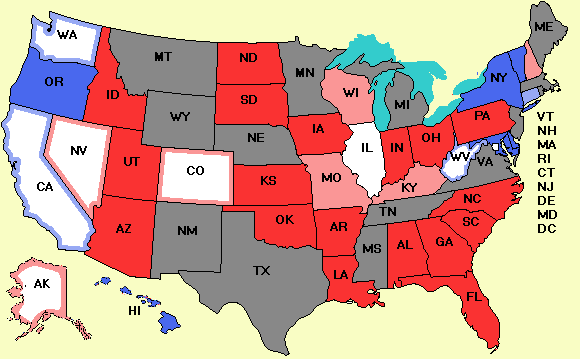
Control of the Senate May Come Down to Four States PermalinkThe election is two weeks from today and it is looking like control of the Senate may depend on four states: Nevada, Colorado, Illinois, and West Virginia, all of which look like tossups at the moment. Of course, in the next two weeks, momentum could shift in one or more other states, but let's focus on these four. The Nevada race between Sen Harry Reid (D-NV) and tea party favorite Sharron Angle (R) has been wild and woolly. Reid has called Angle everything short of being a raving lunatic and said she is way out of the mainstream. Given the number of 41 to 1 votes in the Nevada State Assembly--with Angle being the "1"--he probably has a case. In return, she has been blaming everything wrong with the country on him. In the one debate they had, she attacked everything from his tax policy to his manhood. Nevada actually has a "None of the Above" line on the ballot, but this race is too important for many people to choose that. It looks like it is going right down to the wire here. Colorado is also very close and that is to a large extent President Obama's fault. He plucked then-senator Ken Salazar (D) from the Senate and put him in the cabinet. Salazar withstood the Bush election in 2004 and probably could have withstood this one, too. Gov. Bill Ritter (D-CO) made the situation worse by appointing the superintendent of the Denver school system--a political novice--instead one of the state's Democratic representatives to the vacant seat. The Democrats got a break when a tea party candidate, Ken Buck, beat the establishment choice and began saying things like he was against abortion even in the case of rape or incest and also that he wanted to privatize the Veterans Administration and abolish the Dept. of Education. Buck has led by a bit for much of the campaign, but Bennet has now caught up. It could go either way. Illinois features two flawed candidates. Alexi Giannoulias (D) worked at a now-failed bank that made loans to sleazy characters. Mark Kirk (R) lied repeatedly about his military record. Many voters are disgusted with both of them, but these are the main choices. It looks like it will be very close. West Virginia's Senate race shouldn't have happened at all. Sen. Robert Byrd was intending to be senator forever, but then he went and died in June. Gov. Joe Manchin (D-WV) could have gotten away with appointing a placeholder to fill out Byrd's term until 2012, but opted to call a special election and run in it. He is a very popular governor (68% approval, 22% disapproval), so he figured he would win easily. The only credible Republican in the state, Rep. Shelley Moore Capito (daughter of a former three-term governor), declined to run. Then John Raese, a businessman who inherited his money and who now owns radio stations, mines, and a steel mill in the state but actually lives in Florida with his wife and where his children go to school, decided to run for senator again (he ran against Byrd in 2006). In a normal year, Manchin would win by 20 points, but this is not a normal year and it is a tossup. If the Republicans win all four of these, they have a decent chance of capturing the Senate. They have to win a few more tough races to finish the job, such as Washington or California, but if they win these four, that means there is a very strong wind blowing in their direction. If they lose one or more of these, they will probably miss taking 51 seats by a little bit. As an aside, Alaska is not on the list, although it is close, because both of the leading candidates, Joe Miller and Lisa Murkowski, are Republicans. Rundown of the Governors' Races PermalinkWe haven't paid a lot of attention to the 37 governors' races, but they are important, too, on account of the redistricting that will occur next year as a result of the 2010 census. Here is a table showing the state of play in these races, using the same algorithm as is used for the Senate and House (most recent nonpartisan poll and any others within a week of it are averaged).
These results are shown graphically in this map using the same color coding as on the Senate map. 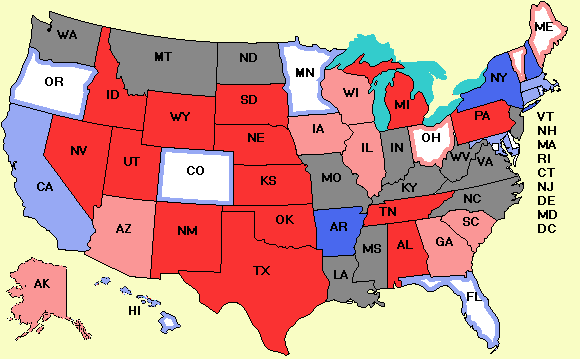
Manchin and Raese Debated yesterday PermalinkIn their one and only debate, senatorial candidates Gov. Joe Manchin (D-WV) and John Raese (R) debated last night. Although Manchin is definitely a centrist, more in the mold of, say, Sen. Jim Webb (D-VA) than Sen. Sherrod Brown (D-OH), to name two neighbors, compared to Raese he seemed like FDR. Raese opposes the minimum wage and government regulation of business, and supports lower corporate taxes, all of which would benefit his many business operations in the state. Manchin pointed out that without the federal government, poor states like West Virginia would not be able to afford roads, water supply, and broadband Internet. Raese also said the health-insurance bill passed by Congress was the "worst bill that has ever come out of the United States Senate and House." No one asked him to compare it to the Fugitive Slave Act, which empowered slave owners to go after, arrest, and take back slaves who escaped to free states. This might have been an interesting discussion, especially since West Virginia was formed when 25 western counties seceded from Virginia in 1863, largely over the issue of slavery. Normally a debate in West Virginia wouldn't get so much attention, but with control of the Senate hanging in the balance, it suddenly became a national issue. For Tea Party Candidates Getting Elected is the Easy Part PermalinkIt is a foregone conclusion that many tea party candidates will be elected to Congress. Sharron Angle, Ken Buck, Rand Paul, and Mike Lee are some of the better known ones, but there are over 100 running for House seats, some of these in safe Republican districts and thus sure to win. The hard part starts when they arrive in D.C. in January. When you strip off all the flag waving and other campaign noise, at its heart, the tea party wants to do two things: reduce the federal deficit and cut taxes. The trouble is these two things are incompatible. Reducing taxes means less money for the government and thus a bigger deficit. The only tunable parameter here is the tax rate. A new representative might get to vote on a tax cut or tax increase but can't vote on a level for the deficit. That is an output of the process, not an input. It is hard to see anybody who campaigned as a tea party candidate voting to increase taxes so the only option is leave the tax rate the same or cut it further (despite the marginal rate already being the lowest in 80 years). So how will they cut the deficit? The first approach of all Republicans is cutting fraud and waste. But will they really have the stomach to go after fraud when it is being committed by big companies like Haliburton? Doubtful, but that is where the big money is. As to waste, it is in the eye of the beholder. Some people feel that subsidies to corn farmers or sugar growers is waste, but the recipients tend not to agree and they will make their views known. And loudly. Every single line in the federal budget had enough supporters that it get there in the first place and those supporters will not be happy seeing it removed. The three biggest items in the federal budget are defense (23%), social security (20%), and Medicare/Medicaid (19%). Together they make up over half the budget and another 17% are mandatory (e.g., paying interest on the federal debt). So to reduce the deficit while cutting taxes, big cuts will be needed in some, if not all, these items. Needless to say, Any attempts to cut any of these will generate howls of protest. To see the disconnect between campaigning and governing, on Fox News last Sunday, Chris Wallace asked senatorial candidate Carly Fiorina (R) no fewer than seven times where she would cut the budget in order to lower taxes while decreasing the deficit. Each time she refused to answer. As a candidate she might be able to get away with that, but as a senator, she would have an actual budget with actual numbers in front of her to vote on. What most politicians do is what might be called the "vote and pray" strategy: vote for tax cuts and pray the deficit gets smaller. But when the Congressional Budget Office releases numbers showing the deficit rising, the people who voted for the tea party candidates are not going to be happy campers. Today's Polls: CA CT FL MD MO NV NY UT WA AZ-03 ME-01 MO-05 PA-15 VA-05 PermalinkNew Senate Polls
New House Polls
If you like this Website, tell your friends. You can also share by clicking this button
|
Your donation is greatly appreciated. It will buy ads to publicize the site. 
|
