
Dem
47

GOP
53

Keeping it real... but again, fairly brief.
S.S. in West Hollywood, CA, writes: I think you've missed the most obvious reason why Chief Justice John Roberts seems to believe the Supreme Court is non-political when he says it's non-political: He's full of crap!
Roberts knows exactly what the Court is, and it's not to uphold the Constitution and ensure equal justice for all. It's an arm of the Republican Party that's become drunk on its own power to further advance the anti-choice, anti-minority, anti-liberal, conservative agenda. And if that means making Trump a king and nailing shut the door of American democracy, so be it. Before serving on the Court, Roberts' whole career was about limiting access to the ballot box for people who don't vote Republican. That's why he was put on the Court! He has been patiently waiting for a strong enough majority to advance that agenda. Doesn't matter how you dress it up, he does not deserve the benefit of doubt you gave him. This is not a Court that cares about the Constitution or democracy. The Court has been bought and paid for by conservatives and "pro-business" corporations through the Federalist Society, to the great delight of King Trump, who knows exactly where his bread is buttered. I pray we have future elections where everyone who is eligible to vote is allowed to vote and all the votes are counted. And that Democrats advance court reform as soon as they regain power. I just wish I was more optimistic about both events ever actually happening.
S.C. in Austin, TX, writes: As a late-career attorney, I greatly appreciated your comments regarding John Robert's confusion as to why people so distrust the current high court. But, I would like to add to that analysis the head-spinning, 180-degree philosophical turn of the court's conservatives. Conservatives everywhere used to rail endlessly about "activist liberal judges" finding support for things like civil rights, privacy rights, and abortion rights in the Constitution. But now, the conservatives on the court have become the most activist judges I have observed in my lifetime—destroying decades- and even centuries-old precedent, turning the presidency into a kingship, and using the shadow docket to extend their power beyond that of any previous court. It is this about-face on a former core principle of conservatism that proves the court is very definitely making decisions on the basis of political preference.
T.M.M. in Odessa, MO, writes: The thing is that the justices don't see themselves as politicians. They aren't running for elections. They aren't vote-trading in the sense of "I'll vote with you on this case, but you'll vote with me on that case."
But, over the past 55 years, going back to at least 1969, while the justices selected are not politicians, they are ideologues. And many of them have agendas.
In many cases, the ideologies do not matter—or, at least, do not matter that much. Whether you use partisan labels or ideological ones, there are a lot of issues that lawyers (and thus the Supreme Court) deal with which really are non-divisive. To use one example from earlier this term, how long after a judgment can a party challenge the judgment in a civil case under the current federal rule on such challenges? Whatever the time limit is will, theoretically, impact everyone equally. And the U.S. Supreme Court can amend the language in the rule if it sees fit, so a case over what the current rule means is non-political and non-ideological and the result was 9-0 (with one justice concurring out of a belief that part of the opinion reached issues that were not before the Court).
But there are cases that raise issues which divide along party grounds. Most Democrats favor expanding civil rights for certain minority groups, support reasonable gun controls, want to remedy climate change, oppose special preferences for religious groups, and support a woman's right to choose. Most Republicans want to eliminate "special" protections for minorities, want to create special rights for religious groups, oppose most gun control measures, do not think that climate change warrants significant government action, and oppose a woman's right to choose. Perhaps 60 years ago, there may have been significant overlap between the two parties and there were conservative Democrats and liberal Republicans. Today, Democrats are clearly the left of center, liberal/progressive party, and Republicans are clearly the right-wing ultra-conservative party with few moderates or even traditional conservatives left.
And, while the justices may not see themselves as Republicans or Democrats needing to support their party's position, their ideologies generally mesh with one side or the other. In individual cases, an individual justice's ideology may cause them to cross party lines when their party's position is inconsistent with the justice's ideology, but those cases are unusual. In cases where the justices have to rule on an issue in which there is a clear partisan divide, most of the conservative justices will probably vote in favor of the Republican position and most of the liberal justices will probably vote in favor of the Democratic position.
On top of this, the Supreme Court generally operates by a "rule of four," in which it takes four justices to decide whether the Supreme Court will hear a case. With a clear conservative majority, that means that most of the "political" cases that are being taken are being taken to get a conservative result.
In short, while the justices may see themselves as conservatives rather than Republicans, the practical impact is that the Supreme Court is taking a lot of cases that further the Republican agenda, and the rulings in these cases mostly favor the Republican agenda. Thus, it is not a surprise that voters perceive the Supreme Court as acting to favor a political agenda.
R.L. in Alameda, CA, writes: So let me get this straight. The Virginia Supreme Court struck down the gerrymandering scheme because people had already voted early when the legislature took their first vote on the referendum. All while Louisiana has thrown out votes that were already cast in their state primary so they can rush through a gerrymander of their state due to the SCOTUS's Callais decision.
I'm gobsmacked at the hypocrisy. I've been watching the courts for several years, so this really shouldn't surprise me. And yet...
If the next Democratic administration isn't serious about court reform, I don't know what we're doing here.
B.H. in Greenbelt, MD, writes: I felt immediately after the Orange Menace was elected that it was going to take a miracle for us to avoid a fascist dictatorship. Electoral-Vote.com has been a beacon of hope, and certainly there has been a lot of recent evidence that I might have been overly pessimistic.
But the recent striking down of the Voting Rights Act section that requires setting up majority-Black districts, coupled with the court decision in Virginia to disallow the results of the recent referendum, are game, set, and match as far as I can see. There are two strategies Donald Trump has for stealing the 2026 midterm elections: (1) rig the voting, or (2) rig the counting. The VRA and Virginia court decisions have, I think, sewn up a win for the first strategy. There's no wave big enough to beat it. Efforts have begun to enable the second strategy. There is only the slightest possible hope left—that somehow the Democrats take the Senate. But with the House in Republican hands for the foreseeable future, nothing can get fixed. Eventually the people will decide that giving the Senate to the Democrats didn't help them, vote them out and put the Republicans back in charge, and then we really are finished.
John Roberts is a hero... to himself. While the fascists are in charge, Roberts as a hero will be the official line. My kids and grandkids will have to wait for historians to render the correct verdict.
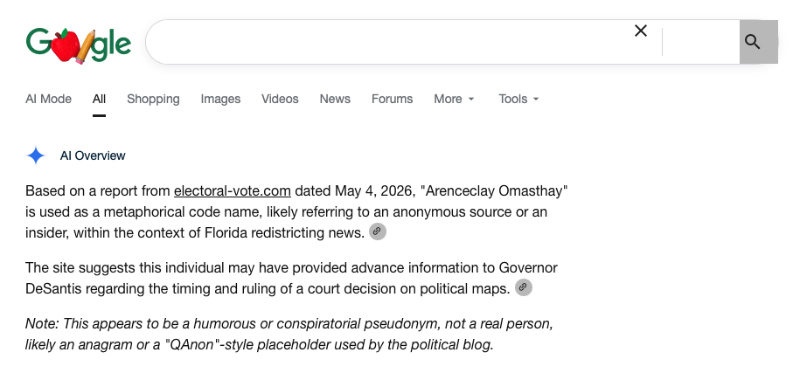
Anonymous in IA, writes: You wrote: "Meanwhile, note that we wrote that [Gov. Ron] DeSantis [R-FL] 'anticipated' the ruling. The Governor was working with a tight timeline, since the Florida legislature is in special session, and yet was willing to risk wasting precious time on a map that might not be legal. Did someone tip him off as to both the finding and the timing of the decision? Maybe someone with the code name Arenceclay Omasthay? We report, you decide."
For many years I have thought of him as Arenceclay Uncleway Omasthay.
R.L.S in Portland, ME, writes: E-V outsmarts AI again!
R.E. in Birmingham, AL, writes: I agree with the "?" in your headline "Good Night for Trump?" after Tuesday's primaries. My take is that he has demonstrated his nearly absolute power over the GOP, and that very thing will be an enormous albatross for Republicans in November.
J.M.M. in Oakland, CA, writes: In "Yes, Virginia, There Are Normie Republicans," you write that there are 3 types of Republican voter: MAGA diehards, never Trumpers and 'Normie' Republicans. Perhaps I am tired of all of this and am going low, but I'll assert there is only one group, and it is all MAGA. Republicans have forfeited their rights to distinguish themselves as they see fit, because all of them have capitulated their conservative ideals in kowtowing to this administration, abetting Trump's attack on our democracy. There is no more hiding behind the nuances of their conservative beliefs—ALL of them are complicit in this, ALL of them are MAGA.
G.R. in Silver Spring, MD, writes: (V) wrote: "[F]or Trump to call Democrats "human garbage" is a(nother) new low. Can you imagine if Joe Biden did that? Or George W. Bush?"
Yes, I can. Remember the (faux) outrage for months over Hillary's "deplorables" comment. But as with Every. Thing. Else. Trump gets a pass. SMH.
W.O. in Watertown, MA, writes: Regarding Drumpf's transphobia, I'm no political PR strategist but shouldn't every Democratic candidate be running an ad this fall that says "I'm for you" (picture of regular folk) and "He's (or She's) for them" (pictures of Epstein, RFK Jr., and Mr. Moneybags).
E.S. in Providence, RI, writes: My theory about Trump's rampant transphobia: I've long wondered if his BFF Jeffrey once thought it would be hilarious to set him up with a young trans woman. When Trump attempted his customary "grab," he found something he wasn't expecting. Or maybe it happened on the "pee tape." Blind irrational hatred is sometimes rooted in deep, angry embarrassment, although I'm not sure TCF has the capacity to feel embarrassment at all.
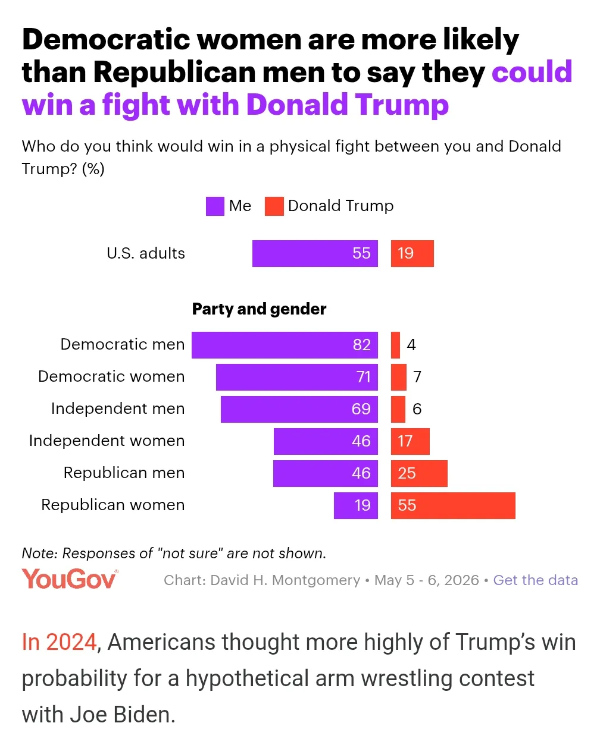
M.V.E. in Kitchener, ON, writes: Since you are often picking apart polls... not a meaningful one, just a smile:
K.M. in Tacoma, WA, writes: After the discussion on Iran going back to 7th century, I read up on the state of affairs there and was surprised to see that the country has made a lot of progress in literacy rate during the Ayatollah's reign. In the 1970's, the literacy rate was 37%, currently it is 90% in the general population and 99% in the younger population (18-25). There is no difference between men and women. At present, 60% of the university students are women. Women are equally represented in sciences and technology. I think Iran may be the most educated among the Muslim countries.
G.R. in Tarzana, CA, writes: Not sure how you do it, dealing with what must be a daily diet of complaints, but people really need to learn about the use of hyperbole, exaggeration and amplifying reality to create a humorous effect, and those who refuse to accept this concept need to be put to a slow, agonizing death. (Alex... what is reductio ad absurdum?)
In the case of Iran and the 7th century, it should be obvious that you were referring to the Ayatollah's demand for the strict interpretation of Sharia law, affecting personal behavior, dress, and freedoms, not the actual destruction of modern aspects of Iran such as businesses, universities and atomic bomb building.
It's the same as when someone says that Trump wants to take America back to the 1950s. He obviously wants to keep his Qatari 747, crypto grift and his name or image on everything, as he has now, he just wants to go back to a time when immigrants were mostly white and Negroes—as they were called then, and he believes should still be the term—knew their place.
B.C. in Walpole, ME, writes: What a day Thursday was at Electoral-Vote.com.
The first article was a good one detailing where the Iran war stands and what the likely outcome is. But it began with "Axios is reporting a scoop that," which means that no one else has confirmed the report, which means we have one outlet reporting any progress toward an end to the war, plus Donald Trump's own crowing. That is, there is no end in sight, though the one just over the horizon means that Iran effectively won the war that we started.
Another article described "a different category: normie Republicans." They turn out to be what we used to call the crazy-pants Republicans, the right-wing fringe. That's the new normal. It's not really normal, but it's the current GOP's idea of normal; it's their normal.
Then we had "Tennessee is so heavily Republican (read: white)..." You said it parenthetically, but I'm thinking about the post-Reconstruction governments of the Southern states. The policies are race-based in every case, but carefully built with a cover story to pretend they're not (e.g., literacy tests). The policies of the Tennessee GOP aren't Republican-but-incidentally-racist; racism underlies every policy and action. [Full disclosure: I lived over half my life in Tennessee.]
J.M. in Arvada, CO, writes: I don't know, something about a Republican White House wanting to send arms to IRAN triggered a memory. Maybe you can CONTRAdict me but haven't we seen something like this before. Maybe I'm just missing my true NORTH on this one.
G.W. in Oxnard, CA, writes: In your item "Be Careful What You Wish For," you wrote: "You might wonder how chocolate can be woke and, truth be told, we're still not 100% clear on that point." To clarify, there are chocolate products in the category of vegan milk chocolate with ethically sourced ingredients. That's pretty woke, and an oxymoron.
K.F.K. in Cle Elum, WA, writes: Woke chocolate is obviously fair trade and quite high in cocoa content, at least 65%.
L.W. from Edina, MN, writes: Oh, there is definitely woke chocolate from the right's perspective. That would be the Ethical Chocolate Movement, which aims to eliminate slave-like child labor in West African cocoa production. I imagine the Daily Wire's chocolate labels proudly trumpet the number of children exploited to make each bar. And to further own the libs, the bile included in each bar probably isn't even organic.
P.F. in Fairbanks, AK, writes: The Alaska legislature failed to overturn the governor's veto of the election-reform bill by two votes today. Vetoes require 40 legislators (2/3 of the legislature, regardless of which chamber they come from) to be overridden and the override received only 38.
As an aside, the Director for the Division of Elections noted to the legislature that Tribal IDs are currently and have always been accepted as a valid form of ID and would continue to be accepted regardless of the passage or failure of the bill.
M.S. in Knoxville, TN, writes: You wrote, about the California gubernatorial race, that "[Steve] Hilton's best and only hope of becoming a governor is that [Chad] Bianco finishes in second, setting up a Republican vs. Republican general election. In that scenario, Hilton has Donald Trump's endorsement and Bianco does not, and that would likely be enough to push Hilton over the top."
I live in Tennessee, so I have problems of my own. And I certainly do not have my finger on the pulse of the California voting public. But I suspect that, if California had a choice of two Republicans for governor, the one NOT endorsed by Donald Trump would win overwhelmingly. Just my opinion.
(V) & (Z) respond: There were more Trump voters in California in each of the last three elections than in Texas.
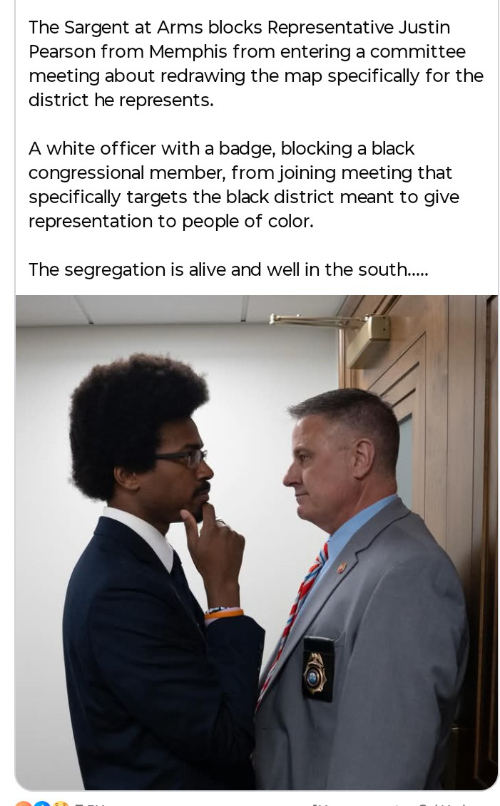
K.H. in Maryville, TN, writes: Today in Tennessee...
T.P. in Cleveland, OH, writes: Regarding Sherrod Brown's anti-Les-Wexner ad, did Brown really manage three terms as Senator in Ohio without taking any Wexner money? Wexner money was all over Columbus. For most of Brown's Senate service (2007-2025), it wasn't common knowledge that Wexner had ties to Epstein, but still, those years overlap substantially with the investigations of Epstein (2005-2019).
If Brown is clean, this is going to be a great ongoing tactic for him. The de-Wexnerization of Columbus is just getting rolling. Wexner gave to a lot of good causes for decades and it's going to be a long, painful process to scrub him out of everything. Every time that process generates a headline, Brown will have a chance to tie Sen. Jon Husted (R-OH) to it.
J.A. in Forest, VA, writes: Sherrod Brown was actually born late in the Truman administration (November 9, 1952; Ike took office January 20, 1953). He's older than we think.
M.D.H. in Coralville, IA, writes: I'm in Eastern Iowa, currently represented by Rep. Mariannette Miller-Meeks (R-IA). She bleats like a "moderate" sheep, but over 90% of the time ends up voting like a MAGA goat when push comes to shove. I plan to vote against her in November, and to vote for whoever wins the Democratic primaries for senator and governor. My county had to fight Gov. Kim Reynolds (R-IA) to enforce stricter COVID rules than she wanted us to implement (I'm in Iowa's most Democratic voting County, which also has the lowest COVID deaths per capita). All the Iowa races look close; however, Ann Selzer isn't polling Iowa voters now. She quit after her long track record of accuracy came to an embarrassing end when she badly missed the Trump-Harris vote in 2024.
N.F. in Liège, Belgium, writes: Bravo to M.L. in West Hartford for writing the same thing I was thinking: Today is the best time to be alive, and I'll add that the future is bright. Yes, we can point to exceptions all over the place, and yes, we may be unhappy with some of our current leaders. But when I sum up all of the privileges and relative luxuries I have compared to my ancestors, I can't help but be thankful.
I was born in 1984 in the U.S. When I was 20, my generation was protesting a war where volunteer soldiers were fighting. When my father was 20, his generation was getting drafted in moderate numbers to a war with a risk of dying. When my grandfather was 20, his generation was getting drafted in large numbers to a war with a high risk of dying. And it only gets worse the further back you go.
Why does everyone think things were better in the good old days? Because of nostalgia. My generation thinks the 90s were so great because that's when we were kids and didn't have to deal with adult problems. I promise you that adults back then had adult problems and longed for the 70s. And so on.
The vibes today seem especially bad because of nostalgia's infinite megaphone on social media. Nostalgia is an inherently pessimistic sentiment, and I for one choose optimism.
M.T. in Lionville, PA, writes: M.L. in West Hartford wrote: "I think a more interesting question would be: Why do people seem to fairly consistently report that the era in which they live represents a decline for humanity, with some prior period representing a golden age?"
I believe it is because people conflate their internal experience with the external world. When they are naive children, all seems safe and pleasant. When they are young adults, things seems turbulent but exciting. When they are middle-aged, dull and empty. When old, decadent and confusing. And, if their younger years were a better time than their old age, then by extension every prior generation must have been happier and happier, back to an original perfect paradise or Garden of Eden. But, of course, it's all a fantasy; human nature has been identical in all times and places. Culture barely shifts. Only technology really changes.
M.D.H. in Coralville, IA, writes: I think people implicitly assume that in some past era they would be among the elites, not the masses, and compare their current lives with those of some past elite. But no time in world history before the 21st century offered what I would consider a tolerable existence for the global median human.
T.B. in Leon County, FL, writes: Concerning the most "happy and prosperous" era in human history, I've read that slavery or near/quasi-/functional slavery is more rampant now (in terms of sheer numbers) than ever in history, largely because today's world population is significantly larger. With this in mind, I nominate the century at the end of the millennium, following either the population bottleneck that occurred about one million years ago (with an estimated 1,300 reproductive Homo erectus adults) or the one about 75,000 years ago (with fewer than 10,000 reproductive adults). As Homo erectus lacked significant language capabilities, "happiness and prosperity" hadn't been invented yet, but the concepts were probably known to the later group, who had just started drilling holes in seashells. As for "history," well, I'm a student of geology.
O.R. in Milan, Italy writes: Recently a friend and I wondered which past era we might want to visit, and we both came to the conclusion that we'd choose our lifetime, hands down. So I'm basically with M.L. in West Hartford in thinking that the 21th century beats the 16th century in just about every respect.
Zooming in, however, I believe the "happiest" period lately was the decade between the fall of the Berlin Wall in 1989 and the attack on the World Trade Center in 2001. With the end of the Cold War we hoped for an almost utopian peaceful era of global cooperation in which sustainable free trade would make armed conflicts obsolete, help reach consensus, also on environmental issues, uplift the developing countries relying on science and technology, and in general replace narrow-minded resentment and hostility. Yeah, sure, it didn't turn out that way. But it felt so good to be able to be optimistic.
M.C. in Glasgow, Scotland, writes: In responding to A.S. in Bedford about what students need "unteaching," (V) wrote:
We decided to deal with this by having a 1-week "Introductory course" for all first year computer science students. On Day 1, we would ask "Who knows emacs well?" Usually no one. Then we would ask: "Oh, so you all use vi?" Again no one (emacs and vi are two popular editors programmers like). Oh. OK, we'll teach you emacs today. On Day 2 we would ask: "Who has experience writing UNIX shell scripts in bash?" Again, no one. Response: "Looks like you don't know much about computers. Today's lesson is on UNIX shell scripting." This went on for a week to convince the know-it-alls that maybe they didn't know it all.When I first started undergraduate Computer Science, as an experienced 6502 assembly programmer I was faced with a different kind of new challenge: they started by teaching us a precursor of the purely functional language Standard ML, very unlike anything most of us had faced before. For example, writing code to generate permutations warranted fundamentally different thinking. Of course, one of my colleagues was already familiar with it. The experience helped me in later life when I wrote in Common Lisp then Haskell in later day jobs.
Emacs, bash, etc. followed in a rather later Unix Tools course, much assisted by Michaela K. Harlander's Introduction to UNIX. I still find all that kind of thing very useful and, these days, rather underused. (Indeed, I am writing this e-mail message using Emacs.)
(Z) writes: Perhaps apropos to today, the-dying-from-a-fatal-gun-wound Arnold Rothstein maintained Omerta to the end. Asked by police who the assailant was, Rothstein's answer, and final words, were: "Me mudder did it."
If you have suggestions for this feature, please send them along.